
Global Camera Market Size by Type, Technology, Connectivity, Application, Distribution Channel and Enduser
Overview
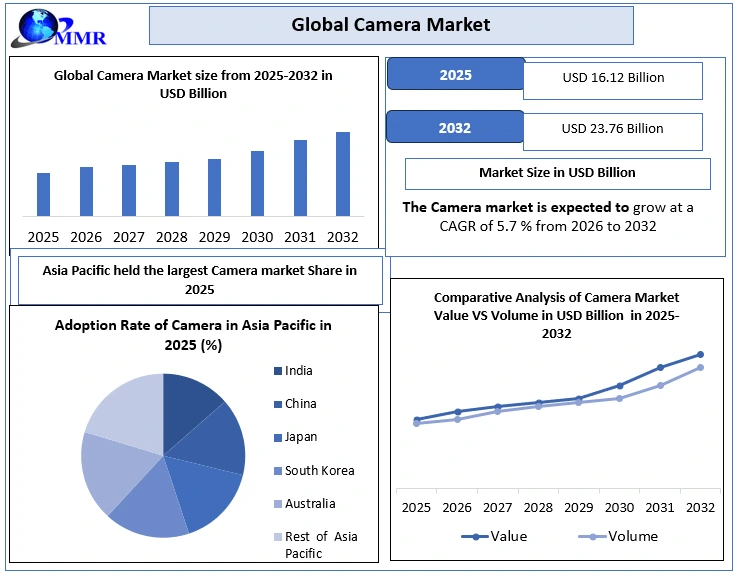
The Global Camera Market was valued at USD 16.12 billion in 2025 and is projected to reach USD 23.76 billion by 2032, growing at a CAGR of 5.7% during the forecast period (2026–2032). Market growth is driven by the transition toward mirrorless and hybrid imaging systems, increasing content creation, and rising adoption of cameras across security, healthcare, and professional imaging applications.
Camera Market Overview
The camera market is undergoing a structural transition driven by technological convergence, shifting consumer behavior, and expanding non-consumer applications. While traditional DSLR demand remains stable in professional photography, the market is increasingly shaped by mirrorless systems, AI-enabled imaging, and specialized cameras for surveillance, healthcare, and industrial inspection.
Growth is further supported by rising digital content creation, improvements in sensor technology, and increasing integration of cameras into security infrastructure and smart devices. Asia Pacific remains the largest manufacturing and consumption hub, supported by strong electronics ecosystems and expanding surveillance deployments.
To know about the Research Methodology :- Request Free Sample Report
In 2025, Sony unveils its ultimate mirrorless lineup, including flagship models like the Alpha 1 II (50 MP, 8K video) and Alpha 9 III (full-frame global shutter, 120 fps), while introducing compact travel-friendly models such as the α7C II and ZV-E1 for creators, solidifying its dominance in high-performance, hybrid imaging systems.
Trend: Rise of Mirrorless & Hybrid Imaging Systems
Mirrorless cameras are increasingly replacing traditional DSLR systems due to their compact form factor, faster autofocus, and superior video performance. Advancements such as on-sensor phase-detection autofocus, in-body image stabilization (IBIS), and 4K–8K video recording are accelerating adoption among professionals and content creators.
In 2025, Sony strengthened its leadership by introducing advanced mirrorless models such as the Alpha 1 II (50 MP, 8K video) and Alpha 9 III featuring full-frame global shutter technology capable of 120 fps, alongside compact creator-focused models like the α7C II and ZV-E1. These launches underscore the industry’s transition toward high-performance hybrid imaging platforms.
Growth of Content Creation & Social Media to Boost Camera Market Growth
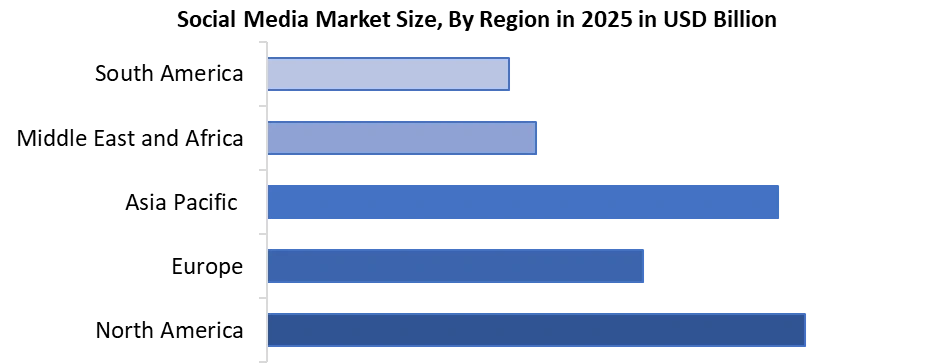
The rapid growth of content creation and social media consumption is a key demand driver for the camera market. According to MMR, 65.7% of the global population was active on social media in 2025, with brands posting an average of 9.5 times per day across platforms.
High-engagement platforms such as TikTok and Instagram have intensified demand for high-quality video content, driving adoption of mirrorless cameras, DSLR cameras, action cameras, and professional video systems. Content creators increasingly seek advanced autofocus, stabilization, and low-light performance, supporting sustained demand beyond smartphone cameras.
Camera Market Opportunity
Specialized Professional & Scientific Imaging Applications
Specialized professional and scientific imaging represents a high-value opportunity within the camera market. Advanced cameras are increasingly used in applications such as fluorescence imaging, gene sequencing, astronomical observation, and industrial diagnostics.
High-speed cameras capable of recording at up to 1,000,000 frames per second and resolutions reaching 4K are essential in research, defense testing, and precision manufacturing. Growing investment in biomedical research, materials science, and security surveillance continues to expand demand for specialized imaging solutions.
Camera Market Restraints
High Cost of Advanced Camera Equipment to Hamper Camera Market
The high cost of advanced camera equipment remains a key restraint for market growth. Premium mirrorless and DSLR cameras utilize high-end sensors, precision optics, and materials such as magnesium and aerospace-grade aluminum alloys, significantly increasing production costs.
Additionally, rapid technological advancements shorten product life cycles, discouraging long-term investment among hobbyists and small studios. These pricing pressures limit broader adoption, particularly in price-sensitive and emerging markets.
Table: Top 7 Most Expensive Cameras in the World 2025
| Rank | Camera Model | Key Features |
| 1 | Leica 0-Series No. 122 | 1923 rare model, collector's item |
| 2 | Leica M10-P Safari Edition | Olive green finish, quiet shutter, limited edition |
| 3 | Hasselblad H6D-400C MS | 400-megapixel, multi-shot, precision |
| 4 | Phase One XF IQ4 | 150-megapixel, high dynamic range, medium format |
| 5 | Sony Alpha 1 | 50.1 MP, 30 fps, 8K video recording |
| 6 | Canon EOS-1D X Mark III | 20.1 MP, 16 fps, advanced autofocus |
| 7 | Nikon D6 | 20.8 MP, 14 fps, robust build, fast autofocus |
Camera Market Segment Analysis
By type, DSLR cameras accounted for a significant share in 2025, supported by continued use in professional photography and institutional applications. However, mirrorless cameras represent the fastest-growing segment, driven by superior video capabilities and compact design.
Smartphone cameras contribute substantially in terms of unit volume but are analyzed separately due to integrated device economics and shorter replacement cycles.

By End-User: Categorized into the Consumer Electronics, Entertainment & Media, Security, Healthcare and Others. Consumer Electronics is expected to dominate the Camera Market over the forecast period (2025-2032). Consumer electronics are driven by the growing demand for digital cameras, DSLR cameras, mirrorless cameras, and smartphone cameras. The rise of security cameras and CCTV cameras also bolsters the security and healthcare sectors. Camera players, such as Canon, Nikon, and Sony, focus on camera accessories, camera lenses, and digital camera reviews to meet consumer and professional needs.

Camera Market Regional Insights
Asia Pacific dominated the global camera market in 2025, driven by strong consumer electronics manufacturing, expanding surveillance deployments, and increasing participation in professional and recreational photography. The region benefits from high demand for DSLR, mirrorless, digital, and CCTV cameras, with continued growth expected due to infrastructure development and rising disposable incomes
Camera Market Competitive Landscape
The Camera Market is highly competitive, led by Canon, Nikon, Sony, and Fujifilm. Key factors include innovation, product differentiation, and focus on DSLR, mirrorless cameras, security cameras, and accessories.
Nikon Corporation: In August 2025, Tamron expanded its 18-300mm f/3.5-6.3 Di III-A VC VXD travel zoom lens to Nikon Z DX and Canon RF-S mounts, offering an affordable all-in-one solution for APS-C users at $629.

Camera Market Scope: Inquire before buying
| Camera Market | |||
|---|---|---|---|
| Report Coverage | Details | ||
| Base Year: | 2025 | Forecast Period: | 2026-2032 |
| Historical Data: | 2020 to 2025 | Market Size in 2025: | USD 16.12 Bn. |
| Forecast Period 2026 to 2032 CAGR: | 5.7% | Market Size in 2032: | USD 23.76 Bn. |
| Segments Covered: | by Type | DSLR Cameras Mirrorless Cameras Point-and-Shoot Cameras Action Cameras Smartphone Cameras Others |
|
| by Technology | Digital Cameras Film Cameras 360-Degree Cameras Infrared Cameras Others |
||
| by Connectivity | Wi-Fi Enabled Cameras Bluetooth Cameras GPS Cameras |
||
| by Application | Personal Use Professional Photography Sports & Action Cameras Surveillance Cameras Medical Imaging Others |
||
| by EndUser | Consumer Electronics Entertainment & Media Security Healthcare Others |
||
| by Distribution Channel | Online Retail Offline Retail |
||
Camera Key Players are:
1. Canon Inc.
2. Nikon Corporation
3. Sony Group Corporation
4. Fujifilm Holdings Corporation
5. Panasonic Corporation
6. OM Digital Solutions Corporation
7. Olympus Corporation
8. Leica Camera AG
9. Sigma Corporation
10. GoPro
11. Pentax
12. Hasselblad
13. Phase One
14. DJI
15. Samsung Electronics
16. Huawei
17. Blackmagic Design
18. RED Digital Cinema
19. Arri
20. JVC
21. Kodak
22. Ricoh
23. Zeiss
24. Casio
25. Acer
26. Toshiba
27. Sharp
28. Benq
29. Vivitar
Frequently Asked Questions:
1. What are the growth drivers for the Camera Market?
Answer: Growth is driven by demand for high-quality cameras, mirrorless, smartphone cameras, autofocus tech, 4K video, AI integration, and content creation via social media.
2. What are the major restraints for the Camera Market growth?
Answer: Major restraints include the high cost of DSLR and mirrorless cameras, rapid technological advancements, and obsolescence, which deter long-term investments and accessibility for hobbyists.
3. Which region is expected to lead the global Camera Market during the forecast period?
Answer: Asia Pacific is expected to lead due to rising demand for DSLR cameras, mirrorless, smartphone cameras, and technological advancements, coupled with increasing consumer spending.
4. What is the expected market size and growth rate of the Camera Market?
Answer: The Camera Market was valued at USD 16.12 Billion in 2025 and is expected to grow at a 5.7% CAGR, reaching USD 23.76 Billion by 2032.
5. What segments are covered in the Camera Market report?
Answer: The report covers Type, technology, Connectivity, Application, End-User, Distribution Channel and Region.