
Global Linseed Meal Market Size by Product Type, Application, and Nature – Segment-Level Market Assessment, Growth Opportunity Analysis, Competitive Landscape & Forecast to 2032
Overview
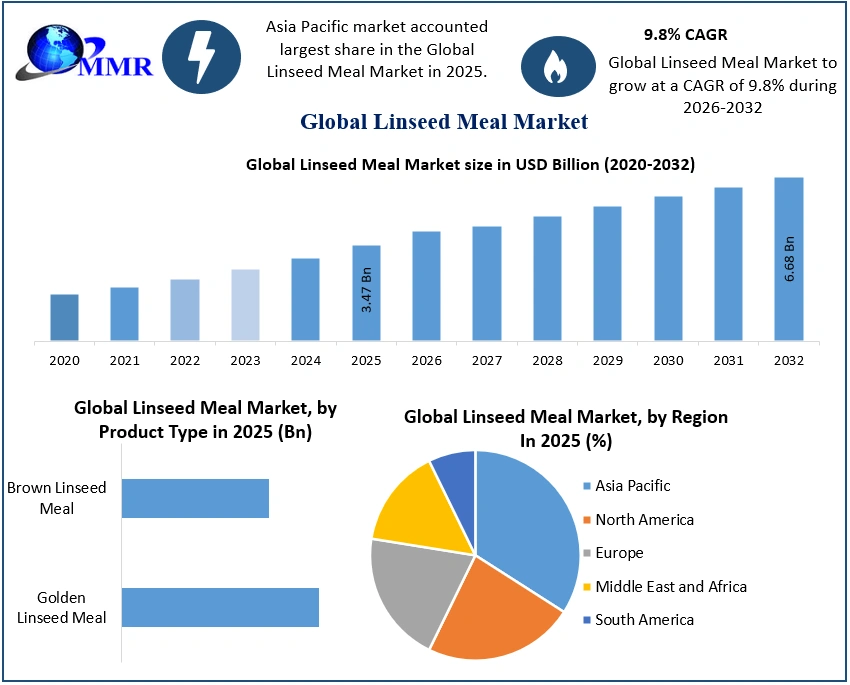
The Linseed Meal Market size was valued at USD 3.47 Billion in 2025 and the total Linseed Meal revenue is expected to grow at a CAGR of 9.8% from 2025 to 2032, reaching nearly USD 6.68 Billion by 2032.
Global Linseed Meal Market Overview:
Linseed is a type of fiber crop cultivated to extract oil and make garments. The use of the cold-pressed method during the extraction of oil removes all toxic substances and leaves a nutrient-rich residue called Linseed Meal. Linseed Meal is used on a large scale as animal fodder and in manufacturing health supplements and dietary food products. The Linseed Meal holds medicinal properties that are used in manufacturing medicines for pulmonary diseases and on mental health-related issues.
Linseed Meal is used in manufacturing cosmetics and personal care products on different hair and skin-related issues. A wide-scale application ranging from food and beverages to the cosmetics industry has resulted in an increased demand for Linseed Meal. An increase in population, rise in the number of people adopting a healthy lifestyle, and growth in demand for nutrient-rich food for humans and animals has resulted in a boom in the Global Linseed Meal Market.
 To know about the Research Methodology :- Request Free Sample Report
Global Linseed Meal Market Dynamics:
A report published by Dotdash states that Linseed Meal holds laxative properties that can be used on a large scale to treat people suffering from Irritable Bowel Syndrome. It is observed that more than 15% of the global population suffers from Irritable Bowel Syndrome and this number is concentrated more in the regions of North America and Europe. An increase in demand for medicine on constipation has resulted in people in these regions spending more than the US $ 400 Million on laxative drugs.
A report by WHO states that 14% of the global population below the age group of 12 years of age suffers from chronic pulmonary diseases. It is observed that more than 21% of the global adult population suffers from some type of disease that affects the lungs and respiratory systems. Linseed Meal holds medicinal properties that are used in manufacturing medications for pulmonary diseases.
A report by the American College of Allergy, Asthma, and Immunology states that 14% of the global population suffers from some type of skin allergy. The number of people suffering from skin and hair allergies is concentrated more in the urban areas. Linseed Meal is used in manufacturing medicines and cosmetics that provide relief to skin allergies. The Global Anti-Allergy medicine market did a business of US $ 26 Billion in the year 2017 and is growing at a rate of 7%. Linseed Meal is a prime component of this market.
An increase in demand for Health supplements and Dietary food products has resulted in an introduction of 300 new products made by Linseed Meal in the market in the last 3 years.
An increase in demand for nutrient-rich food products for humans and animals and a wide level of application in the Pharmaceuticals and Cosmetics
Industry are driving the growth of the Global Linseed Meal Market.
Restraints:
An Increase in social media campaigns stating adverse effects of Linseed Meal on Kidneys is the major restraining factor here.
Segment Analysis:
The Global Linseed Market is segmented on the basis of
By Product Type, It is observed that the high content of essential fatty acid has resulted in a 25% increased preference for Golden Linseed Meal as compared to Brown Linseed Meal.
By Application, Linseed Meal is used on a large scale as food for animals. It is observed that more than 70% of the Linseed Meal produced is used for consumption by humans and animals. An increase in demand for medicines on pulmonary, mental health-related, and skin-allergy issues has resulted in a 6% increase in consumption of Linseed Meal by the Pharmaceuticals Industry. High Omega-3 content has resulted in a 3% increase in consumption of Linseed Meal by the Cosmetics Industry.
Linseed Meal is used on a large scale as food for animals. It is observed that more than 35% of the total Linseed Meal produced is consumed by the Animal Husbandry and Pet Food Industries. An increase in demand for nutrient-rich supplementary food and dietary food products has resulted in a 4% increase in demand for Linseed Meal by the Nutraceuticals Manufacturing Industry.
The use of Linseed Meal in producing medicines on lung and respiratory system-related issues has resulted in a 4.5% increase in consumption by the Pharmaceuticals Industry present in the US and Europe. Increasing demand for improved flavors has resulted in a 1.3% increase in demand for Linseed Meal by the Food & Beverages Industry.
Rising preference for food products that maintain the cholesterol level has resulted in a 1.7% increase in the use of Linseed Meal in manufacturing Bakery and Confectionery Products. Increasing preference for Linseed Meal in manufacturing cosmetics has resulted in a 3% increase in sales of Linseed Meal-based cosmetics. Different food products and medicines use Linseed Meal as per requirement.
Regional Insights:
An increase in demand for nutrient-rich food has resulted in an increase of 4% in demand for Linseed Meal in North America. It is observed that demand for organic health supplements and dietary food products have resulted in a 3.1% increase in demand for Linseed Meal in this region. Rising preference for high nutrient content food from the Dairy and Animal Husbandry Industries has resulted in a 5% increase in sales of Linseed Meal in this region.
The preference for food additives and nutrient-rich animal and pet foods has resulted in a 2.6% increase in sales of Linseed Meal in Europe. The presence of highly nutritional fatty acids and their role in enriching base and skin nourishment has resulted in a 6.2% increase in consumption of cosmetics made by using Linseed Meal.
Asia-Pacific is the biggest manufacturer of Linseed Meal. In 2018, Kazakhstan, a country in Asia-Pacific was accounted for more than 28% of the global production of Linseed. An increase in consumption of medicines on lung-related issues and as an additive in Bakery and Confectionery Products has resulted in a rise of 1.8% in sales of Linseed Meal in this region.
South America is showing a stagnant growth rate, the reason for which is the preference for other low-cost substitutes present in this region. Linseed Meal as a nutrient-rich animal food has observed a growth of 4.5% in sales in this region. The Middle East and Africa’s Market is showing a growth rate in the range of 0.9-1.4% from the last 6 years, the reason for which is the presence of many social and economical restraining factors.
The objective of the report is to present a comprehensive analysis of the global Linseed Meal market to the stakeholders in the industry. The past and current status of the industry with the forecasted market size and trends are presented in the report with the analysis of complicated data in simple language. The report covers all the aspects of the industry with a dedicated study of key players that include market leaders, followers, and new entrants.
PORTER, SVOR, PESTEL analysis with the potential impact of micro-economic factors of the market have been presented in the report. External as well as internal factors that are supposed to affect the business positively or negatively have been analyzed, which will give a clear futuristic view of the industry to the decision-makers.
The report also helps in understanding the global Linseed Meal market dynamics, structure by analyzing the market segments and Project the global Linseed Meal market size. Clear representation of competitive analysis of key players by product, price, financial position, product portfolio, growth strategies, and regional presence in the global Linseed Meal market make the report investor’s guide.
Global Linseed Meal Market Scope: Inquire before buying
| Linseed Meal Market | |||
|---|---|---|---|
| Report Coverage | Details | ||
| Base Year: | 2025 | Forecast Period: | 2026-2032 |
| Historical Data: | 2020 to 2025 | Market Size in 2025: | USD 3.47 Bn. |
| Forecast Period 2026 to 2032 CAGR: | 9.8% | Market Size in 2032: | USD 6.68 Bn. |
| Segments Covered: | by Product Type | Golden Linseed Meal Brown Linseed Meal |
|
| by Application | Food Additives Dietary Supplements Pharmaceuticals Bakery & Confectionery Products Animal Feed Cosmetics Others |
||
| by Nature | Organic Conventional |
||
Global Linseed Meal Market, by Region
North America (United States, Canada and Mexico)
Europe (UK, France, Germany, Italy, Spain, Sweden, Austria and Rest of Europe)
Asia Pacific (China, South Korea, Japan, India, Australia, Indonesia, Malaysia, Vietnam, Taiwan, Bangladesh, Pakistan and Rest of APAC)
Middle East and Africa (South Africa, GCC, Egypt, Nigeria and Rest)
South America (Brazil, Argetina and Rest of South America)
Global Linseed Meal Market, Key Players
1. Bob’s Red Mill
2. Natural Foods
3. NOW Foods
4. Stoney Creek Oil Products Pvt. Ltd.
5. Green Fields Oil Factory
6. Waltanna Farms
7. Bread Factory PanPiek
8. GSSE Group
9. OOU
10. Olmuhle Solling GmbH
11. TPK Varna LLC
12. AG Feeding
13. Tavriyski Mlynari-Trading House LLC
14. Richoil PE
15. Tradefield SA
Frequently Asked Questions:
1. Which region has the largest share in Global Linseed Meal Market?
Ans: Asia-Pacific region held the highest share in 2025.
2. What is the growth rate of Global Linseed Meal Market?
Ans: The Global Linseed Meal Market is growing at a CAGR of 9.8 % during forecasting period 2026-2032.
3. What is scope of the Global Linseed Meal Market report?
Ans: Global Linseed Meal Market report helps with the PESTEL, PORTER, COVID-19 Impact analysis, Recommendations for Investors & Leaders, and market estimation of the forecast period.
4. What was the Global Linseed Meal Market size in 2025?
Ans: The Global Linseed Meal market was valued at USD 3.47 Bn. In 2025.
5. What is the study period of this Market?
Ans: The Global Linseed Meal Market is studied from 2025 to 2032.