
Light Transmitting Concrete Market by Type of Optical Fibre, by Construction Project Type, by End User, by Product Type and Regional Insights 2034
Overview
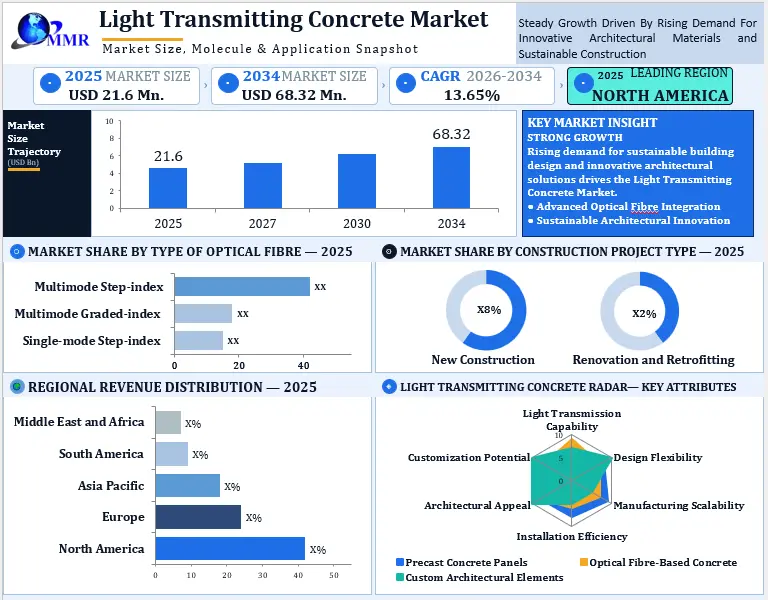
Global Light Transmitting Concrete Market size is USD 21.6 Mn. in 2025 and CAGR is expected to be 13.65% during the forecast period and the market size is expected to reach USD 68.32 Mn. by 2034.
Global Light Transmitting Concrete Market Overview
Light transmitting concrete is an innovative construction material that combines the strength and durability of conventional concrete with the ability to transmit light through embedded optical fibers or light-guiding elements. It is increasingly relevant to modern architecture, sustainable building design, decorative concrete applications, and energy-conscious construction. By integrating natural light into walls, partitions, facades, and interior structures, light transmitting concrete supports visually distinctive buildings while offering new possibilities for architectural design and space utilization.
The Light Transmitting Concrete Market is expanding as architects, construction companies, infrastructure developers, and commercial property owners seek innovative building materials that combine functionality with aesthetic appeal. Growing interest in smart buildings, sustainable construction, energy-efficient architecture, and premium interior design is encouraging the adoption of translucent concrete panels and light transmitting building components. Companies such as Luccon and Litracon have helped establish the material within architectural applications, while green building initiatives promoted by organizations such as the U.S. Green Building Council are increasing industry attention toward energy-conscious building design. North America and Europe represent important markets for architectural innovation, while Asia Pacific offers growth opportunities through urbanization, commercial construction, and infrastructure development.
The MMR report examines Light Transmitting Concrete Market trends, market growth drivers, restraints, emerging technologies, competitive landscape, regional demand, and industry developments. It identifies opportunities in sustainable building materials, smart architectural facades, decorative concrete panels, commercial construction, and modern infrastructure, helping manufacturers, investors, suppliers, and construction businesses evaluate market potential and identify future growth opportunities.
Light Transmitting Concrete Market Growth and Share Analysis
To know about the Research Methodology :- Request Free Sample Report
Global Light Transmitting Concrete Market Key Highlights
| Key Highlight | Insight |
| Strong Market Growth Potential | The market is estimated at USD 21.6 million in 2025 and is projected to reach USD 68.32 million by 2034, registering a CAGR of 13.65%. Growing demand for innovative architectural materials supports this growth outlook. |
| Rising Demand for Sustainable Architecture | Interest in daylight-oriented building designs, modern facades, and energy-conscious construction is creating opportunities for light transmitting concrete in commercial buildings, public infrastructure, and premium interiors. |
| Optical Fibre Technology Shapes Product Development | Multimode optical fibres, particularly step-index fibres, are relevant to translucent concrete applications because their larger cores can support light transmission through concrete panels. Improvements in fibre integration and manufacturing precision remain important development priorities. |
| Precast Panels Offer Strong Commercial Potential | Precast light transmitting concrete panels are positioned as a leading product category due to their suitability for facades, interior feature walls, and decorative architectural installations. Factory-controlled production also supports consistent finishing and customized designs. |
| Specialized Competition and Cost Barriers | Companies such as LUCEM GmbH and LiTraCon participate in this specialized market. However, high manufacturing costs, installation complexity, limited awareness, and the need for reliable performance standards may constrain wider adoption. |
Global Light Transmitting Concrete Market Dynamics:
Rising Demand for Sustainable Architecture and Innovative Construction Materials Drive the Light Transmitting Concrete Market
The light transmitting concrete market is gaining momentum as architects, construction companies, and infrastructure developers seek innovative building materials that combine concrete durability with natural light transmission and modern architectural appeal. Increasing investment in energy-efficient buildings, urban infrastructure, and sustainable construction is encouraging the adoption of translucent concrete for building facades, interior partitions, decorative walls, walkways, and public structures. The United Nations Environment Programme highlights the importance of reducing emissions from the building and construction sector, reinforcing industry interest in energy-conscious building design and material innovation. Light transmitting concrete can support daylight-oriented architectural concepts, although its actual energy-saving benefits depend on building orientation, lighting systems, and installation design. These factors are creating new demand for decorative concrete solutions, premium construction materials, and innovative architectural products across residential, commercial, and institutional construction projects.
High Manufacturing Costs and Complex Installation Restrict Light Transmitting Concrete Market Adoption
The light transmitting concrete market faces limitations associated with high production costs, specialized manufacturing processes, and the technical complexity of integrating optical fibers into concrete structures. Compared with conventional concrete, translucent concrete may require additional material processing, precise fiber placement, specialized molds, and skilled labor, increasing the overall cost of construction projects. Optical fiber quality, concrete mix consistency, panel thickness, and installation accuracy can also influence light transmission, surface finish, and long-term performance. Budget-sensitive residential developments and large infrastructure projects may prioritize conventional concrete because of its established supply chains and familiar installation practices. In addition, limited awareness among contractors, inconsistent product availability, and the need for project-specific fabrication can slow adoption, particularly in markets where construction buyers prioritize low initial costs over distinctive architectural features.
Smart City Development and Premium Architectural Design Create New Light Transmitting Concrete Market Opportunities
Growing investment in smart cities, sustainable buildings, hospitality infrastructure, and contemporary commercial architecture is creating opportunities for light transmitting concrete manufacturers and construction material suppliers. The United Nations estimates that nearly seven in ten people worldwide could live in urban areas by the middle of the century, highlighting the long-term importance of urban planning and infrastructure development. This urbanization trend creates potential applications for translucent concrete in public buildings, transportation terminals, museums, hotels, retail environments, landscape features, and architectural landmarks. Manufacturers can strengthen their market position by developing customizable panels, prefabricated translucent concrete blocks, improved optical fiber integration, and products tailored to specific lighting requirements. Collaboration with architects, engineering consultants, and construction contractors can further improve product awareness and adoption. Opportunities also exist in renovation projects, luxury interiors, branded commercial spaces, and sustainable building designs where distinctive visual effects can command premium value.
Performance Standardization and Limited Market Awareness Challenge Light Transmitting Concrete Market Growth
The light transmitting concrete market must overcome challenges related to product standardization, structural performance validation, installation expertise, and customer confidence. Unlike conventional concrete, light transmitting concrete incorporates light-guiding components that require careful evaluation alongside compressive strength, durability, moisture resistance, fire performance, and long-term maintenance requirements. Manufacturers must demonstrate that their products meet applicable construction codes and project-specific engineering standards rather than relying solely on visual appeal. Consistent optical fiber distribution and reliable light transmission across different panel sizes can also be difficult to achieve during large-scale production. Furthermore, limited contractor familiarity, a relatively specialized supplier base, and a lack of awareness among property developers can restrict specification in mainstream construction projects. Addressing these challenges through standardized testing, technical documentation, installation training, product demonstrations, and collaboration with building professionals will be essential to improving market acceptance and supporting the long-term development of the light transmitting concrete industry.
Global Light Transmitting Concrete Market Key Trends
| Market trend | Description |
| Illuminated Architectural Facades and Exterior Wall Cladding | Architects are increasingly using light transmitting concrete panels in building facades, entrance portals, and exterior wall cladding to combine a concrete finish with distinctive lighting effects. Manufacturers such as LUCEM offer facade systems that integrate translucent materials with controlled illumination, creating opportunities in commercial buildings, corporate headquarters, and landmark architecture. |
| Integration of Digital Lighting and Media Facades | Light transmitting concrete is developing beyond static decorative surfaces through integration with controllable lighting, illuminated graphics, logos, and digital display effects. This trend creates opportunities for retail showrooms, hotels, entertainment venues, and corporate buildings seeking customized architectural branding without relying entirely on conventional display screens. |
| Growing Adoption of Prefabricated Translucent Concrete Panels | Precast translucent concrete panels and custom-fabricated architectural components are attracting interest because they allow manufacturers to control optical fiber placement, surface quality, dimensions, and finishing before installation. Standardized panel formats and project-specific fabrication can simplify installation planning for interior partitions, wall cladding, reception areas, and specialized building projects. |
| Premium Interior Design in Hospitality and Commercial Buildings | Hotels, restaurants, wellness facilities, offices, and luxury retail spaces are using translucent concrete to create feature walls, illuminated counters, decorative partitions, and distinctive reception areas. Demand is particularly relevant to projects where material appearance and customer experience influence design decisions, creating opportunities for customized colors, textures, patterns, and lighting configurations. |
| Development of Advanced Optical Fiber and Light Guide Technologies | Product development is focusing on the integration of optical fibers, polymer-based light guides, and alternative light-transmitting elements within cementitious materials. Improvements in light distribution, material consistency, panel design, and fabrication techniques could help manufacturers address varying architectural requirements while maintaining the concrete's intended structural and surface properties. |
| Increasing Interest in Public Infrastructure and Wayfinding Applications | Transit stations, airports, public buildings, memorial structures, and pedestrian environments offer potential applications for translucent concrete panels that communicate directions, display symbols, or create illuminated architectural features. This trend supports opportunities in customized public-space design, although structural suitability, maintenance requirements, visibility, and project costs must be assessed for each installation. |
Global Light Transmitting Concrete Market Segment Analysis:
By Type of Optical Fibre, Multimode graded-index fibre is an important technology to monitor in optical fibre applications because its graded refractive index helps reduce light dispersion. However, multimode step-index fibre is more relevant to light transmitting concrete applications, where larger light-accepting cores and straightforward integration into concrete panels can support the transmission of daylight and artificial light. Research on light transmitting concrete identifies multimode optical fibres, including plastic optical fibres, as preferred options for this application. Single-mode step-index fibre is less suited to typical translucent concrete designs because its narrow core is primarily intended for specialized optical communication.
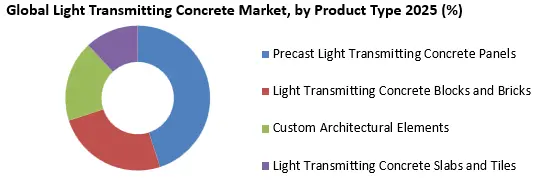
By Product Type, Precast light transmitting concrete panels are expected to represent the leading product type in the light transmitting concrete market, driven by their suitability for building facades, exterior wall cladding, interior feature walls, and commercial architectural projects. Their factory-controlled production allows optical elements to be positioned consistently, while prefabrication can simplify transportation, installation planning, and finishing. Market research also identifies panels as a leading product format for translucent concrete applications. Light transmitting concrete blocks and bricks remain relevant for modular walls and decorative structures, while slabs and tiles serve specialized flooring and surface-design applications. Custom architectural elements cater to bespoke furniture, reception counters, branded installations, and distinctive interior features.
 Global Light Transmitting Concrete Market Regional Insights:
The global light transmitting concrete market is categorized into North America, Europe, Asia Pacific, South America, and Middle East & Africa.
The use of a variety of fiber-optics sensors in concrete structures has enhanced the demand for light-transmitting concrete in the building & construction industry in North America and Europe. The market in Europe is expected to grow at a rapid pace during the forecast period, this is mainly because of the presence of prominent players operates in the light-transmitting concrete market in Europe. Demand for light-transmitting concrete is high in countries in the Asia Pacific such as China, India, and Japan, led by the existence of the vast building & construction industry. Further detailed analysis of each regional & country level market scenario captured in the MMR report.
The objective of the report is to present a comprehensive analysis of the Global Light Transmitting Concrete Market to the stakeholders in the industry. The past and current status of the industry with forecasted market size and trends are presented in the report with the analysis of complicated data in simple language. The report covers all the aspects of the industry with a dedicated study of key players that includes market leaders, followers, and new entrants. PORTER, SVOR, PESTEL analysis with the potential impact of micro-economic factors of the market have been presented in the report. External as well as internal factors that are supposed to affect the business positively or negatively have been analyzed, which will give a clear futuristic view of the industry to the decision-makers.
The report also helps in understanding Global Light Transmitting Concrete Market dynamics, structure by analyzing the market segments and project the Global Light Transmitting Concrete Market size. Clear representation of competitive analysis of key players by type, price, financial position, product portfolio, growth strategies, and regional presence in the Global Light Transmitting Concrete Market make the report investor’s guide.
Global Light Transmitting Concrete Market Competitive Landscape
The light transmitting concrete market is characterized by a specialized competitive landscape in which manufacturers differentiate themselves through optical fibre integration, translucent concrete panels, customized architectural products, manufacturing precision, and design flexibility. LUCEM GmbH and LiTraCon are recognized participants in light transmitting concrete solutions, with applications spanning architectural facades, interior walls, and decorative installations. Fapinex LLC focuses on customized translucent concrete products and integrated lighting applications, while Luccon Lichtbeton GmbH develops light-transmitting concrete elements for architectural use. Other notable participants include CRE Panel GmbH, LCT GesmbH, Concrete LCDA, Dupont Lightstone, Beton Brož, Glass Block Technology Limited, and Pan-United Corporation. Competition in the light transmitting concrete industry increasingly centers on product durability, light transmission quality, precast panel customization, installation efficiency, and the ability to meet architects' requirements for distinctive building facades and premium interiors. Manufacturers that strengthen relationships with construction companies, precast concrete suppliers, architects, and infrastructure developers can improve product visibility and access emerging opportunities in modern construction, decorative concrete, and innovative building materials.
| Region | Country | Company | Market relevance and competitive positioning |
| North America | United States | Fapinex LLC | Develops customized translucent concrete products and illuminated architectural elements, targeting decorative walls, feature panels, and distinctive commercial interiors. |
| North America | United States | Translucent Crete LLC | Associated with translucent concrete solutions for architectural and decorative applications, offering potential differentiation through customized designs and light-transmitting surfaces. |
| Europe | Germany | LUCEM GmbH | A recognized specialist in light transmitting concrete panels and architectural surfaces, with relevance to facade cladding, interior walls, and illuminated building designs. |
| Europe | Hungary | LiTraCon Ltd. | An early pioneer of translucent concrete technology, associated with optical-fibre-based concrete products and architectural applications. |
| Europe | Austria | CRE Panel GmbH | Associated with translucent concrete panels and architectural applications, with relevance to customized facade systems and decorative construction. |
| Asia Pacific | Singapore | Pan-United Corporation Ltd. | A concrete technology and construction materials company with expertise in specialized concrete solutions; its broader concrete capabilities are relevant, although dedicated translucent concrete sales should be verified. |
| South America | Brazil | No independently verified specialist identified | The market may offer opportunities through architectural concrete manufacturers and project-specific suppliers, but a dedicated translucent concrete competitor requires further verification. |
| Middle East and Africa | United Arab Emirates | Fapinex LLC | Listed in market research as a translucent concrete participant with relevance to customized architectural products; its current operating base and regional distribution arrangements should be confirmed. |
Global Light Transmitting Concrete Market Recent Development
| Month in 2026 | Company | Recent development |
| February 2026 | Litracon Ltd | Litracon continues to offer its pXL translucent concrete panel system, which uses specially formed plastic elements instead of conventional optical fibres. A specific February 2026 product launch could not be independently verified. |
| April 2026 | LUCCON | A market research publication reports a new generation of translucent concrete facade panels with improved light transmission and thermal performance. Independent confirmation from the company was not located. |
| May 2026 | LUCEM GmbH | A market research publication reports a digital facade project featuring light transmitting concrete. The company's official product information confirms its digital concrete and illuminated architectural solutions, but the specific May 2026 project date requires confirmation. |
| June 2026 | LUCEM GmbH | A market research publication reports increased production capacity for translucent concrete panels in Germany. An official company announcement confirming this specific expansion was not located. |
| July 2026 | Heidelberg Materials | Heidelberg Materials reported progress in its broader building materials and sustainability operations, including investment in lower-carbon cement production. This is a verified company development, but it is not a dedicated light transmitting concrete product launch. |
Global Light Transmitting Concrete Market Scope: Inquire before buying
| Light Transmitting Concrete Market | |||
|---|---|---|---|
| Report Coverage | Details | ||
| Base Year: | 2025 | Forecast Period: | 2026-2034 |
| Historical Data: | 2020 to 2025 | Market Size in 2025: | 21.6 USD Million |
| Forecast Period 2026-2034 CAGR: | 13.65% | Market Size in 2034: | 68.32 USD Million |
| Segments Covered: | by Type of Optical Fibre | Multimode Graded-index Fiber Multimode Step-index Fiber Single-mode Step-index Fiber |
|
| by Construction Project Type | New Construction Renovation and Retrofitting |
||
| by End User | Residential Buildings Commercial Buildings Industrial Buildings Public Infrastructure Hospitality and Leisure Facilities Other End Users |
||
| by Product Type | Precast Light Transmitting Concrete Panels Light Transmitting Concrete Blocks and Bricks Light Transmitting Concrete Slabs and Tiles Custom Architectural Elements |
||
Global Light Transmitting Concrete Market, by Region
North America (United States, Canada, and Mexico)
Europe (UK, France, Germany, Italy, Spain, Sweden, Austria, and the Rest of Europe)
Asia Pacific (China, South Korea, Japan, India, Australia, ASEAN, Indonesia, Philippines, Malaysia, Vietnam, Thailand, ASEAN, Rest of Asia Pacific)
Middle East & Africa (South Africa, GCC, Nigeria, Rest of ME&A)
South America (Brazil, Argentina, Rest of South America)
Global Light Transmitting Concrete Market Key Players
1. Litracon Ltd.
2. LUCEM GmbH
3. Luccon Lichtbeton GmbH
4. LiTraCon Bt
5. Fapinex LLC
6. Pan-United Corporation Ltd.
7. CRE Panel GmbH
8. LCT GesmbH
9. Dupont Lightstone
10. Glass Block Technology Limited
11. Florack Bauunternehmung GmbH
12. Beton Brož
13. Concrete LCDA
14. Gravelli
15. LiCrete Technologies
16. FİBROBETON
17. DITON s.r.o.
18. GBA Architectural Products
19. Sino-Sina Building Materials Co. Ltd.
20. StoneCast Technologies Pvt. Ltd.
21. Aarka Technology Pvt. Ltd.
22. Gravlite Translucent Concrete Pvt. Ltd.
23. LightBeton Solutions
24. Lumicon Concrete Systems
25. Translucent Crete LLC
26. Transparent Concrete Hub
27. Buchs Beton AG
28. Fritz Fischer GmbH & Co. KG
29. Glas Beton GmbH
30. Heinz Baumgarten Betonwerk GmbH
31. Heidelberg Materials
32. Italcementi
33. Butong AB
34. Josef Loacker GmbH
35. LBM EFO
36. Illuminart
37. Materialsyi
38. Stepsmaterial.com
39. LiTraCon Oy
40. Luccon LLC
41. Lucem Lightbeton Designs
42. Lucem UG
43. LCT GmbH
44. LCTG
45. Luccon UK Ltd.
46. Modern Contempo
47. NUWorld Lighting
48. Materia Exhibitions B.V.
49. HAUTE INNOVATION
50. Pan-United Building Materials
Frequently Asked Questions
1. Which region has the largest share in the Light Transmitting Concrete Market?
Ans: North America is considered a leading region in the light transmitting concrete market, driven by architectural innovation and demand for premium construction materials.
2. What is the growth rate of the Light Transmitting Concrete Market?
Ans: The market is projected to grow at an estimated CAGR of 13.65% during the forecast period from 2026 to 2034.
3. What is the scope of the Light Transmitting Concrete Market report?
Ans: The report covers market estimation, segmentation, regional analysis, competitive landscape, growth drivers, restraints, opportunities, challenges, and strategic recommendations.
4. Who are the key players in the Light Transmitting Concrete Market?
Ans: Key players include Litracon Ltd., LUCEM GmbH, Luccon, CRE Panel GmbH, Fapinex LLC, LCT GesmbH, and Concrete LCDA.
5. What is the study period of the Light Transmitting Concrete Market?
Ans: The market is studied from 2020 to 2034, with 2025 as the base year and 2026 to 2034 as the forecast period.