
Kosher Food Market By Product Category, By Kosher Classification, By End User, By Distribution Channel and Regional Insights 2034
Overview
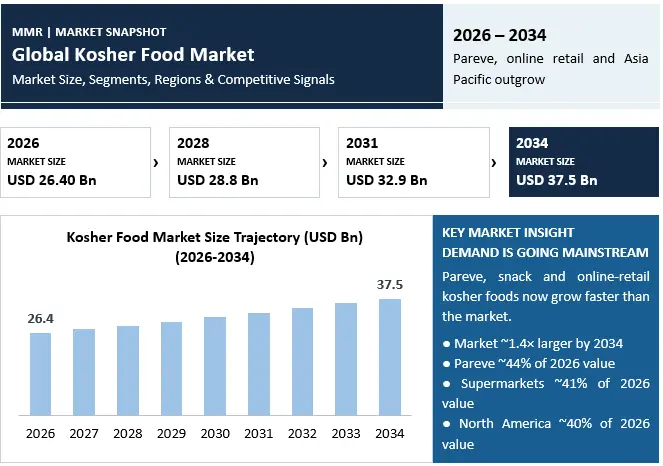
The Global Kosher Food Market was valued at USD 26.40 billion in 2026 and is projected to reach USD 37.5 billion by 2034, growing at a CAGR of 4.5% during 2027–2034, according to Maximize Market Research (MMR). Kosher foods are products grown, processed, prepared and certified in line with kashrut, the Jewish dietary law, and verified by recognized certification agencies. The kosher symbol on a pack now works as a trust mark for ingredient integrity, supervised production and traceability, which is why Kosher Food Market growth reaches well beyond observant households to vegetarian, allergy-aware and quality-conscious consumers in mainstream retail.
This Kosher Food Market analysis answers both sides of the search: what the market is worth for Kosher Food manufacturers, meat and dairy processors, retailers and investors, and what consumers, foodservice buyers and procurement teams want to know, from what counts as kosher to the Kosher Certified Food Market, Kosher Packaged Food Market, Kosher Processed Food Market, Kosher Meat Market, Kosher Dairy Products Market, Kosher Pareve Food Market and Kosher Snacks Market. This market overview and market analysis offer market insights into Kosher Food consumption, Kosher Food demand and Kosher Food supply, with a clear market summary and market outlook for stakeholders. The Kosher Food Market report also tracks Kosher Food Market overview, Kosher Food industry landscape, Kosher Food Market analysis, Kosher Food Market insights, Kosher Food industry trends, Kosher Food Market dynamics, Kosher Food Market size and Kosher Food Market key players.
Pareve foods and supermarket distribution anchor the market and North America is the largest regional buyer, but Kosher Food Market growth is shifting toward packaged and processed foods, snacks and confectionery, plant-based and clean-label products and online retail as mainstream manufacturers add certification, e-commerce widens availability and consumers read the kosher symbol as a quality signal. These industry trends and market dynamics highlight emerging markets and growth prospects across the Kosher Food industry landscape, supported by Kosher Food Market size and Kosher Food Market forecast data through 2034.
Maximize Market Research provides comprehensive analysis of global Kosher Food Market size, share, product category, kosher classification, certification status, distribution channel, end user and regional segmentation, the Kosher Food competitive landscape, strategic scenarios and growth opportunities. The report helps Kosher Food manufacturers, ingredient and additive suppliers, certification agencies, retailers, foodservice operators and investors decide which segments, channels and countries to prioritise through 2034. The market research findings also cover Kosher Food Market competitive landscape, Kosher Food Market segmentation, Kosher Food Market growth prospects, Kosher Food Market opportunities, Kosher Food Market challenges, Kosher Food Market consumer behavior, Kosher Food Market entry and Kosher Food Market emerging markets. Kosher Food industry analysis and Kosher Food certification trends complete the picture.
| 2026 | BASE YEAR | 2034 | FORECAST | GROWTH RATE | LARGEST REGION |
| USD 26.40 Bn | USD 37.5 Bn | 4.5% | North America |
Global Kosher Food Market Overview:
The market is measured at retail-equivalent value across kosher-certified meat and poultry, dairy products, bakery and cereal products, packaged and processed foods, snacks, confectionery and desserts, beverages and other specialty foods, sold through supermarkets, specialty kosher stores, online retail and foodservice channels to households, restaurants, hotels and institutions. Uncertified foods that merely happen to be kosher-compliant, kosher certification service fees and non-food kosher products are excluded.
Three shifts shape 2026–2034: demand is broadening from observant communities into mainstream consumers who value certified quality and ingredient transparency; value is moving toward pareve, packaged, snack and plant-based formats that suit everyday use; and growth is rotating toward online retail, Asia Pacific and clean-label, traceable products. Manufacturers are answering certification cost and production segregation pressure with dedicated lines, kosher-compliant plant design and stronger agency partnerships. This market synopsis reflects the key growth drivers, market opportunities and challenges, along with economic factors, technological advancements and regulatory influences affecting Kosher Food demand and Kosher Food supply. Related Kosher Food Market coverage includes Kosher Food Market outlook, Kosher Food Market research findings, Kosher Food Market summary, Kosher Food Market revenue generated, Kosher Food Market growth drivers, Kosher Food Market Synopsis and Kosher Food Market strategies.
Kosher Food Market Growth and Share Analysis
To know about the Research Methodology :- Request Free Sample Report
Key Findings: Eight Insights Shaping the Global Kosher Food Market
MMR’s analysis of published market data, company announcements, certification agency frameworks, regulatory requirements and industry developments points to eight findings that explain where Kosher Food Market growth and value are created through 2034. These market insights summarise the Kosher Food Market forecast, market segmentation and competitive landscape in one view.
| Sr.No. | Findings | Evidence | So what |
| 1 | The market grows about 1.4× by 2034 | USD 26.40 Bn (2026) to USD 37.5 Bn (2034) at 4.5% CAGR | Certified capacity, supervision and cold-chain capability must scale about 1.4× by 2034 |
| 2 | Pareve is the base, snacks and packaged foods the growth edge | Pareve ~44% of 2026 value; snacks, confectionery and desserts 6.0% CAGR | Neutral, shelf-stable and snack formats widen addressable demand |
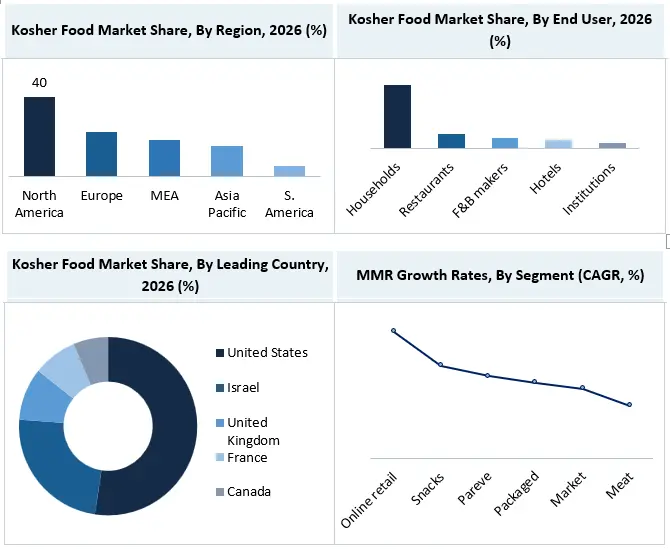
| 3 | North America is the largest region | ~40% share in 2026, led by the United States (~33% of global value) | Certified shelf presence and retailer relationships set share |
| 4 | Online retail outgrows the market | Online retail 8.2% CAGR; supermarkets still ~41% of 2026 value | Omnichannel availability and verified certification data open reach |
| 5 | Mainstream consumers widen demand | Households ~62% of 2026 value; kosher symbol read as a quality signal | Certification works as a trust mark beyond observant buyers |
| 6 | Meat and poultry remain the largest category | Meat and poultry ~27% of 2026 value at 3.4% CAGR | Supervision and cold-chain cost drive pricing and margins |
| 7 | Certification supply is concentrated in recognised agencies | OU, OK Kosher, Star-K, Kof-K and KLBD anchor global supervision | Agency recognition and audit credibility shape export access |
| 8 | Traceability and sustainability are competitive levers | Clean-label, organic, traceable and recyclable-pack ranges gain share | Transparent sourcing raises the bar for new entrants |
Global Kosher Food Market Dynamics:
Global Kosher Food Market Growth Drivers: Mainstream Certification, Clean-Label Preferences, Religious Observance and Online Availability
The Global Kosher Food Market is supported by rising demand for certified, traceable and quality-assured foods, the spread of kosher certification across mainstream manufacturers and the steady food needs of observant communities. Kosher certification gives retailers and shoppers a recognised signal of ingredient verification, supervised production and food safety, which makes kosher certified food a practical differentiator for brands that want wider shelf access. Weekly Shabbat meals, Passover and other festival cycles, together with everyday household grocery needs, pull Kosher Food consumption upward, and repeat purchasing of familiar certified brands gives the Kosher Food Market a recurring revenue base. These factors support steady Kosher Food Market growth across mature and emerging regions, although buying decisions still depend on certification credibility, price, availability and taste. Kosher Food demand and Kosher Food supply are shaped by Kosher Food Market dynamics, Kosher Food industry fluctuations, Kosher Food Market economic factors, Kosher Food Market consumer behavior trends, Kosher Food Market demand and supply, Kosher Food Market competitive forces and Kosher Food Market drivers.
Product and channel breadth are adding new layers of demand. Mainstream manufacturers extend kosher certification to packaged and processed foods, snacks, confectionery, dairy and beverages; clean-label, organic and plant-based lines use kosher pareve status as a quality and allergen-awareness cue; and online retail and specialty kosher stores widen availability beyond traditional neighbourhoods. The Orthodox Union, OK Kosher, Star-K, Kof-K and the London Beth Din (KLBD) show how recognised agencies supervise ingredients, facilities and renewals across global supply chains, while kosher meat, dairy and pareve producers keep B2B volume demand high through supervised, long-term supply relationships with retailers, foodservice operators and institutions. Further Kosher Food Market drivers include Kosher Food Market challenges, Kosher Food Market technological advancements, Kosher Food Market regulatory influences, Kosher Food Market emerging trends, Kosher Food Market opportunities and Kosher Food Market innovation in the industry.
Global Kosher Food Market Restraints: Certification Cost, Production Segregation, Ingredient Price Volatility and Cold-Chain Complexity
Certification cost, production segregation and supply-chain complexity are the main restraints. Kosher production requires approved ingredients, supervised facilities, separate meat and dairy lines, equipment kosherization and periodic audits, so certification fees, downtime and compliance costs raise unit economics for smaller manufacturers. Agricultural commodity prices, food inflation, cold-chain expense and currency movements shape Kosher Food supply and pricing, and a limited number of qualified shechita, meat and dairy processors constrains sourcing alternatives. Retail premiums on kosher meat and poultry can dampen volume in price-sensitive markets. Kosher Food Market constraints are assessed through Kosher Food Market macroeconomic factors, Kosher Food Market growth factors, Kosher Food Market constraints, Kosher Food industry disruptors, Kosher Food Market shifts, Kosher Food Market environmental factors and Kosher Food Market socioeconomic influences.
Regulation, logistics and competition also limit growth. Producers must meet FDA and USDA requirements in the United States, Food Safety Modernization Act (FSMA) compliance, European Union labeling rules, Israeli food regulations and FSSAI requirements in India, while imports and exports depend on international recognition of kosher certification. Cold-chain handling, kosher segregation in warehousing and traceability add cost, and conventional, halal, vegan and other specialty certified foods compete for the same shopper attention. Seasonal demand peaks around Passover and the Jewish holidays can also strain capacity and inventory planning. Related Kosher Food Market pressures include Kosher Food Market trends analysis, Kosher Food Market demand and supply dynamics, Kosher Food Market forces, Kosher Food Market economic indicators, Kosher Food industry evolution and Kosher Food Market competitive landscape shifts.
What Are the Biggest Kosher Food Market Opportunities Through 2034?
Pareve, packaged and processed foods, snacks and confectionery, plant-based kosher products and online retail represent the most significant Kosher Food Market opportunities because they extend revenue beyond traditional kosher meat and dairy. Online retail is projected to grow at 8.2% CAGR and snacks, confectionery and desserts at 6.0% CAGR as consumers look for certified, clean-label and convenient formats. Kosher-certified organic and plant-based lines, meat alternatives and allergen-aware products show how certification can become a marketing advantage. Manufacturers with dedicated kosher-compliant capacity, strong agency partnerships and secure ingredient sourcing may be better positioned to win new retail listings. Kosher Food Market opportunities, Kosher Food Market challenges and Kosher Food consumer demographics, covering observant households, health-conscious shoppers, foodservice operators and institutions, are assessed for each segment.
Emerging-market expansion, export growth and premium specialty products offer further routes to growth. Asia Pacific is projected to be the fastest-growing region at 6.1% CAGR as Australia, India, China, Japan, Singapore and South Korea expand certified food manufacturing, tourism-linked foodservice and import demand, while Middle East & Africa and South America benefit from Israel’s food sector, hospitality demand and export-oriented meat and dairy production in Argentina, Brazil and Uruguay. Kosher airline, cruise and hotel catering, school and hospital meal programs and private-label kosher ranges can widen distribution. Emerging trends, a market gap in affordable kosher-certified packaged foods and untapped market areas create attractive segment-specific opportunities. Kosher Food Market opportunities are reinforced by Kosher Food Market consumer preferences evolution, Kosher Food Market regulatory changes, Kosher Food Market innovation impact, Kosher Food Market technology trends and Kosher Food Market responsiveness.
Kosher Food Market Trends: Mainstream Certification, Clean-Label Kosher, Plant-Based Pareve and Online Kosher Retail
Four Kosher Food Market trends stand out through 2034. First, mainstream certification: global packaged food, dairy, bakery and beverage brands continue to add kosher symbols. Second, clean-label and organic kosher: shoppers read ingredient transparency and supervised production as quality signals. Third, plant-based pareve: vegan, vegetarian and dairy-alternative products fit kosher pareve rules and appeal beyond observant consumers. Fourth, digital availability: e-commerce and specialty retail platforms make certified products easier to find and ship. Production automation, traceability systems and recyclable packaging enable these shifts. Kosher Food Market trends analysis also covers Kosher Food Market external market influences, Kosher Food Market adaptability, Kosher Food Market strategic market changes, Kosher Food Market segmentation shifts, Kosher Food Market customer engagement dynamics, Kosher Food industry resilience, Kosher Food Market fluctuation analysis, Kosher Food Market growth catalysts, Kosher Food Market volatility and Kosher Food Market gap. These Kosher Food Market trends define how suppliers respond through 2034.
Kosher Certification as a Commercial Differentiator and Supply-Chain Advantage
An emerging competitive shift in the Kosher Foods Market is the transformation of kosher certification from a religious dietary requirement into a broader commercial and supply-chain differentiator. Manufacturers are increasingly evaluating kosher certification at the product-development stage rather than treating it as a final labeling exercise. This creates opportunities for dual-certified production facilities, where kosher-compliant processes can be aligned with halal, vegetarian, allergen-aware and clean-label product requirements, subject to their respective standards. The growing importance of ingredient-level verification, digital traceability and certification transparency is also encouraging manufacturers to strengthen supplier databases and production monitoring systems. Another emerging opportunity lies in developing export-ready pareve products, shelf-stable meals and plant-based alternatives that can serve multiple consumer groups through shared distribution networks. For food manufacturers, the next competitive advantage may therefore come not simply from expanding the number of kosher-certified products, but from integrating certification into procurement, manufacturing efficiency, product innovation and international market-entry strategies. This shift could reshape Kosher Foods Industry Trends, Kosher Foods Market Opportunities, Kosher Foods Competitive Positioning and long-term Kosher Foods Market Growth through 2034.
Global Kosher Food Market Segment Analysis:
Kosher Meat Market, Kosher Dairy Products Market, Kosher Pareve Food Market, Product Category and Kosher Classification Analysis
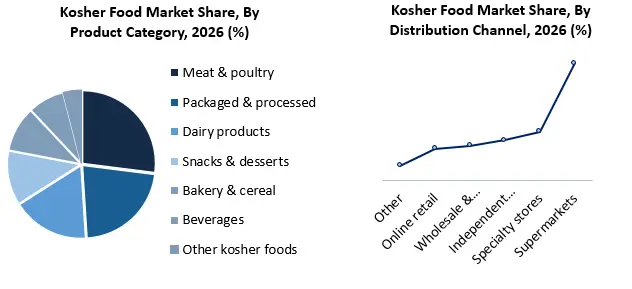
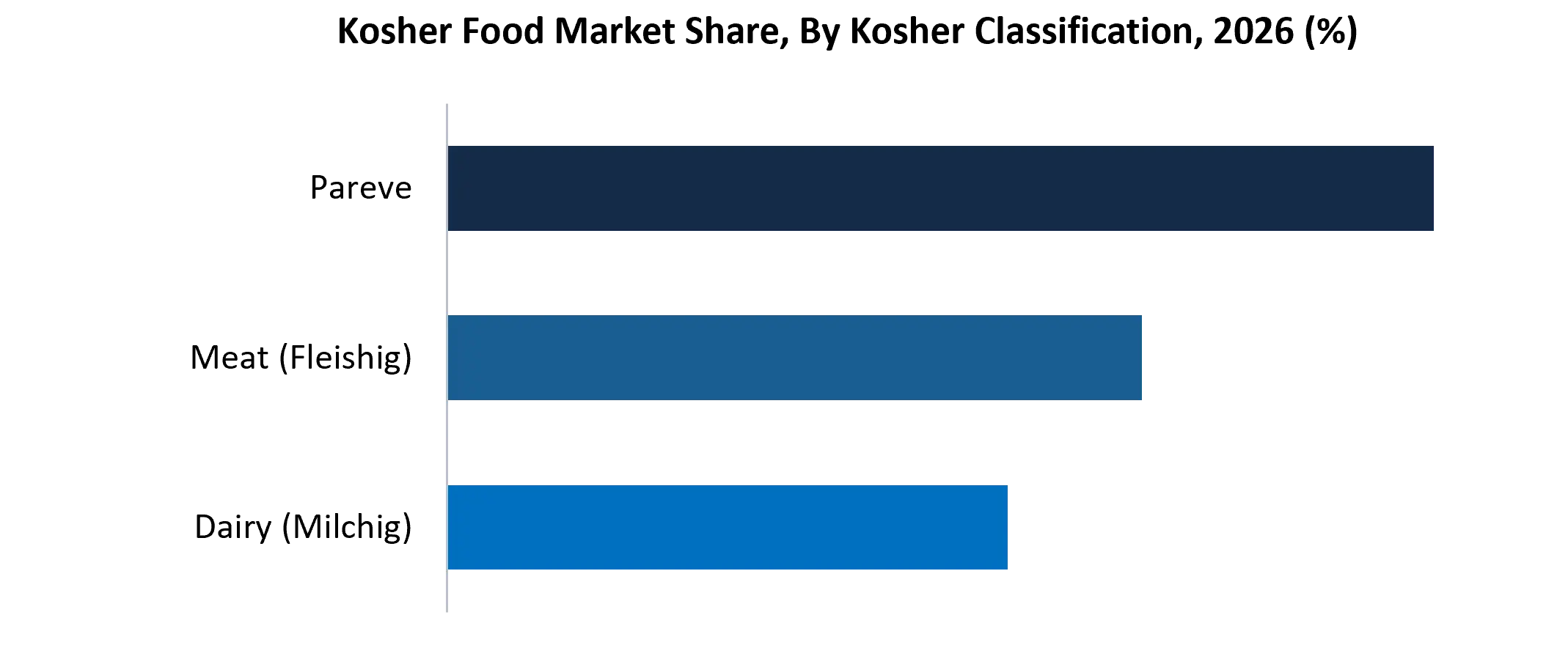
Pareve products represent the largest kosher classification, accounting for 44% of the 2026 market value, followed by kosher meat (fleishig) at 31% and kosher dairy (milchig) at 25%. By product category, meat and poultry lead with a 27% share, followed by packaged and processed foods (22%), dairy (17%), snacks, confectionery and desserts (12%), bakery and cereals (10%), beverages (8%) and other products (4%). Year-round kosher-certified products account for 86% of value, while Passover-certified products hold 14%. Supermarkets and hypermarkets dominate distribution with 41%, followed by specialty kosher stores (17%), independent grocery and convenience retailers (14%), wholesale and foodservice suppliers (12%), online retail (11%) and other channels (5%). Households and individual consumers represent the leading end-user group at 62%.
This Kosher Food Market segment analysis examines industry segmentation, product segmentation, consumer demographics, target markets, geographic distribution, customer profiling and market share by segment. It also evaluates segment growth, competitive dynamics, emerging opportunities, niche markets, behavioral patterns, micro-segmentation, segment attractiveness and customer-specific trends. These insights support the assessment of specialized market sectors, untapped opportunities and tailored marketing strategies across the Kosher Packaged Food Market, Kosher Processed Food Market, Kosher Snacks Market and broader Kosher Certified Food Market.
 Global Kosher Food Market Regional Analysis:
North America dominates the Kosher Foods Market, accounting for 40% of global Kosher Foods Market Share in 2026, driven by strong Kosher Foods Consumption in the United States, Canada, and Mexico. Extensive certified-product availability, established agencies such as Orthodox Union, OK Kosher, Star-K, and Kof-K, and widespread supermarket distribution support regional demand. Europe represents around 22% of global share, led by the UK, France, Germany, Belgium, and the Netherlands, where certification, specialty retail, and cross-border trade sustain Kosher Foods Demand. The region is projected to grow at a 4.0% CAGR.
Middle East & Africa accounts for 18% of global market share, with Israel leading regional Kosher Foods Consumption through widespread certification across manufacturing, retail, and foodservice. Asia Pacific holds around 15% and is the fastest-growing region, with a projected 6.1% CAGR, supported by certified food exports, ingredient manufacturing, and increasing Kosher Foods Adoption in Australia, India, China, Japan, and Singapore. South America contributes nearly 5%, driven by kosher-certified beef, poultry, dairy, and ingredient exports from Argentina, Brazil, Chile, and Uruguay. Overall, Kosher Foods Regional Trends, Kosher Foods Consumption Patterns, Kosher Foods Geographic Demand, Kosher Foods Regional Growth Opportunities, and Kosher Foods Industry Outlook reflect varying consumer preferences, certification requirements, and competitive dynamics across regions.
Kosher Food Companies and Competitive Landscape:
The Kosher Foods competitive landscape comprises several distinct participant groups, including dedicated kosher food manufacturers, multinational food companies, ingredient suppliers, regional producers, and certification agencies. Leading dedicated brands include Manischewitz, Kayco, Empire Kosher Poultry, Streit’s, Gefen, and Hebrew National, alongside Israeli companies such as Tnuva, Strauss Group, Osem-Nestlé, and Willi-Food Investments. Multinational corporations, including General Mills, The Kraft Heinz Company, PepsiCo, The Hershey Company, Mondelez International, Nestlé, and Unilever, offer extensive kosher-certified product portfolios.
Ingredient suppliers such as Cargill, Archer Daniels Midland (ADM), and McCormick & Company support kosher-compliant ingredient sourcing. Regional companies, including Goodman Fielder, Arnott’s Group, Fonterra, Tiger Brands, BRF S.A., JBS S.A., and Grupo Arcor, strengthen regional participation across Asia Pacific, Africa, and South America. Certification organizations such as Orthodox Union, OK Kosher, Star-K, Kof-K, and KLBD provide essential compliance oversight. These participants operate across different industry roles and should not be ranked as directly comparable producers. Kosher Foods Company Revenue, Kosher Foods Company Net Sales, Kosher Foods Competitor Analysis, Kosher Foods Industry Rivals Examination, Kosher Foods Competitive Intelligence, Kosher Foods Rivalry Assessment, Kosher Foods Competitor Benchmarking, Kosher Foods Competitive Strategy Review, Kosher Foods Industry Player Dynamics, Kosher Foods Rivalry Impact Analysis, Kosher Foods Competitor Evaluation, Kosher Foods Competitive Landscape Trends, Kosher Foods Competitive Positioning, Kosher Foods Rivalry Intensity, Kosher Foods Competitor Profiling, and Kosher Foods Competitive Advantage Assessment support industry evaluation.
Competition is increasingly shaped by certification credibility, product diversity, pricing, brand recognition, and distribution reach. Dedicated manufacturers leverage specialized portfolios, multinational companies benefit from economies of scale, while regional and private-label suppliers compete through affordability and local availability. Premium, organic, and specialty offerings create further differentiation. Kosher Foods Player Strategies, Kosher Foods Competitive Benchmark Analysis, Kosher Foods Rival Market Share, Kosher Foods Competitive Market Evolution, Kosher Foods Competitor Differentiation, Kosher Foods Rival Scrutiny, Kosher Foods Competitive Ecosystem Analysis, Kosher Foods Competitive Matrix Investigation, Kosher Foods Sectorial Rivalry Dynamics, Kosher Foods Competitive Maneuver Examination, Kosher Foods Rivalry Intensity Mapping, Kosher Foods Industry Opposition Tactics, and Kosher Foods Strategic Analysis further define the evolving competitive environment.
Global Kosher Food Market Recent Developments
| Period | Development | Why it matters |
| Jan-26 | Orthodox Union (OU) introduced an updated beer certification policy, requiring reliable kosher certification for beers served at OU-certified establishments and events. | Strengthens kosher compliance requirements in foodservice and beverage distribution, particularly for craft and flavored beer products. |
| Jul-26 | EarthKosher partnered with Etimad Halal to introduce a combined kosher and halal certification program, allowing manufacturers to pursue both certifications through a coordinated process. | Simplifies certification procedures, reduces duplicated audits, and improves international market access for food manufacturers. |
| Aug-26 | G. Willi-Food International reported second-quarter 2026 sales of approximately USD 53.7 million, with gross profit increasing 21.5% year over year. | Highlights the financial performance of a major kosher food distributor and its position in international kosher food sourcing and distribution. |
| September–November 2026 | Sephardi Kashrut Authority (SKA) approved and certified additional products, including Gosh! plant-based burgers, Kingsmill protein pancakes, and products from The Coconut Collab. | Expands certified product availability across plant-based foods, protein-enriched bakery products, and dairy alternatives, reflecting diversification of kosher-certified offerings. |
| Nov-26 | Orthodox Union strengthened its outreach to South Korean food manufacturers, encouraging K-food companies to obtain OU kosher certification to access North American and European markets. | Creates export opportunities for Asian food manufacturers and strengthens international demand for kosher-certified packaged foods and specialty products. |
Global Kosher Food Market Scope: Inquire before buying
| Global Kosher Food Market | |||
|---|---|---|---|
| Report Coverage | Details | ||
| Base Year: | 2026 | Forecast Period: | 2027-2034 |
| Historical Data: | 2021 to 2026 | Market Size in 2026: | USD 26.40 Billion |
| Forecast Period 2027 to 2034 CAGR: | 4.5% | Market Size in 2034: | USD 37.5 Billion |
| Segments Covered: | By Product Category | Kosher Meat and Poultry Products Kosher Dairy Products Kosher Bakery and Cereal Products Kosher Packaged and Processed Foods Kosher Snacks, Confectionery and Desserts Kosher Beverages Other Kosher Food Products |
|
| By Kosher Classification | Meat (Fleishig) Dairy (Milchig) Pareve |
||
| By End User | Household and Individual Consumers Restaurants and Commercial Foodservice Operators Hotels and Hospitality Businesses Institutional and Catering Organizations Food and Beverage Manufacturers |
||
| By Distribution Channel | Supermarkets and Hypermarkets Specialty Kosher Food Stores Independent Grocery Stores and Convenience Retailers Online Retail and E-Commerce Platforms Wholesale Distributors and Foodservice Suppliers Other Distribution Channels |
||
Global Kosher Food Market, By Region
North America (United States, Canada, Mexico)
Europe (United Kingdom, France, Germany, Italy, Spain, Netherlands, Belgium, Switzerland, Austria, Poland, Sweden, Rest of Europe)
Asia Pacific (Australia, New Zealand, India, China, Japan, Singapore, South Korea, Indonesia, Malaysia, Philippines, Rest of Asia Pacific)
Middle East & Africa (Israel, United Arab Emirates, Saudi Arabia, South Africa, Morocco, Egypt, Turkey, Ethiopia, Kenya, Nigeria, Rest of Middle East & Africa)
South America (Argentina, Brazil, Chile, Uruguay, Rest of South America)
Global Kosher Food Market, Key Players
A. North America – United States
1. Manischewitz Company
2. Kayco (Kedem Food Products)
3. Empire Kosher Poultry
4. Mehadrin Dairy
5. Abeles & Heymann
6. Streit’s
7. Gefen
8. Tuscanini
9. Golden Taste
10. Kosher Valley
11. Hebrew National
12. Jack's Gourmet
13. Meal Mart
14. KOL Foods
15. Empire Chicken
16. Wise Organic Pastures
17. Aaron's Best
18. Bartenura
19. Lieber's
20. Osem USA
21. Haddar
22. Glick's
23. Brooklyn Cookie Company
24. Blommer Chocolate Company
25. Ice Chips Candy
B. North America – Other North American Food Manufacturers
26. General Mills
27. The Kraft Heinz Company
28. PepsiCo
29. The Hershey Company
30. Conagra Brands
31. Hain Celestial Group
32. Nestlé USA
33. Cargill
34. Archer Daniels Midland (ADM)
35. McCormick & Company
36. Campbell's Company
37. Kellanova
38. Mondelez International
39. Coca-Cola Company
40. Unilever
C. Europe – United Kingdom, France, Germany, Netherlands and Other European Markets
41. Kosher Kingdom
42. Kosher Deli
43. Rakusen's
44. S. Feldman & Son
45. The Gefilte Fish Company
46. Kedem Europe
47. Taanug Foods
48. SL Food
49. Eliko Foods
50. Europe Snacks
51. Eden Gourmet
52. Rapunzel Naturkost
53. Agrana
54. Ferrero
55. Nestlé S.A.
D. Israel
56. Tnuva
57. Strauss Group
58. Osem-Nestlé
59. Willi-Food Investments
60. Neto Group
61. Yotvata Dairy
62. Tara Dairy
63. Gad Dairies
64. Wissotzky Tea
65. Pri Chen
66. Tapugan
67. Sugat
68. Rami Levy
69. Shufersal
70. Williger Industries
E. Asia Pacific – Australia and New Zealand
71. Goodman Fielder
72. Arnott's Group
73. Bega Group
74. Fonterra
75. Sanitarium Health Food Company
76. SPC Global
77. Monde Nissin
78. The a2 Milk Company
79. Chobani Australia
80. Carman's Kitchen
F. Asia Pacific – India and Other Asian Markets
81. Tata Consumer Products
82. Britannia Industries
83. ITC Limited
84. Nestlé India
85. Haldiram's
86. Kikkoman Corporation
87. Morinaga Milk Industry
88. Ajinomoto
89. Indofood
90. Universal Robina Corporation
G. Middle East & Africa – South Africa and Other African Markets
91. Woolworths Holdings
92. Tiger Brands
93. AVI Limited
94. Premier Group
95. RFG Holdings
96. Ambassador Foods
97. Libstar Holdings
98. Rhodes Food Group
H. Middle East & Africa – Middle East
99. Al Islami Foods
100. Americana Group
101. IFFCO Group
102. Agthia Group
I. South America – Argentina, Brazil and Other Latin American Markets
103. Grupo Arcor
104. BRF S.A.
105. JBS S.A.
106. Marfrig Global Foods
107. Minerva Foods
108. Grupo Bimbo
109. Seara Alimentos
110. MBRF Global Foods
Others
Global Kosher Food Market FAQs: Frequently Asked Questions
What is the size and forecast of the global Kosher Food market?
MMR values the global Kosher Food Market at USD 26.40 billion in 2026 and USD 37.5 billion in 2034, a 4.5% CAGR. Published estimates vary by scope: independent 2026 estimates for kosher food range from about USD 23 billion to nearly USD 50 billion, depending on whether only certified products, all kosher-compliant products or adjacent categories such as kosher meat are counted. This market size view reflects Kosher Food demand, Kosher Food supply and Kosher Food consumption trends.
Which region and country is the largest Kosher Food market?
North America holds the largest Kosher Food Market share at about 40% in 2026, with the United States as the principal country market at about 33% of global value and Israel the second-largest at about 15%. Asia Pacific is the fastest-growing region at about 6.1% CAGR, followed by South America at 4.9%, Middle East & Africa at 4.6%, North America at 4.1% and Europe at 4.0%. Geographic analysis and regional market performance confirm these regional insights.
Which Kosher Food segments are growing fastest?
Online retail leads growth at 8.2% CAGR, followed by snacks, confectionery and desserts at 6.0%, pareve products at 5.3% and packaged and processed foods at 4.9%. Pareve products are the largest kosher classification at about 44% of 2026 value, kosher meat and poultry are the largest product category at about 27% with 3.4% CAGR, and supermarkets and hypermarkets are the largest distribution channel at about 41% of value.
Who are the leading Kosher Food companies?
Leading names include Manischewitz, Kayco, Empire Kosher Poultry, Streit’s, Gefen, Hebrew National, Tnuva, Strauss Group, Osem-Nestlé, Willi-Food Investments, General Mills, The Kraft Heinz Company, PepsiCo, The Hershey Company, Mondelez International and Nestlé, along with ingredient suppliers such as Cargill and Archer Daniels Midland (ADM) and certification agencies such as the Orthodox Union, OK Kosher, Star-K, Kof-K and KLBD. The Kosher Food competitive landscape is fragmented by role: dedicated kosher manufacturers, multinational food and beverage companies and regional suppliers each compete in different channels.
Is kosher food still growing compared with other certified and specialty foods?
Yes. Kosher foods compete for shopper attention with halal, organic, vegan, gluten-free and other specialty certified products, and certification cost, segregation requirements and seasonal demand are real pressures. But mainstream certification, clean-label preferences, online retail and export growth support a 4.5% CAGR through 2034, while pareve, snack and plant-based ranges extend reach into new consumer groups.
Global Kosher Food Market Research Methodology
MMR sized the market top-down from a 2026 base of USD 26.40 billion and cross-checked it bottom-up using consumption of kosher-certified meat and poultry, dairy, bakery and cereal, packaged and processed foods, snacks and confectionery, and beverages by distribution channel, end user and region. Inputs included company announcements and filings, product catalogues, certification agency directories, trade and regulatory publications, agricultural commodity and food price series, population and household expenditure data, and published third-party estimates, which were reconciled to MMR’s scope of kosher-certified foods (excluding uncertified kosher-compliant foods and certification service fees). Segment shares and growth rates were then modelled by product category, kosher classification, certification status, distribution channel, end user and region, and reviewed for consistency with the 2026–2034 forecast.