Knee Replacement Market Size by Product, Implant, End-User, Region, Industry-Wide Analysis, Competitive Landscape Assessment & Long-Term Forecast to 2034

4.32%
CAGR (2026-2034)
12.17 USD Bn.
Forecast Market Size
301
Report Pages
127
Market Tables

Overview

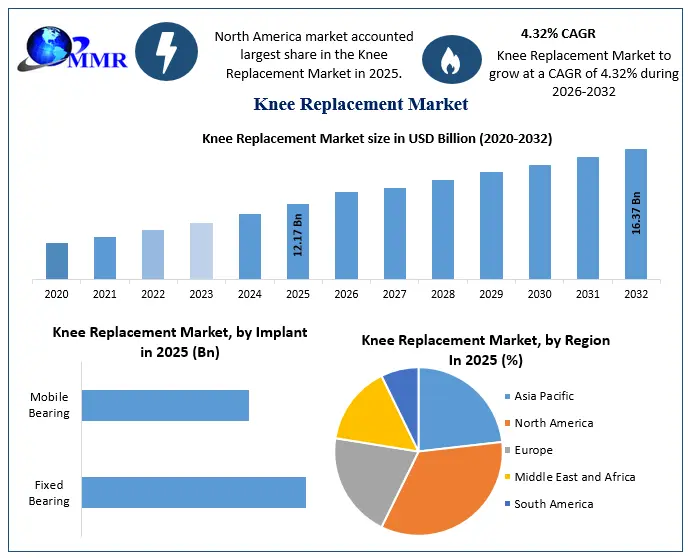
Global Knee Replacement Market size was valued at USD 12.17 Bn. in 2025, and the total revenue is expected to grow at 4.32 % through 2026 to 2034, reaching USD 17.81 Bn.

Global Knee Replacement Market Overview:

The Global Knee Replacement Market is expanding at a CAGR of 4.32% during the forecast period. The market is experiencing steady growth as the incidence of knee osteoarthritis is growing with an aging global population, increasing obesity rates, and continuous advancements in orthopedic implant technologies.  The knee replacement procedure involves total, partial, and revision arthroplasty, and these are becoming the preferred treatment for patients with severe joint degeneration, chronic pain, and mobility impairment, driving demand for advanced implants and minimally invasive surgical techniques.

The increasing volume of knee replacement procedures is a key indicator of market expansion.  The average number of knee replacement procedures reached 156 per 100,000 population across OECD countries, reflecting the continuous recovery in elective orthopedic surgeries and demand for joint replacement treatments.

The investment in healthcare is rising, allowing improved access to orthopedic care; along with this, favorable reimbursement policies provided by developed countries are supporting the growth of the market. Additionally,  adoption of robotic-assisted surgery, AI-enabled surgical planning, patient-specific implants, and 3D-printed prostheses is increasing and gaining traction due to surgical precision, implant longevity, and postoperative outcomes, encouraging greater adoption among healthcare providers.

Countries with developed healthcare infrastructure and efficient policy frameworks for healthcare are experiencing dominance in the market through continuous innovation and improvisation. Countries in North America are dominating the market, while technologically advancing countries in Asia Pacific are also continuing to expand in the market.

Global Knee Replacement Market Size, Share and Forecast Analysis
Knee Replacement Market Growth

To know about the Research Methodology: Request Free Sample Report

Global Knee Replacement Market Dynamics:

Rising Incidence of Osteoarthritis and Growing Surgical Demand are driving Market Growth

The prevalence of knee osteoarthritis is increasing day by day,  coupled with age-old rising obesity rates, and continues to drive demand for knee replacement procedures worldwide.  Patients want permanent relief from chronic joint pain and mobility impairment; as a result, hospitals experience higher volumes of primary and revision arthroplasty procedures. More than 3.7 million hip and knee arthroplasty procedures were captured in 2024, representing an 18% increase in captured procedures compared to the previous year. This reflects the sustained growth in joint replacement surgeries and the increasing adoption of evidence-based orthopedic care.

Robotic-Assisted Surgery and Advanced Implant Technologies are Enhancing Clinical Outcomes

Technological advancement is proved as the boon to the healthcare sector as it is providing precision and success of knee replacement procedures.  Robotic-assisted surgical systems, AI-powered preoperative planning, patient-specific implants, navigation technologies, and highly durable biomaterials are enabling better implant positioning, improved joint functionality, and faster patient recovery. These innovations are encouraging healthcare providers to expand the adoption of advanced orthopedic solutions while reducing revision rates and enhancing long-term patient outcomes.

High Procedure Costs and Limited Access to Specialized Orthopedic Care Restrain Market Expansion

Despite strong demand, the high cost of knee replacement procedures, premium implants, and robotic-assisted surgical systems remains a major barrier, particularly in developing economies. Limited reimbursement coverage, shortages of experienced orthopedic surgeons, and unequal access to specialized healthcare facilities continue to restrict market penetration. In addition, postoperative complications and revision surgeries increase the overall treatment cost, creating challenges for both healthcare providers and patients.

Expansion of Outpatient Arthroplasty and Emerging Healthcare Markets Creates Growth Opportunities

The growing shift toward outpatient knee replacement procedures and ambulatory surgery centers (ASCs) is creating significant growth opportunities for market participants.  Minimally invasive surgical techniques are advancing with enhanced recovery protocols, and digital rehabilitation solutions are reducing hospital stays while improving patient outcomes. Simultaneously, increasing healthcare investments, expanding orthopedic infrastructure, and rising awareness of advanced joint replacement procedures across Asia-Pacific, Latin America, and the Middle East are expected to support long-term market growth.

Knee Replacement Market Trends:

Robotic-Assisted Knee Replacement is Becoming Standard in Orthopedic Care - Robotic-assisted knee replacement is gaining popularity among healthcare providers seek to improve implant positioning, surgical precision, and long-term patient outcomes. Hospitals are increasingly investing in robotic platforms integrated with AI-driven surgical planning and real-time navigation systems.   The use of robotics in total knee arthroplasty increased more than six-fold over the past six years, reaching 15.9% of procedures in 2023, highlighting the rapid adoption of technology-assisted orthopedic surgery.

Growing Adoption of Cementless Implants is Improving Long-Term Outcomes -Manufacturers are increasingly focusing on cementless knee implant technologies to enhance biological fixation, improve implant longevity, and reduce the risk of revision surgeries, particularly among younger and more active patients. Advances in porous implant coatings, 3D printing, and biomaterials are accelerating this transition. The cementless fixation accounted for 21.8% of primary total knee arthroplasty procedures in 2023, reflecting a steady shift toward next-generation implant technologies.

Outpatient Knee Replacement Procedures Continue to Expand - Advances in minimally invasive surgical techniques, enhanced recovery after surgery (ERAS) protocols, improved anesthesia, and digital rehabilitation programs are accelerating the shift toward outpatient knee replacement procedures. Ambulatory Surgery Centers (ASCs) are becoming an increasingly important care setting due to lower costs, shorter hospital stays, and faster patient recovery. The  51% of joint replacement procedures will be performed on an outpatient basis by 2026, reflecting the ongoing transformation of orthopedic care delivery.

Smart Implants and Digital Orthopedics are Shaping the Future of Joint Replacement - The integration of smart implants, wearable rehabilitation devices, remote patient monitoring, and AI-enabled postoperative analytics is reshaping knee replacement care. Orthopedic companies are investing in connected implant technologies and digital health platforms that enable continuous monitoring of patient recovery, personalized rehabilitation programs, and early detection of postoperative complications. These innovations are expected to improve clinical outcomes while supporting value-based healthcare and personalized orthopedic treatment strategies.

Global Knee Replacement Market Segment Analysis:

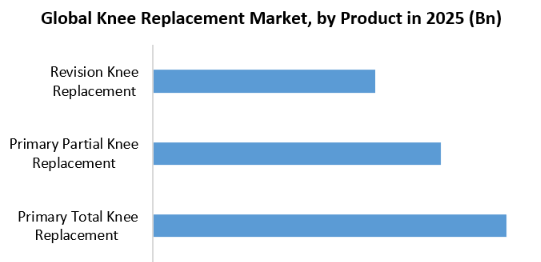
By Product ,The global knee replacement market is segmented by product into primary total knee replacement, primary partial knee replacement (encompassing unicompartmental knee replacement, patellofemoral knee replacement, and bicompartmental knee replacement), and revision knee replacement. Primary total knee replacement holds the largest revenue and procedure volume share, driven by advanced tricompartmental joint degeneration, high patient demand for long-term pain relief, and improved implant longevity. Primary partial knee replacement is gaining strong momentum as surgeons increasingly treat localized compartment damage using bone-conserving techniques and robotic-assisted alignment. Meanwhile, revision knee replacement represents a critical, steadily expanding segment generated by implant wear, loosening, periprosthetic joint infection, instability, and an aging base of earlier joint recipients.Product
By Bearing Mobility Based on bearing mobility, the market is categorized into fixed-bearing implants, mobile-bearing implants, and other bearing designs. Fixed-bearing implants remain the most widely adopted option globally due to their straightforward surgical technique, proven clinical track record, and lower risk of bearing dislocation or spin-out. Mobile-bearing implants are designed to allow rotational or translational movement of the polyethylene insert to reduce polyethylene contact stress and wear, particularly in active or younger patients. Other bearing designs address specialized kinematics and anatomical requirements where conventional fixed or mobile configurations are less suited.

By Bearing Material Combination, the market includes metal-on-polyethylene, ceramic-on-polyethylene, and other material combinations. Metal-on-polyethylene—typically pairing cobalt-chromium or titanium femoral components with highly cross-linked or vitamin E-infused polyethylene inserts—dominates commercial volume owing to decades of clinical validation, cost-effectiveness, and predictable wear performance. Ceramic-on-polyethylene combinations are growing in specialized applications where low surface roughness, scratch resistance, and reduced metal-ion release are prioritized. Other material combinations cover emerging surface treatments and alternative bearing pairings aimed at minimizing friction and extending implant survival.

By fixation type, the market is segmented into cemented fixation, cementless fixation, and hybrid fixation. Cemented fixation remains the established standard across a large share of procedures due to immediate mechanical stability, adaptability to varying bone quality, and reliable antibiotic delivery options. Cementless fixation—utilizing porous coatings, 3D-printed trabecular structures, and biological bone ingrowth—is expanding rapidly, especially among younger and more active patients seeking durable long-term biological fixation and shorter operating times. Hybrid fixation combines cemented and cementless elements across femoral and tibial components to balance immediate stability with long-term bone integration.

By implant constraint level, the market comprises cruciate-retaining, posterior-stabilized, cruciate-substituting / ultracongruent, constrained condylar, hinged, and others. Cruciate-retaining and posterior-stabilized designs form the core of primary knee arthroplasty, chosen based on posterior cruciate ligament integrity, deformity severity, and surgeon preference for native kinematics versus cam-post mechanical rollback. Cruciate-substituting or ultracongruent implants offer congruent articular geometry as an alternative to traditional cam-post stabilization, while constrained condylar and hinged implants are reserved for complex primary deformities and revision cases requiring greater mechanical stability against varus-valgus or rotational laxity.

By clinical indication, the market is divided into osteoarthritis, rheumatoid & other inflammatory arthritis, post-traumatic arthritis, osteonecrosis & other degenerative conditions, and others. Osteoarthritis is the primary driver of knee replacement demand worldwide, propelled by progressive cartilage loss, aging populations, and rising rates of joint wear. Rheumatoid and other inflammatory arthritis, post-traumatic arthritis following joint injuries or fractures, and osteonecrosis account for smaller yet clinically distinct patient pools that often present complex bone stock or younger age profiles.

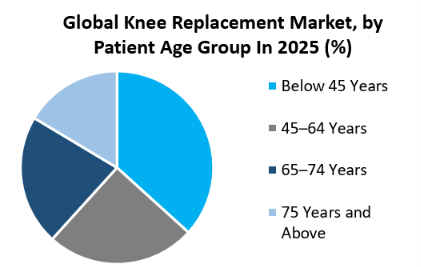
By patient age group, the market is segmented into below 45 years, 45–64 years, 65–74 years, and 75 years and above. Older age cohorts—particularly 65–74 years and 75 years and above—represent a major share of procedure volume due to higher cumulative joint degeneration and age-related osteoarthritis prevalence. At the same time, the 45–64 years and below 45 years segments are recording notable growth as improved implant durability, earlier diagnosis, and active lifestyle expectations prompt earlier surgical intervention.Age
In terms of end user, the market includes hospitals (further divided into public hospitals and private hospitals), ambulatory surgical centers, standalone orthopedic surgical centers, and others. Hospitals remain the largest end-user category overall, handling high-complexity cases, inpatient recovery, and revision surgeries across both public and private healthcare systems. Concurrently, ambulatory surgical centers and standalone orthopedic surgical centers are experiencing strong expansion due to streamlined outpatient care pathways, improved pain management protocols, faster patient mobilization, and lower episode-of-care costs for eligible primary procedures.

Global Knee Replacement Market Regional Insights:

North America dominated the Knee Replacement Market in 2025, characterized by advanced healthcare infrastructure, high adoption of robotic-assisted orthopedic surgery, favorable reimbursement policies, and the presence of leading orthopedic device manufacturers. The United States accounts for the majority of regional demand due to its large aging population and widespread availability of technologically advanced joint replacement procedures. The increasing adoption of AI-enabled surgical planning, outpatient joint replacement, and value-based care models continues to strengthen market growth. Canada also contributes significantly through expanding orthopedic care programs and increasing investments in surgical innovation.

Europe represents a mature and well-established market, supported by universal healthcare systems, high procedure volumes, and continuous adoption of advanced implant technologies. Countries such as Germany, Switzerland, Finland, and Denmark are among the global leaders in knee replacement procedures. These countries recorded some of the highest knee replacement rates in 2023, while the OECD average reached 156 procedures per 100,000 population, reflecting strong demand for joint replacement surgery across the region. Ongoing investments in robotic-assisted surgery, enhanced recovery protocols, and digital orthopedic solutions continue to support market expansion.

Asia-Pacific is expected to register the fastest CAGR during the forecast period, driven by rapid population aging, rising healthcare expenditure, improving access to orthopedic care, and increasing awareness of joint replacement procedures. Countries such as China, India, Japan, South Korea, and Australia are witnessing significant investments in orthopedic hospitals, robotic surgical systems, and advanced implant technologies. The growing prevalence of osteoarthritis, expanding medical tourism, and rising adoption of minimally invasive procedures are further accelerating regional market growth.

South America is experiencing steady market expansion as healthcare infrastructure continues to improve across countries such as Brazil, Mexico, Argentina, and Chile. Increasing government healthcare investments, growing awareness of advanced orthopedic treatments, and greater availability of modern implants are supporting procedure volumes. The expansion of private hospitals and orthopedic specialty centers is also improving patient access to knee replacement surgery across the region.

Middle East & Africa is emerging as a promising market, supported by rising healthcare investments, expanding orthopedic services, and increasing adoption of advanced surgical technologies. Countries including the United Arab Emirates, Saudi Arabia, South Africa, and Qatar are strengthening orthopedic care through hospital modernization, medical tourism initiatives, and the introduction of robotic-assisted joint replacement procedures. Growing healthcare expenditure and increasing awareness of mobility-restoring treatments are expected to create new opportunities for market participants over the forecast period.

Global Knee Replacement Market Competitive Landscape:

The Global Knee Replacement Market is highly competitive and innovation-driven, characterized by the presence of multinational orthopedic device manufacturers, robotic surgery technology providers, and implant developers. Leading market participants are focused on expanding their product portfolios through strategic acquisitions, regulatory approvals, continuous investments in research and development, and the commercialization of next-generation implant technologies. Companies are increasing the adoption of robotic-assisted surgical systems, AI-enabled preoperative planning, patient-specific implants, cementless fixation technologies, 3D-printed orthopedic implants, and smart digital orthopedic platforms to improve surgical precision, implant longevity, and patient outcomes. The increasing preference for minimally invasive procedures and value-based healthcare is further intensifying competition among market players. Robotic-assisted total knee arthroplasty accounted for 15.9% of procedures in 2023, reflecting the growing role of enabling technologies in shaping competitive strategies across the orthopedic industry.

Major companies including Zimmer Biomet Holdings, Inc., Stryker Corporation, Johnson & Johnson MedTech (DePuy Synthes), Smith+Nephew plc, Exactech, Inc., Medacta Group SA, MicroPort Scientific Corporation, B. Braun SE, Corin Group, and Enovis Corporation continue to strengthen their market positions through technological innovation, strategic collaborations, and geographic expansion. These companies are investing heavily in robotic-assisted joint replacement platforms, advanced biomaterials, personalized implant systems, digital surgery ecosystems, and outpatient orthopedic solutions while expanding manufacturing capabilities and surgeon training programs. Strategic partnerships with hospitals, ambulatory surgery centers, research institutes, and healthcare providers are enabling faster adoption of advanced knee replacement technologies and supporting the growing demand for personalized, efficient, and minimally invasive orthopedic care.

Global Knee Replacement Market Recent Developments:

Date Company Development Impact
04 September 2026 DePuy Orthopaedics, Inc. DePuy Orthopaedics received U.S. FDA 510(k) clearance (K262130) for its ATTUNE Revision Knee System introducing ram extrusion as an alternative raw material. The clearance expands revision total knee arthroplasty material options and component consistency for complex joint reconstruction procedures.
08 September 2026 Smith & Nephew, Inc. Smith & Nephew received U.S. FDA 510(k) clearance (K261462) for the uncemented, 3D-printed LANDMARK Total Knee System integrated with CORI handheld robotics. The anatomy-driven implant supports personalized cementless total knee arthroplasty and streamlined robotic workflows across hospitals and surgery centers.
08 September 2026 B-One Ortho, Corp. B-One Ortho obtained U.S. FDA 510(k) clearance (K262341) for b-ONE Mobio Total Knee System revision cemented tibial augments and stem extensions. The regulatory milestone broadens modular fixation and bone-defect management options for revision knee replacement surgeries.
13 October 2026 Zimmer Biomet Holdings, Inc. Zimmer Biomet announced a multi-year extension with THINK Surgical to distribute an exclusive, handheld TMINI Miniature Robotic System compatible with the Persona Knee System. The extended agreement accelerates wireless robotic-assisted knee arthroplasty adoption across U.S. orthopedic practices.
13 November 2026 National Pharmaceutical Pricing Authority (NPPA) India's NPPA issued a two-month extension through January 15, 2027, maintaining ceiling prices on orthopedic knee implants while reviewing industry representations. The interim regulatory extension preserves short-term pricing stability and patient affordability in one of the world's highest-volume knee replacement markets.

Global Knee Replacement Market Scope: Inquiry Before Buying

Knee Replacement Market
Report Coverage Details
Base Year: 2025 Forecast Period: 2026-2034
Historical Data: 2020 to 2025 Market Size in 2025: USD 12.17 Bn.
Forecast Period 2026 to 2034 CAGR: 4.32 % Market Size in 2034: USD 17.81 Bn.
Segments Covered: by Product Primary Total Knee Replacement
Primary Partial Knee Replacement
   Unicompartmental Knee Replacement
   Patellofemoral Knee Replacement
   Bicompartmental Knee Replacement
Revision Knee Replacement
by Bearing Mobility Fixed-Bearing Implants
Mobile-Bearing Implants
Other Bearing Designs
by Bearing Material Combination Metal-on-Polyethylene
Ceramic-on-Polyethylene
Other Material Combinations
by Fixation Type Cemented Fixation
Cementless Fixation
Hybrid Fixation
by Implant Constraint Level Cruciate-Retaining
Posterior-Stabilized
Cruciate-Substituting / Ultracongruent
Constrained Condylar
Hinged
Others
by Clinical Indication Osteoarthritis
Rheumatoid & Other Inflammatory Arthritis
Post-Traumatic Arthritis
Osteonecrosis & Other Degenerative Conditions
Others
by Patient Age Group Below 45 Years
45–64 Years
65–74 Years
75 Years and Above
by End User Hospitals
Public Hospitals
   Private Hospitals
Ambulatory Surgical Centers
Standalone Orthopedic Surgical Centers
Others

Global Knee Replacement Market, by Region

Asia Pacific (China, South Korea, Japan, India, Australia, Indonesia, Malaysia, Vietnam, Taiwan, Bangladesh, Pakistan and Rest of APAC)
Europe (UK, France, Germany, Italy, Spain, Sweden, Austria and Rest of Europe)
North America (United States, Canada and Mexico)
Middle East and Africa (South Africa, GCC, Egypt, Nigeria and Rest of ME&A)
South America (Brazil, Argentina, Rest of South America)

Global Knee Replacement Market, Key Players are:

North America
1.Stryker Corporation
2.Zimmer Biomet Holdings, Inc.
3.DePuy Synthes
4.Exactech, Inc.
5.Conformis
6.CONMED Corporation
7.Kinamed, Inc.
Others

Europe
8. Smith+Nephew
9. Aesculap AG
10. Medacta International
11. Corin Group
12. Waldemar Link GmbH & Co. KG
13. Amplitude Surgical
14. SERF SAS
Others

Asia Pacific
15. MicroPort Orthopedics
16. AK Medical Holdings Limited
17. Beijing Chunlizhengda Medical Instruments
18. Double Medical Technology Inc.
19. Kyocera Corporation
20. United Orthopedic Corporation
21. Japan Medical Dynamic Marketing, Inc.
Others

Middle East & Africa
22. Tebor
23. Tasarımmed
24. NORMMED
Others

South America
25. Víncula
26. Baumer S.A.
27. Implantec
Others

Frequently Asked Questions:

1] What segments are covered in the Knee Replacement Market report?
Ans. The segments covered in the Knee Replacement Market report are based on Product, Bearing Mobility, Bearing Material Combination, Implant Constraint Level, Fixation Type, Clinical Indication, Patient Age Group, and End-User.

2] Which region is expected to hold the highest share in the global Knee Replacement Market?
Ans. North America is expected to hold the highest share in the global Knee Replacement Market.

3] What is the market size of the global Knee Replacement Market by 2034?
Ans. The market size of the global Knee Replacement Market is expected to reach USD 17.81 Bn. by 2034.

4] Who are the top key players in the global Knee Replacement Market?
Ans. Aesculap Implants Systems LLC, Corin Group, DePuy Synthes Companies, Smith & Nephew PLC, Stryker Corporation, Zimmer Biomet, and Exactech Inc. are the top key players in the global Knee Replacement Market.

5] What was the market size of the global Knee Replacement Market in 2025?
Ans. The market size of the global Knee Replacement Market in 2025 was USD 12.17 Bn.

Table of Contents

1.GLOBAL KNEE REPLACEMENT MARKET INTRODUCTION 1.1 Executive Market Landscape and Industry Overview 1.1.1 Global Knee Replacement Market Size, Value in USD Billion, 2025–2034 1.1.2 Comprehensive Overview of Global Knee Replacement Market Structure, Evolution, and Industry Development 1.1.3 Detailed Market Scope, Definition, Classification, and Knee Replacement Industry Boundaries 1.1.4 Key Market Trends, Growth Drivers, Challenges, Opportunities, and Strategic Industry Insights 1.1.5 Historical Evolution of Knee Replacement Across Orthopedic Surgery, Implant Engineering, and Clinical Care 1.1.6 Evolution of Knee Replacement Technologies Across Design, Materials, Surgical Navigation, and Postoperative Recovery Applications 1.2 Global Knee Replacement Market Dynamics 1.2.1 Global Knee Replacement Market Trends 1.2.2 Global Knee Replacement Market Dynamics 1.2.2.1 Drivers 1.2.2.2 Restraints 1.2.2.3 Opportunities 1.2.2.4 Challenges 1.2.3 PORTER’s Five Forces Analysis 1.2.4 PESTLE Analysis 1.3 Healthcare Economics, Ecosystem, and Global Knee Replacement Value Chain 1.3.1 Healthcare Expenditure, Patient Affordability, and Insurance Coverage Influencing Knee Replacement Demand 1.3.2 Microeconomic Factors Affecting Hospital Purchasing Decisions, Implant Pricing, and Treatment Costs 1.3.3 Orthopedic Surgeon Availability, Operating Room Costs, and Surgical Capacity Influencing Procedures 1.3.4 Global Ecosystem Connecting Implant Manufacturers, Hospitals, Surgeons, Distributors, and Procurement Organizations 1.3.5 Value Chain Covering Implant Design, Component Sourcing, Manufacturing, Distribution, Implantation, and Postoperative Care 1.3.6 Stakeholder Relationships, Hospital Profitability, and Investment Decisions Influencing Technology Adoption and Market Development 1.3.7 Global Prevalence of Knee Disorders, Affected Patient Populations, and Eligible Candidates for Knee Replacement Surgery 1.3.8 Annual Knee Replacement Procedure Volumes, Treated Patient Numbers, and the Gap Between Eligible Patients and Actual Treatment Received 1.4 Geographic Healthcare Infrastructure and Patient Demand Mapping 1.4.1 Global Regional Assessment of Knee Replacement Procedures and Implant Demand 1.4.2 Country-Level Assessment of Patient Populations, Surgical Volumes, and Healthcare Infrastructure 1.4.3 State and Province Mapping of Orthopedic Centers and Surgical Facilities 1.4.4 City-Level Mapping of Hospitals, Specialty Clinics, and Joint Replacement Centers 1.4.5 Geographic Distribution of Orthopedic Surgeons, Operating Rooms, and Rehabilitation Facilities 1.4.6 Identification of High-Potential Healthcare Markets Based on Unmet Treatment Demand 1.4.7 Country-Wise Mapping of Annual Knee Replacement Procedure Volumes and Treatment Rates 1.5 Patient Demographics and Knee Replacement Characteristics 1.5.1 Patient Age Profiles and Demographic Patterns Influencing Knee Replacement Procedure Volumes 1.5.2 Gender Distribution and Differences in Knee Replacement Treatment Utilization 1.5.3 Osteoarthritis Prevalence and Other Conditions Driving Surgical Treatment Requirements 1.5.4 Patient Mobility Limitations and Joint Degeneration Influencing Surgical Intervention Decisions 1.5.5 Procedure Volume Distribution Across Primary, Partial, and Revision Knee Replacement Surgeries 1.5.6 Identification of Countries with High Unmet Surgical Demand and Limited Treatment Access 1.5.7 Country-Wise Comparison of Knee Replacement Procedures, Treatment Rates, and Patient Volumes 1.6 Global Knee Replacement Surgery Volume and Trends Analysis 1.6.1 Global Annual Knee Replacement Procedure Volumes Across Major Healthcare Markets 1.6.2 Country-Wise Comparison of Knee Replacement Surgeries Performed Annually 1.6.3 Historical Procedure Volume Trends and Year-on-Year Growth Rates 1.6.4 Knee Replacement Procedures per 100,000 Population Across Countries 1.6.5 Procedure Volume Distribution Across Primary, Partial, and Revision Surgeries 1.6.6 Comparison of Actual Procedures Performed Against Eligible Patient Populations 1.6.7 Regional Procedure Volume Distribution Across Major Healthcare Markets 1.6.8 Procedure Volumes Across Public Hospitals, Private Hospitals, and Orthopedic Centers 1.7 Knee Replacement Procedures and Clinical Application Segmentation 1.7.1 Total Knee Replacement Procedures Across Primary Joint Reconstruction and Severe Degeneration 1.7.2 Partial Knee Replacement Procedures Addressing Localized Damage Within Specific Knee Compartments 1.7.3 Revision Knee Replacement Procedures Addressing Implant Failure, Loosening, Infection, or Complications 1.7.4 Patellofemoral Replacement Procedures Treating Damage Affecting the Kneecap Joint Compartment 1.7.5 Unilateral and Bilateral Procedures Across Eligible Knee Replacement Patient Populations 1.7.6 Procedure Selection Based on Disease Severity, Patient Condition, and Clinical Assessment 1.8 Knee Implant Types and Material Specifications Assessment 1.8.1 Fixed-Bearing and Mobile-Bearing Implant Designs Across Knee Replacement Procedures 1.8.2 Implant Material Assessment Covering Cobalt-Chromium Alloys, Titanium, and Medical-Grade Polyethylene 1.8.3 Ceramic and Alternative Bearing Materials Across Specialized Knee Implant Product Categories 1.8.4 Femoral Components, Tibial Components, and Patellar Components Across Implant Systems 1.8.5 Cemented, Cementless, and Hybrid Fixation Technologies Across Knee Replacement Implants 1.8.6 Implant Specifications Covering Durability, Compatibility, Wear Resistance, and Clinical Performance 1.9 Knee Implant Manufacturing Processes and Production Capacity Assessment 1.9.1 Manufacturing Processes Covering Implant Machining, Casting, Forging, Finishing, and Polishing 1.9.2 Production Capacity Across Femoral Components, Tibial Trays, Inserts, and Patellar Implants 1.9.3 Manufacturing Equipment Requirements Across Precision Machining and Implant Finishing Operations 1.9.4 Quality Control, Dimensional Accuracy, Sterilization, and Implant Traceability Requirements 1.9.5 Production Utilization, Manufacturing Bottlenecks, and Capacity Expansion Across Implant Manufacturers 1.9.6 Supplier Dependencies Involving Medical-Grade Metals, Polymers, Instruments, and Specialized Components 1.10 Installed Base, Equipment Lifecycle, and Replacement Demand Analysis 1.10.1 Installed Base of Knee Implants Across Countries, Regions, and Healthcare Facilities 1.10.2 Knee Implant Survival Periods and Expected Service Life Across Implant Categories 1.10.3 Implant Age Profiles, Wear Patterns, Loosening, and Revision Surgery Requirements 1.10.4 Replacement Ratios Across Primary Implants, Revision Procedures, and Eligible Patient Populations 1.10.5 Manufacturing Machinery Lifecycle Periods Covering CNC Machines, Finishing Equipment, and Inspection Systems 1.10.6 Equipment Age, Modernization Requirements, and Replacement Demand Across Implant Manufacturing Facilities 1.11 Knee Replacement MRO, Aftermarket, and Service Ecosystem Assessment 1.11.1 Maintenance Requirements for Implant Manufacturing Machinery and Precision Production Equipment 1.11.2 Spare Parts Demand Across CNC Systems, Polishing Machines, and Inspection Equipment 1.11.3 Aftermarket Services Covering Equipment Repair, Refurbishment, Calibration, and Component Replacement 1.11.4 Surgical Instrument Maintenance, Inspection, Repair, and Sterilization Service Requirements 1.11.5 Preventive and Predictive Maintenance Practices Across Knee Implant Manufacturing Facilities 1.11.6 Aftermarket Opportunities Across Equipment Servicing, Replacement Components, and Technical Support 1.12 Healthcare End Users and Surgical Facility Demand Assessment 1.12.1 Hospital Demand Across Public, Private, and Multispecialty Orthopedic Healthcare Facilities 1.12.2 Specialty Orthopedic Clinics and Joint Replacement Centers Performing Knee Replacement Procedures 1.12.3 Ambulatory Surgical Centers and Their Role in Eligible Knee Replacement Procedures 1.12.4 Healthcare Facility Procurement Requirements for Implants, Instruments, and Surgical Technologies 1.12.5 Surgical Capacity Utilization and Orthopedic Operating Room Availability Across Healthcare Providers 1.12.6 End-User Purchasing Preferences Based on Clinical Outcomes, Reliability, and Affordability 1.13 Surgical Technologies and Robotics Adoption Across Healthcare Facilities 1.13.1 Conventional Surgical Techniques Used Across Primary and Revision Knee Replacement Procedures 1.13.2 Computer-Assisted Navigation Systems Supporting Implant Alignment and Surgical Precision 1.13.3 Robotic-Assisted Surgery Platforms Supporting Planning, Bone Preparation, and Implant Positioning 1.13.4 Patient-Specific Instrumentation and Customized Surgical Planning Across Selected Procedures 1.13.5 Technology Adoption Influenced by Surgeon Training, Costs, and Clinical Evidence 1.13.6 Surgical Technology Penetration Across Hospitals, Orthopedic Centers, and Regional Healthcare Markets 1.14 Clinical Outcomes, Implant Longevity, and Patient Recovery Assessment 1.14.1 Implant Survival Rates and Revision Risks Across Knee Replacement Implant Categories 1.14.2 Clinical Outcomes Covering Pain Reduction, Mobility Improvement, and Joint Functionality 1.14.3 Complications Involving Infection, Implant Loosening, Instability, and Postoperative Stiffness 1.14.4 Rehabilitation Requirements and Recovery Pathways Following Knee Replacement Surgery 1.14.5 Patient Satisfaction and Functional Outcomes Influencing Implant Selection and Treatment Decisions 1.14.6 Clinical Evidence Influencing Surgeon Preferences and Healthcare Procurement Decisions 1.15 Healthcare Regulations, Implant Standards, and Compliance Requirements 1.15.1 Medical Device Regulations Governing Knee Implant Development, Manufacturing, and Commercialization 1.15.2 Implant Safety Standards Covering Biocompatibility, Mechanical Performance, and Material Quality 1.15.3 Clinical Evaluation Requirements and Approvals for Knee Replacement Implant Technologies 1.15.4 Sterilization, Packaging, Labeling, and Traceability Requirements Across Implant Product Categories 1.15.5 Country-Specific Regulatory Pathways Influencing Product Launches and Market Access 1.15.6 Post-Market Surveillance, Adverse Event Reporting, and Implant Safety Monitoring Requirements 1.16 Healthcare Procurement Practices and Implant Purchasing Framework 1.16.1 Procurement Processes Across Hospitals, Orthopedic Centers, and Healthcare Purchasing Organizations 1.16.2 Implant Selection Criteria Covering Clinical Evidence, Durability, Compatibility, and Pricing 1.16.3 Tendering Procedures and Contractual Purchasing Arrangements Across Healthcare Providers 1.16.4 Surgeon Preferences Influencing Implant Brand Selection and Surgical System Adoption 1.16.5 Importance of Product Availability, Technical Support, and Instrument Set Accessibility 1.16.6 Purchasing Behavior Differences Across Public Hospitals and Private Healthcare Facilities 1.17 Distribution Networks and Knee Implant Market Access Channels 1.17.1 Distribution Structures Connecting Implant Manufacturers, Medical Distributors, and Healthcare Providers 1.17.2 Direct Sales Models Supporting Large Hospitals and Major Orthopedic Centers 1.17.3 Distributor-Led Channels Supporting Regional Hospitals and Independent Orthopedic Healthcare Facilities 1.17.4 Distribution of Implants, Surgical Instruments, and Associated Orthopedic Product Components 1.17.5 Logistics Requirements Covering Sterile Packaging, Inventory Management, and Timely Product Delivery 1.17.6 Regional Market Access Differences Across Healthcare Systems and Distribution Networks 1.18 Knee Implant Pricing, Economics, and Cost Structures 1.18.1 Knee Implant Pricing Across Product Categories, Materials, and Fixation Technologies 1.18.2 Surgical Procedure Costs Covering Implants, Hospital Stays, Anesthesia, and Operating Rooms 1.18.3 Manufacturing Cost Components Covering Materials, Machining, Quality Control, and Sterilization 1.18.4 Total Treatment Costs Covering Surgery, Rehabilitation, Follow-Up, and Complication Management 1.18.5 Pricing Differences Across Public Hospitals, Private Facilities, and Healthcare Markets 1.18.6 Cost Comparisons Influencing Implant Selection, Patient Affordability, and Procurement Decisions 1.19 Knee Replacement Demand Supply Balance and Healthcare Gaps 1.19.1 Knee Replacement Procedure Demand Compared with Available Surgical Capacity Across Countries 1.19.2 Implant Supply Availability Compared with Hospital Procurement and Procedure Requirements 1.19.3 Shortages of Orthopedic Surgeons, Operating Rooms, and Specialized Surgical Infrastructure 1.19.4 Waiting Lists, Treatment Delays, and Unmet Patient Needs Across Healthcare Systems 1.19.5 Regional Gaps in Implant Accessibility, Affordability, and Specialist Healthcare Availability 1.19.6 Opportunities for Capacity Expansion, Distribution Improvements, and Improved Treatment Accessibility 1.19.7 Comparison of Annual Knee Replacement Procedure Volumes Against Estimated Patient Treatment Requirements 1.20 Manufacturing Investment and Knee Replacement Capacity Expansion Outlook 1.20.1 Manufacturing Investments Supporting Additional Knee Implant Production and Product Development 1.20.2 Greenfield Manufacturing Facilities Creating New Implant Production and Distribution Capacity 1.20.3 Brownfield Expansion Increasing Manufacturing Output and Product Portfolio Capabilities 1.20.4 Automation Investments Improving Precision, Production Efficiency, and Manufacturing Consistency 1.20.5 Investment Pipelines Across Implant Manufacturers, Surgical Technologies, and Production Facilities 1.20.6 Capacity Expansion Opportunities Across Established and Emerging Healthcare Markets 1.21 Healthcare Reimbursement and Insurance Coverage Assessment 1.21.1 Public Healthcare Reimbursement Policies Influencing Knee Replacement Procedure Affordability 1.21.2 Private Health Insurance Coverage for Implants, Surgery, and Hospitalization Expenses 1.21.3 Out-of-Pocket Payments Affecting Treatment Accessibility Across Patient Income Categories 1.21.4 Reimbursement Differences Across Countries, Regions, and Healthcare Delivery Systems 1.21.5 Implant Cost Ceilings and Procurement Policies Influencing Product Selection Decisions 1.21.6 Coverage Gaps and Financing Opportunities Supporting Wider Access to Knee Replacement 1.22 Global Knee Replacement Demand Forecast and Opportunity Prioritization 1.22.1 Market Demand Outlook Across Procedures, Implant Types, Materials, and Fixation Technologies 1.22.2 Revenue and Procedure Volume Forecasts Across Major Healthcare Regions and Countries 1.22.3 Forecast Scenarios Based on Patient Demand, Surgical Capacity, and Reimbursement Changes 1.22.4 Replacement Demand Outlook Across Aging Implants and Eligible Revision Surgery Populations 1.22.5 Growth Opportunities Across Implant Manufacturing, Robotic Surgery, and Underserved Healthcare Markets 1.22.6 Prioritization of Countries, Regions, End Users, and Product Categories for Investment 1.22.7 Historical Baseline and Projected Annual Knee Replacement Procedure Volumes by Country and Region 1.23 Global Knee Replacement Market: Market Size and Forecast by Segmentation (by Value USD Billion) (2025–2034) 1.23.1 Global Knee Replacement Market Size and Forecast, By Procedure Type 1.23.1.1 Primary Total Knee Replacement 1.23.1.2 Primary Partial Knee Replacement 1.23.1.2.1 Unicompartmental Knee Replacement 1.23.1.2.2 Patellofemoral Knee Replacement 1.23.1.2.3 Bicompartmental Knee Replacement 1.23.1.3 Revision Knee Replacement 1.23.2 Global Knee Replacement Market Size and Forecast, By Bearing Mobility 1.23.2.1 Fixed-Bearing Implants 1.23.2.2 Mobile-Bearing Implants 1.23.2.3 Other Bearing Designs 1.23.3 Global Knee Replacement Market Size and Forecast, By Bearing Material Combination 1.23.3.1 Metal-on-Polyethylene 1.23.3.2 Ceramic-on-Polyethylene 1.23.3.3 Other Material Combinations 1.23.4 Global Knee Replacement Market Size and Forecast, By Fixation Type 1.23.4.1 Cemented Fixation 1.23.4.2 Cementless Fixation 1.23.4.3 Hybrid Fixation 1.23.5 Global Knee Replacement Market Size and Forecast, By Implant Constraint Level 1.23.5.1 Cruciate-Retaining 1.23.5.2 Posterior-Stabilized 1.23.5.3 Cruciate-Substituting / Ultracongruent 1.23.5.4 Constrained Condylar 1.23.5.5 Hinged 1.23.5.6 Others 1.23.6 Global Knee Replacement Market Size and Forecast, By Clinical Indication 1.23.6.1 Osteoarthritis 1.23.6.2 Rheumatoid & Other Inflammatory Arthritis 1.23.6.3 Post-Traumatic Arthritis 1.23.6.4 Osteonecrosis & Other Degenerative Conditions 1.23.6.5 Others 1.23.7 Global Knee Replacement Market Size and Forecast, By Patient Age Group 1.23.7.1 Below 45 Years 1.23.7.2 45–64 Years 1.23.7.3 65–74 Years 1.23.7.4 75 Years and Above 1.23.8 Global Knee Replacement Market Size and Forecast, By End User 1.23.8.1 Hospitals 1.23.8.1.1 Public Hospitals 1.23.8.1.2 Private Hospitals 1.23.8.2 Ambulatory Surgical Centers 1.23.8.3 Standalone Orthopedic Surgical Centers 1.23.8.4 Others 1.23.9 Global Knee Replacement Market Size and Forecast, By Region 1.23.9.1 North America 1.23.9.2 Europe 1.23.9.3 Asia Pacific 1.23.9.4 Middle East and Africa 1.23.9.5 South America 2.COMPETITIVE INTELLIGENCE & INDUSTRIAL ECOSYSTEM 2.1 Competitive Landscape 2.1.1 MMR Competition Matrix 2.1.2 Competitive Positioning of Leading Global Knee Replacement Market Companies Based on Revenue and Market Share 2.1.3 Key Players Benchmarking 2.1.3.1 Company Name 2.1.3.2 Headquarters 2.1.3.3 Year of Establishment 2.1.3.4 Knee Replacement Product Portfolio 2.1.3.5 Knee Implant Types 2.1.3.6 Knee Implant Manufacturing Capacity 2.1.3.7 Research and Development Capabilities 2.1.3.8 Regulatory Approvals and Certifications 2.1.3.9 Revenue (2025) 2.1.3.10 Knee Replacement Segment Revenue (2025) 2.1.3.11 Market Share (%) 2.1.3.12 Revenue Growth Rate (Y-o-Y%) 2.1.3.13 Operating Profit Margin (%) 2.1.3.14 Geographic Presence 2.1.4 Market Structure 2.1.4.1 Market Leaders 2.1.4.2 Market Followers 2.1.4.3 Emerging Players 2.1.5 Mergers & Acquisitions Details 2.1.6 Recent Key Developments 2.2 Knee Replacement Competitive Landscape and Industry Structure 2.2.1 Competitive Intensity Across Global Knee Implant Manufacturers and Orthopedic Device Companies 2.2.2 Product Differentiation Across Total, Partial, Revision, and Specialized Knee Implants 2.2.3 Knee Implant Portfolio and Procedure Coverage Comparison Across Leading Companies 2.2.4 Implant Materials, Fixation Systems, Bearing Designs, and Product Technology Benchmarking 2.2.5 Clinical Performance, Implant Longevity, Surgical Compatibility, and Patient Outcome Comparison 2.2.6 Geographic Coverage, Healthcare Provider Relationships, and Distribution Network Comparison 2.3 Strategic Initiatives and Expansion Strategy Analysis 2.3.1 Platform Capability Expansion Across Global Knee Replacement Markets 2.3.2 Regional Market Expansion and International Customer Acquisition Strategies 2.3.3 Expansion of Knee Implant Portfolios, Robotic Platforms, and Surgical Solutions 2.3.4 Expansion of Surgeon Training, Clinical Evidence, and Hospital Partnership Networks 2.3.5 Mergers, Acquisitions, Joint Ventures, and Strategic Investments 2.4 Financial Performance and Profitability Benchmarking 2.4.1 Revenue Growth Across Leading Knee Replacement and Orthopedic Device Companies 2.4.2 Profitability and Operating Cost Structure Comparison Across Major Market Participants 2.4.3 Knee Replacement Segment Revenue Contribution Across Diversified Medical Device Companies 2.4.4 Revenue Performance Across Implants, Surgical Instruments, and Orthopedic Technology Portfolios 2.4.5 Research and Development Investment and Capital Expenditure Comparison Across Leading Companies 2.4.6 Financial Resilience Across Medical Devices, Orthopedic Products, and Healthcare Technology Markets 2.5 Innovation Leadership and Knee Replacement Technology Development 2.5.1 R&D Investment Across Leading Knee Implant Manufacturers and Orthopedic Technology Companies 2.5.2 Advanced Implant Materials, Bearing Surfaces, Fixation Systems, and Design Development 2.5.3 Robotic-Assisted Surgery, Navigation Systems, and Digital Surgical Planning Innovation 2.5.4 Patient-Specific Instrumentation and Personalized Knee Replacement Technology Development 2.5.5 Implant Durability, Wear Reduction, Alignment Accuracy, and Longevity Innovations 2.5.6 Smart Implants, Digital Monitoring, and Data-Enabled Postoperative Care Technologies 2.6 Product Portfolio and Clinical Performance Benchmarking 2.6.1 Total, Partial, Revision, and Patellofemoral Knee Implant Portfolio Comparison 2.6.2 Femoral, Tibial, Patellar Components, and Polyethylene Insert Portfolio Assessment 2.6.3 Fixed-Bearing, Mobile-Bearing, Cemented, Cementless, and Hybrid Implant Comparison 2.6.4 Clinical Evidence, Implant Survival, Revision Rates, and Patient Outcomes 2.6.5 Regulatory Approvals, Clinical Certifications, and Product Commercialization Status 2.6.6 Product Positioning Based on Clinical Performance, Surgeon Preference, and Patient Requirements 2.7 Manufacturing Capabilities and Operational Excellence Assessment 2.7.1 Knee Implant Manufacturing Capacity Across Leading Global Orthopedic Device Companies 2.7.2 Manufacturing Automation and Advanced Equipment Adoption Across Production Facilities 2.7.3 Quality Control, Dimensional Inspection, Sterilization, and Implant Traceability Systems 2.7.4 Manufacturing Equipment Lifecycle, Maintenance, Modernization, and Replacement Strategies 2.7.5 Production Efficiency, Capacity Utilization, Scalability, and Supply Reliability Comparison 2.8 Distribution, Aftermarket, and Healthcare Provider Strategy 2.8.1 Distribution Network Comparison Across Hospitals, Orthopedic Clinics, and Surgical Centers 2.8.2 Direct Sales and Distributor-Led Market Access Strategies Across Healthcare Markets 2.8.3 Hospital Partnerships and Orthopedic Surgeon Engagement Strategies Across Key Regions 2.8.4 Surgical Instrument Availability, Technical Support, and Operating Room Service Capabilities 2.8.5 Aftermarket Support Covering Instrument Servicing, Replacement, and Technical Assistance 2.8.6 Inventory Management, Product Availability, and Regional Supply Chain Capabilities 2.9 Company Profile: 25+ Key Players 2.9.1 Profile Framework 2.9.1.1 Overview 2.9.1.2 Business Portfolio 2.9.1.3 Financial Overview 2.9.1.4 SWOT Analysis 2.9.1.5 Strategic Analysis 2.9.1.6 Recent Developments 2.9.2 North America 2.9.2.1 Stryker Corporation 2.9.2.2 Zimmer Biomet Holdings, Inc. 2.9.2.3 DePuy Synthes 2.9.2.4 Exactech, Inc. 2.9.2.5 Conformis 2.9.2.6 CONMED Corporation 2.9.2.7 Kinamed, Inc. 2.9.3 Europe 2.9.3.1 Smith+Nephew 2.9.3.2 Aesculap AG 2.9.3.3 Medacta International 2.9.3.4 Corin Group 2.9.3.5 Waldemar Link GmbH & Co. KG 2.9.3.6 Amplitude Surgical 2.9.3.7 SERF SAS 2.9.4 Asia Pacific 2.9.4.1 MicroPort Orthopedics 2.9.4.2 AK Medical Holdings Limited 2.9.4.3 Beijing Chunlizhengda Medical Instruments 2.9.4.4 Double Medical Technology Inc. 2.9.4.5 Kyocera Corporation 2.9.4.6 United Orthopedic Corporation 2.9.4.7 Japan Medical Dynamic Marketing, Inc. 2.9.5 Middle East & Africa 2.9.5.1 Tebor 2.9.5.2 Tasarımmed 2.9.5.3 NORMMED 2.9.6 South America 2.9.6.1 Víncula 2.9.6.2 Baumer S.A. 2.9.6.3 Implantec 2.9.6.4 Others 3.KEY INSIGHTS, STRATEGIC OUTLOOK & METHODOLOGICAL FRAMEWORK 3.1 Key Findings 3.2 Strategic Moves & Industry Outlook 3.3 Research Methodology

Custom Market Research Services

We Will Customise The Research For You, In Case The Report Listed Above Does Not Meet With Your Requirements