
Jeans Market - Industry Structure Evaluation, Demand Drivers Analysis, Regional Growth Analysis and Identification, Competitive Positioning Review & Global Market Size Forecast to 2034
Overview
The Jeans Market size was valued at USD 2.67 Billion in 2025 and the total Jeans revenue is expected to grow at a CAGR of 5.6% from 2026 to 2034, reaching nearly USD 4.34 Billion.
Jeans Market Overview
The jeans market, a cornerstone of the global fashion industry, continues to evolve amidst shifting consumer preferences and market dynamics. One of the key drivers boosting this market forward is the enduring popularity of denim apparel across demographics and regions. Jeans are celebrated for their versatility, comfort, and timeless appeal, making them a wardrobe staple for individuals of all ages and lifestyles. As fashion trends lean towards casualization and athleisure, jeans remain a go-to choice for both everyday wear and fashion-forward looks, further bolstering their market share.
Jeans Market Growth and share Analysis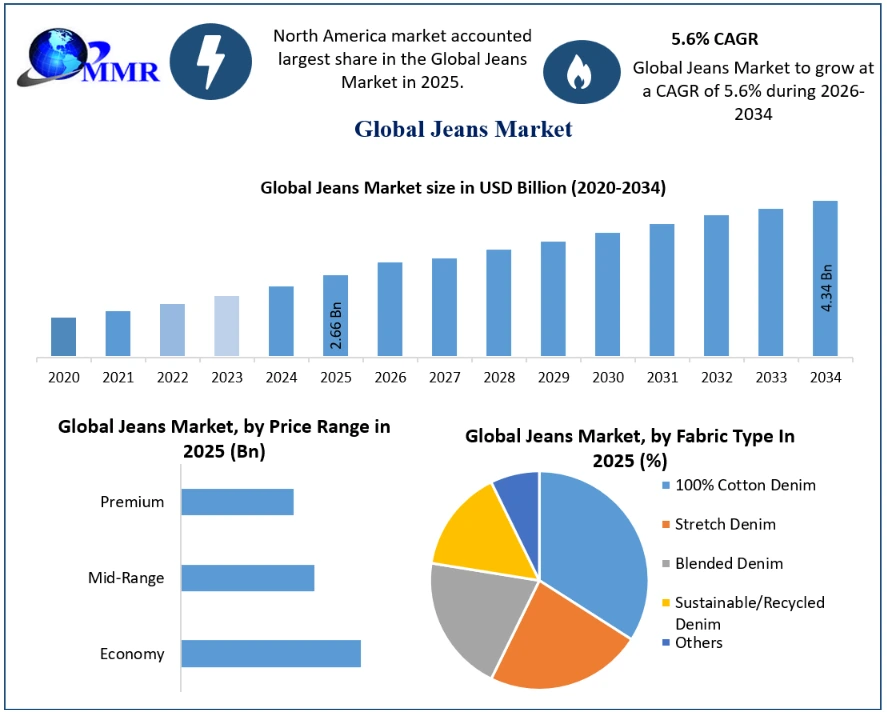
To know about the Research Methodology :- Request Free Sample Report
In recent years, several prominent trends have emerged within the jeans market, reflecting changing consumer tastes and industry innovations. Sustainable and eco-friendly denim production practices have gained traction, with consumers increasingly prioritizing ethically sourced materials and environmentally conscious brands. This shift towards sustainability aligns with growing awareness of environmental issues and social responsibility, influencing purchasing decisions and shaping the competitive landscape. Additionally, the rise of customization and personalization options, facilitated by advancements in technology and manufacturing processes, allows brands to cater to individual preferences and enhance customer engagement, driving sales volume and company profitability.
The Asia Pacific region emerges as the fastest-growing market for jeans, fueled by rising disposable incomes, urbanization, and shifting fashion preferences. As economies in countries like China, India, and Southeast Asia continue to expand, so does the demand for denim apparel, presenting lucrative opportunities for both established players and emerging brands. With its vast population and diverse consumer base, the Asia Pacific region offers immense potential for market expansion and penetration. Companies operating in this region are strategically positioning themselves to capitalize on this growth trajectory, investing in market research, product innovation, and distribution networks to capture a larger share of the burgeoning jeans market.
Dynamic Growth of the Jeans Market
Rising Inclination of Customers Towards Fashionable Clothing
The rising inclination of customers towards fashionable clothing is a significant driver of the jeans market, driving trends towards premium denim and innovative designs. As consumers increasingly prioritize style and individuality, they seek out jeans that reflect current fashion trends and personal aesthetics. This shift in demand towards fashionable clothing creates opportunities for brands to differentiate themselves through creative design, leading to higher profit margins within the value chain. By offering unique and trendy jeans, companies can capture greater market share and command premium prices, ultimately enhancing their position within the jeans market.
1. In March , H&M Hennes & Mauritz AB developed a new denim line called the 'capsule collection,' which focuses on saving water throughout the manufacturing process by collaborating with suppliers who use recycled water systems.
Consumer Awareness of Various Brands of Branded Jeans
Consumer awareness of various brands of branded jeans significantly drives market growth by fostering competition and encouraging brands to innovate and differentiate themselves. As consumers become increasingly informed about the diverse offerings in the branded jeans market, they develop preferences based on factors such as brand reputation, quality, style, and value for money. This heightened awareness compels jeans brands to invest in marketing strategies, such as advertising campaigns, celebrity endorsements, and social media engagement, to capture consumer attention and loyalty. Besides, as consumers actively seek out information about different brands and their unique selling propositions, brands are compelled to continuously innovate, introduce new designs, and improve product quality to stand out in the crowded market landscape. Consequently, this cycle of consumer awareness and brand differentiation fuels market growth by expanding the reach of branded jeans and driving sales through increased consumer demand and brand loyalty.
Restraints Impacting the Jeans Market
The jeans market faces challenges owing to competition from alternative options like athleisure wear and leggings, economic downturns, and fluctuations in disposable income. Consumers are shifting towards eco-friendly and ethically produced alternatives, posing challenges for traditional brands. The cyclical nature of fashion trends also leads to volatility in demand, requiring brands to balance relevance and overproduction. To maintain relevance, jeans brands must adapt to changing consumer preferences, embrace sustainability, and innovate.
Market Trend
The jeans market is beholding several prominent trends shaping consumer preferences and purchasing behaviors. One prominent trend is the growing demand for sustainable and eco-friendly denim options, driven by increasing environmental consciousness among consumers. Brands are responding by incorporating sustainable practices into their production processes, including the use of organic cotton, water-saving techniques, and ethical sourcing. Another trend is the rise of customized and personalized denim, fueled by advancements in technology that allow for on-demand manufacturing and bespoke tailoring. Additionally, there's a prominent shift towards inclusivity and diversity in sizing and marketing, as brands recognize the importance of catering to a broader range of body types and identities. Also, vintage and retro-inspired denim styles continue to gain traction, reflecting a nostalgic appeal and a desire for timeless fashion pieces. Inclusive, these trends reflect the evolving landscape of the jeans market, driven by changing consumer values, technological advancements, and shifts in fashion preferences.
Flowchart – Supply Chain oF Jeans Market
 Jeans Market Segment Analysis
Based on Category, In the jeans market, the "Mass" category holds the leading position in 2025, catering to a wide range of consumers with affordable and accessible denim options. These jeans typically prioritize affordability and availability, making them popular among budget-conscious shoppers and those seeking everyday wear without breaking the bank. While offering competitive pricing, mass-market jeans often maintain decent quality standards to meet consumer expectations. On the other hand, the "Premium" category targets a more discerning clientele willing to invest in higher-quality materials, superior craftsmanship, and distinctive designs. Premium jeans brands often emphasize exclusivity, innovation, and a focus on fashion trends, appealing to individuals seeking a unique and luxurious denim experience. Despite the allure of premium offerings, the mass market's affordability and accessibility continue to attract a broad customer base, solidifying its dominance in the jeans industry.
Based on End Use, Men holds the leading position. This dominance is attributed to several factors, including the historically higher demand for men's denim apparel, broader product offerings tailored to men's preferences and lifestyles, and the enduring popularity of jeans as a staple wardrobe item among male consumers. Men's jeans typically encompass a wide range of styles, fits, and washes, accommodating various tastes and occasions, from casual to formal settings. Additionally, men's jeans often emphasize durability, comfort, and versatility, appealing to a broad demographic of male shoppers across different age groups and socioeconomic backgrounds. While the women's and children's segments also contribute significantly to the jeans market, the enduring appeal and widespread adoption of men's jeans solidify its position as the leading category in terms of end use.
Jeans Market Regional Insights
According to the latest Jeans market trends North America is a top selling region and it holds the largest share in 2025. The region is expected to grow at a CAGR of 5.9% during the forecast period and maintain its dominance by 2025. North America dominates the jeans market, with the United States and Canada playing pivotal roles in shaping its trajectory. The region boasts a robust market characterized by high consumption rates and a strong preference for denim apparel. The United States, in particular, leads the market with its significant import and export activities, fueled by the presence of industry giants like Levi Strauss & Co, VF Corp, and The Gap, Inc. This market dominance is further bolstered by favorable economic conditions, a fashion-conscious consumer base, and continuous innovations in denim technology. The North American jeans market continues to exhibit steady growth, driven by increasing demand for premium and sustainable denim products, coupled with strategic marketing initiatives by key players.
Europe represents a mature market in the denim industry, characterized by a long-standing affinity for jeans and a rich heritage of iconic denim brands. Countries like Sweden, Spain, and Denmark are home to major players such as H&M Hennes & Mauritz AB, Pepe Jeans S.L, and Bestseller A/S. With a well-established consumer base and sophisticated retail infrastructure, Europe has witnessed steady demand for denim apparel over the years. However, the market is also witnessing shifts in consumer preferences towards sustainable fashion and customization, driving brands to innovate in terms of materials, production methods, and design aesthetics. Europe's jeans market remains resilient, with a focus on quality, style, and heritage continuing to drive growth and innovation
Jeans Market Competitive Landscapes
In the jeans market, competition is fierce among key companies and brands striving to capture consumer attention and loyalty. Levi Strauss & Co, VF Corp, and H&M Hennes & Mauritz AB stand out as prominent players, each leveraging its unique brand identity and market presence. Pepe Jeans S.L, True Religion Apparel, Inc, and Guess, Inc also command significant market share with their distinctive styles and marketing strategies. Fast Retailing Co., LTD, a Japanese giant, has a formidable presence, particularly in the Asia-Pacific region. Arvind Fashions, based in India, competes vigorously, catering to the diverse tastes of the South Asian market. Despite challenges, these players continuously innovate in design, sustainability, and customer engagement to maintain their competitive edge and drive growth in the dynamic global denim industry.
1. July 2022: Kontoor Brands' Wrangler, a United States-based jeans giant, expanded its retail network in India by adding the 39th store for denim in the country. The company's CEO announced that they plan to expand the offline retail footprint by adding 100 more stores of Lee & Wrangler in the current fiscal year.
2. March 2022: Gap Inc. opened its First Shop-In-Shop on oxford street, United Kingdom, through a joint venture agreement with NEXT PLC. The Gap store, which has over 4,000 square feet of retail space and is the largest brand shop inside the store, represents the brand's reimagined approach to retail in the United Kingdom with an open, modern, and basic design.
3. March 2022: M&S unveiled its first capsule collection for The Jeans Redesign project. The new range has been responsibly sourced to meet the project's guidelines set out by the Ellen MacArthur Foundation and co-developed with over 80 denim experts.
4. In April 2022, AG Adriano Goldschmied, Inc., premium denim and knitwear house partnered with Tulip, a global leader in cloud-based mobile solutions to provide retail technology solutions that break barriers and create authentic customer connections and create personalized shopping experiences for AG customers.
By Analyzing competitive intelligence in the Jeans market report provides market insightful information on market risks and possibilities. Companies are able to gain a better understanding of the competitive environment by identifying important rivals, their market share, and their strategy.
Global Jeans Market Recent Industry Developments
| Date | Company | Development | Impact |
|---|---|---|---|
| 16 July 2026 | Gap Inc. | Gap launched The Hailey Jean, an exclusive limited-edition denim capsule designed with Hailey Bieber, featuring relaxed wide-leg silhouettes. | The collaboration drives Gen Z brand engagement and omni-channel retail growth across Gap's North American and Asian store networks. |
| 28 July 2026 | H&M Group | H&M integrated lyocell fibers made with 30% recycled Circ pulp into two men's denim styles across European, North American, and Middle Eastern markets. | The commercial expansion advances circular economy scaling and textile-to-textile recycled fiber adoption in mainstream denim lines. |
| 18 August 2026 | Levi Strauss & Co. | Levi Strauss & Co. launched its global Keep It Loose campaign featuring the Loose Prep assortment of contemporary relaxed silhouettes. | The product rollout targets shifting consumer demand for relaxed fits and versatile everyday denim apparel. |
| 24 September 2026 | BESTSELLER | JACK & JONES unveiled its Autumn/Winter 2026 Denim Collection featuring specialized fits and stretch denim constructions. | The launch strengthens the brand's offline retail presence across 82 exclusive brand outlets and 477 shop-in-shops. |
| 03 November 2026 | GUESS?, Inc. | GUESS JEANS made its official market debut in India through an exclusive national retail partnership with Shoppers Stop. | The partnership establishes an omnichannel distribution footprint across physical department stores and major e-commerce platforms. |
Global Jeans Market Scope: Inquire before buying
| Jeans Market | |||
|---|---|---|---|
| Report Coverage | Details | ||
| Base Year: | 2025 | Forecast Period: | 2026-2034 |
| Historical Data: | 2020 to 2025 | Market Size in 2025: | 2.66 USD Billion |
| Forecast Period 2026-2034 CAGR: | 5.6% | Market Size in 2034: | 4.34 USD Billion |
| Segments Covered: | by Fitting Type | Skinny Fit Slim Fit Regular Fit Straight Fit Relaxed/Loose Fit Bootcut & Flared Fit Others |
|
| by Category | Mass Premium |
||
| by Price Range | Economy Mid-Range Premium |
||
| by Fabric Type | 100% Cotton Denim Stretch Denim Blended Denim Sustainable/Recycled Denim Others |
||
| by Distribution Channel | Supermarkets & Hypermarkets Specialty Apparel Stores Brand-Owned Stores Department Stores Online Retail & E-Commerce Factory Outlets Others |
||
| by End User | Men Women Kids |
||
Global Jeans Market, by Region
Asia Pacific (China, South Korea, Japan, India, Australia, Indonesia, Malaysia, Vietnam, Taiwan, Bangladesh, Pakistan and Rest of APAC)
Europe (UK, France, Germany, Italy, Spain, Sweden, Austria and Rest of Europe)
North America (United States, Canada and Mexico)
Middle East and Africa (South Africa, GCC, Egypt, Nigeria and Rest of ME&A)
South America (Brazil, Argentina Rest of South America)
Key Players / Competitors Profiles Covered in Brief in Global Jeans Market Report in Strategic Perspective:
- Levi Strauss & Co
- VF Corp
- The Gap, Inc
- H&M Hennes & Mauritz AB
- PVH Corp
- Fast Retailing Co., LTD
- Pepe Jeans S.L
- Guess, Inc
- True Religion Apparel, Inc
- Bestseller A/S
- Brooks Brothers Group, Inc
- American Apparel, Inc
- Adriano Goldschmied Inc
- Mensa Brands
- Industria de Diseño Textil
- Esprit Holdings Ltd
- Pacific Jeans
- Raymond UCO Denim Pvt
- American Eagle Outfitters Inc
- Diesel S.p.A
- ASOS Plc
- Kontoor Brands
- Arvind Ltd
- Nandan Denim
- Orta Anadolu