
Internet of Thing Microcontroller Market by Product Type, Application, Region – Global Market Size Estimation, Industry-Wide Analysis, Competitive Landscape Assessment & Long-Term Forecast to 2032
Overview
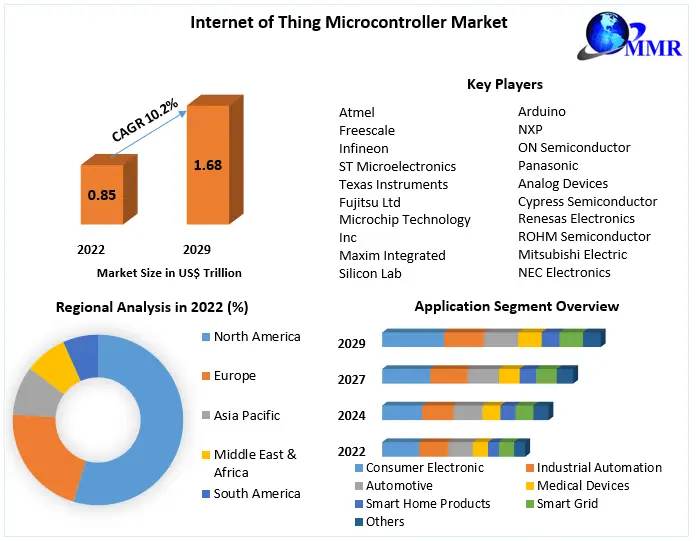
The Internet of Thing Microcontroller Market size was valued at USD 6.74 Billion in 2025 and the total Internet of Thing Microcontroller revenue is expected to grow at a CAGR of 12.05% from 2026 to 2032, reaching nearly USD 14.95 Billion by 2032.
Internet of Thing Microcontroller Market Overview:
Microcontrollers are small computer systems designed to control electronic devices. They are programmable integrated circuits that contain a processor, memory, input/output (I/O) peripherals, and other components. In IoT applications, microcontrollers act as the brains of the system, interfacing with sensors, actuators, and other devices. Microcontrollers are an essential component of the Internet of Things (IoT) ecosystem. They enable the connection of devices and the exchange of data, allowing for the creation of intelligent and interconnected systems.
To know about the Research Methodology :- Request Free Sample Report
Microcontrollers are used in a wide range of applications, such as home automation, industrial control, and automotive systems. Factors such as advancements in wireless communication technologies, the proliferation of smart connected devices, and the growing trend towards automation and digitization are fueling the internet of things microcontroller industry growth. The average selling prices of MCUs are also likely to remain affected until Q4 2023. As such, the fluctuating selling prices of MCUs and the shortages of components, which are turning out to be one of the major bottlenecks for OEMs, device manufacturers, and automakers, are expected to restrain the Internet of Things Microcontroller market's growth.
Popular Internet of Things Microcontroller Brands and Models
1. Arduino
2. Raspberry Pi
3. ESP8266 and ESP32
4. STM32
The research report has incorporated the analysis of different factors that augment the Internet of Thing Microcontroller Market growth. It constitutes trends, restraints, and drivers that transform the market in either a positive or negative manner. The report also provides the scope of different segments and applications that potentially influence the Internet of Thing Microcontroller Market through the forecast period. The detailed information is based on current trends and historic milestones. The report gives a detailed description of all the factors influencing the growth of these market players as well as profiles of their companies, their product portfolios, marketing strategies, technology integrations, and more information about these Internet of Thing Microcontroller Market players.
Internet of Thing Microcontroller Market Dynamics:
Driving Forces behind the Growth of the IoT Microcontroller Market
The Internet of Thing Microcontroller Market is experiencing significant growth due to the increasing adoption of IoT devices across various industries, driving the demand for Internet of Things Microcontrollers. IoT has multiple applications in fleet management, including asset tracking, fleet route planning, and predictive fleet maintenance, to enhance operational flexibility and help transportation and logistics companies cut down on capital and operational expenses. IoT is a modern technology in fleet management that allows for significant improvements in transportation and logistics operations. The integration of IoT technology with sensors, cameras, navigation systems, and mobile devices helps in monitoring vehicle data in real time. The use of IoT technology in fleet management has made it simple to track and monitor important vehicle data and driver performance.

Rising Demand for Energy Efficiency is also driving the Internet of Thing Microcontroller Market Growth. Energy efficiency is a critical factor for IoT devices that are often battery-powered. Advances in low-power microcontroller designs are supporting the deployment of IoT devices in remote and energy-constrained environments. IoT devices are expected to operate for extended periods without human intervention. For instance, remote sensors used in agricultural fields or environmental monitoring systems deployed in locations where frequent battery replacements are impractical. Low power consumption helps extend the battery life of these devices, reducing maintenance needs and ensuring continuous operation.
Challenges in Integration and Power Management of IoT Microcontrollers
Complexity and Integration Issues are Challenges for the Internet of Things Microcontroller Industry. The integration of microcontrollers with diverse IoT devices and systems is complex, requiring expertise in hardware and software development. Compatibility and interoperability issues arise, slowing down deployment. While low-power microcontrollers are essential for battery-operated IoT devices, achieving ultra-low power consumption without compromising performance remains a challenge. Additionally, managing the power consumption of IoT devices and optimizing energy efficiency to prolong battery life and reduce environmental impact.
Internet of Thing Microcontroller Market Segment Analysis:
By Product Type, the 32-bit MCU segment dominated the Internet of Thing Microcontroller Market in 2025 and is expected to maintain its dominance at a CAGR of xx% through the forecast period. A 32-bit microcontroller has 32-bit arithmetic logic units (ALUs), bus width and registers. These microcontrollers provide reading sensors, and data throughput and are used to send real-time sensor data over the internet such as IP network. A surge in the adoption of 32-bit MCUs in IoT applications to enable smooth Wi-Fi connectivity and to deliver low power consumption and high performance to many IoT devices is attributed to the growth of the Internet of Things microcontroller market. Additionally, several Internet of Things microcontroller manufacturing companies such as Atmel, Microchip, and Silicon Lab are continuously introducing these microcontrollers in the market for many IoT applications to improve energy efficiency and performance of the IoT-connected devices, which is ultimately improving the growth of the Internet of Things Microcontroller Industry.
Internet of Thing Microcontroller Market Regional Insight:
The Asia Pacific dominated the region in the Internet of Things Microcontroller Market, driven by China, India, and Southeast Asian countries. The new trade deal, RCEP, between China, and ASEAN nations, along with rising incomes in emerging markets like Vietnam, Malaysia, and Indonesia, is predicted to lead to the production of cheaper smart home products for customers, fueling Internet of Thing Microcontroller Market growth.
Japan's Internet of Thing Microcontroller Market is characterized by a focus on accurate technology and exceptional manufacturing. The country's strong industrial foundation and leading positions in the electronics and automotive industries have created a significant need for IoT solutions. Japan's focus on smart city initiatives and adoption of advanced technology in manufacturing, including industry 4.0 techniques, are driving the Internet of Things Microcontroller industry. The increasing popularity of Internet of Things (IoT) devices drives the Internet of Thing Microcontroller Market in China. These devices use microcontrollers to communicate with other devices. The market for this type of device is growing rapidly across all sectors of the consumer electronics industry
In March 2023, data I/O Corporation and Nuvoton Technology Corporation partnered to support OEMs in creating a secure solution for industries with strict security requirements such as building automation, metering, and medical devices. Data I/O Corporation specializes in advanced security and data deployment solutions for microcontrollers.
Internet of Thing Microcontroller Market Competitive Landscape:
The Internet of Thing Microcontroller Market is highly competitive, driven by continuous innovation and strategic initiatives by key players. Companies are focusing on integrating advanced features like AI and security, increasing their product portfolios, and forming strategic partnerships to maintain and grow their market share. Emerging competitors are also making significant strides, contributing to a dynamic and rapidly evolving market landscape.
1. In March 2023, Data I/O Corporation, a provider of advanced security and data deployment solutions for microcontrollers, joined forces with Nuvoton Technology Corporation to offer security deployment services for Nuvoton's M2354 Series-based IoT Security Microcontroller (MCU) series. The partnership aims to assist Original Equipment Manufacturers (OEMs) in designing solutions for applications like building automation, metering, medical devices, and other areas with stringent security requirements
2. In June 2023, Arduino, the open-source hardware and software platform, has recently unveiled the latest iteration of its popular UNO board. This next-generation UNO R4 board represents a significant advancement from the previous 8-bit technology. With this latest release, Arduino continues to empower makers and enthusiasts with upgraded capabilities, improved performance, and extended possibilities for their projects. The UNO R4 is set to provide enhanced flexibility and functionality for the ever-growing Arduino community.
Internet of Thing Microcontroller Market Scope: Inquire before buying
| Internet of Thing Microcontroller Market | |||
|---|---|---|---|
| Report Coverage | Details | ||
| Base Year: | 2025 | Forecast Period: | 2026-2032 |
| Historical Data: | 2020 to 2025 | Market Size in 2025: | USD 6.74 Billion. |
| Forecast Period 2026 to 2032 CAGR: | 10.2% | Market Size in 2032: | USD 14.65 Billion. |
| Segments Covered: | by Product Type | 8-bit MCU 16-bit MCU 32-bit MCU |
|
| by Application | Consumer Electronic Industrial Automation Automotive Medical Devices Smart Home Products Others |
||
Internet of Thing Microcontroller Market, by Region
North America (United States, Canada and Mexico)
Europe (UK, France, Germany, Italy, Spain, Sweden, Austria and Rest of Europe)
Asia Pacific (China, South Korea, Japan, India, Australia, Indonesia, Malaysia, Vietnam, Taiwan, Bangladesh, Pakistan and Rest of APAC)
Middle East and Africa (South Africa, GCC, Egypt, Nigeria and Rest of ME&A)
South America (Brazil, Argentina Rest of South America)
Internet of Thing Microcontroller Market, Key Players:
1. Microchip Technology Inc
2. Broadcom Corporation
3. Holtek Semiconductor
4. NXP Semiconductors
5. Texas Instruments
6. Infineon Technologies
7. ARM Ltd.
8. Nuvoton Technology Corporation
9. Silicon Laboratories, Inc.
10. STMicroelectronics
11. Renesas Electronics
12. Nordic Semiconductor
13. Analog Devices, Inc.
14. Ambiq Micro
FAQs:
1] What is the growth rate of the Internet of Things Microcontroller Market?
Ans. The Global Internet of Thing Microcontroller Market is growing at a significant rate of 12.05% during the forecast period.
2] What is the expected Internet of Thing Microcontroller Market size by 2032?
Ans. The Internet of Thing Microcontroller Market size is expected to reach USD 14.65 Billion by 2032.
3] What segments are covered in the Market report?
Ans. The segments covered in the market report are Product Type and Applications.
4] What are the factors driving the Internet of Thing Microcontroller Market growth?
Ans. The Internet of Things (IoT) Microcontroller Market is experiencing significant growth due to the increasing adoption of IoT devices across various industries, driving the demand for Internet of Things Microcontrollers.