
Racing Drone Market 2025–2032: FPV Technology, AI-Powered Analytics, and Global Expansion Driving Competitive UAV Sports
Overview
The Racing Drone Market is rapidly evolving, driven by technological advancements and growing global demand for FPV (First Person View) Racing Drones. The Racing Drone Market has emerged as a high-growth segment within the broader drone and consumer electronics ecosystem. The market was valued at USD 1.72 billion in 2025 and is expected to reach USD 3.21 billion by 2032, registering a CAGR of 9.51% during the forecast period.
Racing Drone Market Analysis reveals a strong expansion trajectory, as key industry drivers such as AI-enabled performance analytics, lightweight materials, and advancements in drone racing technology push the limits of what these machines can achieve. Additionally, the rise of drone racing events and global competitions has significantly boosted the popularity and commercial potential of racing drones, especially in the competitive esports space.
The Racing Drone Market is expanding rapidly, with the RTF segment holding 44.7% share in 2025. Growth is driven by competitive drone racing, FPV technology, and AI-enabled systems. North America leads (38%), Europe holds 27%, while Asia-Pacific grows fastest (22% CAGR), supported by rising esports adoption and drone racing events.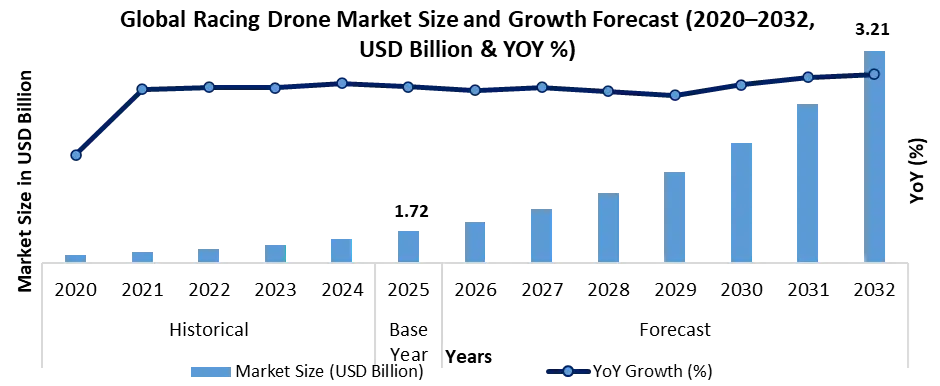
To know about the Research Methodology :- Request Free Sample Report
Racing Drone Market Key Highlights:
| Market Parameter | Value / Insight | Trend |
| Global Racing Drone Market Size (2025) | USD 1.72 Billion | ↑ Strong Growth |
| Expected Market Size (2032) | USD 3.21 Billion | ↑ Accelerating Expansion |
| Forecast CAGR (2026–2032) | 9.51% | ↑ High-Growth Industry |
| Dominant Segment | RTF (Ready-to-Fly) | ↑ Market Leader |
| Fastest Growing Segment | FPV | ↑ From Niche Hobby to Global Trend |
| Key Growth Driver | Sponsorship & Media Rights | ↑ Expanding Commercial Reach |
| Technology Trend | AI-enabled stabilization & low-latency FPV systems | ↑ Performance Optimization |
| Core Components | Hardware, Software, FPV Systems | ↑ Integrated Ecosystem |
| End Users | Hobbyists, Professional Racers, Esports Participants | ↑ Expanding User Base |
| Fastest Growing Region | Asia-Pacific | ↑ Highest CAGR |
| Leading Region (2025) | North America | ↑ Revenue Leader |
| Competitive Landscape | Organized leagues such as the Drone Racing League | ↑ Structured Ecosystem Growth |
| Innovation Focus | Lightweight materials, high-speed controllers, and battery efficiency | ↑ Continuous R&D Investment |
| Entry Barriers | High performance requirements & technical expertise | ↑ Moderate to High |
| Investment Attractiveness | High growth + esports integration | ↑ Strong Opportunity |
The Racing Drones Industry is continuously innovating, with a focus on autonomous racing drones, smart drones, and AI integration that enhances both pilot control and spectator experiences. These technological breakthroughs are contributing to the growth of racing drones, with emerging technologies such as 5G-enabled systems and real-time data transmission expected to transform the sector. Racing drones with AI-enabled stabilization systems and low-latency FPV systems are making drones more agile and performance-optimized, fueling market growth.
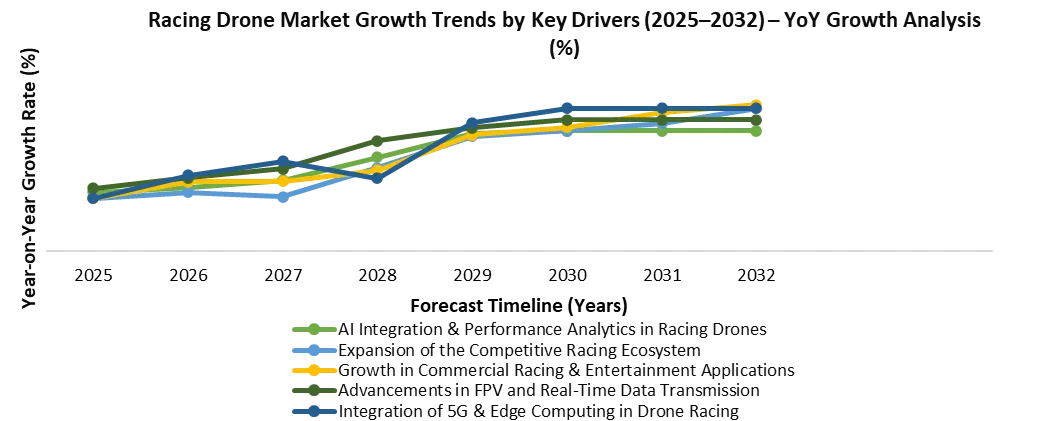
Key Market Drivers for the Racing Drone Market
AI Integration & Performance Analytics in the Racing Drone Market
AI-driven performance analytics are transforming competitive drone racing by improving pilot training, optimizing race strategies, and enabling real-time decision-making. Advanced algorithms analyse flight telemetry, speed metrics, and maneuvering patterns to provide actionable insights that enhance performance on the track.
AI enables:
• Real-time flight performance optimization
• Predictive maintenance of drone components
• Advanced simulation-based pilot training
This evolution is significantly strengthening the Racing Drone Market trends, positioning AI as a key innovation driver.
Expansion of Competitive Racing Drone Market
Ecosystem
The Racing Drone Market is witnessing rapid expansion driven by the growing popularity of organized competitions and esports integration. Professional platforms, such as the Drone Racing League, are increasing global visibility and attracting substantial sponsorship investments.
Applications include:
• Growth of international racing tournaments
• Increased media broadcasting and streaming
• Rising participation across amateur and professional pilots
Growth in Commercial Racing & Entertainment Applications
The commercialization of drone racing is accelerating as the industry evolves into a spectator-driven entertainment segment. Event organizers, media companies, and sponsors are leveraging racing drones to deliver immersive viewing experiences and engage wider audiences.
Applications include:
• Live racing events and esports tournaments.
• Branded sponsorship activations.
• VR/AR-based spectator experiences.
Advancements in FPV and Real-Time Data Transmission
Technological advancements in FPV (First-Person View) systems and low-latency video transmission are significantly improving race precision and pilot control.
Key benefits include:
• Ultra-low latency video feeds
• Enhanced real-time responsiveness
• Improved race accuracy and safety
These innovations are directly contributing to the Racing Drone Market growth.
Integration of 5G & Edge Computing in Drone Racing
The adoption of 5G connectivity and edge computing is enabling faster data transmission and real-time race analytics, improving both pilot performance and spectator experience.
Key advantages include:
• Real-time race data streaming
• Reduced latency in competitive environments
• Enhanced live broadcasting quality.
Emerging Trends Shaping the Racing Drone Industry
• Drone-as-a-Service (DaaS) for Racing Events
Racing leagues and hobbyists are increasingly leveraging Drone-as-a-Service solutions to access high-performance drones and advanced race analytics without significant upfront investment. This reduces entry barriers and expands participation in competitive racing.
• AI and Machine Learning Integration
Racing drones are increasingly leveraging AI and machine learning to enhance performance, safety, and analytics.
Key applications include:
Real-time flight path optimization
Obstacle and collision avoidance
Telemetry-based pilot performance analytics
These advancements are fueling growth in the Racing Drone Data Analytics segment.
• Advanced FPV & Immersive Experiences
The integration of high-resolution FPV cameras with 3D mapping and virtual reality feeds is transforming both pilot training and spectator engagement. This technology enables immersive race simulations, precise course practice, and enhanced interactive experiences.
• Competitive E-sports & Live Streaming
The growth of drone racing leagues and e-sports is driving demand for high-performance drones capable of agile maneuvering, live streaming, and real-time race telemetry. Enhanced audience engagement is accelerating the commercialization of the Racing Drone ecosystem.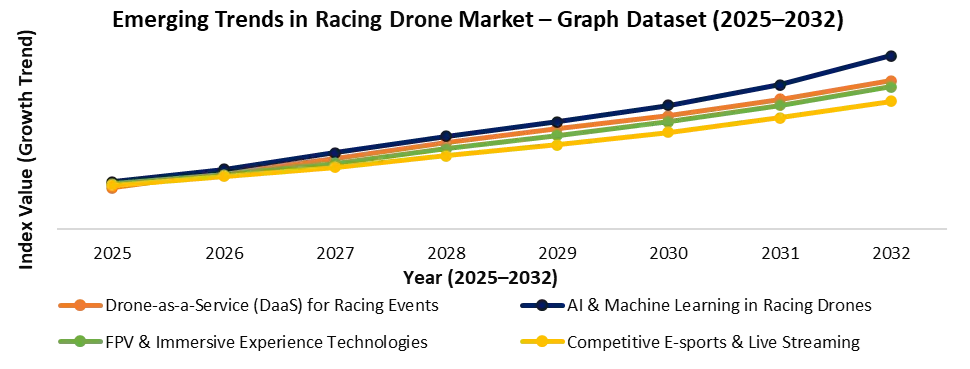
Technology Disruption & Digital Transformation in the Racing Drones Industry
Digital Transformation Driving Market Evolution
The Racing Drone Market is undergoing a significant digital transformation. Key technological convergences include:
• AI-powered racing drone analytics for real-time performance insights
• Cloud-based telemetry and performance monitoring systems
• 5G-enabled UAV communication networks for ultra-low latency
• Edge computing for onboard data processing and instant decision-making
This transformation is moving the market beyond traditional drone operations toward a fully integrated intelligence ecosystem, enabling:
• Predictive race performance modeling for competitive advantage
• Live telemetry dashboards for pilots, teams, and event organizers
• Automated analytics and race performance reporting
• AI-driven flight optimization and strategic insights
The market is transitioning from simple data collection to actionable intelligence, enhancing pilot training, race strategy development, and the overall management of competitive racing events.
Edge AI & Real-Time Drone Racing Market Analysis
Integration of Edge AI into racing drones allows instant, on-device data processing, eliminating delays from cloud dependency.
This enables:
• Real-time flight decision-making during races
• Reduced network bandwidth usage and faster telemetry updates
• Enhanced operational efficiency in competitive and remote environments
This trend is strengthening the Racing Drone Analytics segment, driving autonomous analytics capabilities and instantaneous performance insights.
Racing Drone Market Segment Analysis
The RTF (Ready-to-Fly) segment leads the Racing Drone Market, accounting for 44.7% of the market share in 2025, driven by strong demand from hobbyists, professional racers, and e-sports teams seeking fully assembled, high-performance drones. The BNF (Bind-and-Fly) segment ranks second, favored by semi-professional and advanced pilots who require flexible, easy-to-pair solutions. The ARF (Almost-Ready-to-Fly) category attracts users preferring high-performance components with partial assembly. DIY kits maintain steady growth, supported by hobbyists, makers, and educational institutions focused on hands-on learning and customization. FPV racing drones are experiencing rapid adoption, propelled by the expansion of racing leagues, increasing e-sports participation, and rising demand for agile, high-speed drones. Collectively, these trends highlight the market’s segmentation dynamics and indicate strong growth potential across both consumer and professional segments.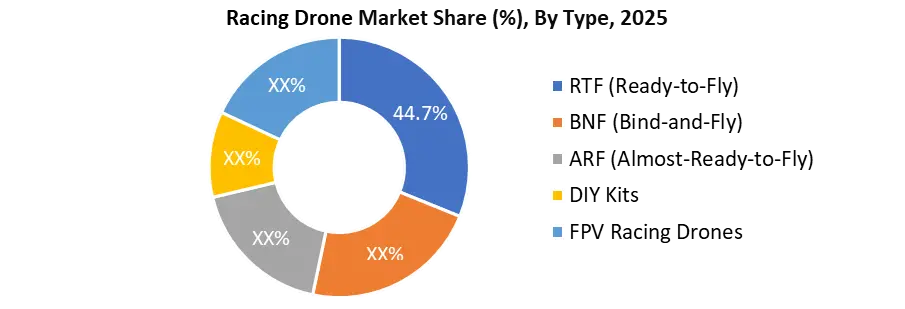
Drone Pricing Breakdown: Affordable DIY Builds vs High-End Ready-to-Fly Kits
| Drone Type | Price (USD) | Key Components | Benefits |
| Micro Racing Drone | USD 120 | BetaFPV 1S 5A F4 flight controller, BetaFPV M03 VTX, Newbie Drone 0802 motors | Budget-friendly, ideal for indoor racing, performance at a fraction of pre-built models |
| 5" Racing Drone | USD 230 | Source One V5 frame, T-Motor Velox 2207 motors, SpeedyBee F405 V4 flight controller | Mid-size, ideal for outdoor racing, a balance of cost and performance |
| DJI FPV Combo | USD 999 | DJI FPV Goggles V2, Controller | Complete immersive package, easy-to-fly kit for beginners |
| iFlight Nazgul5 V2 | USD 300 | Durable construction, high performance | Popular among racers, known for durability and performance |
Racing Drone Market Regional Insights
1. North America Racing Drone Market – Market Leader
North America dominates the Racing Drone Market, driven by advanced digital infrastructure, high AI adoption, and a strong presence of drone analytics and FPV racing technology companies. Leading players include Skydio and AeroVironment, with organized racing events like the Drone Racing League (DRL) boosting market visibility. Government initiatives and investments in drone technology further reinforce market leadership.
2. Europe Racing Drone Market – Compliance & Sustainability Driven
Europe’s Racing Drone Market is driven by strong regulatory frameworks and growing support for drone sports and FPV racing activities. The region is expected to contribute nearly 18–20% of the global market by 2026, supported by increasing participation in competitive drone racing and organized leagues. Regulations under the European Union Aviation Safety Agency (EASA) create both operational challenges and opportunities, fostering innovation in FPV technology, safety standards, and race management systems.
3. Asia Pacific Racing Drone Market – Fastest Growing Region
Countries such as India and China, along with Southeast Asia are witnessing rapid growth due to e-sports expansion, and infrastructure development, fueling demand for racing drones. The region is expected to grow at a CAGR of 22.1% through 2032, with Southeast Asia emerging as a hotspot for both manufacturing and organized racing competitions. Trade volumes in Southeast Asia have surged 533% year-over-year on Alibaba.com, highlighting strong export potential.
4. Middle East & Africa Racing Drone Marke – Emerging Opportunities
Racing drone adoption is rising in the Middle East & Africa, propelled by investments in media, entertainment, and esports applications projects that require high-performance aerial technologies. Though still nascent, the region is expected to capture 4–5% of the global market share by 2032, representing a growing opportunity for commercial and competitive drone applications.
Current Events Shaping the Racing Drone Market
| Event | Description & Impact on Racing Drones |
| Geopolitical Supply Chain Realignments | Taiwan’s USD 1.35 Bn investment in its domestic drone industry is reducing reliance on Chinese components. For Western racing drone manufacturers sourcing from Taiwan, this may increase production costs by 15–20%. |
| US-China Trade Restrictions on Battery Components | Lithium battery shortages could arise, causing racing drone prices to increase by 25–30% by 2026, directly impacting hobbyists, teams, and manufacturers. |
| Market Expansion & Competitive Pressures | With a projected CAGR of 22.1% through 2032, the racing drone market is attracting over $500M in venture capital. However, over 150 new entrants are expected by the end of 2026, intensifying competition among manufacturers and service providers. |
| Drone Champions League Media Rights Expansion | Forecasted $200M in broadcast deals could professionalize racing as a sport. Sponsorships for top teams may rise by 40%, driving revenue growth for elite pilots and event organizers. |
| Explosive Export Growth in Southeast Asia | Trade volumes for racing drones on Alibaba.com surged 533% YoY, with export amounts increasing 477% YoY. This demonstrates strong international demand and untapped export potential for manufacturers and distributors. |
Racing Drone Industry Innovations: From Competitive Leagues to Cutting-Edge Hardware
May 2025 – RAF CH-47 Chinook FPV Drone Deployment
• Development: First-Person View drone launched from a CH-47 Chinook.
• Impact: Enhances battlefield operations, enabling tactical maneuvers with real-time FPV intelligence.
January 2025 – DJI O4 Air Unit Pro Launch
• Features: 4K/120fps video, 1/1.3-inch sensor, 155° ultra-wide FOV, low-latency digital transmission.
• Impact: Elevates content creation and competitive drone racing with high-performance video and FPV control.
November 2023 – DJI Avata Release
• Features: Cinewhoop-style drone, 4K camera, 1/1.7-inch sensor, impact-resistant with propeller guards.
• Impact: Optimized for freestyle flying, tight spaces, and aggressive maneuvers while capturing high-quality aerial footage.
Racing Drone Market Scope: Inquire before buying
| Racing Drone Market | |||
|---|---|---|---|
| Report Coverage | Details | ||
| Base Year: | 2025 | Forecast Period: | 2026-2032 |
| Historical Data: | 2020 to 2025 | Market Size in 2025: | USD 1.72 Bn. |
| Forecast Period 2026 to 2032 CAGR: | 9.51% | Market Size in 2032: | USD 3.21 Bn. |
| Segments Covered: | by Type | RTF (Ready-to-Fly) BNF (Bind-and-Fly) ARF (Almost-Ready-to-Fly) DIY Kits FPV Racing Drones |
|
| by Component Type | Airframe Motors Camera / Sensor Propellers Flight Controller Battery / Power System |
||
| by Size | Micro / Mini Drones (<250g) Standard Racing Drones (250g–1kg) Heavyweight / Professional Drones (>1kg) |
||
| by End-Use | Hobbyists Professional Racers E-sports / Competitive Teams Educational & Research Institutes Drone Racing Leagues |
||
North America (United States, Canada, and Mexico)
Europe (UK, France, Germany, Italy, Spain, Sweden, Austria, and the rest of Europe)
Asia Pacific (China, South Korea, Japan, India, Australia, Indonesia, Malaysia, Vietnam, Taiwan, Bangladesh, Pakistan, and the Rest of APAC)
Middle East and Africa (South Africa, GCC, Egypt, Nigeria, and the Rest of ME&A)
South America (Brazil, Argentina, and Rest of South America)
Key Players/Competitors Profiles Covered in the Racing Drone Market Report in Strategic Perspective
North America
Racing Drone Key Players in United States
1. DJI
2. Skydio
3. Autel Robotics
4. Insitu
5. BetaFPV
6. Fat Shark
7. liftoff
8. QuadAir Drone
9. Rotor Riot
10. Spin Master
11. Betaflight
12. KISS FC Software
Canada
13. DRONEXLABS
14. InsideFPV
Mexico
15. Sub250
Europe
United Kingdom
16. FPV Cycle
17. MultiGP
18. Diabolical FPV
Germany
19. Walkera
20. Skyzone
21. TBS (Team BlackSheep)
22. RotorX
France
23. Parrot
Netherlands
24. Orqa
25. Southern Cross Drones
Switzerland
26. Velox Motors (T-Motor Europe)
Poland
27. Helio Spring
Sweden
28. BrainFPV
Italy
29. SkyFly
Asia-Pacific (APAC)
China
30. Eachine
31. Hubsan
32. iFlight
33. Diatone FPV
34. GEPRC
35. HGLRC
36. AstroRC
37. Makerfire
38. LDARC
39. EMAX
40. HappyModel
India
41. DRONEXLABS
South Korea
42. AcroNerd FPV Software
Australia
43. FPV Cycle Australia
44. Flywoo
Finland
45. Furious FPV
Racing Drone Market – Key FAQs
Q1. What is a racing drone?
Racing drones are high-performance UAVs designed for competitive FPV (first-person view) racing, emphasizing speed, agility, and real-time control.
Q2. Who are the leading players in the global racing drone market?
Prominent players include DJI, Skydio, Autel Robotics, TBS, iFlight, Fat Shark, Walkera, Rotor Riot, DRONEXLABS, and BetaFPV.
Q3. What types of racing drones are available?
The market comprises FPV racing drones, micro/indoor drones, and professional/custom-built drones for competitive events.
Q4. What factors are driving market growth?
Market expansion is fueled by the rising popularity of drone racing leagues, the adoption of AI and telemetry systems, 5G connectivity, and growing consumer and professional engagement.
Q5. What trends will shape the future of the racing drone market?
Future trends include AI-powered autonomous features, cloud-based telemetry, real-time analytics, and immersive FPV experiences, enhancing competitive and recreational racing.