
Interactive Kiosk Market– Industry Structure Evaluation, Demand Drivers Analysis, Regional Growth Analysis and Identification, Competitive Positioning Review & Global Market Size Forecast to 2030
Overview
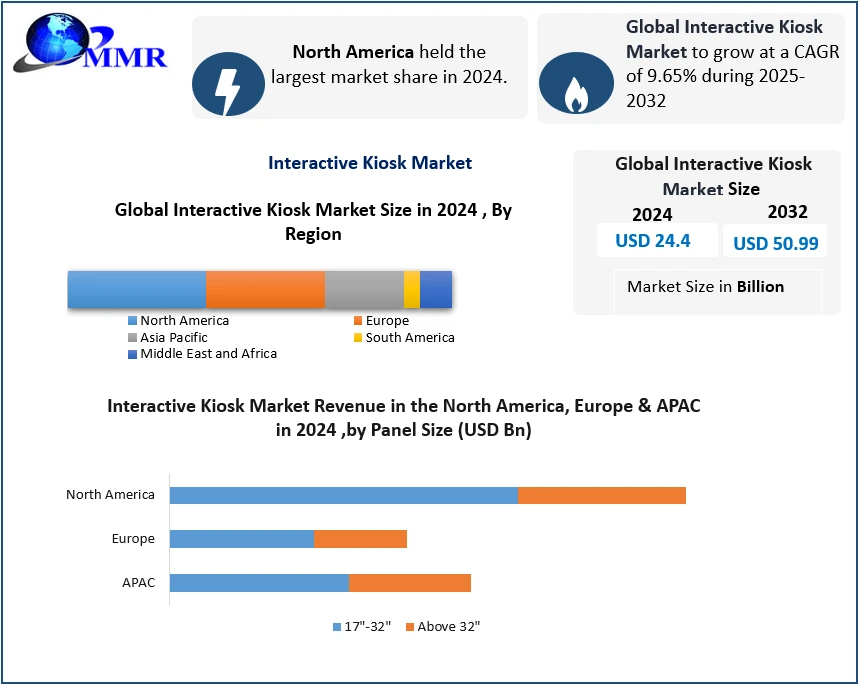
The Global Interactive Kiosk Market size was valued at USD 24.4 billion in 2024, and is expected to grow by 9.65 % from 2024 to 2032, reaching USD 50.99 billion in 2032.
Global Interactive Kiosk Market Overview
The interactive kiosk is a self-service terminal equipped with a touchscreen interface, dedicated hardware, and tailored software, enabling users to independently access information, complete transactions, or interact with various applications in public settings. These kiosks integrate hardware, software, and user interfaces to enhance convenience, streamline processes, and improve customer engagement across various sectors such as retail, healthcare, transportation, banking, education, and government.
 To know about the Research Methodology:- Request Free Sample Report
The global Interactive Kiosk Market is rapidly emerging as a key driver of digital transformation and automation across industries. These systems are reshaping service delivery by enabling time savings, operational efficiencies, and personalized customer engagement. For example, in retail, interactive kiosks provide shoppers with product information, enable self-checkouts, and tailored shopping solutions, fundamentally changing the in-store purchasing experience.
North America currently leads the market, driven by advanced technological infrastructure and high adoption in both commercial and governmental applications. The Asia-Pacific region has emerging growth potential due to rapid urbanization, ongoing digital transformation, and substantial investments in smart city initiatives. The growing demand for touchless, efficient, and user-friendly service solutions positions the interactive kiosk sector as a major contributor to the future of customer engagement and operational efficiency worldwide.
Global Interactive Kiosk Market Dynamics
Rising Demand for Self-Service Solutions and Enhanced Customer Experience to Drive the Interactive Kiosk Market
The growing demand for self-service solutions boosts the Interactive Kiosk Market growth. Organizations increasingly recognize the potential of interactive kiosks to enhance operational efficiency and achieve cost savings through automation. Interactive kiosks contribute significantly to improving the customer experience, fostering customer satisfaction and loyalty. This positive impact on customer interactions positions interactive kiosks as key players in the Interactive Kiosk Market share. Ongoing technological advancements, including improvements in touchscreen technology and software capabilities, drive innovation within the Interactive Kiosk Market. This continuous evolution enhances the overall market potential.
The widespread adoption of interactive kiosks in the retail and hospitality sectors underscores their penetration into key markets. Businesses in these sectors leverage interactive kiosks to streamline operations, enhance customer engagement, and create opportunities for market share. Government initiatives aimed at digital transformation and the adoption of smart technologies contribute significantly to the growth of the Interactive Kiosk Market. These initiatives create favourable conditions for market penetration as public services increasingly rely on interactive kiosks for efficiency and innovation.
High Initial Investment and Limited Customization for Specific Industries to Restrain the Interactive Kiosk Market
The high initial investment required for implementing interactive kiosks, covering hardware, software, and integration expenses, presents a challenge to market penetration. This financial barrier limits the adoption of interactive kiosks, particularly among smaller enterprises with budget constraints. Security concerns related to the handling of sensitive information pose a restraint on the Interactive Kiosk Market. In sectors such as finance and healthcare, where data security is paramount, addressing these concerns becomes crucial for market share growth and sustained growth.
Complex integration issues are a hurdle to seamless deployment within organizations, especially in large enterprises with intricate IT infrastructures. These integration challenges affect the Interactive Kiosk Market. Consumer privacy concerns are critical as a critical factor influencing the Interactive Kiosk Market. In regions with stringent privacy regulations, addressing these concerns becomes crucial to overcoming barriers to market penetration and ensuring sustained innovation in the industry. Evolving market dynamics, coupled with emerging trends and innovations in the industry, underline the importance of staying informed through continuous market analysis for a comprehensive understanding of the current landscape.
Interactive Kiosk Market, Segmentation
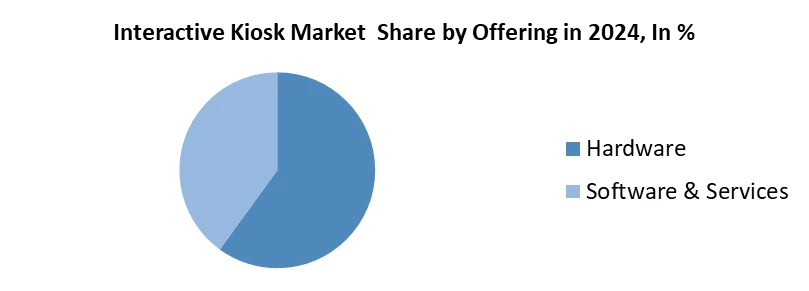
Offering: Based on the offering, the hardware segment held the highest market share in 2024 and is expected to maintain its dominance during the forecast period, including touchscreens, payment devices, sensors, and other physical elements. Hardware serves as the foundational infrastructure essential for enabling the functionality of interactive kiosks. Hardware is a pivotal facet of interactive kiosk deployment, exerting influence over performance, durability, and user interactions. Ongoing advances in hardware technology contribute substantially to the overall innovation and competitiveness within the Interactive Kiosk Market.
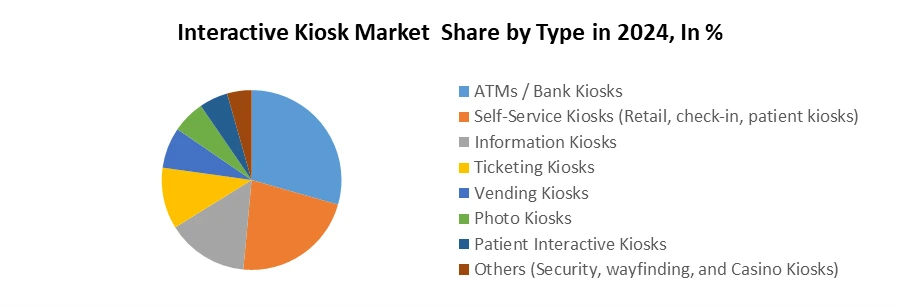
Type: Based on type, ATM / Bank kiosks dominate the interactive kiosk market share in 2024 and are expected to maintain their dominance during the forecast period. They deliver an essential, universally needed service, access to cash and core banking transactions that transcends demographics and technology adoption levels. Unlike other kiosk types, ATMs are not just a convenience but a necessity, supported by regulatory requirements in many countries to ensure physical cash access points. They have a massive global installed base of over three million units, strategically placed in banks, retail outlets, and transit hubs, generating high transaction volumes and consistent fee-based revenue for operators. Their dominance is reinforced by continuous innovations such as biometric authentication, video teller machines, and NFC-enabled transactions, which keep them relevant in the digital age. Additionally, ATMs play a pivotal role in financial inclusion, particularly in emerging economies where they extend banking services to underserved rural areas, often supported by government programs and fintech partnerships. This combination of necessity, profitability, widespread presence, and ongoing technological upgrades ensures ATM kiosks remain the largest revenue contributor within the interactive kiosk market.
Panel Size: Based on panel size, the 17″–32″ panel size segment held dominance in 2024 and is expected to maintain its dominance during the forecast period due to its cost-effectiveness, versatility, and suitability across diverse applications. This size range offers ample screen space for clear visuals and responsive touch interaction while maintaining affordability compared to larger displays. Its moderate footprint allows easy integration into various environments, from retail counters and banking halls to hospital lobbies and transportation hubs. The 17″–32″ size is ergonomically optimal, ensuring comfortable viewing and accessibility for most users without overwhelming smaller spaces.
In contrast, kiosks with screens above 32″ are reserved for specialized use cases such as wayfinding in large public areas, immersive digital signage, or high-traffic event spaces. While larger screens offer greater visual impact, they require more space and incur higher costs, limiting adoption. The practicality, adaptability, and economic efficiency of mid-sized panels make them the preferred choice for most interactive kiosk deployments worldwide.
Interactive Kiosk Market, Regional Growth
North America held the largest market share in 2024 and is expected to maintain its dominance during the forecast period. Businesses are increasingly leveraging kiosks for self-service applications, enabling faster transactions, reducing labor costs, and enhancing customer experiences. Technological advancements, such as AI-powered interfaces, touchless operation, facial recognition, and integration with mobile devices, are expanding the scope of interactive kiosk functionalities. Retailers use them for product information, wayfinding, and automated checkout, while healthcare providers deploy kiosks for patient check-ins, telehealth consultations, and payment processing. In transportation, interactive kiosks streamline ticketing and boarding processes. North America’s strong digital infrastructure, high consumer tech adoption, and presence of leading kiosk manufacturers further support market expansion. The advanced technological landscape and a commitment to customer-centric solutions, the region's economy and major technology players contribute substantially to market growth in the US, Canada, and Mexico.
Table: Government Schemes
| Government/Region | Initiative | Funding | Focus Area |
| U.S. (Department of Commerce) | Digital Service Kiosk Expansion Program | USD 300 Million | Enhancing government and healthcare kiosk infrastructure for public access and digital inclusion. |
| EU (Digital Europe Programme) | Smart Public Interface Initiative | USD 255.56 Million | Deployment of AI-powered kiosks for smart city services, e-governance, and tourism support. |
| China (MIIT) | Smart Retail Terminal Plan | USD 350 Million | Nationwide rollout of interactive kiosks in retail, transit, and logistics hubs. |
Global Interactive Kiosk Market Competitive Landscape
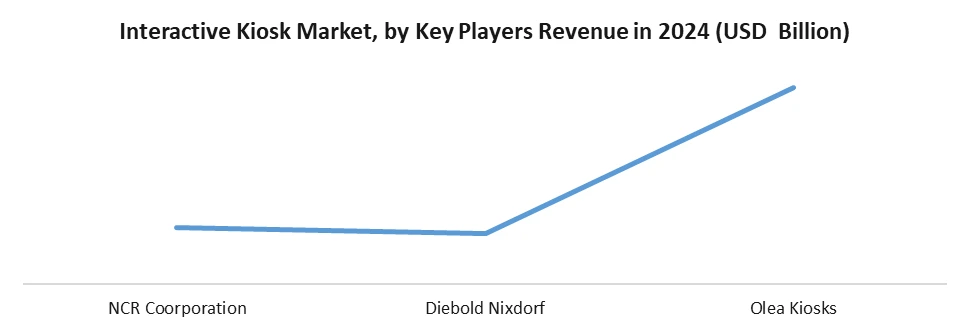
The Interactive Kiosk Market is an intensely competitive component of global markets, with long-standing multinational technology companies, quickly emerging disruptors, and newer entrants competing vigorously for market access and product share, utilizing innovative technologies and service ideas. Leading companies include NCR Corporation and Diebold Nixdorf, which are positioned as the market leaders due to technology leadership, global distribution networks, and well-developed customer relationships in the banking, retail, and transportation markets.
Global Interactive Kiosk Market Recent Development
On May 23, 2023, Samsung launched the KMC-W, a Windows 10 IoT Enterprise-based interactive kiosk with a 24-inch display, designed for industries like retail, food and beverage, healthcare, and travel. Powered by 11th Gen Intel Core processors (Celeron, i3, or i5), 8GB DRAM, and 256GB SSD, it offers high performance, broad software compatibility, and integration with third-party peripherals. Features include a UL-certified antimicrobial coating, shatterproof film, and versatile installation options for counters, walls, or stands. Supporting applications like self-ordering, bill payments, ID scanning, and vending, the KMC-W helps businesses enhance customer engagement and embrace contactless services.
On April 26, 2024, Advantech announced its acquisition of French POS and kiosk brand Aures Technologies SA to strengthen its global position in intelligent retail solutions. The deal, valued at up to $30.61 million includes a potential 100% equity acquisition and a $5 million convertible bond subscription to support Aures’ working capital. Leveraging Aures’ strong brand presence in Europe, Australia, and the U.S. with Advantech’s AIoT and edge computing expertise, the move aims to expand global coverage, enhance product portfolios, and accelerate growth in the smart retail sector
Competitive Landscape
The global interactive kiosk market is highly competitive, featuring established technology leaders and regional specialists. Major global players such as IBM, Panasonic, and Samsung dominate through innovation, brand strength, and global reach. In North America, companies like NCR Corporation, Diebold Nixdorf, and Kiosk Information Systems lead with strong banking, retail, and transportation solutions. Europe’s market is driven by Meridian Kiosks, Ergonomic Solutions, and Diebold Nixdorf AG, emphasizing modular designs and tailored applications. In Asia Pacific, GRG Banking, Fujitsu, NEC, and Advantech excel through advanced manufacturing, AI integration, and cost-efficient production. Strategic partnerships, product diversification, and smart city adoption fuel competition.
Global Interactive Kiosk Market Trends
1. Organizations such as NCR Corporation, Diebold Nixdorf, and View Inc. are utilizing AI, IoT, and biometric technology that work in kiosks to provide personalized service, real-time data analytics, and secure, contactless experiences within smart infrastructure.
2. Companies like Posiflex, Deceuninck, and Asahi Glass continue to pursue a sustainable kiosk vision; they are concentrating on a sustainable kiosk solution made from reclaimed and recycled materials, solar power, and energy-efficient configurations per the worldwide carbon neutrality objective.
Interactive Kiosk Market Scope: Inquire before buying
| Global Interactive Kiosk Market | |||
|---|---|---|---|
| Report Coverage | Details | ||
| Base Year: | 2024 | Forecast Period: | 2025-2032 |
| Historical Data: | 2019 to 2024 | Market Size in 2024: | USD 24.4 Bn. |
| Forecast Period 2025 to 2032 CAGR: | 9.65% | Market Size in 2032: | USD 50.99 Bn. |
| Segments Covered: | by Offering | Hardware Software and Services |
|
| by Type | ATMs / Bank Kiosks Self-Service Kiosks (Retail, check-in, patient kiosks) Information Kiosks Ticketing Kiosks Vending Kiosks Photo Kiosks Patient Interactive Kiosks Others (Security, wayfinding, and Casino Kiosks) |
||
| by Location | Indoor Outdoor |
||
| by Panel Size | 17”–32” Above 32” |
||
| by Vertical | Retail Healthcare Banking & Financial Services Government Transportation Hospitality Entertainment Others (Corporate and Education) |
||
Interactive Kiosk Market, by Region
North America (United States, Canada, and Mexico)
Europe (UK, France, Germany, Italy, Spain, Sweden, Austria, and the Rest of Europe)
Asia Pacific (China, South Korea, Japan, India, Australia, ASEAN, Indonesia, Philippines, Malaysia, Vietnam, Thailand, ASEAN, Rest of Asia Pacific)
Middle East & Africa (South Africa, GCC, Nigeria, Rest of ME&A)
South America (Brazil, Argentina, Rest of South America)
Global Interactive Kiosk Market, Key Players
Major Global Key Players:
1. IBM Corporation (United States)
2. Panasonic Corporation (Japan)
3. Samsung Electronics Co., Ltd. (South Korea)
Key Players in North America:
1. Kiosk Information Systems (KIOSK) (United States)
2. NCR Corporation (United States)
3. Diebold Nixdorf, Incorporated (United States)
4. Phoenix Kiosk, Inc. (United States)
5. ReadyRef Interactive Kiosks (United States)
6. Embross Group (Canada)
7. Olea Kiosks Inc. (United States)
Key Players in Europe:
1. Meridian Kiosks (United Kingdom)
2. Ergonomic Solutions (United Kingdom)
3. Diebold Nixdorf AG (Germany)
4. Kiosks4business (United Kingdom)
Key Player Asia Pacific:
1. GRG Banking Equipment Co., Ltd. (China)
2. Fujitsu Limited (Japan)
3. NEC Corporation (Japan)
4. Advantech Co., Ltd. (Taiwan)
Frequently Asked Questions:
1. What is an interactive kiosk?
Ans: An interactive kiosk is a self-service terminal equipped with touchscreens, payment devices, and other interactive elements, allowing users to access information, perform transactions, and engage with various services.
2. Which industries utilize interactive kiosks?
Ans: Interactive kiosks find applications across diverse industries, including retail, healthcare, banking, transportation, government, and more.
3. What are the key components of interactive kiosks?
Ans: Key components include hardware elements such as touchscreens, sensors, payment devices, and software applications powering interactive capabilities.
4. Which regions show significant growth in the Interactive Kiosk Market?
Ans: North America, Asia Pacific, Europe, and the Middle East and Africa demonstrate substantial growth potential in the Interactive Kiosk Market.
5. What are the major types of interactive kiosks?
Ans: Major types include Bank Kiosks (for financial transactions), Self-service Kiosks (for various industries), and Vending Kiosks (for automated product dispensing).