
Inorganic Metal Finishing Market Size by Product, Application, Technology, Type, Region – Revenue Pool Analysis, Margin Structure Assessment, Capital Flow Trends, Competitive Benchmarking & Forecast to 2034
Overview
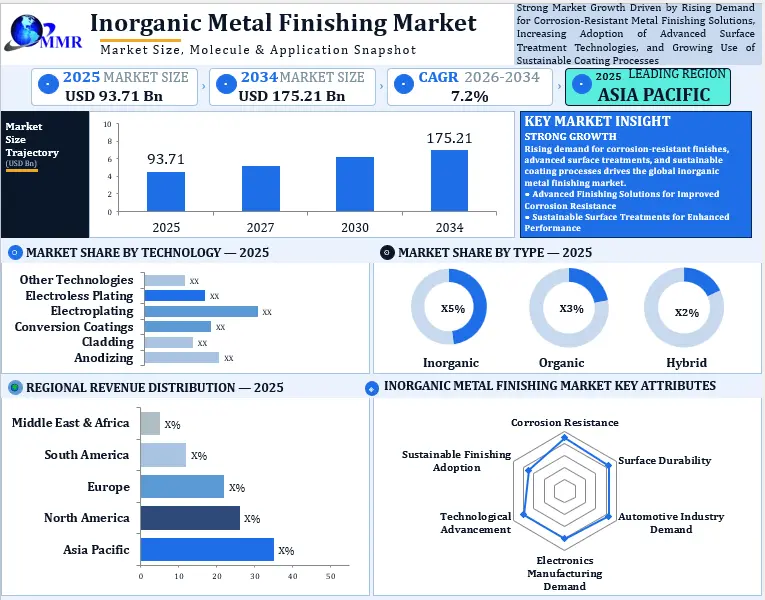
Inorganic Metal Finishing Market was valued US$ 93.71 Bn. in 2025 and is expected to reach US$ 175.21 Bn. by 2034, at CAGR of 7.2 % during forecast period of 2026 to 2034.
There are three major types of metal finishing processes: inorganic, organic, and hybrid. Inorganic metal finishing involves the use of inorganic materials and surface treatment techniques to improve the corrosion resistance, hardness, wear resistance, and durability of metal components. Common processes include electroplating, electroless plating, anodizing, phosphating, and conversion coating, depending on the material and application requirements.
Inorganic metal finishing technology serves various industries, including automotive, aerospace, electrical and electronics, construction, and industrial manufacturing. These processes improve component performance, protect metal surfaces from environmental damage, and extend product service life. Growing demand for durable metal components, reduced maintenance requirements, and advanced surface protection solutions supports the adoption of inorganic metal finishing across diverse industrial applications.
Inorganic Metal Finishing Market Size, Growth & Share Analysis
To know about the Research Methodology :- Request Free Sample Report
Key Highlights – Global Inorganic Metal Finishing Market
• Market Growth: The global inorganic metal finishing market is valued at USD 93.71 billion in 2025 and is projected to reach USD 175.21 billion by 2034, registering a CAGR of 7.2% from 2026 to 2034.
• Regional Leadership: Asia Pacific leads the global market, supported by rapid industrialization, expanding automotive production, electronics manufacturing, and increasing demand for advanced metal surface treatment technologies.
• Key Growth Drivers: Rising demand for corrosion resistance, improved component durability, electric vehicles, and electronic components strengthens the adoption of electroplating, anodizing, electroless plating, and conversion coatings.
• Technology and Sustainability Opportunities: Growing adoption of chromium-free coatings, chemical recovery systems, automated plating lines, and advanced surface treatments creates opportunities for manufacturers seeking improved coating performance and environmental compliance.
• Competitive Landscape: The market features specialty chemical suppliers, surface treatment technology providers, and metal finishing service companies. Key participants include MKS Instruments (Atotech), Element Solutions, Henkel, Oerlikon, Technic, and Pioneer Metal Finishing, with competition focused on technological innovation, coating quality, process automation, and sustainable finishing solutions.
Global Inorganic Metal Finishing Market Dynamics
Global Inorganic Metal Finishing Market Drivers
Rising Demand for Corrosion Protection and Extended Component Life
Increasing demand for durable metal components across automotive, aerospace, construction, and industrial manufacturing drives the global inorganic metal finishing market. Processes such as electroplating, anodizing, galvanizing, and conversion coating improve corrosion resistance, surface hardness, and wear protection. In the automotive industry, metal finishing protects fasteners, chassis components, connectors, and precision parts from moisture, chemicals, and temperature fluctuations. The global automotive sector produces tens of millions of vehicles annually, creating sustained demand for reliable surface treatment solutions. The market reaches USD 93.71 billion in 2025 and is projected to grow at a CAGR of 7.2% from 2026 to 2034, supported by expanding industrial applications and increasing requirements for component durability.
Increasing Demand from Electronics and Electric Vehicle Manufacturing
The growing production of electric vehicles, electronic devices, and advanced electrical systems creates opportunities for inorganic metal finishing technologies. Electroplating improves electrical conductivity and solderability in connectors, terminals, and circuit components, while anodizing enhances the corrosion resistance of aluminum battery housings and electronic enclosures. Electric vehicle battery systems operate at voltages reaching 400–800 volts in many passenger vehicle platforms, increasing the importance of reliable electrical connections and protective component surfaces. Manufacturers also require precise finishing processes to support miniaturized electronics, lightweight materials, and complex component geometries. These requirements strengthen demand for specialized finishing solutions that deliver consistent electrical, mechanical, and protective performance.
Global Inorganic Metal Finishing Market Restraints
High Capital Investment and Operational Costs
Inorganic metal finishing requires specialized equipment, chemical treatment baths, temperature-control systems, ventilation, wastewater treatment, and quality inspection facilities. Establishing an industrial electroplating line involves multiple stages, including surface cleaning, pretreatment, coating deposition, rinsing, drying, and final inspection. The requirement for continuous chemical monitoring and controlled operating conditions increases production costs, particularly for small and medium-sized finishing facilities. Fluctuations in nickel, chromium, zinc, and other metal input prices also affect operating margins. These financial requirements can delay capacity expansion and limit the adoption of advanced finishing technologies among smaller manufacturers.
Environmental Compliance and Hazardous Chemical Management
Metal finishing facilities face increasing pressure to control wastewater discharge, chemical exposure, hazardous sludge, and air emissions. Certain conventional processes use substances such as hexavalent chromium and other hazardous chemicals that require stringent handling and treatment measures. In the United States, 40 CFR Part 433 establishes wastewater discharge standards for specified metal finishing operations, covering activities such as electroplating, anodizing, and chemical coating. Compliance requires investment in effluent treatment, chemical monitoring, worker protection, and waste management. These obligations increase operational complexity and encourage manufacturers to adopt alternative chemistries, improved recovery systems, and more efficient treatment processes.
Global Inorganic Metal Finishing Market Opportunities
Growing Adoption of Sustainable and Chromium-Free Finishing Technologies
The transition toward lower-hazard surface treatment processes creates opportunities for manufacturers offering trivalent chromium systems, chromium-free conversion coatings, and improved chemical recovery technologies. These alternatives help manufacturers address environmental requirements while maintaining essential properties such as corrosion resistance, adhesion, and surface durability. Closed-loop rinsing systems and metal recovery technologies also help reduce water consumption and recover valuable materials from process streams. Companies that combine environmental compliance with reliable coating performance can strengthen their position among automotive, aerospace, electronics, and industrial customers seeking more sustainable manufacturing solutions.
Advanced Finishing for Lightweight Alloys and Precision Components
Increasing use of aluminum alloys and other lightweight metals in electric vehicles, aerospace structures, electronic housings, and industrial equipment creates opportunities for specialized inorganic finishing processes. Anodizing improves the hardness and corrosion resistance of aluminum surfaces, while electroless plating provides uniform coatings on complex geometries where consistent surface coverage is essential. Manufacturers also require advanced finishing solutions for precision components used in medical equipment, high-performance machinery, and electronic assemblies. The development of automated plating lines, real-time bath monitoring, and precision coating technologies supports improved production consistency and expands the range of applications for inorganic metal finishing.
Global Inorganic Metal Finishing Market Challenges
Maintaining Consistent Coating Quality Across Complex Components
Achieving uniform coating thickness, strong adhesion, and consistent surface properties remains a significant challenge in inorganic metal finishing. Component geometry, base-metal composition, surface contamination, bath chemistry, temperature, and processing time influence the final coating quality. Complex components with narrow cavities, intricate shapes, or multiple material interfaces require carefully controlled treatment conditions. Variations in these parameters can cause uneven deposition, poor adhesion, discoloration, or premature corrosion. Manufacturers therefore invest in process automation, thickness measurement, chemical analysis, and standardized inspection procedures to maintain product quality and reduce rejection rates.
Raw Material Price Volatility and Supply Chain Dependence
The industry depends on a range of metals, chemicals, additives, and specialized equipment, making operating costs sensitive to fluctuations in raw material prices and supply availability. Nickel, zinc, copper, and chromium compounds serve important functions in different finishing processes, while specialty chemicals influence deposition quality, surface appearance, and corrosion performance. Price changes and supply disruptions affect procurement planning, production schedules, and customer pricing. Manufacturers address these challenges through supplier diversification, chemical recovery, optimized bath utilization, and improved inventory management. Maintaining consistent access to qualified materials remains important for ensuring uninterrupted production and reliable finishing performance.
Inorganic Metal Finishing Market Segment Analysis
In terms of Product, the inorganic metal finishing market is segmented into pretreatment/surface preparation, consumables and spares, and inorganic metal finishing processes. By technology, the market is segmented into cladding, anodizing, electro-less plating, electroplating, galvanizing, and others including electro-polishing. An electroplating segment is expected to grow at the highest xx% CAGR during the forecast period.
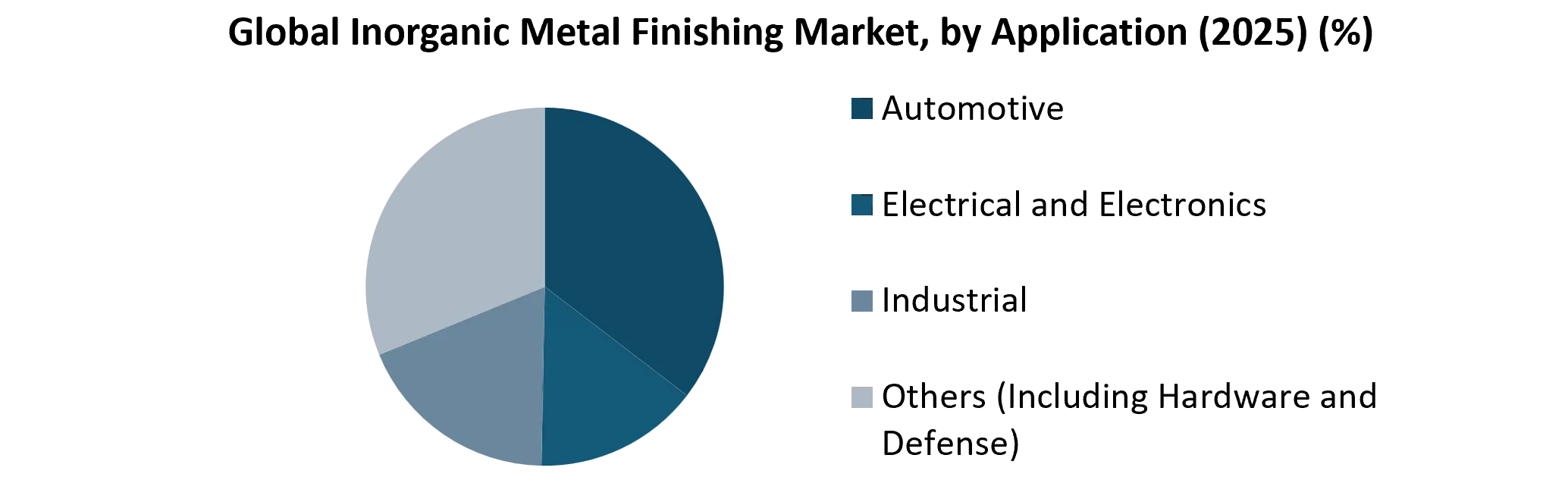
By Application, the report segments the Inorganic Metal Finishing Market into automotive, electrical and electronics, industrial, others including defense and hardware. Amongst these, in 2025, automotive applications segment accounted for xx% of market share on the basis of revenue. Industrial applications straggled automotive applications and held the second-largest xx% of share market during the forecast periods.
Multinational companies are proactively discovering the new opportunities in the electroplating segment by adopting strategies such as the acquisition of start-up companies and forming deal to establish their presence in the market.
Inorganic Metal Finishing Market Regional Analysis
Asia Pacific dominates the global inorganic metal finishing market, driven by rapid industrialization, expanding manufacturing activities, and rising demand for metal surface treatment, electroplating, anodizing, and corrosion-resistant coatings. China, India, Japan, and South Korea contribute significantly through their automotive, electrical and electronics, industrial machinery, and construction industries. The region benefits from large-scale manufacturing facilities and increasing demand for durable metal components. Growing electric vehicle production, electronics manufacturing, and infrastructure development further strengthen the adoption of advanced inorganic metal finishing technologies. The expansion of industrial production and demand for high-performance surface protection solutions reinforce Asia Pacific's leading position in the market.
North America represents a significant share of the inorganic metal finishing market, supported by advanced automotive, aerospace, electronics, medical equipment, and industrial manufacturing sectors. The United States drives regional demand through its established manufacturing infrastructure and increasing requirement for precision metal finishing, protective coatings, and advanced surface treatment technologies. Electroplating, anodizing, and conversion coating processes enhance corrosion resistance, electrical conductivity, wear resistance, and component durability. Increasing electric vehicle production, aerospace component manufacturing, and investments in advanced electronics support market expansion. Additionally, environmental compliance requirements encourage manufacturers to adopt sustainable metal finishing processes, automated treatment systems, and improved chemical recovery technologies.
Europe maintains a strong position in the global inorganic metal finishing market, supported by its established automotive, aerospace, industrial machinery, and precision engineering industries. Germany, France, Italy, and the United Kingdom contribute significantly to regional demand for electroplating services, anodizing solutions, galvanizing technologies, and corrosion protection systems. Manufacturers prioritize high-performance surface treatments that improve component reliability, durability, and resistance to harsh operating conditions. The region also emphasizes environmentally compliant metal finishing technologies, including chromium-free coatings, efficient wastewater treatment, and chemical recovery systems. Growing electric vehicle manufacturing, industrial automation, and advanced engineering applications continue to support demand for inorganic metal finishing solutions.
South America experiences growing demand in the inorganic metal finishing market, supported by automotive manufacturing, construction, agricultural machinery, and industrial maintenance activities. Brazil represents a major regional contributor, while Argentina supports demand through manufacturing and engineering applications. Metal plating, galvanizing, anodizing, and protective surface coatings improve the durability and corrosion resistance of components used in industrial equipment, transportation systems, and infrastructure. Increasing investment in industrial modernization, construction projects, and machinery production creates opportunities for metal finishing service providers. However, capital investment requirements, raw material price fluctuations, and environmental compliance obligations influence the adoption of advanced finishing technologies across the region.
Middle East & Africa presents emerging opportunities in the global inorganic metal finishing market, driven by infrastructure development, industrial diversification, construction activities, and energy sector investments. Saudi Arabia and the United Arab Emirates contribute through industrial expansion and demand for durable metal components, while South Africa supports regional demand through mining equipment, automotive manufacturing, and industrial engineering. Corrosion-resistant metal coatings, electroplating, galvanizing, and advanced surface treatment solutions help protect components exposed to moisture, heat, chemicals, and demanding operating environments. Increasing investment in industrial facilities, transportation infrastructure, and equipment maintenance supports market development, while improved access to advanced finishing technologies and wastewater treatment systems strengthens long-term growth opportunities.
Global Inorganic Metal Finishing Market Competitive Landscape
The global inorganic metal finishing market features a competitive mix of surface treatment technology providers, specialty chemical manufacturers, and industrial metal finishing service companies. Market participants compete through advanced electroplating technologies, anodizing solutions, corrosion-resistant coatings, precision surface treatments, and environmentally compliant finishing processes. Leading companies focus on improving coating uniformity, surface hardness, wear resistance, and component durability to meet the requirements of automotive, aerospace, electronics, and industrial manufacturing customers.
Competitive Positioning and Strategic Focus
| Competitive Factor | Strategic Focus | Market Impact |
| Technology Innovation | Advanced electroplating, electroless plating, anodizing, and conversion coatings | Improves coating quality, surface performance, and process efficiency |
| Environmental Compliance | Chromium-free alternatives, chemical recovery, and wastewater treatment | Supports regulatory compliance and sustainable manufacturing |
| Application Specialization | Finishing solutions for automotive, aerospace, electronics, and medical components | Strengthens customer relationships and industry-specific expertise |
| Process Automation | Automated plating lines, digital monitoring, and precision process controls | Enhances coating consistency and reduces operational variability |
| Product Quality | Improved adhesion, corrosion resistance, hardness, and wear protection | Supports demanding component performance requirements |
| Strategic Expansion | Capacity expansion, acquisitions, partnerships, and geographic diversification | Broadens service capabilities and customer reach |
Key Competitive Participants
The competitive landscape includes established technology suppliers and specialized finishing companies such as:
• MKS Instruments (Atotech) – Electroplating chemistry and advanced surface treatment technologies.
• Element Solutions Inc. (MacDermid Enthone) – Specialty chemicals and surface finishing solutions.
• OC Oerlikon Management AG – Surface engineering and protective coating technologies.
• Henkel AG & Co. KGaA – Industrial surface treatment and metal pretreatment solutions.
• Honeywell International Inc. – Advanced materials and technologies serving industrial applications.
• Pioneer Metal Finishing, LLC – Specialized metal finishing services for industrial and precision components.
• Advanced Plating Technologies – Electroplating, electroless plating, and engineered finishing services.
• C. Uyemura & Co., Ltd. – Plating chemicals and surface treatment technologies.
• Technic Inc. – Specialty plating chemistry, equipment, and precious-metal finishing solutions.
• Hubbard-Hall Inc. – Industrial metal finishing chemicals and process treatment solutions.
Emerging Competitive Trends
Competition increasingly emphasizes high-performance surface engineering, sustainable chemical formulations, automated finishing operations, and application-specific coating solutions. Suppliers that improve chemical utilization, reduce process waste, and maintain consistent coating quality strengthen their position with industrial customers. Demand for precision finishing in electric vehicles, electronics, aerospace components, and medical devices also encourages companies to expand specialized treatment capabilities. These strategies support differentiation in a market where technical expertise, process reliability, environmental compliance.
Inorganic Metal Finishing Market Recent Development
| Date | Company | Development | Impact |
| March 18, 2026 | CHEMEON Surface Technology and SurTec | Form a strategic alliance to expand international access to surface treatment solutions, including trivalent chromium-based corrosion protection technologies. | Expands access to chromium-free alternatives and strengthens sustainable metal finishing capabilities. |
| April 13, 2026 | Sharretts Plating Company | Announces an initiative to develop wafer-level electroplating and electroless plating capabilities for semiconductor and microelectronics manufacturing. | Supports precision metallization, advanced semiconductor packaging, and high-reliability electronic components. |
| April 17, 2026 | MKS Inc. (Atotech) | Announces its participation in Surface Technology GERMANY 2026, highlighting chromium-free coatings, non-PFAS solutions, low-temperature cleaning, and closed-loop wastewater management. | Strengthens the adoption of resource-efficient surface finishing, reduced chemical waste, and environmentally compliant processes. |
| May 4, 2026 | Prince Manufacturing | Reports expansion of its automated metal plating operations in Santa Catarina, Monterrey, with a second facility planned to increase capacity and process capabilities. | Increases regional plating capacity and supports demand from automotive, electronics, aerospace, and industrial customers. |
| September 1, 2026 | Valence Surface Technologies | Announces the acquisition of Cametoid Technologies, expanding its ion vapor deposition capabilities for aerospace and defense applications. | Broadens specialized surface treatment capabilities and strengthens support for high-performance aerospace and defense components. |
| September 2, 2026 | Talica | Announces the acquisition of Hard Anodize Inc., expanding precision aluminum anodizing and specialized surface treatment services. | Enhances anodizing capacity and strengthens service offerings for aerospace, defense, medical devices, and precision industrial components. |
| September 10, 2026 | Skye Metal Coating LLC | Expands its Dubai operations with a dedicated hard anodizing line, additional color options, and specialized processing equipment. | Increases finishing capacity and supports demand for functional and decorative finishes on aluminum components. |
| September 18, 2026 | MKS Inc. (Atotech) | Announces advanced aluminum cleaning, pretreatment, and conversion coating solutions for die-casting applications at the 2026 NADCA Die Casting Congress. | Supports improved corrosion resistance, paint adhesion, bonding performance, and more resource-efficient aluminum processing. |
Inorganic Metal Finishing Market Scope : Inquire before buying
| Global Inorganic Metal Finishing Market | |||
|---|---|---|---|
| Report Coverage | Details | ||
| Base Year: | 2025 | Forecast Period: | 2026-2034 |
| Historical Data: | 2020 to 2025 | Market Size in 2025: | US $ 93.71 Bn. |
| Forecast Period 2026 to 2034 CAGR: | 7.2% | Market Size in 2034: | US $ 175.21 Bn. |
| Segments Covered: | by Product | Pretreatment/Surface Preparation Inorganic Metal Finishing Processes Consumables and Spares |
|
| by Application | Automotive Electrical and Electronics Industrial Others (Including hardware and defense) |
||
| by Technology | Anodizing Cladding Conversion Coatings Electroplating Electro less Plating Other |
||
| by Type | Inorganic Organic Hybrid |
||
Inorganic Metal Finishing Market, by Region
North America (United States, Canada and Mexico)
Europe (UK, France, Germany, Italy, Spain, Sweden, Austria and Rest of Europe)
Asia Pacific (China, South Korea, Japan, India, Australia, Indonesia, Malaysia, Vietnam, Taiwan, Bangladesh, Pakistan and Rest of APAC)
Middle East and Africa (South Africa, GCC, Egypt, Nigeria and Rest of ME&A)
South America (Brazil, Argentina Rest of South America)
Inorganic Metal Finishing Market, Major Players
1. Abakan Inc.
2. Metal Finishing Technologies, LLC
3. Sequa Corporation
4. Industrial Metal Finishing Company
5. TIB Chemicals AG
6. Elementis plc
7. Rockwood Holdings, Inc.
8. Honeywell International Inc.
9. Atotech (MKS Instruments, Inc.)
10.Vanchem Performance Chemicals
11.Molded Devices, Inc.
12.Innovative Coatings, Inc.
13.Texas Dip Molding & Coating, Inc.
14.Technic Inc.
15.Metfab Technologies
16.A Brite Company, Inc.
17.Tiodize Co., Inc.
18.Element Solutions Inc.
19.MacDermid Enthone Industrial Solutions
20.C. Uyemura & Co., Ltd.
21.DuPont de Nemours, Inc.
22.Chemetall GmbH
23.Henkel AG & Co. KGaA
24.Aalberts N.V.
25.Pioneer Metal Finishing, LLC
26.Sharretts Plating Company, Inc.
27.Advanced Plating Technologies
28.Hubbard-Hall Inc.
29.Haviland Enterprises, Inc.
30.Dr.-Ing. Max Schlötter GmbH & Co. KG
31.Okuno Chemical Industries Co., Ltd.
32.JCU Corporation
33.Coventya International
34.SIFCO Applied Surface Concepts
35.Valence Surface Technologies, LLC
36.Oerlikon Management AG
37.Lincoln Industries
38.Guyson International Ltd.
39.Grauer & Weil (India) Limited
40.DOWA Metaltech Co., Ltd.
41.SurTec International GmbH
42.Nihon Parkerizing Co., Ltd.
43.Advanced Chemical Company
44.Metal Finishing Group
45.Precision Plating Company, Inc.
46.Electro-Spec, Inc.
47.Interplex Holdings Pte. Ltd.
48.Arlington Plating Company
49.Roy Metal Finishing Company
50.Columbia Chemical Corporation
Frequently Asked Questions:
1. Which region has the largest share in Global Inorganic Metal Finishing Market?
Ans: Asia Pacific region held the highest share in 2025.
2. What is the growth rate of Global Inorganic Metal Finishing market?
Ans: The Inorganic Metal Finishing Market is growing at a CAGR of 7.2% during forecasting period 2026-2034.
3. What is scope of the Global Inorganic Metal Finishing market report?
Ans: Inorganic Metal Finishing Market report helps with the PESTEL, PORTER, COVID-19 Impact analysis, Recommendations for Investors & Leaders, and market estimation of the forecast period.
4. Who are the key players in Global Inorganic Metal Finishing market?
Ans: The important key players in the Inorganic Metal Finishing Market are – Denso Corporation, Hanon Systems, Sanden Holding Corporation, Mitsubishi Heavy Industries Ltd, MAHLE GmbH, Valeo SA, Keihin Corporation, Calsonic Kansei Corporation, Samvardhana Motherson Group, Subros Limited, SMAC Auto Air, TransAir Manufacturing, Eberspacher Group, Marelli Corporation.
5. What is the study period of this Global Inorganic Metal Finishing Market?
Ans: The market is studied from 2020 to 2034.