
Global Monolithic Ceramic Market Size by Product, Application, Region, Industry-Wide Analysis, Competitive Landscape Assessment & Long-Term Forecast to 2034
Overview
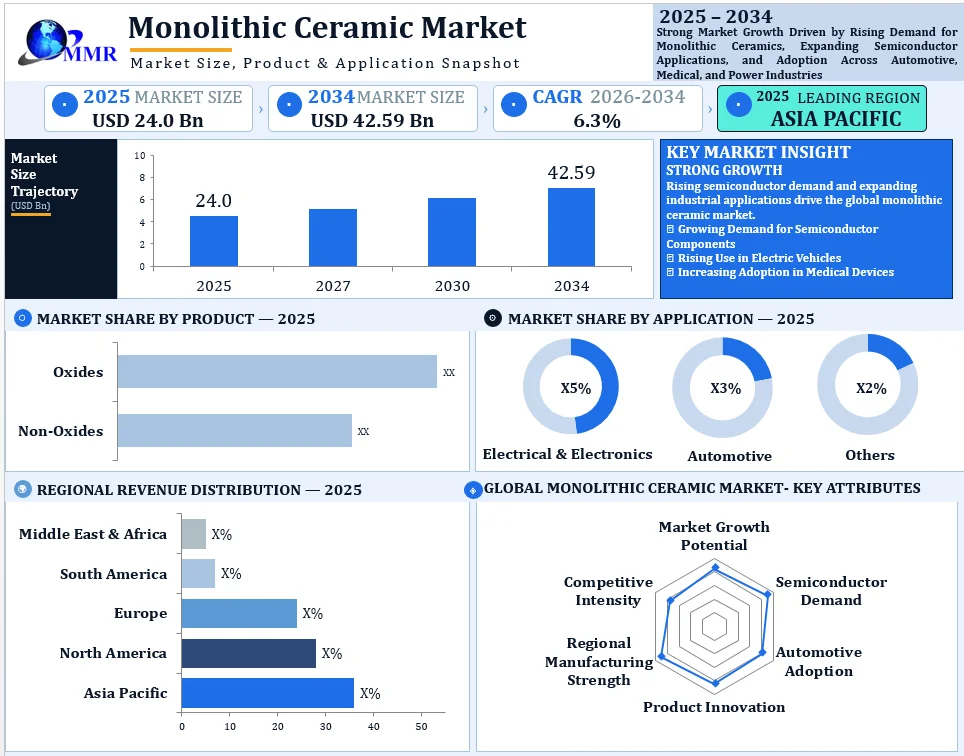
The Global Monolithic Ceramic Market is valued at USD 24.0 billion in 2025 and is projected to grow at a CAGR of 6.3% from 2026 to 2034, reaching USD 41.59 billion by 2034.
Global Monolithic Ceramic Market Overview
The global monolithic ceramic market comprises the production and supply of advanced ceramic materials manufactured as single, integrated structures. These materials offer excellent mechanical strength, hardness, thermal stability, corrosion resistance, wear resistance, and electrical insulation, making them suitable for demanding industrial applications. Major material types include alumina, zirconia, silicon carbide, silicon nitride, and other advanced ceramics, which support applications requiring durability and reliable performance under extreme operating conditions.
The market experiences growing demand from the electrical and electronics, semiconductor, automotive, aerospace and defence, medical, energy, and industrial manufacturing sectors. Monolithic ceramics support the production of electronic substrates, insulating components, automotive sensors, engine components, medical devices, and precision industrial equipment. Increasing investments in semiconductor manufacturing, electric vehicle production, renewable energy infrastructure, and advanced manufacturing further strengthen demand for high-performance ceramic materials.
Manufacturers focus on improving material purity, thermal conductivity, fracture toughness, and production efficiency through advancements in ceramic powder processing, precision machining, sintering, and additive manufacturing. However, high manufacturing costs, energy-intensive production, and machining complexities influence market growth. Increasing adoption of lightweight, durable, heat-resistant, and corrosion-resistant materials continues to create opportunities for the global monolithic ceramic market.
To know about the Research Methodology :- Request Free Sample Report
Global Monolithic Ceramic Market – Key Highlights
• The global monolithic ceramic market is valued at USD 24.0 billion in 2025 and projects a CAGR of 6.3% from 2026 to 2034.
• Oxide and non-oxide ceramics serve diverse applications due to their thermal stability, mechanical strength, corrosion resistance, and electrical insulation properties.
• Electrical and electronics applications account for 33.14% of market revenue in 2025, supported by semiconductor manufacturing and demand for advanced electronic components.
• Asia Pacific dominates the market with a 44.22% revenue share in 2025, driven by strong electronics, semiconductor, and automotive manufacturing.
• Increasing investments in electric vehicles, renewable energy, medical devices, and advanced ceramic manufacturing create new growth opportunities.
Global Monolithic Ceramic Market Dynamics
Global Monolithic Ceramic Market Drivers
Rising Demand from Electronics and Semiconductor Industries: The expansion of semiconductor manufacturing, electronic devices, and miniaturized components increases demand for monolithic ceramics due to their excellent electrical insulation, thermal stability, and dimensional precision. Electronics and semiconductor applications account for 33.14% of global monolithic ceramic market revenue in 2025, supporting demand for alumina, silicon carbide, and other high-performance ceramic materials.
Increasing Adoption in Automotive and Electric Vehicles: Growing electric vehicle production and the adoption of advanced automotive electronics increase the use of monolithic ceramics in power modules, sensors, thermal management systems, and high-temperature components. Their resistance to heat, wear, and chemical degradation supports reliable performance in demanding automotive environments.
Growing Applications in Medical and Healthcare: Increasing demand for dental restorations, medical implants, and precision healthcare components supports the adoption of zirconia and alumina ceramics. Their biocompatibility, hardness, and wear resistance make them suitable for dental crowns, prosthetic components, and specialized medical devices.
Global Monolithic Ceramic Market Restraints
High Manufacturing and Processing Costs: Monolithic ceramic production involves specialized raw materials, high-temperature sintering, precision machining, and quality-control processes. These requirements increase manufacturing costs and limit adoption in price-sensitive applications. High-purity ceramic powders and advanced processing equipment further influence production economics.
Material Brittleness and Machining Complexity: Despite their high hardness and thermal resistance, monolithic ceramics exhibit brittleness and limited fracture toughness compared with several metallic alternatives. Their machining, shaping, and finishing requirements increase production complexity and restrict their use in applications involving sudden impact or mechanical stress.
Global Monolithic Ceramic Market Opportunities
Expansion of Renewable Energy and Power Applications: Increasing investment in renewable energy, energy storage, and advanced power systems creates opportunities for monolithic ceramics in solid-oxide electrolyzers, electrical insulation components, and high-temperature energy equipment. The energy and power segment records a projected 6.99% CAGR through 2031, highlighting its growing demand potential.
Advancements in Advanced Ceramic Manufacturing: Developments in additive manufacturing, precision forming, powder processing, and advanced sintering improve the production of complex ceramic components. These technologies support applications in aerospace, defence, semiconductor equipment, and medical devices while creating opportunities for customized, high-performance ceramic solutions.
Global Monolithic Ceramic Market Challenges
Competition from Alternative Materials: Monolithic ceramics face competition from metals, polymers, composites, and ceramic-matrix composites in applications where toughness, flexibility, weight, or cost influences material selection. Manufacturers need to demonstrate superior thermal, mechanical, and chemical performance to strengthen adoption.
Raw Material Supply and Energy Consumption: Dependence on high-purity alumina, zirconia, silicon carbide, and specialized additives exposes manufacturers to raw material price fluctuations and supply-chain constraints. Energy-intensive firing and sintering processes also increase operating expenses and create challenges in improving production efficiency.
Global Monolithic Ceramic Market Segment Analysis
By Product
The product segment comprises non-oxide and oxide ceramics, which serve diverse industrial applications due to their distinct material properties. Non-oxide ceramics offer high thermal resistance, mechanical strength, and wear resistance, making them suitable for demanding engineering and high-temperature environments. Oxide ceramics provide excellent hardness, electrical insulation, corrosion resistance, and chemical stability, supporting their use in electronic components, medical devices, automotive systems, and industrial equipment. Increasing demand for durable, high-performance materials across advanced manufacturing industries supports the growth of both product categories.
By Application
The application segment comprises electrical and electronics, automotive, medical, and power industries. Monolithic ceramics play an important role in electronic substrates, electrical insulators, semiconductor components, automotive sensors, engine systems, dental restorations, medical implants, and power-generation equipment. Their excellent thermal stability, electrical insulation, mechanical strength, and resistance to corrosion support their adoption across these industries. Increasing semiconductor production, electric vehicle manufacturing, demand for advanced medical components, and investments in power infrastructure further drive the use of monolithic ceramic materials.
Global Monolithic Ceramic Market Regional Insights
Asia Pacific dominates the global monolithic ceramic market, supported by strong electronics manufacturing, semiconductor production, automotive manufacturing, and industrial development across China, Japan, India, and South Korea. The region benefits from established advanced ceramic production capabilities, expanding electric vehicle manufacturing, and increasing investments in semiconductor fabrication facilities. Growing demand for alumina ceramics, zirconia ceramics, silicon carbide, and silicon nitride supports applications in electronic substrates, automotive components, electrical insulators, and industrial equipment. The region accounts for 44.22% of global monolithic ceramic market revenue in 2025, supported by its manufacturing scale and growing consumption of high-performance ceramic materials.
North America maintains a significant position in the monolithic ceramic market through demand from the aerospace and defence, semiconductor, medical, automotive, and power industries. The United States drives regional development through investments in domestic semiconductor manufacturing, defence technologies, advanced electronics, and medical device production. Increasing demand for high-temperature ceramic components, precision engineering materials, electrical insulation, and semiconductor processing components supports market expansion. Canada and Mexico contribute through industrial manufacturing, automotive production, and specialized engineering applications.
Europe represents an established market for monolithic ceramics, supported by advanced automotive manufacturing, aerospace engineering, industrial automation, healthcare technologies, and energy transition initiatives. Germany, France, the United Kingdom, and Italy contribute through demand for technical ceramics, zirconia components, alumina-based materials, and high-performance insulating ceramics. Increasing investments in electric vehicles, renewable energy systems, hydrogen technologies, and advanced manufacturing strengthen the adoption of monolithic ceramic materials across the region.
South America experiences growing demand for monolithic ceramics through industrial manufacturing, automotive production, mining, energy generation, and electrical infrastructure development. Brazil and Argentina support regional consumption through their industrial and manufacturing activities. Increasing requirements for wear-resistant ceramic components, corrosion-resistant materials, thermal insulation, and industrial equipment components create opportunities for market participants. Investments in power infrastructure and industrial modernization further support regional demand.
The Middle East and Africa market develops through investments in energy infrastructure, industrial manufacturing, mining, power generation, and construction-related industries. Saudi Arabia, the UAE, South Africa, and other developing economies support demand for high-temperature ceramics, electrical insulation materials, corrosion-resistant components, and advanced industrial ceramics. Expanding energy projects, industrial diversification, and infrastructure modernization strengthen the adoption of monolithic ceramic materials across the region.
Global Monolithic Ceramic Market – Competitive Landscape
The global monolithic ceramic market features established advanced ceramic manufacturers and specialized technical ceramic suppliers competing through product innovation, material quality, manufacturing capabilities, pricing, and geographical presence. Key players focus on expanding their product portfolios across oxide ceramics, non-oxide ceramics, electronic substrates, industrial ceramic components, and high-temperature materials. Research indicates a moderately concentrated market, with the five leading companies accounting for around 41% of global market revenue in 2025.
Leading Market Participants
|
Company |
Competitive Position |
Key Product Focus |
|
Kyocera Corporation |
Global advanced ceramics |
Alumina, zirconia, silicon nitride |
|
CoorsTek Inc. |
Industrial and technical ceramics |
Alumina, silicon carbide and |
|
CeramTec GmbH |
Specialist in high-performance |
Oxide and non-oxide ceramics for |
|
Morgan Advanced Materials |
Advanced materials and engineering |
Technical ceramics, insulation |
|
Saint-Gobain |
Diversified materials manufacturer |
Advanced ceramics, refractory |
These companies maintain their competitive positions through specialized material development, application engineering, manufacturing capabilities, and customer relationships.
Competitive Strategy Analysis
|
Competitive Factor |
Industry Approach |
Strategic Importance |
|
Product Innovation |
Development of advanced oxide and |
Improves material performance and |
|
Manufacturing Capabilities |
Investment in precision forming, |
Enhances product quality and |
|
Research and Development |
Improvement in thermal stability, |
Supports technological |
|
Customization |
Development of |
Strengthens customer relationships |
|
Geographic Expansion |
Strengthening distribution and |
Improves regional market access |
|
Strategic Partnerships |
Collaboration with industrial, |
Supports product development and |
Global Monolithic Ceramic Market – Recent Developments
|
Date |
Company |
Development |
Impact |
|
14 January 2026 |
Steinbach AG |
Acquires |
Increases |
|
15 April 2026 |
Kyocera Corporation |
Expands |
Strengthens |
|
27 April 2026 |
NGK Corporation |
Announces |
Strengthens |
|
27 May 2026 |
Schunk Group |
Begins |
Supports |
|
22 September 2026 |
CeramTec GmbH |
Opens |
Strengthens |
|
28 October 2026 |
Lithoz GmbH |
Introduces |
Improves |
Global Monolithic Ceramic Market Scope : Inquire before buying
| Monolithic Ceramic Market | |||
|---|---|---|---|
| Report Coverage | Details | ||
| Base Year: | 2025 | Forecast Period: | 2026-2034 |
| Historical Data: | 2020 to 2025 | Market Size in 2025: | USD 24.0 Bn. |
| Forecast Period 2026 to 2034 CAGR: | 6.3% | Market Size in 2034: | USD 42.59 Bn |
| Segments Covered: | by Product | Non-Oxides Oxides |
|
| by Application | Electrical and Electronics Automotive Medical Power |
||
Monolithic Ceramic Market, by Region
• North America (United States, Canada and Mexico)
• Europe (UK, France, Germany, Italy, Spain, Sweden, Austria and Rest of Europe)
• Asia Pacific (China, South Korea, Japan, India, Australia, Indonesia, Malaysia, Vietnam, Taiwan, Bangladesh, Pakistan and Rest of APAC)
• Middle East and Africa (South Africa, GCC, Egypt, Nigeria and Rest of ME&A)
• South America (Brazil, Argentina Rest of South America)
Key Players Operating the Monolithic Ceramic Market,
1. Pingxiang NANXIANG Chemical Packing Co., Ltd.
2. Pingxiang Yingchao Chemical Packing Co., Ltd.
3. Pingxiang Xingfeng Chemical Packing Co., Ltd.
4. McDanel Advanced Ceramic Technologies
5. Advanced Ceramics Manufacturing LLC
6. Saint-Gobain Ceramic Materials
7. Morgan Advanced Materials plc
8. Murata Manufacturing Co., Ltd.
9. KYOCERA Corporation
10. Rauschert GmbH
11. Elan Technology
12. CoorsTek, Inc.
13. 3M Company
14. Corning Incorporated
15. CeramTec GmbH
16. Godo Ceramics Ltd.
17. Zircoa, Inc.
18. Allied Mineral Products
19. NGK Insulators, Ltd.
20. Niterra Co., Ltd. (formerly NGK Spark Plug Co., Ltd.)
21. AGC Ceramics Co., Ltd.
22. Almatis GmbH
23. APC International, Ltd.
24. Applied Ceramics, Inc.
25. Blasch Precision Ceramics, Inc.
26. BCE Special Ceramics GmbH
27. Central Electronics Limited
28. Dyson Technical Ceramics
29. ENrG, Inc.
30. Ferrotec Holdings Corporation
31. International Syalons (Newcastle) Ltd.
32. MARUWA Co., Ltd.
33. Materion Corporation
34. Momentive Technologies
35. Noritake Co., Limited
36. Ortech Advanced Ceramics
37. Superior Technical Ceramics
38. TOSOH Corporation
39. Vesuvius plc
40. Wonik QnC Corporation
41. Nishimura Advanced Ceramics Co., Ltd.
42. Small Precision Tools, Inc.
43. Sparkler Ceramics Pvt. Ltd.
44. Mantec Technical Ceramics Ltd.
45. IBIDEN Co., Ltd.
46. SGL Carbon SE
47. Sumitomo Electric Industries, Ltd.
48. Precision Ceramics USA
49. PremaTech Advanced Ceramics
50. Accuratus Corporation
Frequently Asked Questions:
1. What is the global monolithic ceramic market size in 2025?
Ans. The global monolithic ceramic market is valued at USD 24.0 billion in 2025.
2. What is the projected CAGR of the global monolithic ceramic market?
Ans. The market is projected to grow at a CAGR of 6.3% from 2026 to 2034.
3. What is the projected market size by 2034?
Ans. The global monolithic ceramic market is projected to reach USD 42.59 billion by 2034.
4. Which region dominates the global monolithic ceramic market?
Ans. Asia Pacific dominates the market with a 44.22% revenue share in 2025.
5. Which are the major application segments of the monolithic ceramic market?
Ans. The major application segments include electrical and electronics, automotive, medical, and power industries.