
Industrial metrology Market Size by Offering, Equipment Type, Application, End-User and Region – Segment-Level Market Assessment, Growth Opportunity Analysis, Competitive Mapping & Forecast to 2034
Overview
The Industrial Metrology Market size was valued at USD12.92 Billion in 2025 and the total Industrial Metrology revenue is expected to grow at a CAGR of 6.2% from 2026 to 2034, reaching nearly USD 22.20 Billion.
Global Industrial Metrology Market Overview:
The design and maintenance of controlled production processes in modern industry are primarily based on measurements. Metrology, the science of measurement, is essential not only in industry but in every aspect of personnel in all fields of measurement, thus metrology is essential for the development of science and technology in all countries. The need for precise dimensional analysis and validation of geometric accuracy is a primary driver of Industrial Metrology Market growth. Industries are increasingly depending on metrology equipment to ensure product quality and compliance with stringent standards. Advancements in metrology technologies, such as non-contact measurement methods and 3D scanning, are enhancing measurement accuracy and efficiency, further accelerating Industrial Metrology Market growth.
Industrial Metrology Market Growth and Share Analysis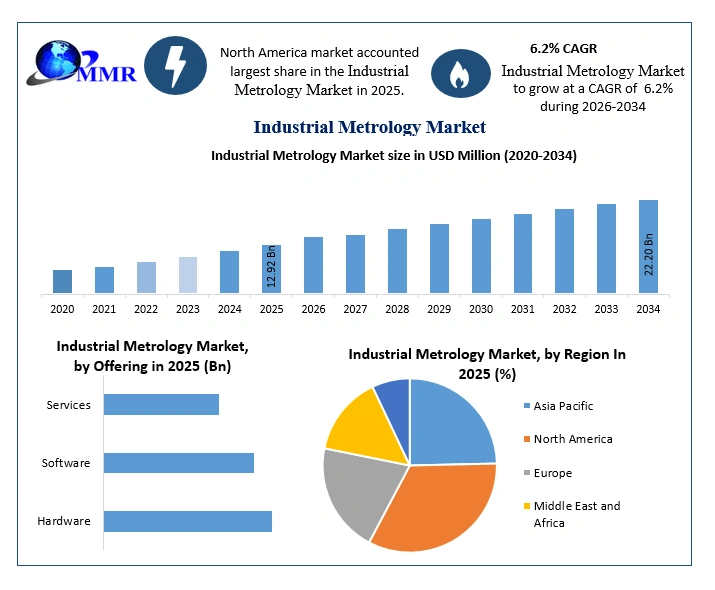
To know about the Research Methodology :- Request Free Sample Report
Industrial Metrology Market Trend:
The future of industrial metrology promises a dynamic transformation characterized by digitalization, automation, and advanced technologies. As Industry 4.0 continues to evolve, metrology integrates with digital systems, leveraging IoT and cloud computing for real-time data analysis, thereby enhancing process control and enabling remote monitoring. Advanced 3D scanning and printing technologies revolutionize product design and quality control, facilitating rapid prototyping and customization. Artificial intelligence and machine learning play important roles in data analysis, predictive maintenance, and process optimization, reducing downtime and boosting efficiency.
Miniaturization of metrology tools enables on-site measurements and greater flexibility, while augmented reality and virtual reality applications provide intuitive visualizations and enhance training. Sustainable practices and blockchain technology for data traceability become essential, and emerging quantum technologies enable ultra-precise measurements, setting the stage for innovation in various industries. Harmonization of metrology standards at the global level is for facilitating international trade and ensuring compatibility across diverse sectors. Together, these trends represent a promising future for industrial metrology, promoting efficiency, innovation, and quality assurance.
Industrial Metrology: The Future
Industrial metrology is a beneficial process that helps meet the demand for manufacturing high-quality products that comply with internationally recognized standards. The industrial metrology infrastructure enforces and confirms the accuracy and traceability criteria necessary to validate the reliability of the measurements. However, the high cost of precision equipment has hampered the maintenance of inventory consistency in various industries, necessitating manufacturers to outsource measurement needs. Thus, there is scope for cost-effective production of high-precision equipment.
Industrial Metrology Impact on Economy.
Industrial metrology significantly impacts the economy by enhancing product quality, reducing costs through efficient processes, and fostering innovation. It ensures compliance with international standards, facilitating global trade and market expansion. Precise measurements also enable predictive maintenance, reducing downtime and increasing productivity. Research and development benefit from metrology, leading to breakthrough innovations. Compliance with regulatory requirements is essential in industries such as aerospace and healthcare. Metrology creates export opportunities and stimulates job growth through skill development. Industrial metrology makes industries more competitive and contributes to economic growth and stability.
Industrial Metrology Market Dynamics:
Increasing Demand for Quality Control and Inspection Boosts the Industrial Metrology Growth
The industrial metrology market is growing due to the increasing demand for quality control and inspection. In today's viciously competitive business environment, prioritizing top-tier product quality is essential. Key sectors such as automotive, aerospace, manufacturing, and electronics depend extensively on industrial metrology to guarantee that their products consistently meet and uphold stringent quality standards. This proactive approach ensures product quality but also minimizes defects and costly rework, saving both time and resources. Additionally, it helps industries comply with regulatory standards and enhances customer satisfaction. The continuous advancement of technology enhances industrial metrology solutions, providing faster, more precise, and non-destructive measurement methods. This heightened sophistication intensifies the demand for these systems, solidifying their indispensable role in modern manufacturing, quality assurance, and process optimization.
Increasing Automotive Industry Drives Market Growth
The automotive industry is an important and enduring market for industrial metrology due to its stringent precision and quality control requirements. Automotive manufacturing relies heavily on metrology tools like coordinate measuring machines (CMMs) and laser scanners to ensure that components meet exact specifications and tolerances. With the increasing complexity of vehicle designs, metrology solutions are indispensable for measuring intricate surfaces and contours with sub-millimeter precision, allowing manufacturers to create aerodynamic and lightweight components while maintaining structural integrity. Moreover, the automotive sector's adherence to strict safety standards, including those for airbags, collision avoidance systems, and crash tests, underscores the role of metrology in guaranteeing compliance.
Integration of industrial metrology processes is expected to limit market growth due to high initial costs, resistance to change, technical barriers, and data management challenges. Smaller companies may find these barriers prohibitive, while compatibility issues and regulatory compliance complexities slow adoption. Additionally, the uncertainty surrounding return on investment prevents potential users. However, successful integration offers improved accuracy, efficiency, and quality control, ultimately driving market growth by enhancing product and process quality. Overcoming these limitations requires careful planning, proper training, and a focus on long-term ROI, allowing companies to compete and thrive in their industries.
Industry 4.0 and Smart Manufacturing Creates Lucrative Growth Opportunities for Market Growth
Industry 4.0 and Smart Manufacturing represent a transformative shift in the industrial landscape. These approaches leverage advanced technologies like IoT sensors, artificial intelligence, and big data analytics to create highly interconnected and intelligent manufacturing systems. In Industry 4.0, factories become "smart" by collecting and analyzing real-time data from machines and processes, enabling predictive maintenance, process optimization, and better decision-making. Smart Manufacturing goes beyond this, emphasizing the integration of data, communication, and collaboration across the entire value chain, from suppliers to customers. These approaches improve efficiency, reduce downtime, enhance quality control, and enable more flexible and customized production. Industrial metrology plays a pivotal role in this context by providing precise measurement data that underpins the quality and reliability of smart manufacturing processes, ensuring that products meet exact specifications in this era of data-driven production.
Industrial Metrology Market Segment Analysis:
Based on Offering, the services segment holds the maximum share in 2025 and boost at a high CAGR in the year 2034. The industrial metrology market requires high investments to install and the lack of experts responsible for segmentation growth. As a result, major manufacturing companies are outsourcing industry metrology to reduce costs. The software segment is expected to register a significant share of the global market, due to the high cost incurred in setting up a metrology facility and the lack of metrology experts. The growing adoption of cloud-based services among manufacturing industries is also boosting the software segment.
Based on Equipment, The market is categorized by equipment type CMM equipment dominate the Market in the year 2025. CMM equipment stands out as the most widely adopted choice among end-users and is expected to dominate the global market share. CMM machines come in both contact and non-contact models, featuring touch probes and spherical objects for precise measurements.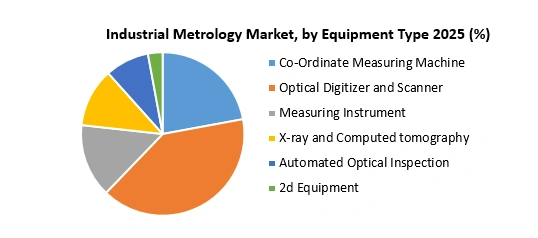 These machines play a pivotal role in the manufacturing industry accurately measuring and recording the physical-geometrical characteristics of objects. The increasing demand for precision dimensional analysis and validation of geometric accuracy across various sectors, including manufacturing, aerospace, and automotive, is propelling the growth of this segment. In essence, CMM equipment serves as an indispensable tool in meeting the exacting standards of these industries, fueling its market prominence.
Industrial Metrology Market Regional Insight
North American region holds a significant share of the global Industrial Metrology Market in the year 2025. The industrial metrology market's propulsion is attributed to advanced manufacturing sectors, encompassing aerospace, automotive, and electronics. The United States and Canada highest growth in this region, emphasizing stringent quality control and precision measurement within manufacturing operations. However, The Asia Pacific region emerged as the fastest-growing hub for industrial metrology.
This surge in demand is largely attributed to the thriving manufacturing landscapes in nations like China, Japan, South Korea, and India. The relentless growth of these sectors has heightened the need for precise measurement and quality assurance processes, elevating the significance of industrial metrology. Consequently, the Asia Pacific region has become a focal point for the industry, with expanding opportunities and an ever-increasing demand for metrology solutions in these flourishing manufacturing economies. The region has seen increased investments in metrology equipment to enhance product quality and manufacturing efficiency.
Industrial Metrology Ecosystem

Competitive Landscape:
The global Industrial Metrology market is highly competitive. The report provides a comprehensive analysis of the key players in the Global Industrial Metrology Market. The Major players in the market are focusing on mergers and acquisitions to innovate the products and maintain sustainability. Also, the key players rising focus on partnerships and investment to expand the product portfolio. As the industrial metrology market evolves, players are increasingly focusing on non-contact measurement methods, Industry 4.0 integration, and expanding into emerging markets. To boom in a competitive area, commitment to innovation, adherence to regulations, and adaptability to changing markets are crucial. Extensive R&D investments keep leaders ahead in technology. Pricing strategies, marketing efforts, and customer support help in their competitiveness. Moreover, strategic partnerships and acquisitions contribute to their growth and diversification.
Industrial Metrology Market Recent Industry Developments
| Date | Company | Development | Impact |
|---|---|---|---|
| 06 May 2025 | Hexagon Manufacturing Intelligence | Hexagon launched MAESTRO, its next-generation coordinate measuring machine (CMM) featuring cloud-connected workflows, advanced sensors, and high-speed precision inspection. | The launch improves inspection throughput, automation, and digital quality control for automotive, aerospace, and precision manufacturing industries. |
| 07 May 2025 | Hexagon Manufacturing Intelligence & ZeroTouch | Hexagon partnered with ZeroTouch (Sandvik) to introduce high-speed, non-contact inline metrology systems for European precision manufacturers. | The collaboration enables 100% inline dimensional inspection, reducing scrap and enhancing manufacturing quality in high-volume production. |
| 16 June 2025 | Hexagon Manufacturing Intelligence | Hexagon unveiled the Autonomous Metrology Suite, an AI-enabled software platform that automates CMM programming, inspection, and reporting through its Nexus cloud platform. | The solution accelerates quality inspection workflows while reducing dependence on highly skilled metrology programmers. |
| 16 December 2025 | Hexagon AB | Hexagon acquired IconPro, integrating its AI-powered predictive maintenance platform into industrial metrology and CMM solutions. | The acquisition strengthens AI-driven equipment monitoring, improving metrology system uptime, reliability, and operational efficiency. |
| 21 April 2026 | Hexagon Manufacturing Intelligence | Hexagon released QUINDOS 2026.1, adding advanced CMM monitoring, faster scanning, and enhanced inspection analysis for complex metrology applications. | The software upgrade boosts measurement productivity, accuracy, and standards-compliant inspection across industrial manufacturing environments. |
Industrial Metrology Market Scope: Inquire before buying
| Industrial Metrology Market | |||
|---|---|---|---|
| Report Coverage | Details | ||
| Base Year: | 2025 | Forecast Period: | 2026-2034 |
| Historical Data: | 2020 to 2025 | Market Size in 2025: | USD 12.92 Bn. |
| Forecast Period 2026 to 2034 CAGR: | 6.2% | Market Size in 2034: | USD 22.20 Bn. |
| Segments Covered: | by Offering | Hardware Software Services |
|
| by Equipment Type | Coordinate Measuring Machine Optical Digitizer and Scanner Measuring Instrument X-Ray and Computed Tomography Automated Optical Inspection 2D Equipment |
||
| by Application | Reverse Engineering Quality Control & Inspection Mapping and Modelling Other Applications |
||
| by End-User | Aerospace and Defense Automotive Manufacturing Semiconductor Other End User Industries |
||
Industrial Metrology Market by Region
North America (United States, Canada, and Mexico)
Europe (UK, France, Germany, Italy, Spain, Sweden, Austria, and the Rest of Europe)
Asia Pacific (China, South Korea, Japan, India, Australia, Indonesia, Malaysia, Vietnam, Taiwan, Bangladesh, Pakistan, and the Rest of APAC)
Middle East and Africa (South Africa, GCC, Egypt, Nigeria, and the Rest of ME&A)
South America (Brazil, Argentina Rest of South America)
Industrial Metrology Market Key Players
1. Hexagon AB (Sweden)
2. Renishaw PLC (UK)
3. FARO Technologies (US)
4. Carl Zeiss AG (Germany)
5. Nikon (Japan)
6. Jenoptik (Germany)
7. KLA Corporation (US)
8. Mitutoyo Corporation (Japan)
9. Automated Precision Inc
10. Baker Hughes (US)
11. CyberOptics (US)
12. Cairnhill Metrology (Singapore)
13. ATT Metrology Services (US)
14. SGS Group (Switzerland)
15. TriMet (US)
16. Applied Materials Inc. (US)
Frequently Asked Questions:
1] What segments are covered in the Global Industrial Metrology Market report?
Ans. The segments covered in the Industrial Metrology Market report are based on Offering, Equipment Type, Application, End User, and Regions.
2] Which region is expected to hold the highest share in the Global Industrial Metrology Market?
Ans. The North American region is expected to hold the highest share of the Industrial Metrology Market.
3] What was the Global Industrial Metrology Market size in 2025?
Ans: The Global Industrial Metrology Market size was USD 12.92 Billion in 2025.
4] What is the forecast period for the Global Industrial Metrology Market?
Ans. The forecast period for the Industrial Metrology Market is 2026-2034.
5] What is the market size of the Global Industrial Metrology Market in 2034?
Ans. The market size of the Industrial Metrology Market in 2034 is valued at USD 22.20 Bn.