
Hospital Information Systems Market – Industry Structure Evaluation, Demand Drivers Analysis, Regional Growth Analysis and Identification, Competitive Positioning Review & Global Market Size Forecast to 2032
Overview
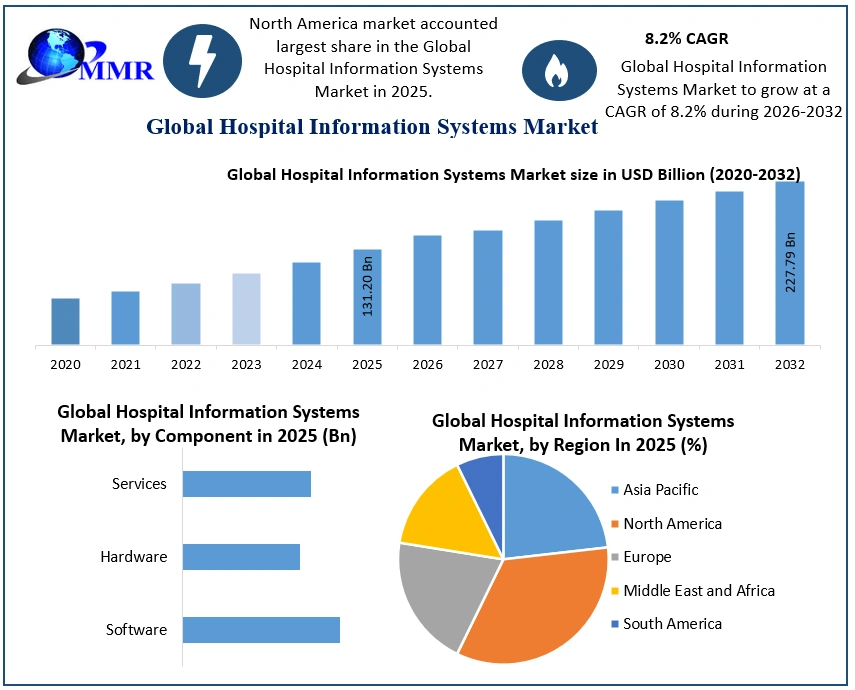
The Hospital Information Systems Market size was valued at USD 131.20 Billion in 2025 and the total Hospital Information Systems revenue is expected to grow at a CAGR of 8.2% from 2025 to 2032, reaching nearly USD 227.79 Billion by 2032.
Global Hospital Information Systems Market Overview
Global Hospital information system (HIS) hospitals software platforms designed to manage clinical, administrative, financial and operational functions. They improve the care of the patient, streamline workflows, and increase data accuracy in departments.
Global Hospital Information Systems (HIS) Market has been experiencing significant growth driven by the rising demand for digital healthcare infrastructure, improved patient care, and streamlined clinical workflows. Key drivers include increasing adoption of Electronic Health Records (EHRs), growing need for integrated healthcare systems and government mandates for digital documentation and data security. The software segment leads the market owing to its scalability, real-time data management and support for telehealth and AI-driven analytics.
North America dominated the market in 2025 due to strong healthcare IT investments, favourable policies like the HITECH Act and the presence of leading players such as Cerner Corporation, Epic Systems Corporation, Allscripts Healthcare Solutions, and MEDITECH. emerging markets, where digitization in healthcare is expanding rapidly, especially across Asia-Pacific. As hospitals prioritize patient engagement, data security and operational efficiency, the hospital information system market is set to witness continued innovation and adoption across all healthcare settings.
To know about the Research Methodology :- Request Free Sample Report
Increase the accuracy of the information, lowers, errors and reduces the time for documentation. With the rise in number of patients and varying disease Products, it becomes complicated to make the data available to financiers and regulatory authorities. If the information is not conveyed properly, it can result in poor delivery of care. With the help of HIS, professionals can take proper care and provide proper medications to patients by studying their health history.
The growing urge of hospitals and adoption of upgraded automation systems are expected to drive the market for HIS. Inefficiency of manual procedures and increased patient flow in hospitals has created a demand for such systems. Moreover, recently developed information systems possess additional and advanced benefits such as easy data access, high data security, maximum flexibility and data integrity.
Hence, there is an increased demand for Information systems which is expected to drive the market in the forecast period. Rapid development in healthcare infrastructure coupled with other factors such as increasing investments, favourable reimbursement policies for patients are encouraging hospitals to opt for information systems to maintain consistency of healthcare procedures. Information systems improve the data efficiency, minimizes data duplication and protects the data from thefts. The stated factors are expected to favour the market growth for hospital information systems in the forecast period.
The report contains detailed analysis of Strengths, Weakness and opportunities of the key players operating in the Hospital Information systems market. It also provides information on current market trends, competitive ranking analysis, regional bifurcation, turnover forecasts, industry drivers and the key challenges.
The report has profiled eighteen key players in the market from different regions. However, the report has considered all market leaders, followers and new entrants with investors while analysing the market and estimation the size of the same. The growing healthcare infrastructure in each region is different and focus is given on availability of advanced technology and new techniques.
Global Hospital Information Systems Market Segment Analysis
By Type, the Electronic Health Records (EHRs) holds the largest market share in the Global Hospital Information Systems Market. According to MMR analysis, the segment is further expected to grow at a CAGR of 8.3 % during the forecast period. In the Hospital Information Systems (HIS) market, Electronic Health Records (EHRs) dominate the segment, holding the largest share due to their critical role in modern healthcare delivery and compliance requirements. EHRs serve as the backbone of hospital IT infrastructure, providing a comprehensive, digital version of a patient’s health history that is accessible across multiple healthcare providers. Unlike standalone systems, EHRs integrate medical history, diagnoses, medications, treatment plans, laboratory results, and imaging data, ensuring seamless information flow and continuity of care.

The dominance of EHRs is driven by increasing government mandates and policies that encourage or enforce the adoption of digital health records to improve efficiency, reduce medical errors, and support value-based healthcare. For example, initiatives in the United States under the HITECH Act, and similar programs in Europe and Asia, have accelerated adoption rates. Additionally, the rising demand for interoperability and data sharing across healthcare systems further strengthens the need for robust EHR platforms.
Hospitals also prefer EHRs due to their ability to integrate with advanced technologies such as AI, cloud computing, and analytics, enabling predictive care and operational efficiency. The growing trend of telehealth and remote patient monitoring has made EHRs even more indispensable, as they act as central repositories for patient data, accessible in real-time by clinicians across different settings.
Global Hospital Information Systems Market Regional Analysis
North America dominated the market in 2025 & is expected to hold largest share during the forecast period. Hospital's information system (HIS) market, mainly due to its advanced healthcare infrastructure and strong emphasis on digital changes. The sector benefits from adequate investment in Healthcare IT, which is supported by favourable government initiatives like Health Information Technology for Economic and Clinical Health (Hitech) Act and Affordable Care Act (ACA), which promotes adoption of electronic health records and inter -operational systems.
Presence of major market players such as Cerner Corporation, EPIC Systems, and Allscripts contributes to the widespread implementation of innovation and their solutions. The focus of the area on the improvement of the patient's consequences through data-powered decision making, clinical workflow adaptation and individual healthcare of the patient further enhances the growth of the market. Regulatory structures that support data security, interoperability, and price-based care, encourage hospitals and clinics to refine their platforms. These factors collectively make North America a leading area in the global market, which set a benchmark to follow other areas.
Global Hospital Information Systems Market Competitive Landscape
Major Key Players of the global hospital information market Cerner Corporation, Epic Systems Corporation and Allscripts Healthcare Solutions, Inc. Cerner Corporation is a global leader, providing advanced EHR platforms and population health management tools, widely adopted by large hospital networks. Epic Systems Corporation, known for its robust, customizable software, dominates the U.S. hospital segment with its MyChart and EpicCare platforms, emphasizing patient engagement and seamless data exchange.
Allscripts Healthcare Solutions, Inc. offers a wide suite of solutions from EHRs to revenue cycle management, targeting mid-sized and large healthcare providers with an emphasis on open and connected systems. These companies are constantly innovating to meet regulatory requirements and enhance patient outcomes through AI, data analytics and cloud-based solutions.
The competitive landscape is also shaped by regional players and tech firms entering the healthcare space, intensifying the race for scalable, secure, and patient-centric HIS platforms. Strategic partnerships and acquisitions remain key growth strategies.
Global Hospital Information Systems Market Trends
| Trend | Description |
| AI and Predictive Analytics Integration | Increasing use of AI for diagnostics, patient monitoring, and clinical decisions. |
| Interoperability Focus | Demand for seamless data exchange across multiple healthcare systems and platforms. |
| Cybersecurity Enhancements | Stronger security protocols due to increasing cyber threats and data breaches. |
Global Hospital Information Systems Key Developments:
In 15 January 2024 Cerner Corporation (North America) launched an AI-driven clinical decision support tool integrated into its Millennium EHR to enhance diagnostic accuracy and streamline clinician workflows.
In 10 March 2024 Epic Systems Corporation (North America) launched "Epic Garden," an AI-powered analytics module focused on enhancing mental health and behavioural care insights within its EHR system.
In 5 June 2025 Orion Health (Asia-Pacific), introduced advanced population health analytics tools designed to support integrated care delivery and data-driven decision-making across healthcare systems.
In 18 September 2024 Siemens Healthineers (Europe), launched a cloud-native Hospital Information System in collaboration with AWS, aiming to enhance scalability and secure data management across European hospitals.
Global Hospital Information Systems Market Scope : Inquire before buying
| Global Hospital Information Systems Market | |||
|---|---|---|---|
| Report Coverage | Details | ||
| Base Year: | 2025 | Forecast Period: | 2026-2032 |
| Historical Data: | 2020 to 2025 | Market Size in 2025: | USD 131.20 Billion |
| Forecast Period 2026 to 2032 CAGR: | 8.2% | Market Size in 2032: | USD 227.79 Billion |
| Segments Covered: | by Component | Software Hardware Services |
|
| by Type | Electronic Health Record Electronic Medical Record Real-time Healthcare Patient Engagement Solution Population Health Management Others |
||
| by Deployment | Web-based On-premises Cloud-based |
||
Hospital Information Systems Market, by Region
North America (United States, Canada, and Mexico)
Europe (UK, France, Germany, Italy, Spain, Sweden, Austria, and the Rest of Europe)
Asia Pacific (China, South Korea, Japan, India, Australia, Indonesia, Philippines, Malaysia, Vietnam, Thailand and Rest of APAC)
Middle East & Africa (South Africa, GCC, Nigeria, Rest of ME&A)
South America (Brazil, Argentina, Rest of South America)
Hospital Information Systems Market, Key Players
1. Epic Systems
2. Oracle Health
3. MEDITECH
4. Allscripts / Veradigm
5. athenahealth
6. eClinicalWorks
7. NextGen Healthcare
8. GE HealthCare
9. Siemens Healthineers
10. Philips Healthcare
11. Dedalus Group
12. InterSystems
13. Wipro
14. Tata Consultancy Services (TCS)
15. NTT DATA
16. Agfa HealthCare
17. Neusoft Medical Systems
18. Netsmart Technologies
19. TruBridge
20. Medhost
21. Altera Digital Health
22. Greenway Health
23. eMDs
24. Orion Health
25. Optum
26. Modernizing Medicine (ModMed)
27. DrChrono
28. Practice Fusion
29. 3M Health Information Systems
Frequently Ask Questions
1. What was the market size of the Hospital Information Systems market in 2025?
Ans The Hospital Information Systems market was valued at USD 131.20 Billion in 2025.
2. Which region dominated the HIS market in 2025 and why?
Ans North America dominated due to advanced healthcare infrastructure, high IT investment, and supportive government policies.
3. Which segment led the market based on components?
Ans The software segment led the market due to demand for EHRs, analytics.
4. What is one major trend shaping the HIS market?
Ans Integration of AI and predictive analytics for diagnostics and patient monitoring is a major trend.
5. Name a key development by Cerner Corporation in 2024.
Ans On January 15, 2024, Cerner launched an AI-powered clinical decision support tool integrated into its Millennium EHR.