
Histone Deacetylase Inhibitors Market Size by Class, Application, End-User and Region – Segment-Level Market Assessment, Growth Opportunity Analysis, Competitive Mapping & Forecast to 2030
Overview
Global Histone Deacetylase Inhibitors Market size was valued at USD 1.27 Bn. in 2023 and the total Histone Deacetylase Inhibitors revenue is expected to grow by 7.74 % from 2024 to 2030, reaching nearly USD 2.14 Bn.
Histone Deacetylase Inhibitors Market Overview:
Histone deacetylase (HDAC) inhibitors are a new class of anti-cancer agents that play important roles in epigenetic or non-epigenetic regulation. The Histone Deacetylase Inhibitors Market is currently undergoing rapid growth, driven by the promising role of histone deacetylase (HDAC) inhibitors in cancer treatment. These inhibitors are finding application in the treatment of various diseases, particularly cancer and neurodegenerative disorders, thanks to their ability to modulate gene expression patterns. The growing market owes its growth to several key factors, the increasing global incidence of cancer, has created a growing demand for innovative treatment options. Ongoing advancements in epigenetic research have highlighted the therapeutic potential of HDAC inhibitors. For instance, the recent collaboration between AMO PHARMA and Ranedis Pharmaceuticals to develop RND-001 for specific lysosomal storage disorders and neurodegenerative disorders represents the dynamic nature of the Histone Deacetylase Inhibitors market.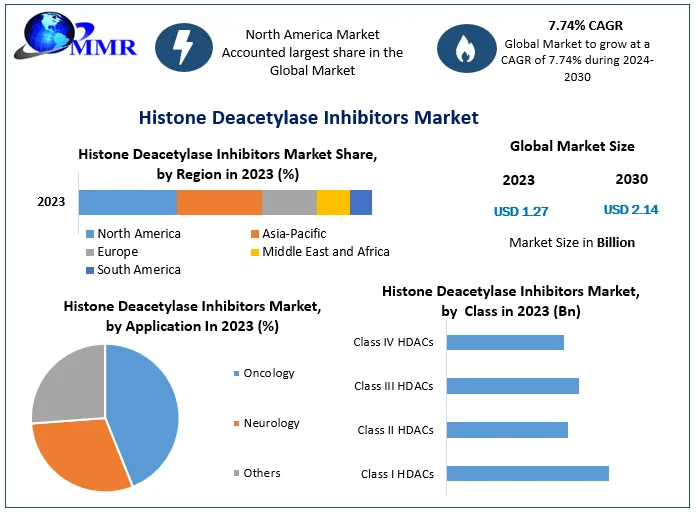 To know about the Research Methodology :- Request Free Sample Report
Histone Deacetylase Inhibitors Market Scope and Research Methodology
The Histone Deacetylase Inhibitors Market report offers a thorough evaluation of the market for the forecast period. It examines patterns and factors shaping the market, including drivers, constraints, opportunities, and challenges. The report also provides expected revenue growth for the Histone Deacetylase Inhibitors Market during the forecast period. The research on the Histone Deacetylase Inhibitors Market analyses major applications, business strategies, and influencing factors. The report examines market trends, volume, cost, share, supply, and demand, and utilizes methods like SWOT and PESTLE analysis. Primary research resources include databases and surveys.
Histone Deacetylase Inhibitors Market Dynamics: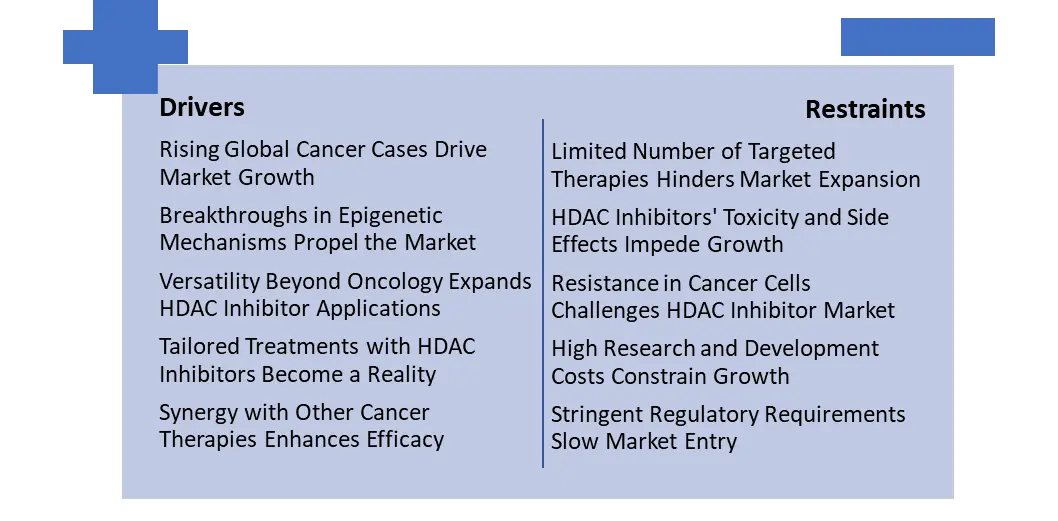
Personalized Treatments with HDAC Inhibitors on the Rise
The Histone Deacetylase Inhibitors Market is experiencing significant growth driven by multiple factors. The rising global cancer cases have become a primary driver, with Novartis' panobinostat (Farydak) addressing the need for innovative oncology therapies in the treatment of multiple myeloma. Ongoing breakthroughs in understanding epigenetic mechanisms are propelling the market forward, as exemplified by Celgene's romidepsin (Istodax) for cutaneous T-cell lymphoma. HDAC inhibitors are finding applications beyond oncology, with Novartis developing treatments for neurodegenerative disorders, showcasing market versatility. The tailoring of treatments to individual patients using HDAC inhibitors is becoming a reality, with Mirati Therapeutics leading the way in precision oncology. Synergies with other cancer therapies are enhancing treatment efficacy, emphasized by Beigene's research in combination treatments.
The Histone Deacetylase Inhibitors market is further growing into rare diseases and orphan indications, as seen in TetraLogic Pharmaceuticals' initiatives. HDAC inhibitors are also gaining ground in the treatment of neurological disorders like multiple sclerosis, with Eisai's eribulin mesylate (Halaven) demonstrating their application. Substantial investments from pharmaceutical companies in HDAC inhibitor research and development are fueling market growth, and Pfizer's presence in this space underscores industry commitment.
The development of HDAC inhibitors is increasingly driven by precision medicine and biomarker-driven strategies, as evidenced by Pharmacyclics' abexinostat (Xpovio) in multiple myeloma treatment. Collaborations and investments in HDAC inhibitor manufacturing are further signaling market growth, with Crown Bioscience's preclinical drug development services contributing to growth by supporting research efforts.
High R&D Costs Constrain Histone Deacetylase Inhibitors Market
A prominent restraint in the Histone Deacetylase Inhibitors Market is the limited number of targeted therapies, exemplified by Novartis' panobinostat's promise in multiple myeloma but a restricted scope in treating various cancer types, impeding broader Histone Deacetylase Inhibitors market growth. HDAC inhibitors are also associated with significant toxicity and side effects, as seen with Celgene's romidepsin (Istodax), hindering patient compliance and challenging market growth. The emergence of resistance in cancer cells against HDAC inhibitors, highlighted in Mirati Therapeutics' precision oncology efforts, poses a critical challenge for long-term Histone Deacetylase Inhibitors market growth.
The substantial cost of research and development for these inhibitors may hinder market expansion, even with the commitment of industry leaders such as Pfizer. stringent regulatory requirements, illustrated by Pharmacyclics' abexinostat, impede market expansion. Increasing market competition with the need for differentiation, limited clinical data, challenges in tailoring treatments to individual patients, pricing issues in developing countries, and the evolving landscape of cancer treatments, including emerging alternatives like immunotherapies, all collectively contribute to market constraints and the necessity for adaptability and innovation.
Histone Deacetylase Inhibitors Market Opportunities:
Customized HDAC Treatments with Immunotherapy Combinations
The Histone Deacetylase Inhibitors Market presents a wealth of promising growth opportunities. The exploration of new indications, such as Novartis' pioneering research into HDAC inhibitors for neurodegenerative disorders, extends their applications beyond oncology, opening up diverse therapeutic possibilities. The customization of treatments using HDAC inhibitors, exemplified by Mirati Therapeutics' precision oncology initiatives, paves the way for highly targeted and effective therapies, that appeal to individual patient needs. The synergy of HDAC inhibitors with other cancer therapies, as demonstrated by Beigene's research in combination treatments, offers a potent avenue for enhancing treatment outcomes.
Histone Deacetylase Inhibitors Market is expected to grow by addressing rare diseases and orphan indications, supported by initiatives such as TetraLogic Pharmaceuticals' work, and by harnessing HDAC inhibitors for neurological disorders like multiple sclerosis, as exemplified by Eisai's eribulin mesylate (Halaven). Moreover, exploring combinations with immunotherapies, expanding market access to developing countries, advancing biomarker research, considering pediatric applications, and fostering collaborations among pharmaceutical companies and research institutions collectively provide pathways to foster innovation, broaden market reach, and drive expansion.
The substantial allocation of USD 7.3 billion to the National Cancer Institute (NCI) through the Consolidated Appropriations Act of 2023 underscores a significant market opportunity for cancer treatment. This funding injection, with a specific allocation of USD 216 million for the NCI's role in the Cancer Moonshot initiative, signifies a robust commitment to advancing cancer research, innovation, and treatment, creating a fertile environment for the development of novel therapies and precision medicine approaches, and accelerating progress in the fight against cancer.
Histone Deacetylase Inhibitors Market Segment Analysis:
Based on Class, Class I HDAC dominated the Histone Deacetylase Inhibitors Market Histone Deacetylase Inhibitors Market as it is frequently implicated in various cancers, making them a prominent target in cancer treatment. Inhibitors targeting Class I HDACs, such as panobinostat and entinostat, have shown promise in multiple myeloma and breast cancer. Class II HDACs are a fast-growing segment in Histone Deacetylase Inhibitors Market as they are implicated in both cancer and neurodegenerative disorders. Class III HDACs, also known as sirtuins, have garnered attention for their potential role in age-related diseases, and research is ongoing to explore their therapeutic potential. Class IV HDACs are less well-defined but may have implications in cancer and other diseases, warranting further investigation.
Based on Application, The oncology segment dominated the market as HDAC inhibitors have witnessed substantial growth, with an increasing incidence of cancer cases. They play a vital role in epigenetic regulation and are employed in various cancers like multiple myeloma, breast cancer, and cutaneous T-cell lymphoma. Novartis' panobinostat and Celgene's romidepsin are notable examples of HDAC inhibitors for oncological treatments. In Neurology, HDAC inhibitors have gained attention for their potential in addressing neurodegenerative disorders like multiple sclerosis.
Eisai's eribulin mesylate (Halaven) exemplifies this application by harnessing HDAC inhibitors' anti-inflammatory and anti-apoptotic properties. In the "Others" category, HDAC inhibitors are being explored for their versatility beyond oncology and neurology, including applications in rare diseases, orphan indications, and potentially age-related conditions.
Histone Deacetylase Inhibitors Market Regional Insights:
North America dominated the Histone Deacetylase Inhibitors Market driven by extensive research and development efforts in the United States. Leading pharmaceutical companies like Novartis and Celgene are actively engaged in HDAC inhibitor development, contributing to the region's production capacity. In terms of import-export dynamics, Europe plays a vital role. The region not only produces HDAC inhibitors but also engages in significant international trade. European countries export HDAC inhibitors to various global markets, contributing to the growth of the industry. These nations have witnessed an increase in pharmaceutical manufacturing activities, including HDAC inhibitors, owing to cost-effective production processes.
Asia-Pacific is becoming a significant consumer of HDAC inhibitors due to its large patient population and increasing cancer prevalence. As a result, the region has also emerged as an importer of HDAC inhibitors, often sourcing these drugs from North America and Europe. This intricate web of production, consumption, and trade signifies the global nature of the Histone Deacetylase Inhibitors Market, with North America, Europe, and Asia-Pacific being key players in shaping its regional dynamics.
Competitive Landscape Histone Deacetylase Inhibitors Market:
The Histone Deacetylase Inhibitors market is highly competitive and has dynamic scenarios in product offerings, mergers and acquisitions, and new developments or product launches. Established pharmaceutical giants such as Novartis, Celgene (now part of Bristol-Myers Squibb), and Pfizer dominate the market with their extensive product portfolios. Novartis, for instance, has panobinostat (Farydak) approved for multiple myeloma, showcasing their commitment to oncology.
Meanwhile, Celgene's romidepsin (Istodax) is a notable HDAC inhibitor used in the treatment of cutaneous T-cell lymphoma, illustrating their foothold in the field. Mergers and acquisitions have also shaped the landscape, exemplified by Bristol-Myers Squibb's acquisition of Celgene, consolidating its position. New developments continue to drive the market, with Mirati Therapeutics at the forefront of precision oncology, utilizing HDAC inhibitors for tailored cancer treatments. Pharmacyclics' abexinostat (Xpovio) reflects the trend of biomarker-driven strategies in multiple myeloma treatment.
Collaboration and innovation are evident with Crown Bioscience's preclinical drug development services, supporting research efforts. In summary, the Histone Deacetylase Inhibitors market is characterized by established players, strategic mergers, innovative product developments, and a focus on personalized medicine, underlining its competitive and rapidly evolving nature.
Histone Deacetylase Inhibitors Market Scope: Inquiry Before Buying
| Histone Deacetylase Inhibitors Market | |||
|---|---|---|---|
| Report Coverage | Details | ||
| Base Year: | 2023 | Forecast Period: | 2024-2030 |
| Historical Data: | 2018 to 2023 | Market Size in 2023: | US $ 1.27 Bn. |
| Forecast Period 2024 to 2030 CAGR: | 7.74% | Market Size in 2030: | US $ 2.14 Bn. |
| Segments Covered: | by Class | Class I HDACs Class II HDACs Class III HDACs Class IV HDACs |
|
| by Application | Oncology Neurology Others |
||
| by End User | Hospitals Oncology Clinics Others |
||
Histone Deacetylase Inhibitors by Region
North America (United States, Canada, and Mexico)
Europe (UK, France, Germany, Italy, Spain, Sweden, Austria, and the Rest of Europe)
Asia Pacific (China, South Korea, Japan, India, Australia, Indonesia, Malaysia, Vietnam, Taiwan, Bangladesh, Pakistan, and the Rest of APAC)
Middle East and Africa (South Africa, GCC, Egypt, Nigeria, and the Rest of ME&A)
South America (Brazil, Argentina Rest of South America)
Histone Deacetylase Inhibitors Market Key Players
1. 4SC AG -: Planegg-Martinsried, Germany
2. Beactica AB -: Uppsala, Sweden
3. Beigene Ltd. -: Beijing, China
4. Biotheryx, Inc. -: San Diego, California, USA
5. CanBas Co., Ltd. -: Kobe, Japan
6. Celgene Corporation (Now part of Bristol-Myers Squibb) -: Summit, New Jersey, USA
7. Cellerant Therapeutics, Inc. -: San Carlos, California, USA
8. Celleron Therapeutics Ltd. -: London, United Kingdom
9. Eisai Co., Ltd. -: Tokyo, Japan
10. EnVivo Pharmaceuticals, Inc. -: Watertown, Massachusetts, USA
11. Forma Therapeutics Holdings, LLC -: Watertown, Massachusetts, USA
12. HUYA Bioscience International -: San Diego, California, USA
13. Merck & Co., Inc. -: Kenilworth, New Jersey, USA
14. Mirati Therapeutics, Inc. -: San Diego, California, USA
15. Mirum Pharmaceuticals, Inc. -: Foster City, California, USA
16. Novartis International AG -: Basel, Switzerland
17. Oncoceutics, Inc. -: Philadelphia, Pennsylvania, USA
18. Pfizer Inc. -: New York City, New York, USA
19. Pharmacyclics LLC (A subsidiary of AbbVie Inc.) -: Sunnyvale, California, USA
20. Shenzhen Chipscreen Biosciences Co., Ltd. -: Shenzhen, China
21. Syndax Pharmaceuticals, Inc. -: Waltham, Massachusetts, USA
22. TetraLogic Pharmaceuticals Corporation -: Malvern, Pennsylvania, USA
23. Treadwell Therapeutics -: New York City, New York, USA
24. Voronoi -: Beijing, China
Frequently Asked Questions:
1] What segments are covered in the Global Histone Deacetylase Inhibitors Market report?
Ans. The segments covered in the market report are based on Class, Application, End User, and Region.
2] Which region is expected to hold the highest share of the Global Histone Deacetylase Inhibitors Market?
Ans. The North American region is expected to hold the highest share of the market.
3] What is the market size of the Global Histone Deacetylase Inhibitors Market by 2030?
Ans. The market size of the market by 2030 is expected to reach USD 2.14 Bn.
4] What is the forecast period for the Global Histone Deacetylase Inhibitors Market?
Ans. The forecast period for the market is 2024-2030.
5] What was the market size of the Global Histone Deacetylase Inhibitors Market in 2023?
Ans. The market size of the market in 2023 was valued at USD 1.27 Bn.