
Global Highway Driving Assist Market by Component Type, Function and Region – Global Market Size Estimation, Industry-Wide Analysis, Competitive Landscape Assessment & Long-Term Forecast to [2032]
Overview
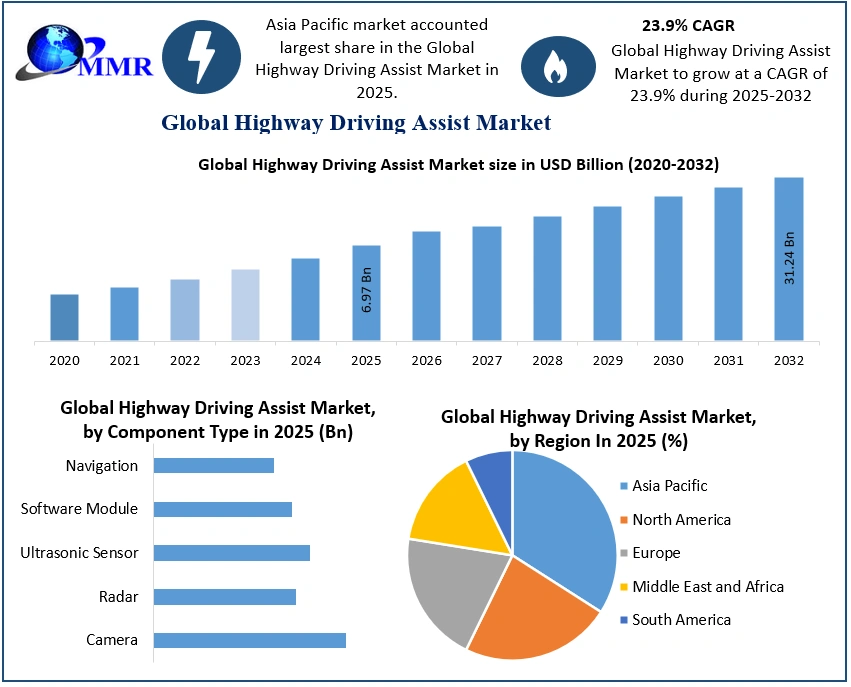
The Highway Driving Assist Market size was valued at USD 6.97 Billion in 2025 and the total Highway Driving Assist revenue is expected to grow at a CAGR of 23.9% from 2025 to 2032, reaching nearly USD 31.24 Billion by 2032.
Global Highway Driving Assist Market Overview
The highway driving assist system is a semi-automated driving system that supports the driver in monotonous driving conditions on expressways and highways by allowing the car to automatically accelerate and decelerate, as well as move the vehicle within predetermined limits. The Highway driving assist system combines advanced safety features such as lane hold assist and adaptive cruise control into one package. Cadillac CT6, Audi A8, Audi Q7, Rolls Royce Wraith, Bentley Bentayga, Mercedes-Benz S-class, and BMW 7series are only a few of the new vehicles with highway driving assistance.
In luxury and passenger cars, North America and Europe are the main regions where OEMs are providing features such as Tesla's Autopilot, Traffic Jam Assist in Audi and Acura vans, Cadillac's Super Cruise, BMW's Driving Assistant Plus, and Nissan's ProPilot Assist. As China, Japan, and Korea aggressively work against autonomous networks, demand in APAC is expected to steadily grow.
The report also covers the detailed analysis of the global highway driving assist industry with the classifications of the market based on component type, function and region. Analysis of past market dynamics from 2020 to 2025 is given in the report, which will help readers to benchmark the past trends with current market scenarios with the key player's contribution in it.
 To know about the Research Methodology :- Request Free Sample Report
Global Highway Driving Assist Market Dynamics
Long monotonous driving conditions, especially on highways, can lead to driver fatigue and possible road accidents. The driver assists functionality allows the driver to assist in driving by monitoring the steering, acceleration, and deceleration functions of the vehicle, preventing highway collisions, and offering a seamless driving experience. This has resulted in the expansion of the highway driving assist market.
Similarly, the market for highway driving assist technology is expected to grow rapidly due to a rise in the automobile industry, demand for road safety, and advancements in ADAS and advanced technologies. Increased penetration of semi-autonomous vehicles from luxury to mid-segment vehicles, which provides protection and relieves drivers from monotonous and uncomfortable driving on long highways and motorways, is expected to fuel the demand for highway driving assistance market during the forecast period. However, data protection issues and the higher cost of the technology are likely to hinder the development of the highway driving assist system during the forecast period.
Global Highway Driving Assist Market Segmentation Analysis
By Component Type, the Software Module segment is projected to rise at the fastest CAGR. The automotive software industry is quickly growing, and automotive embedded software has emerged as a core area for innovation as connected and autonomous vehicle technologies gain traction.
The automobile tech module has evolved as a result of factors such as increased demand for specialized driver assistance features and federal regulations that are more oriented on vehicle safety and emission standards. This software module defines the input and output relationship between functions including adaptive cruise control, blind-spot detection, lane-keeping assist, lane-change assist, automatic emergency braking, and the collision avoidance system. Nvidia, Aptiv, Mobileye, Veoneer, and Intel are among the companies that offer a tech interface to highway driving assist manufacturers.
By Function, the adaptive cruise control segment holds a prominent share of the highway driving assist market during the forecast period.
Since it dynamically adjusts the vehicle speed while keeping a predefined minimum distance from the corresponding vehicle, adaptive cruise control (ACC) is a key feature for highway driving assistance. Adaptive cruise control is being developed as a result of technological advancements and the growing need for passenger safety. Also, Cooperative ACC (C-ACC) is expected to be the ACC of the future, using satellites, mobile infrastructures or reflectors, and transmitters mounted on the backs of other vehicles.
The high rate of use of active protection systems such as ADAS in these areas and the participation of several large car companies including Ford and GM make North America and Europe a significant part of the global highway driving assist market. The EU's policies on safety standards and the use of ADAS in new vehicles are projected to continue to be a critical force in the area that is likely to drive the highway driving assist the market in the region over the forecast period.
Car companies in this area concentrate on security applications through the provision of smart vehicle security systems, such as road drivers, which are intended to enhance road safety in terms of accident prevention, crashes, and post-crash protection. The United States is North America's main market for highway assist systems. Many OEMs in the United States are collaborating with Tire 1 and Tier 2 firms to build self-driving cars. In addition, the government is actively invested in infrastructure and startup capital.
Canada, on the other hand, serves as a platform for many luxury car brand demand. Premium models are available in Canada from major OEMs such as Volkswagen, Toyota, GM, Nissan, Ford, Daimler, and Tesla. Canada is more likely to demand autonomous vehicles due to its proximity to the United States and existing infrastructure in many ways. In 2019, Canada had a 3% penetration in mid-segment cars and a 5% penetration in premium vehicles.
Global Highway Driving Assist Market Scope: Inquire before buying
| Global Highway Driving Assist Market | |||
|---|---|---|---|
| Report Coverage | Details | ||
| Base Year: | 2025 | Forecast Period: | 2026-2032 |
| Historical Data: | 2020 to 2025 | Market Size in 2025: | USD 6.97 Bn. |
| Forecast Period 2026 to 2032 CAGR: | 23.9% | Market Size in 2032: | USD 31.24 Bn. |
| Segments Covered: | by Component Type | Camera Radar Ultrasonic Sensor Software Module Navigation |
|
| by Function | Adaptive Cruise Control Lane Keeping Assist Lane Centering Assist Collision Avoidance Assist |
||
Global Highway Driving Assist Market, by Region
North America (United States, Canada, and Mexico)
Europe (UK, France, Germany, Italy, Spain, Sweden, Austria, and the Rest of Europe)
Asia Pacific (China, South Korea, Japan, India, Australia, ASEAN, Indonesia, Philippines, Malaysia, Vietnam, Thailand, ASEAN, Rest of Asia Pacific)
Middle East & Africa (South Africa, GCC, Nigeria, Rest of ME&A)
South America (Brazil, Argentina, Rest of South America)
Global Highway Driving Assist Market, Key Players
1. Continental AG
2. Robert Bosch GmbH,
3. Delphi
4. Valeo
5. Denso Corporation
6. Wabco
7. Magna International
8. Mobileye
9. ZF Friedrichshafen AG
10.Autoliv Inc
11.Hyundai Motor Company
12.Toyota Motor Corporation
13.Visteon
14.Mando
15.AVL
16.Aptiv
17.Veoneer
Frequently Asked Questions:
1. Which region has the largest share in Global Highway Driving Assist Market?
Ans: Asia Pacific region held the highest share in 2025.
2. What is the growth rate of Global Highway Driving Assist Market?
Ans: The Global Highway Driving Assist Market is growing at a CAGR of 23.9% during forecasting period 2026-2032.
3. What is scope of the Global Highway Driving Assist Market report?
Ans: Global Highway Driving Assist Market report helps with the PESTEL, PORTER, COVID-19 Impact analysis, Recommendations for Investors & Leaders, and market estimation of the forecast period.
4. Who are the key players in Global Highway Driving Assist Market?
Ans: The important key players in the Global Highway Driving Assist Market are – Continental AG, Robert Bosch GmbH,, Delphi, Valeo, Denso Corporation, Wabco, Magna International, Mobileye, ZF Friedrichshafen AG, Autoliv Inc, Hyundai Motor Company, Toyota Motor Corporation, Visteon, Mando, AVL, Aptiv, Veoneer.
5. What is the study period of this Market?
Ans: The Global Market is studied from 2025 to 2032.