
Healthcare Asset Management Market by Type, Application, End User Industry and Region – Global Market Size Estimation, Industry-Wide Analysis, Competitive Landscape Assessment & Long-Term Forecast to 2032
Overview
The Healthcare Asset Management Market size was valued at USD 6.16 Billion in 2025 and the total Healthcare Asset Management revenue is expected to grow at a CAGR of 4.52% from 2026 to 2032, reaching nearly USD 8.39 Billion.
Healthcare Asset Management is a systematic approach of tracking, managing, and optimizing medical assets and inventory within healthcare facilities to meet the growing demand for healthcare services efficiently. The Healthcare Asset Management Market is experiencing robust growth driven by the rising demand for efficient asset tracking solutions in healthcare facilities. Factors driving market growth include the need for real-time location tracking of medical equipment, the adoption of RFID and RTLS technologies, and the implementation of inventory management systems.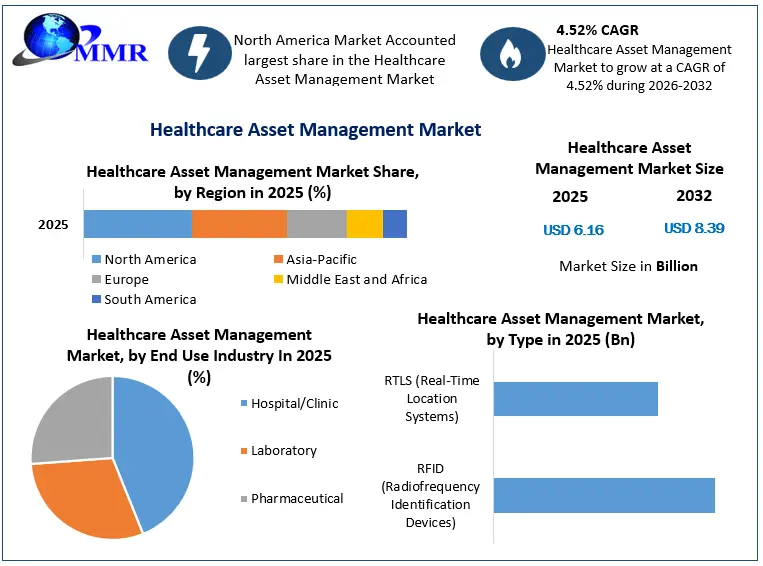
To know about the Research Methodology:-Request Free Sample Report
The COVID-19 pandemic has further accelerated the adoption of asset management solutions to manage the influx of medical equipment and ensure their availability where needed most. The Healthcare Asset Management Market faces the challenge of managing a diverse range of medical assets amidst an aging population, higher prevalence of chronic diseases, and increasing pollution levels. The complexity of medical assets encompasses various categories, including diagnostic and supporting equipment such as ECG, X-ray, and ultrasound machines, laboratory and surgical instruments like surgical tools and pacemakers, and consumables like medicines, surgical disposables, and cleaning supplies. These assets require efficient management to ensure timely availability, proper maintenance, and compliance with regulatory standards.
Key players like IBM, GE Healthcare, and Siemens Healthineers are investing in advanced asset management platforms incorporating AI and ML algorithms for predictive maintenance and optimizing asset lifecycle management. Partnerships and collaborations among healthcare providers, technology vendors, and regulatory bodies are driving innovation in the development of comprehensive asset management solutions tailored to the unique needs of healthcare organizations. These solutions not only enhance operational efficiency but also improve patient outcomes by ensuring timely access to critical medical resources. With the integration of IoT devices and cloud-based platforms, the healthcare asset management market is poised for significant growth, offering opportunities for stakeholders to capitalize on the increasing demand for smart healthcare infrastructure and digital transformation initiatives worldwide.
Healthcare Asset Management Market Dynamics:
Growing adoption of sophisticated technology in the medical field is driving market growth
The rising demand for efficient resource utilization within healthcare facilities driving the growth of Healthcare Asset Management Market. Institutions like Johns Hopkins Hospital have implemented real-time location systems (RTLS) to track essential equipment, reducing search time significantly and saving substantial costs annually. Stringent regulatory compliance requirements also contribute to the market's growth, with asset management solutions aiding healthcare organizations in maintaining accurate records of medical assets to meet standards such as the FDA's Unique Device Identification (UDI) system. Advancements in RFID and RTLS technologies further enhance operational efficiency by enabling real-time tracking of medical assets, as evidenced by the Cleveland Clinic's successful deployment of RFID tags to reduce rental costs and improve asset utilization rates.
The increasing adoption of IoT devices enables seamless integration with asset management systems, facilitating automated tracking and management of medical assets. Philips Healthcare's IoT-enabled asset tracking solutions exemplify this trend, allowing healthcare providers to monitor the location and status of medical devices remotely. As patient safety remains a top priority, asset management solutions play a crucial role in preventing equipment failures and minimizing errors. Mayo Clinic's implementation of predictive maintenance systems underscores the importance of such solutions in enhancing patient care quality by reducing equipment downtime. Moreover, with healthcare facilities expanding rapidly, Kaiser Permanente's utilization of asset management software to centralize inventory management across its network of hospitals highlights the need for efficient management of medical assets across multiple locations.
Poor Workflow Design with Lack of Integration hindering the market growth
Data Inaccuracy hampers the growth of Healthcare Asset Management Market, as Healthcare institutions deal with lots of data regarding patients, drugs and treatment methods. Inaccurate data collected from manual methods can give hospitals a wrong overview of their capital requirements and take a toll on their performance. A solid Asset management solution that shows actionable data so hospitals can better assess their requirements and performance is the key. While healthcare facilities merge with growth, their supply chains often remain siloed.
This results in inconsistent workflows that eventually impact the bottomline and challenge the growth of Healthcare Asset Management Market4. It is important to integrate supply chains and centralize purchases from all departments with good Asset management solution.
Disconnected supply chains from different departments bleed into unnecessarily duplicated workflows. This simply takes up more time and resources. Automating and integrating siloed tasks with Asset management technology can free up human resources and streamline the entire workflows of a hospital. Overnight shipping costs of emergency items due to frequent Asset stockouts can have a detrimental impact on a hospital’s revenue. With a better Asset management solution, you can pull down instances of stockouts and eliminate these costs.
Drug shortages are inescapable in the healthcare industry, forcing hospitals to purchase more expensive alternatives or disrupting their entire supply chain. A technology that gives early notifications or alerts on long run drug shortages can help healthcare institutions effectively monitor and manage foreseen and some unforeseen drug shortages.
Healthcare Asset Management Market Segment Analysis:
Based on Application, Staff Management solutions streamline workforce allocation and optimize operational efficiency, addressing staffing shortages and enhancing patient care. Equipment Tracking systems ensure the availability and maintenance of crucial medical equipment, reducing downtime and improving resource utilization. Patient Tracking technologies enhance safety and care coordination by monitoring patient movements and interactions, ultimately improving patient outcomes and satisfaction. Supply Chain Management solutions optimize inventory management and procurement processes, ensuring timely access to critical supplies while minimizing waste and costs. While each application serves unique needs, they collectively contribute to a more efficient, safer, and cost-effective healthcare ecosystem, driving adoption across diverse healthcare settings worldwide.
Healthcare Asset Management Market Recent Industry Developments:
| Date | Company | Development | Impact |
|---|---|---|---|
| 04 March 2025 | CenTrak | The company expanded its RTLS portfolio with the launch of an integrated, plug-and-play Bluetooth Low Energy (BLE) platform featuring a new suite of asset tags and badges. | This solution lowers the cost barrier for healthcare facilities, allowing seamless scalability between basic asset tracking and high-precision clinical-grade locating networks. |
| 19 August 2025 | Sonitor | The company announced a strategic merger with Tagnos, combining its SonitorONE hardware infrastructure with Tagnos's advanced software orchestrations. | The consolidated entity delivers an end-to-end framework that unifies real-time location hardware with workflow analytics to minimize asset bottlenecks in clinics. |
| 09 December 2025 | Kontakt.io | The provider launched Access Agent, an AI-powered engine designed to dynamically optimize outpatient exam room assignments. | The platform increases room utilization workflows to unlock up to 20% additional patient capacity without requiring physical hospital facility expansion. |
| 09 March 2026 | CenTrak | The tracking specialist introduced AI-Enhanced AssetsRT, a software upgrade utilizing natural language search and predictive reporting tools for hospital fleets. | Integrating this software helps clinical administrators spot deep utilization trends, reducing the need for redundant medical equipment rentals or purchases. |
| 07 April 2026 | Zebra Technologies | The company entered a strategic partnership with Aiva Health to deploy the Aiva Nurse Assistant on Zebra's WS101-H wearable badges and mobile computers. | This alliance connects real-time location data with ambient voice AI to automate work orders, cutting nurse documentation time and incidental overtime costs. |
| 01 May 2026 | Securitas Healthcare | The enterprise completed the acquisition of ZulaFly to incorporate its specialized, cloud-native real-time location system infrastructure. | The transaction expands Securitas's ability to offer centralized cloud asset tracking software, reducing long-term technology ownership costs for global health systems. |
Healthcare Asset Management Market Regional Insights:
North America Dominated the Healthcare Asset Management Market
North America stands out as a significant hub for the adoption and utilization of hospital asset management solutions within the healthcare sector. The region's robust healthcare infrastructure has played a pivotal role in fostering the demand for such solutions, owing to the feasibility of their immediate implementation. A crucial contributing factor to this trend is the region's status as an early adopter of IT infrastructure, with an impressive internet penetration rate of 89.4% of the population, as reported by Internet World Stats. This high level of connectivity facilitates the seamless deployment and integration of asset management solutions across healthcare facilities.
North America commands a substantial portion, exceeding 40%, of the global pharmaceutical industry. This dominance underscores the region's pivotal role in shaping trends and driving innovations within the healthcare sector. Consequently, the increasing recognition of the manifold benefits associated with the deployment of asset management systems in healthcare settings is expected to further propel the demand for such solutions in the foreseeable future. The symbiotic relationship between the burgeoning pharmaceutical industry and the healthcare asset management market is evident. The growth trajectory of the former significantly influences the dynamics of the latter, with the demand for asset management solutions being intricately linked to the evolving needs and requirements of pharmaceutical stakeholders. As such, the expansion of the pharmaceutical industry in North America emerges as a primary driver driving the growth of the healthcare asset management market in the region.
Healthcare Asset Management Market Scope: Inquire before buying
| Global Healthcare Asset Management Market | |||
|---|---|---|---|
| Report Coverage | Details | ||
| Base Year: | 2025 | Forecast Period: | 2026-2032 |
| Historical Data: | 2020 to 2025 | Market Size in 2025: | USD 6.16 Bn. |
| Forecast Period 2026 to 2032 CAGR: | 4.52% | Market Size in 2032: | USD 8.39 Bn. |
| Segments Covered: | by Type | RFID (Radiofrequency Identification Devices) RTLS (Real-Time Location Systems) |
|
| by Application | Staff Management Equipment Tracking Patient Tracking Supply Chain Management |
||
| by End Use Industry | Hospital/Clinic Laboratory Pharmaceutical |
||
Healthcare Asset Management Market, by Region
North America (United States, Canada and Mexico)
Europe (UK, France, Germany, Italy, Spain, Sweden, Austria, Turkey, Russia and Rest of Europe)
Asia Pacific (China, India, Japan, South Korea, Australia, ASEAN and Rest of APAC)
Middle East and Africa (South Africa, GCC, Egypt, Nigeria and Rest of ME&A)
South America (Brazil, Argentina, Columbia and Rest of South America)
Healthcare Asset Management Market Key Players:
Major Contributors in the Healthcare Asset Management Industry:
1. IBM Corporation
2. AeroScout
3. Ekahau
4. Awarepoint Corporation
5. Siemens Healthcare
6. GE Healthcare
7. AiRISTA Flow
8. Elpas
9. CenTrak
10. ThingMagic
11. Sonitor
12. Stanley Healthcare
13. Versus Technology
14. Symantec
15. CA Technologies
16. Philips
17. DXC Technology
18. CloudPassage
19. FireEye
20. Zebra Technologies
FAQs:
1] Which region is expected to hold the highest share in the Global Healthcare Asset Management Market?
Ans. North America region is expected to hold the highest share in the Healthcare Asset Management Market.
2] What is the market size of the Global Healthcare Asset Management Market by 2032?
Ans. The market size of the Healthcare Asset Management Market by 2032 is expected to reach USD 8.39 Billion.
3] What is the forecast period for the Global Healthcare Asset Management Market?
Ans. The forecast period for the Healthcare Asset Management Market is 2026-2032.
4] What was the Global Healthcare Asset Management Market size in 2025?
Ans: The Global Healthcare Asset Management Market size was USD 6.16 Billion in 2025.