
Wearable Medical Devices Market – Global Market Size, Strategic Growth Drivers, Risk Assessment Framework, Regulatory Landscape Review, Competitive Intensity Mapping & Long-Term Industry Outlook to 2032
Overview
Global Wearable Medical Devices Market size was valued at US$ 34.44 Bn in 2024 and the total Wearable Medical Devices revenue is expected to grow at 20.2% through 2025 to 2032, reaching nearly US$ 150.07 Bn.
Wearable Medical Devices Market Overview:
Wearable Medical Devices are non-invasive, body worn electronic devices designed to monitor, diagnose or treat medical conditions in real time or over extended periods. The wearable medical devices market has been experiencing rapid growth driven by rising chronic diseases, telehealth adoption and AI integration with applications spanning fitness tracking to clinical grade remote patient monitoring.
North America led the wearable medical devices market in 2024, fuelled by strong demand for remote healthcare monitoring and preventive medicine solution within its advanced medical infrastructure. Market pioneers like Dexcom, Abbott and Apple are driving innovation through breakthrough technology including AI powered diagnostics, continuous glucose monitoring systems and FDA approved smartwatches with medical grade health tracking capabilities. The sector benefit from widespread adoption across multiple user segment like healthcare providers utilizing clinical wearable for real time patient monitoring, fitness conscious consumer adopting smart devices for wellness tracking and chronic disease patient depending on connected health tool for personalized treatment management. This dynamic landscape where diabetes care, cardiac monitoring and telehealth integration serve as primary growth catalysts illustrate how wearable medical device are transforming global healthcare delivery while meeting stringent regulatory requirements and addressing growing consumer demand for accessible, precise and interconnected health management solutions.
In this report, the wearable medical devices market's growth reasons, as well as the market's many segments (Product, Device Type, Grade Type, Application and, Region), are discussed. Data has been given by market players, regions, and specific requirements. This market report includes a comprehensive overview of all the significant improvements that are presently prevailing in all market segments. Key data analysis is presented in the form of statistics, infographics, and presentations. The study discusses the wearable medical devices market's Drivers, Restraints, Opportunities, and Challenges. The report helps to assess the market growth drivers and determines how to use these drivers as a tool. The report also helps to rectify and resolve issues related to the global wearable medical devices market situation.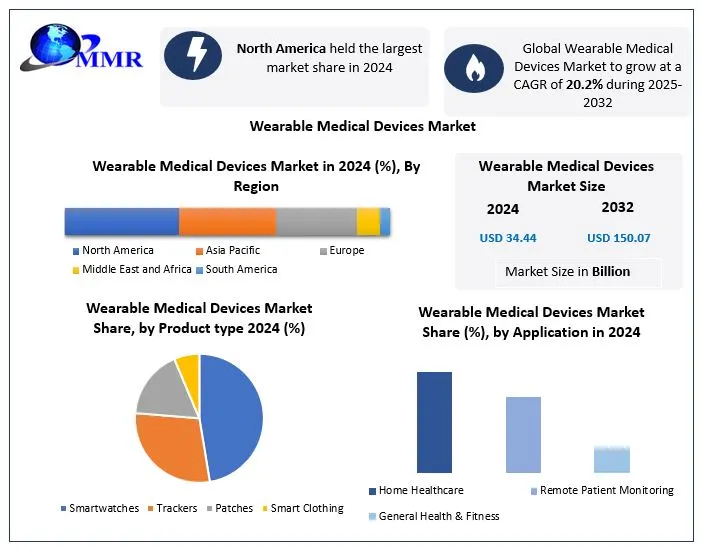 To know about the Research Methodology:-Request Free Sample Report
Wearable Medical Devices Market Dynamics:
Rising Health Awareness to Drive Wearable Medical Devices Market
A major driver of the wearable medical devices market is the increasing awareness of fitness and healthcare among consumers. The healthcare market has grown significantly in recent years, owing to the growing geriatric population, the rising incidences of chronic diseases, and the application of modern medical devices i.e. wearable medical devices that enable the delivery of high-quality care outside of hospitals.
Regulatory Hurdles to Restrain Wearable Medical Devices Market
A major restraint of the market are the unfavourable standards and regulations present in the healthcare sector. For example, in deciding compensation for mobile healthcare, national agencies play a significant role. National regulations in several European countries define medical treatment in terms of the patient and doctor's physical presence, which has an impact on payments for mobile and remote healthcare solutions. Wearables adoption in the healthcare sector is slowed by such regulations.
AI, 5G and Predictive Medicine to Create Opportunity in Wearable Medical Devices Market
The key opportunity in the wearable medical devices market is the increasing endorsement of Artificial Intelligence and other technologies. Artificial intelligence can be utilized in 5G to predict a patient's potential diagnosis and treatments. Moreover, AI can assist medical systems in predicting which patients are likely to experience postoperative difficulties, allowing for early intervention. In general, real-time learning with a large amount of data necessitates reliable and high-bandwidth networks. Healthcare businesses may leverage AI technologies to give the finest treatment possible in real-time, wherever they are, thanks to 5G networks. As a result, the utilization of new tools and technologies is predicted to give high-growth prospects in the wearable medical devices market.
Rising Menace of Patent Rolls to Challenge Wearable Medical Devices Market
The main challenge in the wearable medical devices market is the patent protections need for the devices. Clinical device makers in the United States and Europe confront significant hurdles from patent reform and patent trolls. Patent trolls are firms that buy patents in order to collect royalties from businesses that purportedly infringe on trademarks held by patent claim entities or non-practicing organizations. Patent trolls made their debut in the medical technology business in the last decade, when they filed a slew of violation cases against medical device manufacturers. Companies may secure the financial and legal rewards of properly filed patents and reduce possible losses caused by patent trolls by taking precautions efforts to safeguard mobile medical technology developments through patents. The key to success in the fast-developing clinical-grade wearables business is to protect patents.
Wearable Medical Devices Market Segment Analysis:
By Device Type, the Diagnostic and Monitoring devices segment dominated the wearable medical devices market in 2024. This segment is also projected to witness the highest CAGR of 10.3% in the forecast period (2025-2032). The increasing frequency of neurological and nephrological illnesses is the primary factor influencing the segment's growth.
According to the 2024 survey, migraine was the most common neurological illness in the United States. In the United States, 92.5% of individuals suffer from migraines. Neuromodulation devices are the most commonly used to diagnose and treat migraine in this scenario. In addition, the wearable monitoring device segment is likely to grow as people become more aware of the capacity of neurological wearables to continually measure people's cognitive capacities while they go about their daily lives.
Because of the rising intake of traditional diagnostic devices, the of traditional diagnostic device sector is expected to grow at the quickest rate throughout the projected period. Furthermore, market growth is expected to be aided by a robust portfolio of medical devices such as intelligent asthma action products, smart pain reliever gadgets, and insulin management devices. Pain control devices, glucose monitoring devices, recovery devices, and respiratory therapy devices make up the monitoring device segment. Due to the large population suffering from diabetes, insulin monitoring device sub-segment was dominant in 2024 and is expected to remain dominant over the forecast period (2025-2032).
Based on Grade Type, Wearable Medical Devices Market is sub segmented into consumer grade, clinical grade, traditional diagnostic devices and healthcare devices. In 2024, the consumer-grade wearable medical devices segment dominated the market, accounting for the largest revenue share, driven by rising health awareness, affordability, and widespread adoption of fitness trackers and smartwatches. Brands like Apple (Apple Watch), Fitbit, and Garmin lead this segment by integrating FDA-cleared health features (e.g., ECG, SpO₂, sleep tracking) into user-friendly devices, appealing to both fitness enthusiasts and general consumers.
Wearable Medical Devices Market Regional Insights:
North America dominated Wearable Medical Devices Market
The wearable medical devices market was led by North America, with the United States emerging as the leading contributor in 2024. Due to the high incidence of heart and lifestyle-related disorders, rising acceptance of wearable medical advances, and high per capita medical spending, the United States has the greatest share of the wearable medical device market. The North American market for wearable medical devices is forecast to grow at a modest rate of 12.3% over the forecast period, because of the growing illness prevalence in the region.
The COVID-19 has influenced group and individual behaviour, affecting both the workplace and healthcare. Devices are available in the form of technology to meet these new problems. Wearables have an essential part in the full continuum of care, as well as in the professional and leisure life, when it comes to health, work, and economy during COVID-19. In the United States, Philips launched another whole wearable biosensor for early health deterioration detection in 2023, including clinical surveillance for COVID-19.
The objective of the report is to present a comprehensive analysis of the Wearable Medical Devices market to the stakeholders in the industry. The past and current status of the industry with the forecasted market size and trends are presented in the report with the analysis of complicated data in simple language. The report covers all the aspects of the industry with a dedicated study of key players that include market leaders, followers, and new entrants.
PORTER, PESTEL analysis with the potential impact of micro-economic factors of the market have been presented in the report. External as well as internal factors that are supposed to affect the business positively or negatively have been analysed, which will give a clear futuristic view of the industry to the decision-makers.
The report also helps in understanding the Wearable Medical Devices market dynamics, structure by analysing the market segments and project the market size. Clear representation of competitive analysis of key players by product, price, financial position, product portfolio, growth strategies, and regional presence in the Wearable Medical Devices market make the report investor’s guide.
Wearable Medical Devices Market Competitive Landscape
iHealth Labs, Inc., a U.S.based subsidiary of Andon Health, competes in consumer and clinical wearable medical device market with products like smart blood pressure monitor, glucose meter and fitness trackers. Key competitors include Omron Healthcare (dominant in connected blood pressure monitors), Dexcom (leader in continuous glucose monitoring) and Fitbit (Google) & Garmin in fitness wearables. While iHealth leverage affordability and FDA cleared device it faces challenges from larger players with stronger brand recognition (e.g., Abbott’s FreeStyle Libre in diabetes) and tech giant like Apple (Apple Watch’s health features). Its differentiation lies in seamless smartphone integration and a focus on chronic condition management but scaling against entrenched rival remain a hurdle.
Wearable Medical Devices Market Key Trends
• AI & Predictive Analytics Integration: Wearables now leverage AI-driven diagnostics (e.g., early arrhythmia detection, diabetes risk prediction).
Example: CGMs like Dexcom G7 use AI for real-time glucose trend forecasting.
• Expansion into Chronic Disease Management: Devices are shifting from fitness tracking to clinical-grade monitoring (e.g., hypertension, COPD, heart failure).
Example: Omron’s ECG-enabled smartwatches for atrial fibrillation detection.
• 5G & Remote Patient Monitoring (RPM): 5G-enabled wearables support real-time data transmission for telehealth and proactive care.
Example: Philips’ wearable biosensors for hospital-at-home programs.
Wearable Medical Devices Market Key Developments
• VitalConnect (US)- June 2024: Launched the VitalPatch RTM 2.0, an AI-powered biosensor for real-time sepsis detection in hospitalized patients.
• Dexcom Inc. (US)- January 2025: Received FDA approval for its next-gen Dexcom G8 CGM, featuring 15-day wear and no fingerstick calibration.
• Sky Medical Technology (UK)- March 2024: Partnered with the NHS to deploy its wearable compression monitor for post-surgical DVT prevention.
• Siemens Healthineers (Germany)-September 2024: Unveiled the Magnetom Viato.Mobile, the first MRI-compatible wearable for cardiac arrhythmia monitoring.
• Huawei Device Co. Ltd. (China)- November 2024: Integrated Pulse Wave Velocity (PWV) monitoring into its Huawei Watch 5, targeting hypertension management.
Wearable Medical Devices Market Scope: Inquire before buying
| Wearable Medical Devices Market | |||
|---|---|---|---|
| Report Coverage | Details | ||
| Base Year: | 2024 | Forecast Period: | 2025-2032 |
| Historical Data: | 2019 to 2024 | Market Size in 2024: | USD 34.44 Bn. |
| Forecast Period 2025 to 2032 CAGR: | 20.2 % | Market Size in 2032: | USD 150.07 Bn. |
| Segments Covered: | by Product | Trackers Smartwatches Patches Smart Clothing |
|
| by Device Type | Diagnostic and Monitoring Devices Multiparameter Tracker ECG\Heart Rate Monitors Pulse Oximeters |
||
| by Grade Type | • Traditional Diagnostic Devices • Consumer-Grade Wearable Healthcare Devices • Clinical-Grade Wearable Healthcare Devices |
||
| by Application | General Health and Fitness Remote Patient Monitoring Home Healthcare |
||
Wearable Medical Devices Market, by Region
North America (United States, Canada and Mexico)
Europe (United Kingdom, France, Germany, Italy, Spain, Sweden, Russia, Rest of Europe)
Asia Pacific (China, Japan, South Korea, India, Australia, Malaysia, Thailand, Vietnam, Indonesia, Philippines, Rest of APAC)
Middle East and Africa (South Africa, GCC, Nigeria, Egypt, Turkey, Rest of MEA)
South America (Brazil, Argentina, Colombia, Chile, Peru, Rest of South America)
Wearable Medical Device Key Players
North America
1. Ihealth Lab, Inc (US)
2. Biotricity Inc (US)
3. Ge Healthcare (US)
4. Verily Life Sciences (US)
5. Vitalconnect (US)
6. Dexcom Inc, (US)
7. Abbot Laboratories (US)
8. TheraB Medical (US)
9. Edwards Lifesciences (US)
10. tandemdiabetes (US)
Europe
11. Medibiosense Ltd (UK)
12. Sky Medical Technology (UK)
13. Siemens Healthineers (Germany)
14. Philips (Netherlands)
15. Braster SA (Poland)
16. Teleflex Medical Srl. (Italy)
17. Garmin Ltd. (Switzerland)
18. Alpha Wearables (Sweden)
Asia-Pacific
19. Minttihealth (China)
20. Contec Medical Systems Co. Ltd (China)
21. Huawei Device Co. Ltd., (China)
22. Omron Healthcare Co., Ltd (Japan)
23. Ten3t Healthcare (India)
Middle East and Africa
24. Bio-Beat (Israel)
South America
25. SmartWalk (Brazil)
FAQs:
1. Which is the potential market for Wearable Medical Devices in terms of the region?
Ans. The wearable medical devices market was led by North America, with the United States emerging as the leading contributor in 2024.
2. What are the drivers for new market entrants?
Ans. A major driver of the wearable medical devices market is the increasing awareness of fitness and healthcare among consumers.
3. What is expected to drive the growth of the Wearable Medical Devices Market in the forecast period?
Ans. The healthcare market has grown significantly in recent years, owing to the growing geriatric population.
4. What is the projected market size & growth rate of the Wearable Medical Devices Market?
Ans. Global Wearable Medical Devices Market size was valued at US$ 34.44 Bn in 2024 and the total Wearable Medical Devices revenue is expected to grow at 20.2% through 2025 to 2032, reaching nearly US$ 150.07 Bn.
5. What segments are covered in the Wearable Medical Devices Market report?
Ans. The segments covered are Product, Device Type, Grade Type, Application and region.