Hair Removal Products Market - Industry Structure Evaluation, Demand Drivers Analysis, Regional Growth Analysis and Identification, Competitive Positioning Review & Global Market Size Forecast to 2034

4.9%
CAGR (2026-2034)
4.68 USD Bn.
Forecast Market Size
327
Report Pages
144
Market Tables

Overview

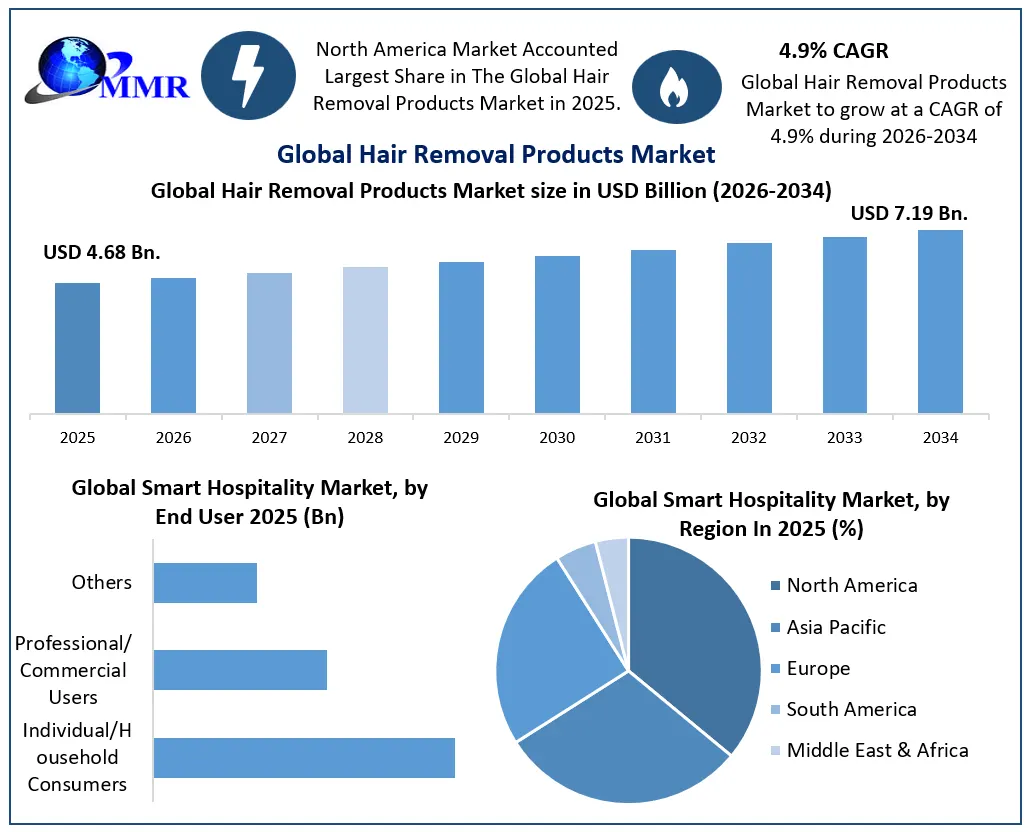
The Global Hair Removal Products Market size was valued at USD 4.68 Billion in 2025 and the total Hair Removal Products revenue is expected to grow at a CAGR of 4.9% from 2026 to 2034, reaching nearly USD 7.19 Billion.

The global Hair Removal Products Market report is a comprehensive analysis of the industry, market, and key players. The report has covered the market by demand and supply-side by segments. The global Hair Removal Products Market report also provides trends by market segments, technology, and investment with a competitive landscape.

Global Hair Removal Products Market Growth Outlook
Hair Removal Products Market Growth Outlook

To know about the Research Methodology :- Request Free Sample Report

Global Hair Removal Products Market Overview:

Depilatory cream is a cosmetic preparation used to remove unwanted hair growth on the body. Depilatory cream contains an alkaline chemical that is safely reacting with the body to remove hair. The mechanism of the cream is that they work by breaking down the keratin protein in hair and weakens them by dissolving.

Global Hair Removal Products Market Dynamics:

The global hair Removal Products market was valued at USD 4.68 Billion in the year 2025 and is estimated to reach 7.19 Billion by 2034, with a growing CAGR of 4.9% in the forecast period 2026-2034.

The swelling trend from hair removal and beauty products is driving the market growth of hair removal products. The consciousness together with personal grooming and surging aesthetic appeal are fueling the market growth in the forecast period 2026-2034.

Increasing disposable income of the individual, and spending health hygiene together with personal care products are funding a major contribution to the growth of the market. Moreover, rising technology with advanced hair removal electronic machines like lesser hair removal, tremor, intense pulse light (IPL), Energy-based devices are hitting the market due to convenience and easy & quick hair removal.

The rising cost of raw materials are anticipated to obstruct the growth of the market. As the dispensing of raw materials from one place to another, shipping charges, labor cost, the tariff on import and export, and these factors overall induce the cost of final good also this factor is creating a negative impact on the hair removal market.

Global Hair Removal Products Market Segment Analysis:

The cream is dominating the Product Type segment of the Global Hair Removal Products Market:

Hair removal cream is gaining more attention in the market due to its convenience and easy application also has a quick mode of action. The market share of the cream segment accounted for 39.23% in 2025. Likewise, creams come with additional benefits like moisturizing the skin after hair removal, pleasant fragrance, and lives skin silky and smooth and these benefits are likely to fuel the market growth in the forecast period.

Waxing is second dominating in the global hair removal product market and is growing with a CAGR of 12.6%. This process is widely preferred by women, and women account for 56.4% of the market share in the forecast period as compared to men in the hair removal product market. Further, the low cost of the waxing process is likely to motivate the application.
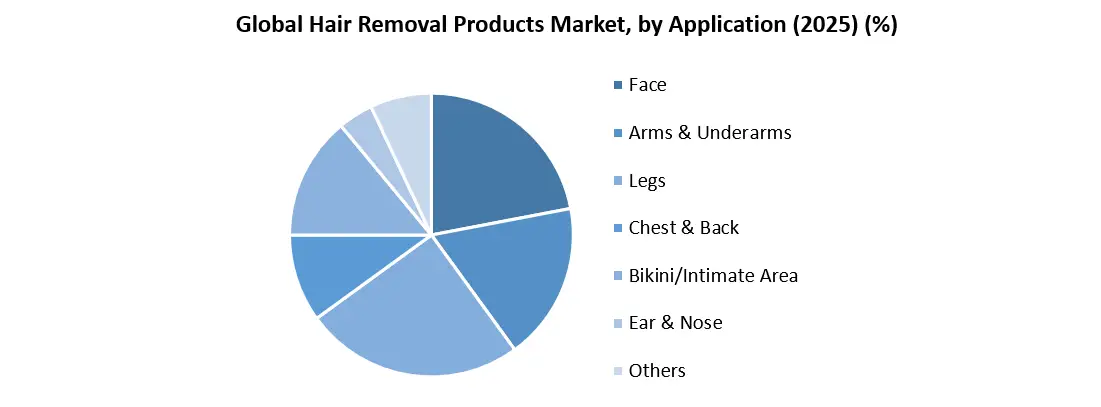
Hair Removal Products Market, by Application

Beauty Clinic sub-segment is trending in the Distribution Channel segment of the Global Hair Removal Products Market.

The beauty clinic sub-segment accounted for the largest market share in the forecast period. The global beauty clinic and spas market was valued at USD 144760 million in 2025 and is estimated to reach USD 217500 million at a CAGR of 6.2% in the forecast period. As beauty clinics and saloons are at easy access and are affordable, with professional service, and tools these elements drive the market growth. Further, high awareness about saloons and their services for skin and hair treatment is auxiliary boosting the market growth of hair removal products. Dermatology clinic is second dominating in the distribution channel segment of the hair removal product market. These clinics are expensive as compared to beauty salons and the services are available on appointments only. This process is conducted by highly professional and skilled persons. And this process is carried out under the supervision of a dermatologist.

Global Hair Removal Products Market Regional Insights:

North America is dominating in the hair removal product market with a market share of 29.7% in 2025 as the region is highly attracted towards the aesthetic and grooming personalities of the individual. Moreover, due to high disposable income and purchasing power consumers tend to invest more in personal hygiene and beauty products, and the growing demand for electronic devices in the region together with the rapid advancement and huge investments by the market players is further motivating the market growth. Moreover, lesser treatment and application of cosmetic products is higher as compared to any other region in North America.

The Asia Pacific is marked as the fastest-growing region with a CAGR of 6.8% in the forecast period due to growing modernization and a growing young population. Moreover improved living standards are further boosting the market growth of hair removal products in the region. China is the fastest-growing company in the Asia Pacific and is likely to reach USD 374.3 Million with a CAGR of 11.5% in the forecast period and Japan is likely to grow at 4.3% in the forecast period.

Key Industrial Development

• Vi-john- Vi-john Company declared India’s first men hair removal cream- Master Strock for Men. This product is particularly design for thick skin and rough and harsh hair growth. This product is dermatologically verified and tested to offer safe hair removal for men.

The objective of the report is to present a comprehensive analysis of the global Market to the stakeholders in the industry. The past and current status of the industry with the forecasted market size and trends are presented in the report with the analysis of complicated data in simple language. The report covers all the aspects of the industry with a dedicated study of key players that include market leaders, followers, and new entrants.

PORTER, SVOR, PESTEL analysis with the potential impact of micro-economic factors of the market have been presented in the report. External as well as internal factors that are supposed to affect the business positively or negatively have been analyzed, which will give a clear futuristic view of the industry to the decision-makers.

The report also helps in understanding the global Market dynamics, structure by analyzing the market segments and project the global Market size. Clear representation of competitive analysis of key players by Grade, price, financial position, Grade portfolio, growth strategies, and regional presence in the global Market make the report investor’s guide.

Global Hair Removal Products Market Recent Industry Developments:

Date Company Development Impact
15 January 2026 Procter & Gamble (Gillette Venus) Gillette Venus launched the upgraded Venus Pubic Hair & Skin Collection featuring razor cartridges with an Irritation Defense Bar and skin-soothing formulations. The product line targets specific intimate grooming challenges to reduce skin irritation and capture market share in specialized body care categories.
16 March 2026 Ya-Man Ya-Man announced the commercial release of its Ray Beauté Cool Power IPL hair removal device tailored for high-output home use. The high-power optical system integrates active cooling technology to reduce skin heat discomfort during high-fluence at-home IPL treatments.
17 July 2026 Beijing Nubway S&T Co., Ltd. Beijing Nubway received FDA 510(k) clearance (K261693) for its QDTM-04 808 nm diode laser hair removal system. The clearance expands the commercial availability of permanent laser hair reduction technologies suitable across Fitzpatrick skin types I–VI.
01 September 2026 Koninklijke Philips N.V. Philips introduced the Lumea 9900 Pro, the first at-home IPL hair removal device equipped with real-time audio guidance and a SmartSkin sensor. The intelligent system delivers guided treatment coverage and automated pulse adaptation to improve at-home epilation efficacy and safety.
04 November 2026 Seppic Seppic signed a definitive agreement to acquire Minasolve, a specialist in bio-based preservation boosters and cosmetic ingredients. The strategic acquisition enhances Seppic's raw material offerings for clean beauty depilatory gels and natural post-epilation skincare formulations.

Global Hair Removal Products Market Scope: Inquire before buying

Global Hair Removal Products Market
Report Coverage Details
Base Year: 2025 Forecast Period: 2026-2034
Historical Data: 2020 to 2025 Market Size in 2025: 4.68 USD Billion
Forecast Period 2026-2034 CAGR: 4.9% Market Size in 2034: 7.19 USD Billion
Segments Covered: by Product Type Depilatory & Shaving Products
Depilatory Creams & Lotions
   Wax
      Soft Wax
      Hard Wax
      Wax Strips
    Shaving Gels, Foams & Creams
   Other Hair Removal Preparations
Hair Removal Devices
Razors
Disposable Razors
       Reusable/System Razors
       Electric Razors/Shavers
Epilators
    Electric Trimmers
    Laser Hair Removal Devices
    Intense Pulsed Light (IPL) Devices
Other Devices
by Price Range Economy
Mid-Range
Premium
by Application Area Face
Arms & Underarms
Legs
Chest & Back
Bikini/Intimate Area
Ear & Nose
Others
by Consumer Target Men
Women
by End User Individual/Household Consumers
Professional/Commercial Users
 Beauty Salons
     Spas
     Dermatology & Aesthetic Clinics
Others
by Distribution Channel Online
Company/Brand Websites
    E-commerce Marketplaces
Offline
  Supermarkets & Hypermarkets
   Pharmacies & Drugstores
   Beauty & Personal Care Specialty Stores
   Department Stores/Mass Merchandisers

Global Hair Removal Products Market, by Region

North America (United States, Canada and Mexico)
Europe (UK, France, Germany, Italy, Spain, Sweden, Austria and Rest of Europe)
Asia Pacific (China, South Korea, Japan, India, Australia, Indonesia, Malaysia, Vietnam, Taiwan, Bangladesh, Pakistan and Rest of APAC)
Middle East and Africa (South Africa, GCC, Egypt, Nigeria and Rest of ME&A)
South America (Brazil, Argentina Rest of South America)

Key Players / Competitors Profiles Covered in Brief in Global Hair Removal Products Market Report in Strategic Perspective:

North America
1. Procter & Gamble
2. Church & Dwight Co., Inc.
3. Edgewell Personal Care Co.
4. Conair Corporation
5. Emjoi, Inc.
6. Spectrum Brands
7. Revlon, Inc.
8. Coty Inc.
9. American International Industries
10. Harry's, Inc.
11. Dollar Shave Club
12. Billie, Inc.
13. Finishing Touch Flawless
14. Nood
15. Tria Beauty, Inc.
16. Cynosure, LLC
17. Candela Corporation
18. Cutera, Inc.
19. Parissa Laboratories
20. Venus Concept Inc.
Others

Europe
1. Reckitt Benckiser Group plc
2. Cyden Ltd.
3. Koninklijke Philips N.V.
4. Braun GmbH
5. MERKUR Stahlwaren
6. Oriflame Holding AG
7. BIC Group
8. Cirepil
9. Fotona d.o.o.
Others

Asia Pacific
1. Panasonic Corporation
2. Feather Safety Razor Co., Ltd.
3. KAI Corporation
4. DORCO CO., LTD.
5. Ulike
6. JOVS Beauty
7. VI-John Group
8. Bombay Shaving Company
9. VLCC Health Care Ltd.
10. Nad’s
Others

Middle East & Africa
1. Epilady
2. Home Skinovations Ltd.
3. Lumenis Ltd.
4. Alma Lasers
5. InMode Ltd.
Others

Frequently Asked Questions:

  1. Which region has the largest share in Global Hair Removal Products Market?

    Ans: North Americaregion held the highest share in 2025.

  2. What is the growth rate of Global Hair Removal Products Market?

    Ans: The Global Hair Removal Products Market is growing at a CAGR of 4.9% during forecasting period 2026-2034.

  3. What is scope of the Global Hair Removal Products Market report?

    Ans: Global Hair Removal Products Market report helps with the PESTEL, PORTER, COVID-19 Impact analysis, Recommendations for Investors & Leaders, and market estimation of the forecast period.

  4. Who are the key players in Global Hair Removal Products Market?

    Ans: The important key players in the Global Hair Removal Products Market are – Reckitt Benckiser Group plc, Procter & Gamble Company, Church & Dwight Co., Inc., L'Oréal S.A., Energizer Holdings, Inc., Beiersdorf AG, Softsheen-Carson, Sally Hansen, Vi-John Group, Urban Yog, Sanfe, and Deyga Organics.

  5. What is the study period of this Market?

    Ans: The Global Hair Removal Products Market is studied from 2020 to 2034.

Table of Contents

1. SECTION: GLOBAL HAIR REMOVAL PRODUCTS MARKET INTRODUCTION 1.1. Executive Market Landscape & Industry Overview 1.1.1. Global Hair Removal Products Market Size (Value USD Billion), 2025-2034 1.1.2. Historical Market Size Trends and Growth Momentum Across Industry 1.1.3. Global Hair Removal Market Development Across Traditional and Advanced Products 1.1.4. Historical Emergence and Commercial Significance of Advanced Hair Removal Solutions 1.1.5. U.S. Hair Removal Products Market Development and Consumer Adoption Trends 1.1.6. CAGR Analysis of Global Hair Removal Products Market (2025–2034) 1.2. Global Hair Removal Products Market Dynamics 1.2.1. Market Trends 1.2.2. DROC Analysis 1.2.3. Drivers 1.2.4. Restraints 1.2.5. Opportunities 1.2.6. Challenges 1.2.7. PORTER'S Five Forces Analysis 1.2.8. PESTLE Analysis 1.3. Hair Removal Product Economics, Pricing & Cost Structure 1.3.1. Raw-material cost structure for blades, polymers, lubricants, wax formulations, depilatory chemicals, and electronic components 1.3.2. Manufacturing-cost comparison between disposable products and reusable hair removal devices 1.3.3. Cost contribution of precision blades, flexible heads, ergonomic handles, sensors, batteries, and optical components 1.3.4. Pricing architecture across mass-market, mid-premium, and premium hair removal products 1.3.5. Price differentiation between manual, chemical, mechanical, and energy-based hair removal methods 1.3.6. Promotional pricing and discounting strategies across retail and e-commerce channels 1.4. Hair Removal Product & Technology Ecosystem 1.4.1. Razor and blade manufacturing ecosystem 1.4.2. Electric shaver and epilator component ecosystem 1.4.3. Wax, depilatory cream, and chemical formulation supply chain 1.4.4. IPL and light-based device component ecosystem 1.4.5. Laser hair removal equipment and professional treatment technology ecosystem 1.4.6. Supply of precision blades, foils, motors, batteries, optical filters, lamps, and sensors 1.5. Hair Removal Method & Product Technology Analysis 1.5.1. Shaving technology and multi-blade cartridge evolution 1.5.2. Electric foil and rotary hair removal technologies 1.5.3. Mechanical epilation and tweezer-disc systems 1.5.4. Waxing technologies including hot wax, warm wax, cold wax, strips, and roll-on systems 1.5.5. Chemical depilatory technologies and active-ingredient formulations 1.5.6. IPL-based long-term hair reduction technology 1.6. Razor, Blade & Shaving System Analysis 1.6.1. Single-blade, multi-blade, and precision-trimmer configurations 1.6.2. Fixed versus pivoting razor-head architectures 1.6.3. Blade coating and lubrication technologies 1.6.4. Flexible head and contour-following systems 1.6.5. Cartridge replacement mechanisms and refill formats 1.6.6. Safety guards and skin-protection features 1.7. Depilatory Cream, Wax & Chemical Hair Removal Analysis 1.7.1. Depilatory cream formulations by active chemical composition 1.7.2. Product differentiation by application area and skin sensitivity 1.7.3. Wax formulation comparison by melting temperature and application method 1.7.4. Pre-waxed strips versus salon-style wax systems 1.7.5. Roll-on and cartridge-based waxing systems 1.7.6. Post-treatment soothing and skin-conditioning formulations 1.8. Epilator, Trimmer & Mechanical Device Technology Analysis 1.8.1. Rotary versus foil-based electric hair removal systems 1.8.2. Tweezer-disc configuration and hair-grabbing efficiency 1.8.3. Adjustable speed and precision-control systems 1.8.4. Integrated trimming and shaving attachments 1.8.5. Battery technology, charging systems, and operating-time characteristics 1.8.6. Waterproofing and cleaning-system technologies 1.8.7. Attachment ecosystems for facial, body, bikini, and sensitive areas 1.9. IPL, Laser & Light-Based Hair Reduction Technology Analysis 1.9.1. IPL technology architecture and flash-generation systems 1.9.2. Professional laser technology versus consumer IPL devices 1.9.3. Diode, Alexandrite, and Nd:YAG laser application landscape 1.9.4. Skin-tone and hair-color detection technologies 1.9.5. Automatic energy adjustment and skin-contact sensors 1.9.6. Cooling technologies for treatment comfort 1.10. Hair Removal Application & Body-Area Analysis 1.10.1. Facial hair removal requirements 1.10.2. Leg and arm hair removal applications 1.10.3. Underarm hair removal requirements 1.10.4. Bikini and intimate-area hair removal applications 1.10.5. Chest and back hair removal for male consumers 1.10.6. Eyebrow and precision facial grooming applications 1.10.7. Sensitive-area hair removal requirements 1.10.8. Application-specific differences in product design, precision, safety, and comfort 1.11. Consumer Behavior, Grooming Preferences & Usage Patterns 1.11.1. Consumer preference by hair removal frequency 1.11.2. At-home versus professional treatment preference 1.11.3. Product selection based on speed, convenience, cost, comfort, and longevity 1.11.4. Consumer sensitivity toward irritation, cuts, burns, and ingrown hairs 1.11.5. Brand loyalty and cartridge/device replacement behavior 1.11.6. Switching behavior between shaving, waxing, epilation, and light-based methods 1.12. Skin Type, Hair Type & Product Suitability Analysis 1.12.1. Hair removal performance by coarse, medium, and fine hair 1.12.2. Product suitability for straight, curly, and ingrown-prone hair 1.12.3. Hair-removal requirements by light, medium, and dark hair 1.12.4. Product considerations across different skin-tone categories 1.12.5. Sensitive, dry, oily, and irritation-prone skin requirements 1.12.6. Product formulation and device considerations for sensitive skin 1.12.7. Compatibility limitations across hair-removal technologies 1.13. Product Innovation, Smart Features & Technology Integration 1.13.1. Sensor-enabled hair removal devices 1.13.2. Smart skin-tone detection and automated intensity adjustment 1.13.3. Connected devices and mobile-app integration 1.13.4. Personalized treatment scheduling and usage tracking 1.13.5. AI-assisted treatment guidance and consumer personalization 1.13.6. Compact and travel-oriented device innovation 1.14. Distribution Channel & Retail Ecosystem Analysis 1.14.1. Supermarkets and hypermarkets 1.14.2. Specialty beauty and personal-care retailers 1.14.3. Brand-owned stores and direct-to-consumer channels 1.14.4. Online marketplaces and e-commerce platforms 1.14.5. Professional beauty and salon distribution 1.14.6. Dermatology and aesthetic-clinic procurement channels 1.14.7. Omnichannel distribution strategies 1.15. E-Commerce, Digital Marketing & Consumer Acquisition Analysis 1.15.1. Online search behavior for hair removal products 1.15.2. Marketplace visibility and product-ranking strategies Social-commerce adoption for beauty and grooming products 1.15.3. Influencer and creator-led product discovery 1.15.4. Consumer reviews and ratings as purchase-decision factors 1.15.5. Digital promotions, bundles, and personalized offers 1.15.6. Online demonstration and educational content for device-based products 1.16. Hair Removal Product Lifecycle, Replacement & Consumables Analysis 1.16.1. Replacement cycles for disposable razors and cartridges 1.16.2. Blade sharpness deterioration and replacement triggers 1.16.3. Wax and depilatory product consumption frequency 1.16.4. Battery and device lifecycle considerations 1.16.5. IPL lamp/flash lifetime and device replacement behavior 1.16.6. Accessory replacement and attachment demand 1.17. Sustainability, Packaging & Environmental Impact Analysis 1.17.1. Environmental impact of disposable razors and cartridges 1.17.2. Recyclability of blades, cartridges, and electronic components 1.17.3. Sustainable packaging materials and packaging reduction 1.17.4. Environmental considerations associated with chemical depilatories and wax products 1.17.5. Battery disposal and electronic-device end-of-life management 1.17.6. Brand sustainability initiatives across the hair removal ecosystem 1.18. Regulatory, Safety & Product Compliance Analysis 1.18.1. Safety requirements for razors and mechanical hair removal products 1.18.2. Cosmetic regulations applicable to depilatory creams and waxing products 1.18.3. Electrical safety requirements for epilators and electronic devices 1.18.4. Regulatory considerations for IPL and light-based hair removal devices 1.18.5. Product labeling and consumer-use instructions 1.18.6. Advertising and efficacy-claim compliance 1.19. Professional Hair Removal & Aesthetic Treatment Ecosystem 1.19.1. Beauty salons and waxing-center adoption 1.19.2. Dermatology clinics and medical-aesthetic centers 1.19.3. Professional laser hair removal treatment models 1.19.4. Clinic equipment procurement and replacement cycles 1.19.5. Treatment pricing and consumer session economics 1.19.6. Professional versus at-home treatment preference 1.19.7. Franchise-based aesthetic service expansion 1.19.8. Training and certification requirements for professional operators 1.19.9. Integration of hair removal with broader aesthetic treatment portfolios 1.20. Trade Flow, Manufacturing & Regional Supply Chain Analysis 1.20.1. Major manufacturing hubs for razors and grooming products 1.20.2. Regional production of depilatory formulations and wax products 1.20.3. Manufacturing concentration for IPL and electronic devices 1.20.4. Import dependence for specialized hair removal equipment 1.20.5. Cross-border movement of grooming products and devices 1.20.6. Regional sourcing strategies for blades, polymers, chemicals, and electronics 1.20.7. Localization of manufacturing and packaging 1.21. Global Hair Removal Products Market: Market Size and Forecast by Segmentation (by Value USD Billion and Volume in Billion Units) (2025-2034) 1.21.1. Global Hair Removal Products Market Size and Forecast, By Product Type 1.21.1.1. Depilatory & Shaving Products 1.21.1.2. Depilatory Creams & Lotions 1.21.1.3. Wax 1.21.1.4. Soft Wax 1.21.1.5. Hard Wax 1.21.1.6. Wax Strips 1.21.1.7. Shaving Gels, Foams & Creams 1.21.1.8. Other Hair Removal Preparations 1.21.1.9. Hair Removal Devices 1.21.1.10. Razors 1.21.1.11. Disposable Razors 1.21.1.12. Reusable/System Razors 1.21.1.13. Electric Razors/Shavers 1.21.1.14. Epilators 1.21.1.15. Electric Trimmers 1.21.1.16. Laser Hair Removal Devices 1.21.1.17. Intense Pulsed Light (IPL) Devices 1.21.1.18. Other Devices 1.21.2. Global Hair Removal Products Market Size and Forecast, By Price Range 1.21.2.1. Economy 1.21.2.2. Mid-Range 1.21.2.3. Premium 1.21.3. Global Hair Removal Products Market Size and Forecast, By Application Area 1.21.3.1. Face 1.21.3.2. Arms & Underarms 1.21.3.3. Legs 1.21.3.4. Chest & Back 1.21.3.5. Bikini/Intimate Area 1.21.3.6. Ear & Nose 1.21.3.7. Others 1.21.4. Global Hair Removal Products Market Size and Forecast, by By Consumer Target 1.21.4.1. Men 1.21.4.2. Women 1.21.5. Global Hair Removal Products Market Size and Forecast, by By End User 1.21.5.1. Individual/Household Consumers 1.21.5.2. Professional/Commercial Users 1.21.5.3. Beauty Salons 1.21.5.4. Spas 1.21.5.5. Dermatology & Aesthetic Clinics 1.21.5.6. Others 1.21.6. Global Hair Removal Products Market Size and Forecast, By distribution channel 1.21.6.1. Online 1.21.6.2. Company/Brand Websites 1.21.6.3. E-commerce Marketplaces 1.21.6.4. Offline 1.21.6.5. Supermarkets & Hypermarkets 1.21.6.6. Pharmacies & Drugstores 1.21.6.7. Beauty & Personal Care Specialty Stores 1.21.6.8. Department Stores/Mass Merchandisers 1.21.7. Global Behind The Meter Market Size and Forecast, By Region 1.21.7.1. North America 1.21.7.1.1. United States 1.21.7.1.2. Canada 1.21.7.1.3. Mexico 1.21.7.2. Europe 1.21.7.2.1. Germany 1.21.7.2.2. UK 1.21.7.2.3. France 1.21.7.2.4. Italy 1.21.7.2.5. Spain 1.21.7.2.6. Netherlands 1.21.7.2.7. Poland 1.21.7.2.8. Switzerland 1.21.7.2.9. Austria 1.21.7.2.10. Belgium 1.21.7.2.11. Rest of Europe 1.21.7.3. Asia Pacific 1.21.7.3.1. China 1.21.7.3.2. Australia 1.21.7.3.3. Japan 1.21.7.3.4. India 1.21.7.3.5. South Korea 1.21.7.3.6. Australia 1.21.7.3.7. Singapore 1.21.7.3.8. Indonesia 1.21.7.3.9. Thailand 1.21.7.3.10. Vietnam 1.21.7.3.11. Philippines 1.21.7.3.12. Rest of Asia Pacific 1.21.7.4. Middle East & Africa 1.21.7.4.1. Saudi Arabia 1.21.7.4.2. UAE 1.21.7.4.3. Israel 1.21.7.4.4. Turkey 1.21.7.4.5. South Africa 1.21.7.4.6. Qatar 1.21.7.4.7. Egypt 1.21.7.4.8. Rest of Middle East & Africa 1.21.7.5. South America 1.21.7.5.1. Brazil 1.21.7.5.2. Argentina 1.21.7.5.3. Chile 1.21.7.5.4. Colombia 1.21.7.5.5. Rest of South America 2. SECTION – COMPETITIVE INTELLIGENCE & INDUSTRIAL ECOSYSTEM (40+KEYPLAYERS) 2.1. Competitive Landscape 2.1.1. MMR Competition Matrix 2.1.2. Competitive Positioning of Leading Key Players [Revenue and Market Share(%)] 2.1.3. Key Players Benchmarking 2.1.3.1. Company Name 2.1.3.2. Headquarter 2.1.3.3. Product Portfolio 2.1.3.4. Product Innovations 2.1.3.5. Technology Innovation & Differentiation 2.1.3.6. Revenue (2025) 2.1.3.7. R&D Investment (%) 2.1.3.8. Profit Margin (%) 2.1.3.9. Growth Rate (Y-o-Y %) 2.1.3.10. Certifications 2.1.3.11. Geographic Presence 2.1.4. Market Structure 2.1.4.1. Market Leaders 2.1.4.2. Market Followers 2.1.4.3. Emerging Players 2.1.5. Mergers and Acquisitions Details 2.1.6. Recent Key Developments 2.1.6.1 North America 2.1.7. Procter & Gamble 2.1.8. Church & Dwight Co., Inc. 2.1.9. Edgewell Personal Care Co. 2.1.10. Conair Corporation 2.1.11. Emjoi, Inc. 2.1.12. Spectrum Brands 2.1.13. Revlon, Inc. 2.1.14. Coty Inc. 2.1.15. American International Industries 2.1.16. Harry's, Inc. 2.1.17. Dollar Shave Club 2.1.18. Billie, Inc. 2.1.19. Finishing Touch Flawless 2.1.20. Nood 2.1.21. Tria Beauty, Inc. 2.1.22. Cynosure, LLC 2.1.23. Candela Corporation 2.1.24. Cutera, Inc. 2.1.25. Parissa Laboratories 2.1.26. Venus Concept Inc. 2.1.26.1 Others 2.1.26.2 Europe 2.1.27. Reckitt Benckiser Group plc 2.1.28. Cyden Ltd. 2.1.29. Koninklijke Philips N.V. 2.1.30. Braun GmbH 2.1.31. MERKUR Stahlwaren 2.1.32. Oriflame Holding AG 2.1.33. BIC Group 2.1.34. Cirepil 2.1.35. Fotona d.o.o. 2.1.35.1 Others 2.1.35.2 Asia Pacific 2.1.36. Panasonic Corporation 2.1.37. Feather Safety Razor Co., Ltd. 2.1.38. KAI Corporation 2.1.39. DORCO CO., LTD. 2.1.40. Ulike 2.1.41. JOVS Beauty 2.1.42. VI-John Group 2.1.43. Bombay Shaving Company 2.1.44. VLCC Health Care Ltd. 2.1.45. Nad’s 2.1.45.1 Others 2.1.45.2 MIDDLE EAST & AFRICA 2.1.46. Epilady 2.1.47. Home Skinovations Ltd. 2.1.48. Lumenis Ltd. 2.1.49. Alma Lasers 2.1.50. InMode Ltd. 2.1.50.1 Others 2.2. Competitive Landscape Overview 2.2.1. Overall market structure and competitive concentration assessment 2.2.2. Tier classification across global, regional, emerging players 2.2.3. Global versus regional presence of leading competitors 2.2.4. Competitive intensity assessment using Porter’s Five Forces 2.2.5. Recent shifts in competitive strategies and dynamics 2.2.6. Key differentiators among established market participants 2.3. Key Player Company Profiles 2.3.1. Company overview and core business segment analysis 2.3.2. Hair removal product portfolio and brand overview 2.3.3. Financial performance, revenue trends, and growth analysis 2.3.4. Geographic presence and key operating market coverage 2.3.5. Recent product launches and strategic business developments 2.3.6. SWOT analysis highlighting competitive strengths and weaknesses 2.4. Market Share & Competitive Positioning Analysis (2020–2025) 2.4.1. Market share breakdown among leading product manufacturers 2.4.2. Regional market share distribution across key competitors 2.4.3. Market share analysis by product category 2.4.4. Positioning matrix comparing price and product effectiveness 2.4.5. Competitive benchmarking across major market participants 2.4.6. Year-on-year changes in company market share rankings 2.5. Mergers, Acquisitions & Strategic Partnerships 2.5.1. Timeline of recent mergers and acquisition activities 2.5.2. Strategic partnerships among brands and distribution companies 2.5.3. Collaborations involving retailers, salons, and technology providers 2.5.4. Investment and funding activities across market participants 2.5.5. Strategic rationale behind major corporate transactions 2.5.6. Post-acquisition integration outcomes and market impact 2.6. New Entrants & Startup Ecosystem 2.6.1. Emerging startup landscape across major regional markets 2.6.2. Venture capital and private equity funding trends 2.6.3. Innovative hair removal solutions introduced by startups 2.6.4. Role of incubators and beauty innovation platforms 2.6.5. Successful startup growth stories and case studies 2.6.6. Competitive threat assessment against established market players 2.7. Product & Technology Portfolio Benchmarking 2.7.1. Product comparison across razors, creams, waxes, devices 2.7.2. Technology benchmarking of IPL and laser devices 2.7.3. Product performance comparison including safety and effectiveness 2.7.4. Brand portfolio breadth across different consumer segments 2.7.5. Innovation benchmarking across formulations and device technologies 2.7.6. Product differentiation strategies among leading market players 2.8. Distribution Channels & Go-to-Market Strategy 2.8.1. Direct sales versus retailer distribution model comparison 2.8.2. Strength of salon, pharmacy, and dealer networks 2.8.3. Online and direct-to-consumer sales strategy adoption 2.8.4. E-commerce marketplace partnerships and channel development strategies 2.8.5. Regional variations in market entry strategies 2.8.6. Customer acquisition and brand loyalty strategy benchmarking 2.9. Emerging Competitive Threats & Disruptive Business Models 2.9.1. Subscription-based hair removal product business model emergence 2.9.2. Direct-to-consumer brands disrupting traditional retail channels 2.9.3. Smart IPL and connected device technology entrants 2.9.4. Beauty technology companies entering hair removal markets 2.9.5. Sustainable and natural product alternatives gaining traction 2.9.6. Long-term competitive risk outlook for established players 3. SECTION - KEY INSIGHTS, STRATEGIC OUTLOOK & METHODOLOGICAL FRAMEWORK 3.1. Key Findings 3.2. Strategic Outlook & Future Opportunities 3.3. Global Behind The Meter Market : Research Methodology

Custom Market Research Services

We Will Customise The Research For You, In Case The Report Listed Above Does Not Meet With Your Requirements