Green Tires Market Size by Vehicle Type, Sales Channel, Application and Region – Segment-Level Market Assessment, Growth Opportunity Analysis, Competitive Mapping & Forecast to 2034

9.9%
CAGR (2026-2034)
117.80 USD Bn.
Forecast Market Size
317
Report Pages
163
Market Tables

Overview

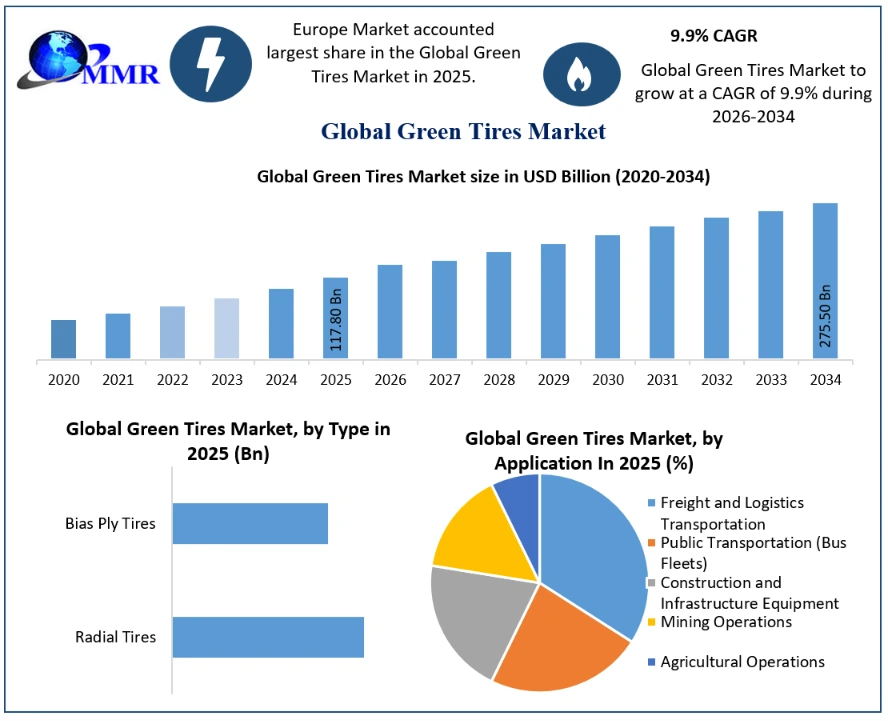
The Global Green Tires Market size was valued at USD 117.80 Bn. in 2025, and the total Global Green Tires Market revenue is expected to grow by 9.9% from 2026 to 2034, reaching nearly USD 275.50 Bn.

Global Green Tires Market Overview

Green tires are engineered for environmentally sustainable use, enabling reduced fuel use and reduced carbon emissions, as well as increased safety and performance. By utilizing advanced materials such as silica-based ingredients, advanced tread patterns, and low rolling resistance, green tires are used in passenger cars, fleets, and electric vehicles (EVs) in response to sustainability mandates, with widespread consumer use.

The market supply of tires is growing as tire manufacturers increasingly invest in green technologies and develop eco-focused production lines. Global demand is spurred by increased advertising pressures due to carbon reduction regulations, mandated environmental sustainability policies, the uptake of EVs, and consumers interested in sustainable mobility solutions for a moment that has posed impediments. In addition, the high upfront cost of green tires and difficulty sourcing sustainable raw materials will inhibit green-tire solutions in low-cost markets, which promote the creation of more affordable green innovations as demand increases and pricing pressures get too high.

Europe is presently the largest green tire market, driven by strict environmental and carbon reduction laws, the high penetration of EVs, and OEMs' goals to become sustainable. The fastest growing market is the Asia-Pacific region, including China, India, and Japan, with urban growth and infrastructure development, and government policies supporting eco-friendly solutions. The main competitors in the marketplace are Michelin, a leader in energy-efficient cargo tires, Bridgestone, a leader in sustainable sourcing, also Goodyear and Pirelli, who both focus on smart tread technologies aimed at maximizing fuel efficiency.

Green Tires Market Size, Share and Growth AnalysisGreen Tires Market Growth
To know about the Research Methodology:-Request Free Sample Report

Global Green Tires Market Dynamics

Rising Focus on Sustainability and EV Adoption to Drive Green Tires Market Growth

The worldwide transition toward carbon neutrality and fuel-efficient mobility is significantly pushing the adoption of green tires. Green tires offer reduced rolling resistance, improve fuel economy, and decrease vehicle emissions, which is consistent with climate policies and emission norms. The rapid rate of electric vehicle (EV) adoption in Europe, North America, and Asia-Pacific has increased demand for performance and energy-efficient tires. OEMs as well as fleet managers are placing a priority on green tires to meet ESG goals, while developments in silica-based compounds and tread technologies are also making green tires more efficient and durable.

Rising Production Expenses and Raw Materials Restrictions to Create Green Tires Market Challenge

The green tires segment is struggling to grow because of rising initial costs and raw material restrictions. Sustainable materials like bio-based rubbers and the latest silica compounds are more expensive than traditional materials and can often make the product simply not affordable for cost-sensitive consumers. The manufacturing process, including energy-intensive production processes and precision compounding, can add additional costs. These limitations will continue to discourage rapid take-up in the emerging market, though with ongoing R&D in low-cost sustainable materials, this could allow for some alleviation of market growth over time, through wider acceptance of these products.

Government Regulations and Green Mobility Programs to Create Green Tires Market Opportunities

Governments around the world are putting various emission standards and fuel economy regulations into place, creating supportive policy contexts for the adoption of green tires. For example:

Government Body Program/Initiative Focus Area Budget (Approx.)
EU Commission Green Deal & Fit for 55 Mobility Emission Reduction USD 1000 billion (Green Deal overall)
U.S. EPA Clean Vehicle Standards Fuel Efficiency & Tire Performance Regulatory enforcement
India NITI Aayog FAME-II & Green Mobility EV adoption & Fuel-saving Technologies USD 100 billion

Global Green Tires Market Segment Analysis:

Based on Sales Channel, the OEM (Original Equipment Manufacturer) segment dominated the global green tires market by sales channel, primarily due to the automotive industry's growing emphasis on sustainability and regulatory compliance. Automobile manufacturers are increasingly integrating green tires into new vehicle models to meet stringent environmental regulations related to carbon emissions and fuel efficiency. Green tires, designed with low rolling resistance and eco-friendly materials, help improve fuel economy and reduce the vehicle's overall environmental footprint, making them a preferred choice for OEMs aiming to enhance their green credentials. Additionally, partnerships between tire manufacturers and OEMs ensure large-volume, long-term supply agreements, giving the OEM segment a significant market share advantage over the aftermarket.

Based on Vehicle Type, the passenger car segment held the largest share in the green tyres market in 2024. This is expected to fuel market growth for green tyres in passenger automobiles throughout the forecast period. The rising need for fuel-efficient automobiles, as well as increased consumer awareness, are driving up demand for green tyres in the passenger car market. Manufacturers are increasingly concentrating on lowering fuel consumption. Consumption, either to decrease CO2 emissions or to boost passenger vehicle mileage.

Global Green Tires Market Recent Development

Date Company Development Impact
03 March 2025 Continental AG Continental partnered with Schlager Transport Logistik to integrate its sustainable green tires and digital tire monitoring system for commercial fleets. The collaboration accelerates alternative drive applications and improves operational efficiency across sustainable logistics operations.
15 May 2025 JK Tyre & Industries Ltd. JK Tyre introduced India’s first sustainable passenger car tire built with 80% sustainable materials certified under the ISCC Plus standard. The commercial launch reinforces market presence in eco-friendly tire manufacturing and accelerates adoption of low-emission mobility solutions.
09 July 2025 Pirelli & C. S.p.A. Pirelli launched its first standard production tire made with over 70% bio-based and recycled materials, including FSC-certified natural rubber. This development advances responsible natural rubber supply chains and targets 100% FSC-certified rubber across European facilities by 2026.
17 September 2025 Continental AG Continental unveiled the Conti Urban HA 5 NXT city bus tire featuring up to 60% renewable and mass-balance-certified materials. The tire cuts rolling resistance by 25 percent, effectively expanding electric bus driving range by up to 15 percent.

Global Green Tires Market Regional Insights

Europe dominates the global ecological tire market, thanks to stringent environmental regulations, elevated levels of EV adoption (notably in Norway), and ambitious sustainability goals driven by the recent EU Green Deal. In principle, leading tire manufacturers such as Continental AG, Michelin, and Pirelli (to name a few) are investing heavily in sustainable tire technologies and sourcing industrial processes in countries like Germany, France, and Italy. The new government programs, including the EU's Circular Economy Action Plan and the Law on Mobility Orientation led by France, are also advocating for the inclusion of green components into transportation systems by implementing even more circular production models. The aforementioned tire industry leaders are already operating significant production and R&D operations in Europe, where the best suppliers for low rolling resistance and recyclable components can be found.

Government Funding

Government/Program Initiative Funding (EUR) Focus Area
European Commission EU Green Deal & Circular Economy Action Plan USD 1000 Bn. (overall) Sustainable mobility, circular tire production
Germany (BMUV & BMBF) Environmental Innovation Program USD 0.25 Bn. Eco-materials, low-emission manufacturing
France (ADEME) Mobility Orientation & Eco-Design Funding USD 0.150 Bn. Green tire R&D, EV tire technology

Global Green Tires Market Competitive Landscape

The Green Tires Market is very competitive. Europe is the leading market, with strong initiatives in sustainability, strict environmental regulations (air emissions standards), and electric vehicle (EV) penetration. Europe's competitive advantages include the EU Green Deal, an established automotive manufacturing ecosystem specialized in "green" values (low environmental impacts), and favorable government policies. Michelin (France), with its Energy Saver and ePrimacy brands, is made to improve fuel efficiency and EV performance. In 2025, Michelin reported about USD 30.2 billion in revenue, largely as a result of continuing to develop sustainable materials, smart tire technologies, and circularity in production. Bridgestone Corporation (Japan), competitive advantage lies in its continued strong positions in developed and developing markets. The company's ENLITEN® platform focuses on environmentally friendly, lightweight tires designed for next-generation vehicles. Bridgestone's revenue was about USD 29.1 billion in 2024 as part of its strategic focus on a carbon-neutral manufacturing process, along with sustainability for the long term.

Global Green Tires Market Recent Development

• Michelin (France), on January 9, 2025, introduced SmartWear predictive tire technology with QNX IVY for connected and fuel-efficient driving at CES and continued airless tire testing with Uptis on the Chevy Bolt EV.

• Bridgestone (Japan), on February 15, 2025, announced a partnership with Michelin to start a trial of airless tires in the autonomous shuttle systems of Japan.

• Continental (Germany), On March 19, 2025, Continental, at the Tire Technology Expo, announced COKOON, an eco-friendly adhesive solution while continuing to research sustainable tire approaches.

• Goodyear (USA), on October 23, 2025, announced a CAD 500 million investment to build out its EV tire production capacity in Ontario, Canada.

• Pirelli (Italy), on April 2, 2025, reported on changes to improve eco-performance with upgraded Cinturato sidewalls and extended research and advancement of bio-sourced smart tire technologies, which aligned with the EU Green Deal.

Global Green Tires Market Trends

• As the number of electric vehicles (EVs) grows, there is are increasing need for green tires designed specifically for performance on EVs, including lower rolling resistance, support for higher loads, and lower noise.
Bridgestone's ENLITEN® technology provides lightweight tires for EVs, improving energy efficiency and distance traveled.

• OEMs are changing manufacturing practices to increase the use of bio-based, renewable, and recycled materials to reduce the environmental footprint, while still meeting safety and performance requirements.
Goodyear reached a milestone announcement to demonstrate a tire made up of 90% sustainable materials with materials like soybean oil, rice husk ash, and recycled polyester.

• Smart sensors allow for the real-time monitoring of tire pressure, wear, and temperature, which helps improve fuel efficiency and reduces CO₂ emissions.
Michelin’s SmartWear Technology, launched at CES 2025, incorporates embedded sensors to track tread depth and can provide recommendations on when tires should be replaced to reduce waste and fuel.

Green Tires Market Scope: Inquire before buying

Green Tires Market
Report Coverage Details
Base Year: 2025 Forecast Period: 2026-2034
Historical Data: 2020 to 2025 Market Size in 2025: USD 117.80
Bn.
Forecast Period 2026 to 2034 CAGR: 9.9% Market Size in 2034: USD 275.50
Bn.
Segments Covered: by  Type Radial Tires
Bias Ply Tires
by Sales Channel OEM
Aftermarket
by Application Freight and Logistics Transportation
Public Transportation (Bus Fleets)
Construction and Infrastructure Equipment
Mining Operations
Agricultural Operations
by  Vehicle Type Light Commercial Vehicles (LCVs)
Heavy Commercial Vehicles (HCVs)
Heavy-Duty Trucks
Buses and Coaches
Off-the-Road (OTR) Vehicles
Construction Equipment
Mining Equipment
Agricultural Machinery
by Propulsion ICE Vehicles
Battery Electric Vehicles (BEV)
Hybrid Vehicles (HEV/PHEV)
Fuel Cell Electric Vehicles (FCEV)
by Material  Silica-Based Composite Tires
Natural Rubber-Dominant Tires
Synthetic Rubber Blended Tires
Bio-Based Polymer Tires
Recycled Material-Based Tires
by Tire Functionality / Technology Low Rolling Resistance Tires
Fuel-Efficient Performance Tires
Retreadable Green Tires
Smart / Sensor-Enabled Tires

Global Green Tires Market by Region

North America (United States, Canada, and Mexico)
Europe (UK, France, Germany, Italy, Spain, Sweden, Austria, and the Rest of Europe)
Asia Pacific (China, South Korea, Japan, India, Australia, ASEAN, Indonesia, Philippines, Malaysia, Vietnam, Thailand, ASEAN, Rest of Asia Pacific)
Middle East & Africa (South Africa, GCC, Nigeria, Rest of ME&A)
South America (Brazil, Argentina, Rest of South America)

Global Green Tires Market Key Player

1.Goodyear Tire & Rubber Company (USA)
2.Cooper Tire & Rubber Company (a subsidiary of Goodyear) (USA)
3.Michelin (France)
4.Continental AG (Germany)
5.Pirelli & C. S.p.A. (Italy)
6.Nokian Tyres plc (Finland)
7.Bridgestone Corporation (Japan)
8.Yokohama Rubber Co., Ltd. (Japan)
9.Sumitomo Rubber Industries, Ltd. (Japan)
10.Hankook Tire & Technology Co., Ltd. (South Korea)
11.Kumho Tire Co., Inc.(South Korea)
12.Maxxis International (Cheng Shin Rubber) (Taiwan)
13.Toyo Tire Corporation (Japan)
14.Apollo Tyres Ltd. (India)
15.MRF Ltd.(India)
16.Triangle Titries Ltd. (India)
17.ZC Rubber (Zhongcere Co., Ltd. (China)
18.CEAT Ltd. (India)
19.JK Tyre & Indus Rubber Group Co., Ltd.) (China)
20.Linglong Tire (China)

Frequently Asked Questions

1. Which region has the largest share in the Global Green Tires Market?
Ans: The Europe region held the highest share in 2025.

2. What is the growth rate of the Global Green Tires Market?
Ans: The Global Market is expected to grow at a CAGR of 9.9 % during the forecast period 2026-2034.

3. What is the scope of the Global Green Tires Market report?
Ans: The Global Green Tires Market report helps with the PESTEL, Porter's, Recommendations for Investors and leaders, and market estimation for the forecast period.

4. Who are the key players in the Global Green Tires Market?
Ans: The important key players in the Global Green Tires Market are Michelin (France), Continental AG (Germany), Pirelli & C. S.p.A. (Italy), and Nokian Tyres plc (Finland)

5. What is the study period of this market?
Ans: The Global Green Tires Market is studied from 2026 to 2034.

Table of Contents

1. SECTION A – GLOBAL GREEN TIRES MARKET INTRODUCTION 1.1 Executive Market Landscape and Industry Overview 1.1.1 Global Green Tires Market Size (USD Bn. and 000’units), 2025–2034 1.1.2 Global Green Tire Market Definition and Evolving Industry Scope 1.1.3 Strategic Importance of Sustainability in Commercial Mobility Transformation 1.1.4 Key Macroeconomic Influences Shaping Demand Across Freight and Infrastructure 1.1.5 Green Tire Adoption Maturity Curve Across Commercial and OTR Applications 1.1.6 High-Impact Market Shifts Observed During 2020–2025 Transition Period 1.1.7 Forward-Looking Outlook with Strategic Inflection Points Through 2034 1.2 Global Green Tires Market Dynamics 1.2.1 Green Tires Market Trends 1.2.2 Green Tires Market Dynamics 1.2.3 Drivers 1.2.4 Restraints 1.2.5 Opportunities 1.2.6 Challenges 1.2.7 PORTER’s Five Forces Analysis (Global Tractor Industry) 1.2.7.1 Supplier Power 1.2.7.2 Buyer Power 1.2.7.3 Threat of Substitutes 1.2.7.4 Threat of New Entrants 1.2.7.5 Competitive Rivalry 1.2.8 PESTLE Analysis 1.3 Demand-Side Structural Drivers and Fleet Transformation Trends 1.3.1 Increasing Fuel Efficiency Mandates Driving Green Tire Adoption Globally 1.3.2 Fleet Operators Focusing on Total Cost of Ownership Optimization Strategies 1.3.3 Rising Logistics and E-Commerce Activities Increasing Heavy Vehicle Utilization 1.3.4 Electrification of Commercial Vehicles Influencing Tire Performance Requirements 1.3.5 Expansion of Mining and Infrastructure Sectors Boosting OTR Demand 1.3.6 Regulatory Pressure on Emissions Accelerating Transition Toward Sustainable Tires 1.4 Supply Ecosystem and Raw Material Sustainability Dynamics 1.4.1 Shift from Carbon Black to Silica-Based Compound Technologies 1.4.2 Increasing Adoption of Bio-Based and Recycled Rubber Materials 1.4.3 Volatility in Natural Rubber Supply Impacting Cost Competitiveness 1.4.4 Integration of Circular Economy Practices in Tire Manufacturing Ecosystems 1.4.5 Supplier Consolidation and Strategic Sourcing Agreements Across Value Chain 1.4.6 Impact of Energy Costs on Sustainable Tire Production Economics 1.5 Technology Evolution and Green Tire Performance Innovations 1.5.1 Development of Ultra-Low Rolling Resistance Tread Compound Technologies 1.5.2 Advancements in Tire Durability for Heavy-Duty Commercial Operations 1.5.3 Smart Tire Integration with IoT-Enabled Fleet Monitoring Systems 1.5.4 Retreading Innovations Extending Lifecycle of Commercial and OTR Tires 1.5.5 Lightweight Tire Structures Enhancing Fuel Efficiency and Emissions Reduction 1.5.6 R&D Investments Focused on Next-Generation Sustainable Material Compositions 1.6 Regulatory Landscape and Environmental Compliance Framework Analysis 1.6.1 Global Emission Standards Influencing Tire Efficiency Requirements Evolution 1.6.2 Government Mandates on Sustainable Materials and Recycling Compliance Adoption 1.6.3 Carbon Taxation Policies Impacting Commercial Fleet Operational Strategies 1.6.4 Incentives Promoting Adoption of Eco-Friendly Mobility and Logistics Solutions 1.6.5 Compliance Challenges Faced by Manufacturers in Emerging Economies 1.6.6 Long-Term Regulatory Roadmap Shaping Industry Sustainability Benchmarks 1.7 Cost Structure Analysis and Pricing Dynamics Assessment 1.7.1 Breakdown of Production Cost Components for Green Tire Manufacturing 1.7.2 Premium Pricing Trends Compared to Conventional Commercial Tire Products 1.7.3 Impact of Raw Material Fluctuations on Margin Sustainability Outlook 1.7.4 Lifecycle Cost Advantages Driving Adoption Among Fleet Operators 1.7.5 Pricing Differentiation Based on Performance, Durability, and Sustainability Metrics 1.7.6 Future Pricing Outlook Driven by Scale Economies and Innovation Maturity 1.8 Value Chain Optimization and Distribution Network Transformation 1.8.1 Upstream Supplier Integration for Sustainable Raw Material Sourcing Efficiency 1.8.2 Manufacturing Optimization Strategies Improving Energy and Resource Utilization 1.8.3 Role of Distributors and Dealers in Green Tire Market Penetration 1.8.4 Digital Platforms Transforming Tire Procurement and Fleet Management Processes 1.8.5 Reverse Logistics and Recycling Ecosystem Development Across Key Markets 1.8.6 Strategic Partnerships Enhancing Value Chain Resilience and Efficiency 1.9 Trade Flow Analysis and Import Export Dynamics 2020–2025 1.9.1 Global Trade Patterns for Commercial and OTR Green Tire Products 1.9.2 Import Dependency Trends Across Developing Industrial Economies 1.9.3 Export Competitiveness of Major Manufacturing Hubs and Production Clusters 1.9.4 Tariff Structures Impacting Cross-Border Tire Trade Economics 1.9.5 Supply Chain Disruptions and Recovery Trends Post-Pandemic Period 1.9.6 Strategic Shifts Toward Regional Manufacturing and Supply Chain Localization 1.10 End-Use Industry Transformation and Mobility Ecosystem Impact 1.10.1 Logistics Sector Modernization Driving Demand for Fuel-Efficient Tires 1.10.2 Mining Sector Mechanization Increasing Requirement for Durable OTR Solutions 1.10.3 Infrastructure Development Accelerating Heavy Equipment Utilization Globally 1.10.4 Agriculture Mechanization Contributing to OTR Tire Demand Expansion 1.10.5 Integration of Autonomous and Connected Vehicles Impacting Tire Design 1.10.6 Fleet Digitization Enabling Performance Tracking and Predictive Maintenance 1.11 Lifecycle Analysis and Sustainability Impact Assessment Framework 1.11.1 Cradle-to-Grave Environmental Impact Assessment of Green Tire Products 1.11.2 Carbon Footprint Reduction Potential Compared to Conventional Tire Alternatives 1.11.3 Recycling and Retreading Contribution Toward Circular Economy Objectives 1.11.4 Waste Management Challenges and Regulatory Compliance Requirements Globally 1.11.5 Sustainability Benchmarking Across Product Categories and Performance Metrics 1.11.6 Long-Term Environmental Benefits Influencing Adoption Decisions Among Stakeholders 1.12 Innovation Pipeline and Emerging Technology Roadmap Analysis 1.12.1 Breakthrough Developments in Bio-Based Elastomers and Advanced Compounds 1.12.2 Adoption of Artificial Intelligence in Tire Design and Performance Optimization 1.12.3 3D Printing Applications in Tire Prototyping and Manufacturing Processes 1.12.4 Advanced Curing Technologies Improving Production Efficiency and Consistency 1.12.5 Nanotechnology Applications Enhancing Durability and Fuel Efficiency Performance 1.12.6 Innovation Timelines Expected to Shape Next-Generation Green Tire Products 1.13 Risk Assessment and Market Uncertainty Evaluation Framework 1.13.1 Raw Material Supply Volatility and Geopolitical Risk Exposure Analysis 1.13.2 Technology Adoption Risks and Performance Reliability Concerns Assessment 1.13.3 Regulatory Uncertainty Impacting Long-Term Investment Planning Decisions 1.13.4 Competitive Pressure Leading to Pricing and Margin Erosion Risks 1.13.5 Economic Slowdown Impact on Commercial Vehicle and Infrastructure Demand 1.13.6 Mitigation Strategies Adopted Across Value Chain Participants 1.14 Investment Trends and Capital Allocation Strategies Analysis 1.14.1 Capital Expenditure Trends in Sustainable Tire Manufacturing Facilities 1.14.2 Investment Focus on R&D and Innovation-Driven Product Development Initiatives 1.14.3 Strategic Funding Toward Circular Economy and Recycling Infrastructure Development 1.14.4 Private Equity and Institutional Investor Interest in Sustainable Mobility Solutions 1.14.5 Joint Ventures and Partnerships Driving Technology and Market Expansion 1.14.6 Future Investment Outlook Aligned with Sustainability and ESG Priorities 1.15 Strategic Opportunity Mapping and High-Growth Use Case Identification 1.15.1 High-Growth Application Areas Within Commercial and OTR Green Tires 1.15.2 Untapped Opportunities in Emerging Fleet Modernization Initiatives Globally 1.15.3 Potential in Electrified Heavy Vehicle Ecosystem and Supporting Infrastructure 1.15.4 Retreading and Recycling Services as Revenue Diversification Opportunities 1.15.5 Digital Fleet Management Integration Enabling Value-Added Service Offerings 1.15.6 Long-Term Opportunity Outlook Driven by Sustainability Transition Momentum 1.16 Digital Transformation and Smart Fleet Integration Ecosystem Analysis 1.16.1 Integration of Smart Tire Sensors Enabling Real-Time Performance Monitoring 1.16.2 Adoption of Telematics Platforms Improving Fleet Efficiency and Safety Outcomes 1.16.3 Predictive Maintenance Models Reducing Downtime and Operational Cost Burdens 1.16.4 Data Analytics Enhancing Tire Lifecycle Management and Replacement Strategies 1.16.5 Connectivity Solutions Linking Tires with Broader Fleet Management Systems 1.16.6 Digital Transformation Accelerating Adoption of Intelligent Green Tire Solutions 1.17 Operational Efficiency Benchmarking Across Tire Lifecycle Performance 1.17.1 Comparative Analysis of Durability Across Green and Conventional Tire Products 1.17.2 Fuel Efficiency Benchmarking Across Commercial Fleets Using Sustainable Tire Technologies 1.17.3 Maintenance Frequency Reduction Enabled by Advanced Compound and Tread Designs 1.17.4 Retreading Performance Comparison Across Leading Green Tire Product Categories 1.17.5 Lifecycle Cost Advantages Influencing Purchasing Decisions Among Fleet Operators 1.17.6 Efficiency Metrics Aligned with Sustainability and Emissions Reduction Objectives 1.18 Procurement Strategy Evolution Among Large Fleet Operators Globally 1.18.1 Shift Toward Long-Term Procurement Contracts Ensuring Price and Supply Stability 1.18.2 Vendor Selection Criteria Emphasizing Sustainability Performance and Lifecycle Efficiency 1.18.3 Centralized Procurement Models Improving Negotiation Leverage and Cost Optimization 1.18.4 Strategic Partnerships with Tire Manufacturers Enabling Customized Product Solutions 1.18.5 Integration of Digital Procurement Platforms Enhancing Transparency and Efficiency 1.18.6 Focus on Total Cost of Ownership Influencing Purchasing Strategy Decisions 1.19 Energy Consumption Trends in Sustainable Tire Manufacturing Processes 1.19.1 Reduction in Energy Intensity Through Advanced Curing and Processing Technologies 1.19.2 Adoption of Renewable Energy Sources Across Tire Manufacturing Facilities Globally 1.19.3 Energy Efficiency Initiatives Lowering Operational Costs and Environmental Impact 1.19.4 Comparative Analysis of Energy Consumption Between Green and Traditional Tires 1.19.5 Government Regulations Driving Energy Optimization in Industrial Manufacturing Sectors 1.19.6 Long-Term Energy Outlook Influencing Production Economics and Sustainability Targets 1.20 Product Performance Benchmarking and Efficiency Standards Comparison 1.20.1 Standardized Testing Methodologies Evaluating Rolling Resistance and Durability Metrics 1.20.2 Performance Comparison Across Commercial and OTR Green Tire Product Categories 1.20.3 Impact of Tread Design Innovations on Traction and Fuel Efficiency Outcomes 1.20.4 Benchmarking Against Regulatory Efficiency Standards and Compliance Requirements Globally 1.20.5 Performance Variability Based on Operating Conditions and Application Environments 1.20.6 Continuous Improvement Initiatives Enhancing Product Reliability and Lifecycle Value 1.21 Circular Economy Integration and Recycling Infrastructure Development Trends 1.21.1 Expansion of Tire Recycling Facilities Supporting Sustainable Waste Management Systems 1.21.2 Retreading Ecosystem Growth Reducing Material Consumption and Environmental Footprint 1.21.3 Development of Secondary Markets for Recycled Rubber and Tire-Derived Materials 1.21.4 Regulatory Support Driving Circular Economy Adoption Across Tire Industry Value Chain 1.21.5 Investment in Recycling Technologies Improving Material Recovery Efficiency Rates 1.21.6 Long-Term Sustainability Benefits Enhancing Industry Transition Toward Circular Models 1.22 ESG Impact Assessment and Sustainability Reporting Standards Alignment 1.22.1 Increasing Importance of ESG Metrics in Evaluating Tire Manufacturer Performance 1.22.2 Alignment with Global Sustainability Reporting Frameworks and Disclosure Standards 1.22.3 Carbon Neutrality Commitments Influencing Strategic Decisions Across Industry Participants 1.22.4 Social Impact Considerations Including Labor Practices and Supply Chain Ethics 1.22.5 Governance Structures Supporting Transparency and Accountability in Sustainability Initiatives 1.22.6 Investor Focus on ESG Compliance Driving Capital Allocation and Valuation Metrics 1.23 Demand Elasticity and Price Sensitivity Across Commercial Applications 1.23.1 Price Sensitivity Variations Across Logistics, Mining, and Construction Sectors Globally 1.23.2 Impact of Fuel Cost Savings on Willingness to Adopt Premium Green Tires 1.23.3 Elasticity Analysis Based on Fleet Size and Operational Intensity Factors 1.23.4 Trade-Offs Between Upfront Cost and Long-Term Efficiency Benefits Evaluation 1.23.5 Economic Cycles Influencing Purchasing Behavior Among Commercial Fleet Operators 1.23.6 Pricing Strategies Aligned with Value Proposition and Performance Differentiation 1.24 Scenario Analysis Including Best Case and Worst Case Forecast Models 1.24.1 Best Case Scenario Driven by Strong Regulatory Support and Adoption Acceleration 1.24.2 Base Case Scenario Reflecting Moderate Growth and Gradual Technology Integration 1.24.3 Worst Case Scenario Influenced by Economic Slowdown and Demand Contraction Risks 1.24.4 Sensitivity Analysis Based on Raw Material Price Fluctuations and Supply Disruptions 1.24.5 Impact of Technological Breakthroughs on Market Growth Trajectory Assumptions 1.24.6 Strategic Implications of Different Scenarios on Investment and Expansion Decisions 1.25 Electric Vehicle Tire Compatibility & Demand Impact 1.25.1 EV-Specific Green Tire Performance Requirements (Torque, Weight Load, Range) 1.25.2 Noise, Vibration & Harshness (NVH) Standards in Electric Commercial Vehicles 1.25.3 Battery Range Extension Through Ultra-Low Rolling Resistance Tires 1.25.4 EV Fleet Procurement Patterns Across Logistics and Transit Operators 1.25.5 Charging Infrastructure Co-Location Impact on Green Tire Service Networks 1.26 Tire-as-a-Service (TaaS) & Subscription Business Models 1.26.1 Emergence of Pay-Per-Kilometer Tire Service Models Globally 1.26.2 OEM Partnerships Enabling Performance-Based Tire Contracts 1.26.3 Digital Monitoring Enabling TaaS Viability for Commercial Fleets 1.26.4 Revenue Model Comparison: TaaS vs Traditional Sales 1.26.5 Adoption Barriers and Enablers in OTR Tire Service Models 1.27 Microplastics, Abrasion Emissions & Euro 7 Compliance Impact 1.27.1 Euro 7 Tire Abrasion Emission Limits and Market Implications 1.27.2 Material Innovation Driven by Microplastic Reduction Mandates 1.27.3 Green Tire Advantage in Low-Abrasion Performance Benchmarking 1.27.4 Global Regulatory Convergence on Tire Particle Emission Standards 1.27.5 Fleet Operator Compliance Timelines and Procurement Shifts 1.28 Tire Labeling, Rating Systems & Buyer Decision Influence 1.28.1 EU Tire Labeling Regulation and Rolling Resistance Grading Impact 1.28.2 Fuel Efficiency Rating Influence on Fleet Procurement Decisions 1.28.3 Country-Wise Labeling Mandates and Market Readiness 1.28.4 Green Certification and Eco-Label Programs for Commercial Tires 1.29 Global Green Tires Market: Market Size and Forecast by Segmentation (by Value USD Billion and Volume in 000’Units) (2025–2034) 1.29.1 Global Green Tires Market Size and Forecast, By Vehicle Type 1.29.1.1 Light Commercial Vehicles (LCVs) 1.29.1.2 Heavy Commercial Vehicles (HCVs) 1.29.1.3 Heavy-Duty Trucks 1.29.1.4 Buses and Coaches 1.29.1.5 Off-the-Road (OTR) Vehicles 1.29.1.6 Construction Equipment 1.29.1.7 Mining Equipment 1.29.1.8 Agricultural Machinery 1.29.2 Global Green Tires Market Size and Forecast, By Type 1.29.2.1 Radial Tires 1.29.2.2 Bias Ply Tires 1.29.3 Global Green Tires Market Size and Forecast, By Material 1.29.3.1 Silica-Based Composite Tires 1.29.3.2 Natural Rubber-Dominant Tires 1.29.3.3 Synthetic Rubber Blended Tires 1.29.3.4 Bio-Based Polymer Tires 1.29.3.5 Recycled Material-Based Tires 1.29.4 Global Green Tires Market Size and Forecast, By Propulsion Type 1.29.4.1 ICE Vehicles 1.29.4.2 Battery Electric Vehicles (BEV) 1.29.4.3 Hybrid Vehicles (HEV/PHEV) 1.29.4.4 Fuel Cell Electric Vehicles (FCEV) 1.29.5 Global Green Tires Market Size and Forecast, By Tire Functionality / Technology 1.29.5.1 Low Rolling Resistance Tires 1.29.5.2 Fuel-Efficient Performance Tires 1.29.5.3 Retreadable Green Tires 1.29.5.4 Smart / Sensor-Enabled Tires 1.29.6 Global Green Tires Market Size and Forecast, By Application 1.29.6.1 Freight and Logistics Transportation 1.29.6.2 Public Transportation (Bus Fleets) 1.29.6.3 Construction and Infrastructure Equipment 1.29.6.4 Mining Operations 1.29.6.5 Agricultural Operations 1.29.7 Global Green Tires Market Size and Forecast, By Sales Channel 1.29.7.1 OEM Sales 1.29.7.2 Aftermarket Sales 1.29.8 Global Green Tires Market Size and Forecast, By Region 1.29.8.1 North America 1.29.8.1.1 United States 1.29.8.1.2 Canada 1.29.8.1.3 Mexico 1.29.8.2 Europe 1.29.8.2.1 United Kingdom 1.29.8.2.2 France 1.29.8.2.3 Germany 1.29.8.2.4 Italy 1.29.8.2.5 Spain 1.29.8.2.6 Sweden 1.29.8.2.7 Russia 1.29.8.2.8 Rest of Europe 1.29.8.3 Asia Pacific 1.29.8.3.1 China 1.29.8.3.2 South Korea 1.29.8.3.3 Japan 1.29.8.3.4 India 1.29.8.3.5 Australia 1.29.8.3.6 Indonesia 1.29.8.3.7 Philippines 1.29.8.3.8 Malaysia 1.29.8.3.9 Vietnam 1.29.8.3.10 Thailand 1.29.8.3.11 Rest of Asia Pacific 1.29.8.4 Middle East and Africa 1.29.8.4.1 South Africa 1.29.8.4.2 GCC 1.29.8.4.3 Nigeria 1.29.8.4.4 Egypt 1.29.8.4.5 Rest of ME&A 1.29.8.5 South America 1.29.8.5.1 Brazil 1.29.8.5.2 Argentina 1.29.8.5.3 Chile 1.29.8.5.4 Colombia 1.29.8.5.5 Rest Of South America 2. SECTION B – COMPETITIVE INTELLIGENCE & INDUSTRIAL ECOSYSTEM 2.1 Company Profiles: Key Players 2.1.1 Overview 2.1.2 Business Portfolio 2.1.3 Financial Overview 2.1.4 SWOT Analysis 2.1.5 Strategic Analysis 2.1.6 Recent Developments 2.1.7 Key Market Players 2.1.7.1 Michelin Group 2.1.7.2 Bridgestone Corporation 2.1.7.3 Continental AG 2.1.7.4 Pirelli & C. S.p.A. 2.1.7.5 Goodyear Tire & Rubber Company 2.1.7.6 Sumitomo Rubber Industries 2.1.7.7 Yokohama Rubber Company 2.1.7.8 Hankook Tire & Technology 2.1.7.9 Toyo Tire Corporation 2.1.7.10 Nokian Tyres Plc 2.1.7.11 Apollo Tyres Limited 2.1.7.12 MRF Limited 2.1.7.13 CEAT Limited 2.1.7.14 JK Tyre & Industries Ltd. 2.1.7.15 BKT (Balkrishna Industries Limited) 2.1.7.16 Linglong Tire 2.1.7.17 Zhongce Rubber Group 2.1.7.18 Triangle Tire Co., Ltd. 2.1.7.19 Giti Tire 2.1.7.20 Trelleborg Wheel Systems 2.1.7.21 Titan International Inc. 2.1.7.22 GRI Tires 2.1.7.23 Carlisle Companies Inc. 2.1.7.24 Kenda Rubber Industrial Company 2.1.7.25 Maxxis International 2.1.7.26 Others 2.2 Competitive Landscape Overview and Market Structure Analysis 2.2.1 Market Concentration Levels and Competitive Intensity Assessment Globally 2.2.2 Positioning of Global Leaders in Sustainable Commercial Tire Segment 2.2.3 Role of Regional Players in OTR Green Tire Ecosystem Development 2.2.4 Competitive Differentiation Based on Technology, Pricing, and Sustainability 2.2.5 Evolution of Market Share Trends During 2020–2025 Period 2.2.6 Barriers to Entry and Expansion Challenges for New Participants 2.3 Company Benchmarking and Strategic Positioning Analysis 2.3.1 Comparative Benchmarking of Leading Companies Across Key Performance Indicators 2.3.2 Product Portfolio Strength in Commercial and OTR Green Tire Segments 2.3.3 Innovation Capabilities and R&D Investment Intensity Comparison 2.3.4 Sustainability Initiatives and ESG Alignment Across Major Players 2.3.5 Operational Scale and Global Manufacturing Footprint Assessment 2.3.6 Strategic Positioning Based on Pricing and Value Proposition Differentiation 2.4 Product Innovation and Technology Leadership Assessment 2.4.1 Company-Wise Innovation Strategies in Green Tire Material Development 2.4.2 Leadership in Low Rolling Resistance and Durability Enhancement Technologies 2.4.3 Patent Activity Trends Indicating Future Technology Leadership Positioning 2.4.4 Collaboration with Technology Providers and Research Institutions Globally 2.4.5 Integration of Digital and Smart Tire Technologies Across Product Lines 2.4.6 Innovation Pipeline Strength and Commercialization Timelines Evaluation 2.5 Strategic Initiatives Including Mergers, Partnerships and Alliances 2.5.1 Key Mergers and Acquisitions Shaping Competitive Landscape Evolution 2.5.2 Strategic Alliances for Sustainable Material Sourcing and Innovation Development 2.5.3 Joint Ventures Expanding Manufacturing Capacity and Geographic Presence 2.5.4 Collaboration with Fleet Operators for Product Testing and Validation 2.5.5 Partnerships with Recycling Companies Enabling Circular Economy Integration 2.6 Financial Performance and Revenue Trend Analysis 2020–2025 2.6.1 Revenue Growth Trends Across Green Tire Product Portfolios Globally 2.6.2 Profitability Analysis Influenced by Raw Material and Energy Costs 2.6.3 Capital Expenditure Allocation Toward Sustainable Manufacturing Initiatives 2.6.4 Margin Comparison Between Green Tires and Conventional Product Segments 2.6.5 Impact of Global Demand Fluctuations on Financial Performance Stability 2.6.6 Financial Outlook Aligned with Increasing Adoption of Sustainable Tire Solutions 2.7 Supply Chain Strategies and Global Manufacturing Footprint Optimization 2.7.1 Localization Strategies Reducing Dependency on Volatile Global Supply Chains 2.7.2 Expansion of Regional Manufacturing Hubs Improving Delivery Efficiency and Responsiveness 2.7.3 Strategic Sourcing Agreements Ensuring Sustainable Raw Material Availability Globally 2.7.4 Integration of Suppliers Enhancing Quality Control and Production Consistency 2.7.5 Risk Diversification Approaches Mitigating Geopolitical and Logistics Disruption Challenges 2.7.6 Capacity Expansion Aligned with Growing Demand for Green Tire Products 2.8 Pricing Strategy and Competitive Positioning Across Key Players 2.8.1 Premium Pricing Models Justified by Lifecycle Cost and Efficiency Benefits 2.8.2 Competitive Pricing Strategies Across Commercial and OTR Tire Product Segments 2.8.3 Value-Based Pricing Aligned with Sustainability and Performance Differentiation Factors 2.8.4 Discounting and Contract Pricing Strategies for Large Fleet Operators Globally 2.8.5 Pricing Flexibility Influenced by Raw Material Cost Fluctuations and Demand Cycles 2.8.6 Strategic Positioning Balancing Profitability with Market Share Expansion Objectives 2.9 Customer Engagement Models and Fleet Partnership Strategies Analysis 2.9.1 Long-Term Contracts with Fleet Operators Ensuring Recurring Revenue Streams 2.9.2 Customized Tire Solutions Developed Based on Specific Operational Requirements 2.9.3 Aftermarket Services Including Maintenance, Monitoring, and Retreading Solutions 2.9.4 Digital Platforms Enhancing Customer Engagement and Service Delivery Efficiency 2.9.5 Collaboration with Logistics Companies Enabling Real-World Product Validation Testing 2.9.6 Customer Retention Strategies Focusing on Performance Reliability and Cost Savings 2.10 ESG Commitments and Sustainability Roadmap Evaluation Across Companies 2.10.1 Net Zero Emission Targets Driving Transformation in Manufacturing Operations 2.10.2 Adoption of Sustainable Materials Increasing Share of Eco-Friendly Tire Products 2.10.3 Investment in Recycling and Circular Economy Initiatives Across Operations 2.10.4 Transparent Sustainability Reporting Aligned with Global ESG Disclosure Frameworks 2.10.5 Social Responsibility Initiatives Focusing on Workforce and Community Development Programs 2.10.6 Governance Structures Ensuring Accountability and Long-Term Sustainability Performance Tracking 3. SECTION C – STRATEGIC OUTLOOK 3.1 Key Findings 3.2 Analyst Recommendation 3.3 Research Methodology

Custom Market Research Services

We Will Customise The Research For You, In Case The Report Listed Above Does Not Meet With Your Requirements