Global Golf Simulators Market By Component, By Technology, By Product Type, By Installation Environment, By Price Category, By Primary Application, By End User, By Distribution Channel, by Region and Forecast 2034

8.5%
CAGR (2026-2034)
2.20 USD Bn.
Forecast Market Size
308
Report Pages
145
Market Tables

Overview

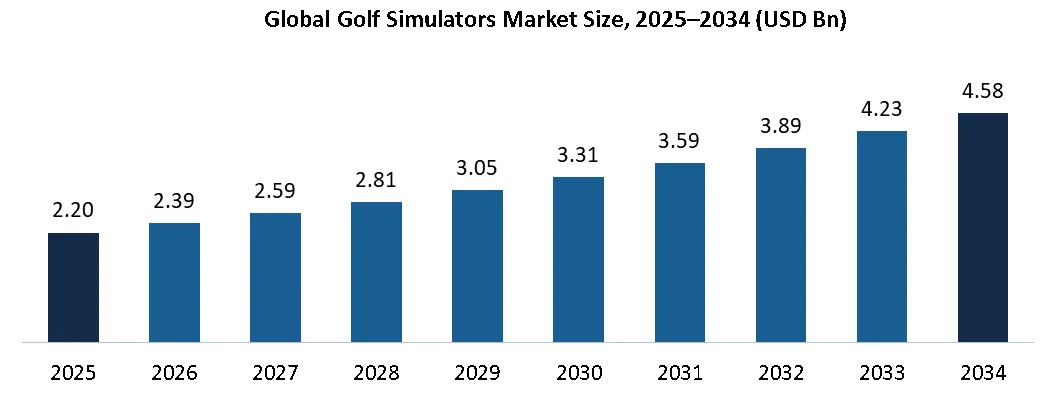
The Global Golf Simulators Market was valued at USD 2.20 billion in 2025 and is projected to reach USD 4.58 billion by 2034, growing at a CAGR of 8.5% during 2026–2034, according to Maximize Market Research (MMR). Golf simulators combine launch monitors, ball-tracking sensors, displays, impact screens and simulation software so golfers can practise, play virtual courses and be coached indoors or outdoors.

This report answers both sides of the search: what the market is worth for manufacturers, operators and investors, and what buyers want to know, from how a golf simulator works and radar versus camera launch monitors to home simulator cost, room size, screen golf and where to buy in the US, UK, Europe, Asia and India.

Hardware anchors the market and commercial venues are the largest buyers, but growth is shifting toward software subscriptions, home installations and Asia Pacific, with hybrid tracking and competitive virtual golf growing faster than the market.

Maximize Market Research provides comprehensive analysis of global golf simulators market size, share, component, technology, product, installation, price, application, end-user, channel and regional segmentation, competitive landscape, strategic scenarios and growth opportunities. The report helps simulator makers, launch-monitor brands, software developers, indoor golf operators, golf clubs and investors decide which segments, channels and countries to prioritise through 2034.

2025 | BASE YEAR

2034 | FORECAST

GROWTH RATE

LARGEST REGION

USD 2.20 Bn

USD 4.58
Bn

8.5%

North
America

Global Golf Simulators Market Overview: Size, Share, Trends and Outlook to 2034

The market is measured at system-value level across golf simulator hardware, software and services sold for residential and commercial use worldwide, including integrated, modular, portable and custom-built systems and the launch monitors, sensors, displays, screens and computing hardware inside them. Outdoor range ball-tracking is included only where it is sold as a simulation system.

Three shifts shape 2026–2034: demand is broadening from commercial venues into homes, value is moving from one-off hardware to software, content and services, and growth is rotating toward Asia Pacific, where screen golf is already mainstream. Consolidation has begun, with media groups buying simulator platforms.

Global Golf Simulators Market Size, Growth and Share Analysis
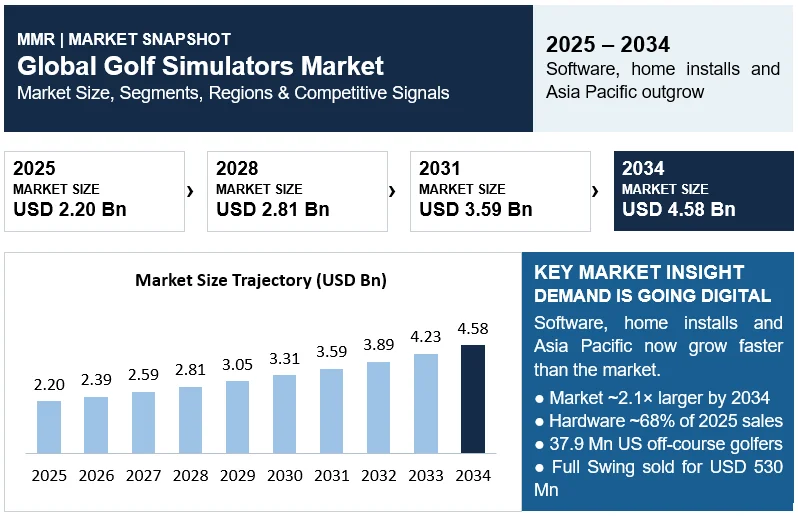
Golf Simulators Market Growth

To know about the Research Methodology :- Request Free Sample Report
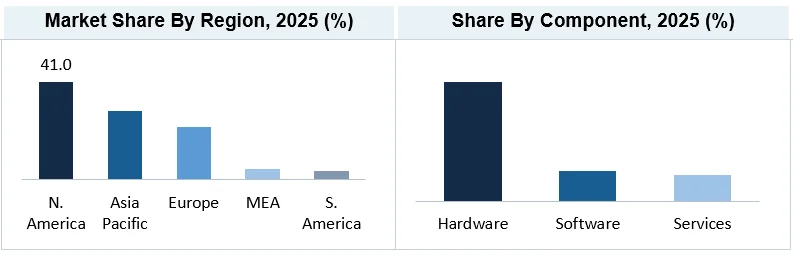
by region, by component

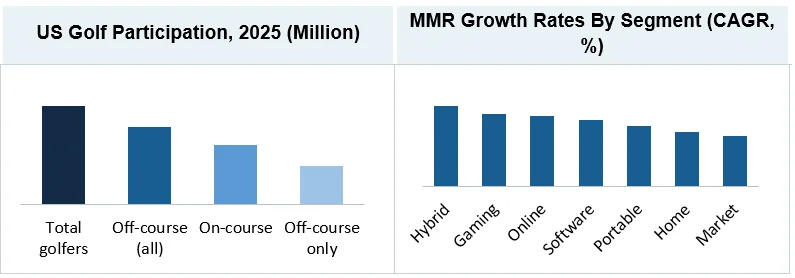
golf participation

Golf Simulator Quick Answers: 20 Most-Searched Questions About Golf Simulators, Answered in One Line

This report is built around what buyers, operators and investors actually search for. Use this table for instant answers, then jump to the section named in the last column.

Question
people search

Short
answer

Section

How big is the golf simulators
market?

USD 2.20 Bn
in 2025 (MMR); USD 4.58 Bn by 2034 at 8.5% CAGR

Market Size

How fast is the golf simulator market
growing?

8.5% CAGR on
MMR’s base; published estimates range from about 7% to 11%

Market Size

Which region buys the most golf
simulators?

North America
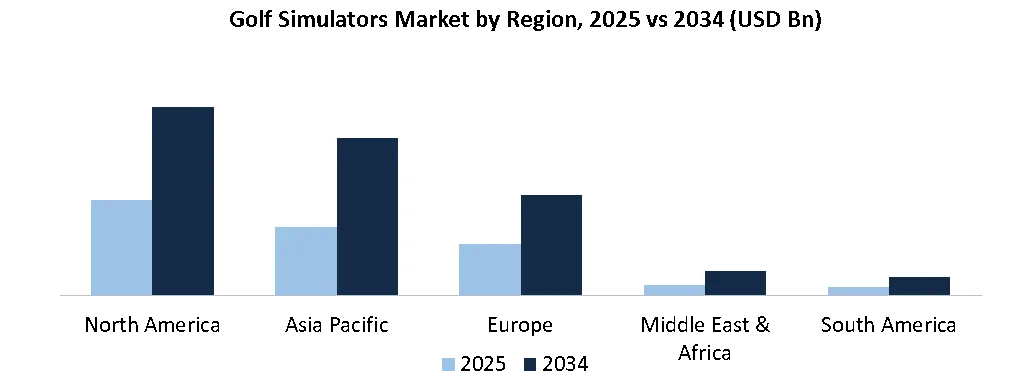
leads with 41.0% share; Asia Pacific is fastest at 9.8% CAGR

Regional

What is a golf simulator?

A launch
monitor or tracking system, software, display or screen and hitting area that
models ball flight on virtual courses

Overview

How does a golf simulator work?

Sensors read
ball and club data at impact; software calculates ball flight and renders it
on a screen

Technology

Radar or camera launch monitor?

Camera and
photometric units read the ball in a short indoor space; radar tracks flight
and needs more depth; hybrids combine both

Technology

Which tracking technology is growing
fastest?

Hybrid
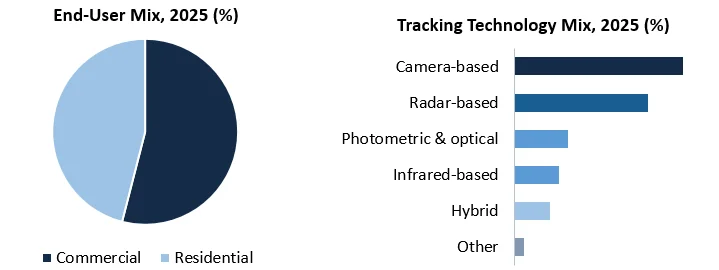
tracking at about 13.5% CAGR, from 8% of 2025 sales

Technology

How much does a home golf simulator
cost?

MMR bands:
entry-level under USD 5,000, mid-range USD 5,000 to 25,000, premium above USD
25,000 before a custom room build

Price

Do I need a launch monitor?

Yes. It
supplies the ball and club data that drives the software, and its accuracy
sets the quality of the whole system

Hardware

How much space does a golf simulator
need?

Rule of
thumb: about 10 ft ceiling, 12 ft width and 15 ft depth; confirm against the
maker’s specification

Residential

What is screen golf?

Korea’s
indoor golf format of multi-person simulator rooms, led by Golfzon, now
exporting to the US and other markets

Asia Pacific

Are golf simulators a good business?

NGF counts
1,500+ US simulator businesses; returns depend on bay utilisation, session
price and food and drink spend

Commercial

Who are the leading golf simulator
companies?

TrackMan,
Full Swing, Foresight Sports (Revelyst), Golfzon, TruGolf, Uneekor, SkyTrak,
Rapsodo and Garmin lead launch-monitor and system lists

Competitive

Who owns Full Swing?

Versant,
which agreed a USD 530 Mn purchase in July 2026 and completed it on 3 August
2026

Developments

How many Americans play golf
off-course?

NGF reports
37.9 Mn off-course participants in 2025, within a record 48.1 Mn total US
golfers

Demand

Residential or commercial: which is
bigger?

Commercial
leads with 54% of 2025 value; residential grows faster at 9.2% CAGR

Segmentation

Is software a recurring revenue
stream?

Software is
17% of 2025 value and the fastest component at 11.3% CAGR

Software

Can simulators be used for club
fitting and coaching?

Yes.
Professional-grade launch monitors serve fitting and instruction, which
together make up about 17% of applications

Applications

Which distribution channel is growing
fastest?

Online retail
at about 11.9% CAGR; direct sales remain the largest channel

Channels

Where can I buy a golf simulator?

Manufacturer
direct, authorised dealers, specialty golf retailers, online stores and
turnkey installers

Channels

Key Findings: Eight Insights Shaping the Global Golf Simulators Market

MMR’s analysis of published market data, National Golf Foundation participation statistics, company filings and industry announcements points to eight findings that explain where golf simulator value is created through 2034.

Sr.No.

Findings

Evidence

So
what

1

The market
roughly doubles in about 8.5 years

USD 2.20 Bn
(2025) to USD 4.58 Bn (2034) at 8.5% CAGR

Component
supply, installer capacity and venue space must scale about 2.1× by 2034

2

Hardware is
the base, software the growth edge

Hardware 68%
of 2025 sales; software 11.3% CAGR

Recurring
content and subscriptions become the margin engine

3

North America
is the largest region

41.0% share
in 2025; US golfers reached a record 48.1 Mn (NGF)

US demand
sets product standards and pricing

4

Asia Pacific
is the fastest-growing region

9.8% CAGR;
Golfzon 2025 revenue KRW 483.3 Bn

Screen golf
is a proven template for Western venues

5

Off-course
golf is the demand engine

37.9 Mn US
off-course participants; 1,500+ simulator businesses (NGF)

Simulators
are the entry ramp to the green-grass game

6

Residential
is catching up with commercial

Residential
9.2% CAGR vs commercial 7.9%

Home systems
and subscriptions are the volume opportunity

7

Consolidation
has started

Versant
bought Full Swing for USD 530 Mn, about 3.3× the USD 160 Mn Bruin paid in
2021

Strategic
buyers now value simulator platforms and data

8

Hybrid
tracking and virtual competition lead growth

Hybrid tech
13.5% CAGR; competitive gaming 12.3%

Accuracy and
engagement now differentiate more than price

Global Golf Simulators Market Size, Share and Forecast, 2025–2034

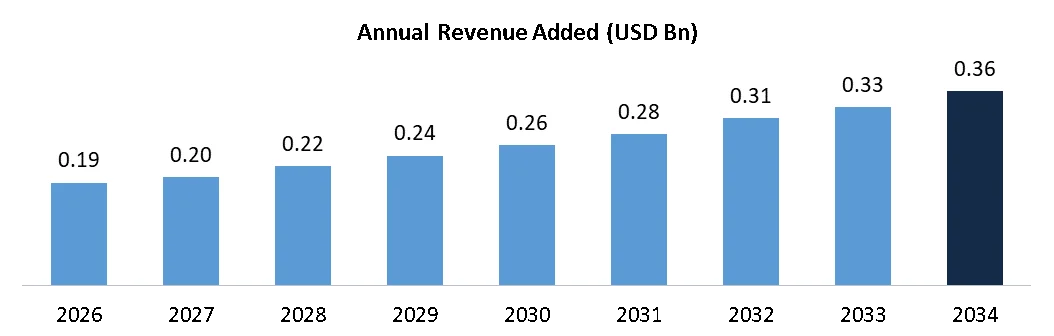
MMR sizes the market at USD 2.20 billion in 2025, rising to USD 2.39 billion in 2026 and USD 4.58 billion in 2034, an 8.5% CAGR. The market adds about USD 2.38 billion over the period; about 52% of the 2034 market is revenue that does not exist today.

How Big Is the Global Golf Simulators Market, and How Fast Is It Growing?
Golf Simulators Market size

revenue added

Global Golf Simulators Market Dynamics: Growth Drivers, Restraints and Opportunities

Global Golf Simulators Market Growth Drivers: Participation, Indoor Practice, Software and Venues

Drivers

How it
adds demand

Evidence
/ signal

Record golf participation and
off-course play

Simulators
convert interest into practice and give non-golfers a low-barrier entry

NGF: 48.1 Mn
US golfers in 2025, 37.9 Mn off-course

Weather-independent, year-round practice

Indoor
systems remove season and daylight limits for homes, clubs and academies

Indoor
systems about 87% of 2025 value (MMR est.)

Cheaper accurate tracking

Consumer
launch monitors and compact systems lower the entry price

Entry-level
systems 9.3% CAGR

Software, virtual courses and
gamification

Course
libraries, multiplayer play and leagues raise usage and recurring revenue

Software
11.3% CAGR; Full Swing app–simulator update (Aug 2026)

Commercial indoor golf and golf
entertainment

Bars,
lounges, franchises and multi-bay venues add bay capacity

NGF: 1,500+
US simulator businesses

Sports media and tour tie-ins

Tour-linked
leagues and licences build awareness and aspiration

Full Swing
powers TGL and is the PGA Tour’s licensed simulator

Global Golf Simulators Market Restraints: Cost, Space, Commoditisation and Venue Economics

Restraints

Why it
matters

Mitigation

High upfront cost and space needs

Premium
systems and custom rooms are large purchases that need ceiling height and
depth

Compact,
portable and subscription-financed offers

Hardware commoditisation

Low-cost
launch monitors compress prices and margins for system makers

Software,
content and service attach to defend value

Ecosystem lock-in and compatibility

Software,
hardware and course libraries are not always interoperable, which slows
upgrades

Open
integrations and published data standards

Discretionary-spend and rate
sensitivity

Home and
venue purchases weaken when household budgets and financing costs tighten

Leasing,
financing and lower-ticket product ladders

Commercial venue economics

Returns
depend on bay occupancy, session price and retention; weak sites churn

Memberships,
leagues and food-and-drink attach

Component supply and trade costs

Sensors,
optics, projectors and GPUs cross borders; tariffs and cost swings change
bills of materials

Dual
sourcing, regional assembly and price architecture

What Are the Biggest Golf Simulator Market Opportunities Through 2034?

Opportunities

Basis

Illustrative
size lever

Software and content subscriptions

Fastest
component at 11.3% CAGR

Course
libraries, coaching apps, leagues, analytics

Residential installations

Residential
9.2% CAGR

Portable,
garage and dedicated-room systems

Hybrid and AI-enabled tracking

Hybrid
tracking 13.5% CAGR

Accuracy gains,
AI swing analysis, automated coaching

Asia Pacific and emerging markets

Asia Pacific
9.8% CAGR

Screen-golf
formats, India, Southeast Asia, Middle East

Competitive and skill-based golf

Competitive
gaming 12.3% CAGR

Leagues,
tournaments, wagering where regulation allows

Franchise and turnkey venues

System
integrators 9.6% CAGR

Franchise
packages, bay design, managed software

Global Golf Simulators Market Segmentation: By Component, Technology, Product Type, Installation, Price, Application, End User and Channel

Golf Simulators Market by End User and Tracking Technology: Commercial, Residential and Sensor Type
end user mix

Golf Simulators Market by Component, Product Type and Distribution Channel

Hardware is 68% of 2025 value, with software and services lifting their combined share as recurring revenue grows. Portable systems lead by unit volume in published estimates (about 64% in 2025) but integrated and custom systems lead by value, so MMR reports value shares. Online retail is the fastest channel at about 11.9% CAGR, while direct sales and authorised dealers remain the main routes for high-ticket and commercial systems.

Segmentation

Largest
segment (2025 share)

Fastest
segment (CAGR)

MMR
view

Component

Hardware

Software

Defend hardware, scale subscriptions

Technology

Camera-based

Hybrid

Hybrid accuracy is the premium upgrade path

Product type

Integrated

Portable

Portable widens the home base

Installation

Indoor

Outdoor

Outdoor ranges add a second leg

Price category

Mid-range

Entry-level

Entry-level feeds the funnel

Primary application

Practice and play

Competitive gaming

Engagement formats outgrow practice

End user

Commercial

Residential

Residential closes the gap

Distribution channel

Direct sales

Online retail

Online discovery, direct fulfilment


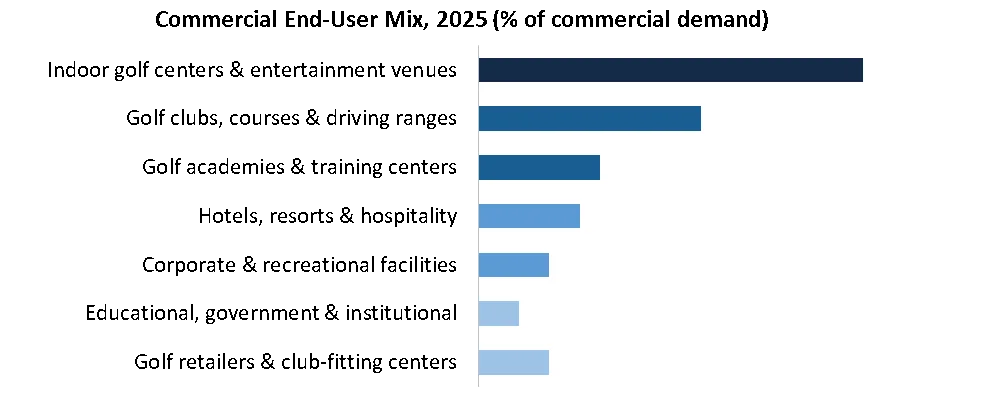
Commercial End-User Mix: Where Commercial Simulator Demand Sits
 

Global Golf Simulators Market Regional Analysis: North America, Asia Pacific, Europe, Middle East & Africa and South America
by region (1)

Region

2025
share

2025
(USD Bn)

2034
(USD Bn)

CAGR

Notes

North America

41.0%

0.90

1.77

7.8%

US is the
anchor; residential, club and golf-entertainment demand; NGF record
participation

Asia Pacific

XX

XX

XX

9.8%

Screen golf
in South Korea; strong manufacturing base; fastest region

Europe

XX

XX

XX

7.7%

Golf-club
integration, Nordic launch-monitor and software strength; indoor golf in UK
and DACH

Middle East & Africa

XX

XX

XX

9.6%

Premium
hospitality and golf-entertainment investment, led by the UAE and Saudi
Arabia

South America

XX

XX

XX

8.9%

Early-stage
commercial adoption; Brazil, Argentina and Chile lead

Golf Simulator Companies and Competitive Landscape: Who Are the Top Golf Simulator Manufacturers and Players?

Top Golf Simulator Companies: Launch-Monitor Specialists, System Makers, Venue Operators and Suppliers

MMR separates participants by role, because a launch-monitor brand, a venue operator and a display supplier do not compete with each other.

Group

Examples

Role

Launch-monitor and tracking
specialists

TrackMan,
Foresight Sports (Revelyst), SkyTrak, Rapsodo, Garmin, Uneekor, Voice Caddie,
Bushnell Golf

Ball and club
data; the accuracy layer

Integrated simulator system makers

Full Swing
(Versant), TruGolf, aboutGolf, Golfzon, HD Golf, OptiShot, P3ProSwing, ProTee
United

Complete
systems, software and course libraries

Software and analytics platforms

GSA Golf,
Creative Golf 3D, Swing Catalyst, Golf Genius Software

Courses,
coaching, leagues and tournament management

Commercial and entertainment
operators

Five Iron
Golf, Drive Shack, BigShots Golf, X-Golf, GOLFTEC, Golfzon screen golf
networks

Bay capacity,
memberships, coaching

Display and hardware suppliers

BenQ, Epson,
Panasonic, impact-screen, enclosure and mat makers

Projectors,
screens, turf and enclosures

Data, standards and rule-making
bodies

National Golf
Foundation, R&A, USGA, UL, IEC, FCC, CE conformity bodies

Participation
data, rules, safety and EMC compliance

Golf Simulator Company Benchmark: Disclosed 2025 Results and Strategic Signals

Company

Strategic
signal

GOLFZON Co., Ltd.

Korean screen
golf; overseas push

TruGolf Holdings

Hardware
+7.1%; software subscriptions −49%; franchising and wagering software

Full Swing (Versant)

Official PGA
Tour simulator licensee; powers TGL

Revelyst Golf Technology

Next-generation
Foresight simulation software due late 2026

TrackMan

Reference
launch monitor for instruction; Zen Golf active-terrain prototype

Global Golf Simulators Market Recent Developments, Consolidation and Industry News | 2026

Date

Development

Why it
matters

Jan 2026

Revelyst Golf
Technology debuts at the PGA Merchandise Show, uniting Foresight Sports,
Bushnell Golf and GolfLogix

Creates a
scaled tracking-and-software group

Jan 2026

Zen Golf
shows an active-terrain hitting surface integrated with TrackMan iO

Physical slope
matching adds realism

Jan–Feb 2026

NGF reports
record 48.1 Mn US golfers and 37.9 Mn off-course participants for 2025

Confirms the
off-course demand base

Apr 2026

TruGolf
reports FY2025 revenue of USD 18.9 Mn and plans first TruGolf Links franchise
site

Franchise and
software mix is shifting

Jul 2026

Versant
agrees to buy Full Swing for USD 530 Mn

Signals
institutional appetite for simulators

Aug 2026

Versant
completes the Full Swing acquisition

Links
simulators with Golf Channel, GolfNow and GolfPass

Aug 2026

Full Swing
launches a connected app–simulator experience with enhanced performance
tracking

Software
ecosystems become the battleground

Aug 2026

TruGolf signs
an agreement to acquire tokenisation firm Polymath

Adds
digital-asset capability to a simulator vendor

Global Golf Simulators Market Scope: Inquire before buying

Global Golf Simulators Market

Report Coverage

Details

Base
Year:

2025

Forecast Period:

2026-2034

Historical
Data:

2020 to 2025

Market Size in 2025:

USD 2.20 Billion

Forecast
Period 2026 to 2034 CAGR:

8.5%

Market Size in 2034:

USD 4.58 Billion

Segments
Covered:

By Component

Hardware (Launch Monitors & Ball
Tracking, Cameras & Sensors, Projectors & Displays, Screens &
Enclosures, Mats & Turf, Computing Units, Others); Software (Simulation
& Virtual Course, Analytics, Multiplayer & Tournament, Coaching,
Facility Management); Services (Installation, Customization, Maintenance
& Support, Consulting & Calibration, Managed Subscription)

By Technology

Camera-Based; Radar-Based; Infrared-Based;
Photometric & Optical Sensor-Based; Hybrid; Others

By Product Type

Integrated Systems; Modular Systems;
Portable Systems; Custom-Built Systems

By Installation Environment

Indoor; Outdoor

By Price Category

Entry-Level; Mid-Range; Premium

By Primary Application

Practice & Recreational Play;
Professional Training; Club Fitting & Testing; Entertainment & Social
Gaming; Competitive Gaming & Leagues; Instruction & Coaching

By End User

Residential; Commercial (Indoor Golf
Centers & Entertainment Venues; Golf Clubs, Courses & Driving Ranges;
Academies & Training Centers; Hotels & Resorts; Corporate &
Recreational; Educational & Government; Retailers & Club-Fitting
Centers)

By Distribution Channel

Direct Sales; Authorized Distributors &
Dealers; Specialty Golf Retailers; Online Retail & E-Commerce; System
Integrators & Turnkey Partners

Global Golf Simulators Market, By Region

North America (United States, Canada, Mexico)
Europe (Germany, United Kingdom, France, Italy, Spain, Netherlands, Denmark, Sweden, Norway, Finland, Switzerland, Austria, Poland, Rest of Europe)
Asia Pacific (China, Japan, South Korea, India, Australia, New Zealand, Singapore, Thailand, Indonesia, Malaysia, Vietnam, Taiwan, Rest of Asia Pacific)
Middle East & Africa (UAE, Saudi Arabia, Qatar, Israel, South Africa, Egypt, Turkey, Rest of Middle East & Africa)
South America (Brazil, Argentina, Chile, Colombia, Rest of South America)

Global Golf Simulators Market, Key Players

North America
1. Full Swing Golf, Inc. (Versant)
2. Foresight Sports (Revelyst)
3. aboutGolf Limited
4. TruGolf Holdings, Inc.
5. SkyTrak
6. Bushnell Golf (Revelyst)
7. Garmin Ltd.
8. Rapsodo Inc.
9. Ernest Sports, Inc.
10. OptiShot Golf
11. Uneekor, Inc.
12. High Definition Golf (HD Golf)
13. Sports Coach Systems Ltd.
14. P3ProSwing
15. Golfzon America
16. X-Golf America
17. Toptracer
18. GOLFTEC
19. Five Iron Golf
20. Drive Shack
21. BigShots Golf
22. Carl's Place
23. Rain or Shine Golf
24. Shop Indoor Golf
25. PinSeeker
26. BenQ Corporation
27. Epson America, Inc.
28. Panasonic Connect North America
Europe
29. TrackMan A/S
30. ProTee United B.V.
31. GSA Golf
32. Golf Simulator Software Ltd.
33. Creative Golf 3D
34. Inrange Golf
35. Range Servant AB
36. Power Tee
37. GolfBays
38. Swing Catalyst
39. Vgolf
40. Golf Swing Systems Ltd.
41. Awesome Golf Ltd.
42. Golf Genius Software
43. PuttView GmbH
44. Foresight Sports Europe
Asia Pacific
45. GOLFZON Co., Ltd.
46. Phigolf Co., Ltd.
47. Kakao VX Corp.
48. Voice Caddie (VC Inc.)
49. Golfzon Deca Inc.
50. GOLFJOY
51. Bogolf Co., Ltd.
52. T-UP Vision
53. Panasonic Corporation
54. DAIYA Corporation
55. DUNLOP Sports
56. Golfzon Holdings Co., Ltd.
57. Korea Golf University Technology Partners
58. TeeTime Ventures
59. Golf VX
Middle East & Africa
60. Golfzon Middle East
61. TrackMan Middle East
62. X-Golf UAE
63. Topgolf Dubai
South America
64. Golfzon Latin America
65. TrackMan Latin America
66. Full Swing Latin America

Global Golf Simulators Market FAQs: Frequently Asked Questions

What is the size and forecast of the global golf simulators market?
MMR values the global golf simulators market at USD 2.20 billion in 2025, USD 2.39 billion in 2026 and USD 4.58 billion by 2034, an 8.5% CAGR over 2026–2034. The market doubles in about 8.5 years, between 2033 and 2034.

Which region and country is the largest golf simulator market?
North America holds the largest share at 41.0% in 2025, anchored by the United States, where the National Golf Foundation counts a record 48.1 million golfers. Asia Pacific is the fastest-growing region at about 9.8% CAGR, led by South Korea’s screen-golf industry.

Which golf simulator segments and channels are growing fastest?
Hardware is the largest component at 68% of 2025 value, while software grows fastest at about 11.3% CAGR. Hybrid tracking leads technologies at 13.5%, residential leads end users at 9.2%, competitive gaming leads applications at 12.3% and online retail leads channels at 11.9%.

Who are the leading golf simulator companies?
Leading names include TrackMan, Full Swing (owned by Versant), Foresight Sports and Bushnell Golf (Revelyst), Golfzon, TruGolf, Uneekor, SkyTrak, Rapsodo and Garmin, alongside venue operators such as Five Iron Golf and Drive Shack.

How does a golf simulator work, and what is the difference between radar and camera systems?
A launch monitor measures ball and club data at impact, and software turns it into ball flight shown on a screen. Camera and photometric systems read the ball over a short distance, which suits indoor rooms; radar tracks the ball in flight and generally needs more depth; hybrid systems combine sensors to improve accuracy.

How much does a golf simulator cost?
MMR groups systems into entry-level (under USD 5,000), mid-range (USD 5,000 to 25,000) and premium (above USD 25,000). Total cost also includes the screen, projector, enclosure, hitting mat, computer, software subscription and any room build, so total cost of ownership is usually well above the headline price.

Is a commercial golf simulator business profitable?
It can be, but results depend on bay utilisation, session price, memberships and food-and-drink spend. NGF counts more than 1,500 US simulator businesses, and consolidation such as Versant’s USD 530 million Full Swing deal shows investor interest, but weak locations still struggle with occupancy and retention.

Global Golf Simulators Market Research Methodology

MMR sized the market top-down from a 2025 base of USD 2.20 billion and an 8.5% CAGR for 2026–2034, then triangulated against published market reports (2025 estimates of about USD 1.9 to 2.5 billion and CAGRs of about 7% to 11%), National Golf Foundation participation data, company filings and press releases (Golfzon, TruGolf, Versant, Revelyst) and industry announcements through November 2026. Segment shares and regional shares are MMR estimates anchored to published splits (for example North America at about 41% and commercial use at roughly half of demand) and are normalised so every segment set sums to the market total. Annual values are constant-CAGR interpolation. Segment CAGRs are the effective rates after normalisation; scenario rates and opportunity levers are MMR judgement.

Table of Contents

1.1. Global Golf Simulators Market Size (Value USD Billion), 2025–2034 1.2. Evolution of Golf Simulation Technology from Basic Indoor Golf Systems to Advanced Virtual Golf Environments 1.3. Definition, Scope and Classification of Golf Simulators 1.4. Role of Golf Simulators in Indoor Golf Practice, Performance Analysis and Recreational Entertainment 1.5. Integration of Launch Monitors, Ball Tracking Sensors, Projection Systems and Golf Simulation Software 1.6. Growth of Residential Golf Simulation and Commercial Indoor Golf Facilities 1.7. CAGR Analysis of Global Golf Simulators Market During 2025–2034 2. Golf Simulators Market Dynamics 2.1. Golf Simulators Market Trends 2.2. Golf Simulators Market Dynamics 2.2.1. Drivers 2.2.2. Restraints 2.2.3. Opportunities 2.2.4. Challenges 2.3. PORTER's Five Forces Analysis 2.4. PESTLE Analysis 3. Golf Simulators Market Macroeconomic Factors 3.1. Global GDP Growth and Consumer Disposable Income Influencing Golf Simulator Purchases 3.2. Household Spending on Recreational Equipment, Sports Technology and Home Entertainment 3.3. Global Golf Participation Trends and Investments in Golf Infrastructure 3.4. Commercial Real Estate Development and Expansion of Indoor Golf Entertainment Facilities 3.5. Construction Costs, Equipment Manufacturing Expenses and Electronic Component Pricing 3.6. Interest Rates, Consumer Financing and Capital Investments in Commercial Golf Facilities 3.7. Foreign Exchange Movements, International Trade and Golf Equipment Supply Chains 4. Golf Simulator Industry Trends & Emerging Technology Requirements 4.1. Increasing Adoption of Home-Based Golf Simulation and Indoor Practice Systems 4.2. Expansion of Commercial Indoor Golf Centers and Technology-Enabled Driving Ranges 4.3. Growing Demand for High-Precision Ball and Club Tracking Technologies 4.4. Integration of Artificial Intelligence, Computer Vision and Real-Time Swing Analysis 4.5. Increasing Adoption of Virtual Golf Courses, Multiplayer Gaming and Online Competitions 4.6. Development of Portable and Compact Golf Simulator Systems for Residential Users 4.7. Growth of Premium Golf Simulator Installations in Hospitality and Corporate Entertainment Facilities 5. Golf Simulator Technology Architecture & Ecosystem Landscape 5.1. Golf Ball Tracking and Launch Measurement Technologies 5.2. Club Tracking, Swing Analysis and Biomechanical Measurement Systems 5.3. High-Speed Camera Systems and Optical Measurement Infrastructure 5.4. Doppler Radar, Infrared Sensors and Photometric Imaging Technologies 5.5. Golf Simulation Software, Virtual Course Rendering and Game Engines 5.6. Projection Screens, Impact Screens, Display Systems and Immersive Visual Technologies 5.7. Hardware-Software Integration, Data Processing and Real-Time Performance Analytics 6. Golf Simulator Systems & Product Configuration Landscape 6.1. Fully Integrated Golf Simulator Systems and Turnkey Installation Packages 6.2. Modular Golf Simulator Systems with Independently Sourced Components 6.3. Portable Golf Simulator Systems and Compact Home Golf Solutions 6.4. Fixed and Permanent Golf Simulator Installations for Commercial Facilities 6.5. Professional-Grade Golf Simulator Systems for Training and Club Fitting 6.6. Multi-Bay Golf Simulator Configurations for Commercial Entertainment Venues 6.7. Custom-Built Golf Simulator Rooms and Premium Residential Installations 7. Golf Launch Monitors, Ball Tracking & Swing Measurement Systems 7.1. Golf Launch Monitor Technology and Ball Flight Measurement Capabilities 7.2. Ball Speed, Club Speed, Launch Angle and Spin Rate Measurement 7.3. Carry Distance, Total Distance and Shot Dispersion Analysis 7.4. Club Path, Face Angle, Attack Angle and Swing Plane Measurement 7.5. Indoor and Outdoor Launch Monitor Calibration and Performance Accuracy 7.6. Professional Launch Monitors for Club Fitting and Golf Instruction 7.7. Consumer-Grade Launch Monitors for Residential Golf Simulation 8. Golf Simulator Hardware & Equipment Ecosystem 8.1. Golf Launch Monitors, Radar Sensors and Optical Tracking Equipment 8.2. High-Speed Cameras, Infrared Sensors and Motion Capture Devices 8.3. Projectors, Display Screens and Image Rendering Equipment 8.4. Impact Screens, Enclosures, Nets and Protective Structures 8.5. Golf Hitting Mats, Turf Systems and Putting Surfaces 8.6. Computers, Processing Units and Graphics Hardware 8.7. Golf Simulator Accessories, Mounting Systems and Installation Components 9. Golf Simulator Software, Virtual Courses & Digital Gaming Platforms 9.1. Golf Simulation Software and Virtual Course Rendering Platforms 9.2. Digital Golf Course Libraries and Real-World Course Replication 9.3. Multiplayer Golf Gaming and Virtual Competition Platforms 9.4. Golf Performance Analytics, Shot Tracking and Player Data Management 9.5. Golf Coaching Software and Personalized Practice Programs 9.6. Subscription-Based Golf Simulation Software and Digital Content Services 9.7. Cloud Connectivity, Online Golf Leagues and Tournament Management Platforms 10. Golf Simulator Installation, Customization & Integration Services 10.1. Residential Golf Simulator Room Design and Installation 10.2. Commercial Golf Simulator Facility Planning and Turnkey Development 10.3. Projector Positioning, Screen Installation and Optical Calibration 10.4. Launch Monitor Configuration, Sensor Alignment and System Calibration 10.5. Acoustic Treatment, Lighting Control and Environmental Optimization 10.6. Golf Simulator Maintenance, Equipment Servicing and Technical Support 10.7. Custom Simulator Design, Upgrades and System Integration Services 11. Golf Simulators for Residential & Home-Based Applications 11.1. Residential Golf Simulator Installations in Dedicated Indoor Golf Rooms 11.2. Compact Golf Simulator Systems for Garages and Multi-Purpose Rooms 11.3. Premium Home Golf Simulation Systems and Luxury Residential Installations 11.4. Portable Golf Simulators for Space-Constrained Residential Environments 11.5. Home-Based Golf Practice, Swing Improvement and Performance Monitoring 11.6. Residential Golf Simulator Software Subscriptions and Digital Course Access 12. Golf Simulators for Commercial Indoor Golf & Entertainment Facilities 12.1. Dedicated Indoor Golf Simulator Centers and Multi-Bay Facilities 12.2. Screen Golf Venues and Technology-Enabled Golf Entertainment Centers 12.3. Golf Entertainment Bars, Lounges and Social Gaming Venues 12.4. Commercial Golf Simulator Installations in Sports and Recreation Centers 12.5. Membership-Based Indoor Golf Facilities and Subscription Business Models 12.6. Commercial Golf Simulator Revenue Models, Bay Utilization and Customer Retention 13. Golf Simulators in Golf Clubs, Courses & Driving Ranges 13.1. Golf Simulator Installations in Private and Public Golf Clubs 13.2. Indoor Golf Practice Facilities within Traditional Golf Courses 13.3. Technology-Enabled Driving Ranges and Ball-Tracking Infrastructure 13.4. Golf Simulator Integration for Club Member Practice and Training 13.5. Indoor Golf Facilities for Off-Season Training and Weather-Independent Practice 13.6. Commercial Simulator Revenue Generation and Golf Facility Modernization 14. Golf Simulators in Golf Academies, Coaching & Professional Training 14.1. Golf Simulator Systems for Professional Golf Coaching and Instruction 14.2. Golf Training Academies and Player Development Facilities 14.3. Swing Analysis, Biomechanical Assessment and Performance Monitoring 14.4. Junior Golf Training and Skill Development Programs 14.5. Professional Player Training and Tournament Preparation 14.6. Golf Club Fitting, Equipment Testing and Performance Optimization 15. Golf Simulators in Hospitality, Corporate & Institutional Facilities 15.1. Golf Simulator Installations in Hotels and Resorts 15.2. Golf Simulation Facilities in Residential Clubs and Premium Hospitality Properties 15.3. Corporate Offices, Business Clubs and Executive Recreation Facilities 15.4. Golf Simulators in Universities, Sports Institutions and Educational Facilities 15.5. Military, Government and Institutional Sports Recreation Facilities 15.6. Golf Simulator Integration in Mixed-Use Commercial and Recreational Developments 16. Golf Simulator Performance Analytics, Coaching & Player Development 16.1. Real-Time Golf Shot Analysis and Ball Flight Data Interpretation 16.2. Swing Mechanics, Club Delivery and Biomechanical Performance Assessment 16.3. Personalized Golf Coaching and Data-Driven Training Programs 16.4. Player Performance Tracking and Historical Progress Analysis 16.5. AI-Enabled Swing Analysis and Automated Performance Recommendations 16.6. Golf Simulator-Based Player Assessment and Skill Benchmarking 17. Golf Simulator Virtual Gaming, Entertainment & Competitive Ecosystem 17.1. Virtual Golf Course Experiences and Digital Recreation Platforms 17.2. Multiplayer Golf Simulation and Social Gaming Experiences 17.3. Online Golf Tournaments, Leagues and Competitive Gaming Platforms 17.4. Skill-Based Golf Gaming and Virtual Competition Formats 17.5. Golf Simulator Integration with Professional Golf Events and Entertainment 17.6. Gamification, Digital Rewards and Customer Engagement Models 18. Golf Simulator Pricing, Business Models & Cost Economics 18.1. Golf Simulator Pricing Across Entry-Level, Mid-Range and Premium Systems 18.2. Pricing of Launch Monitors, Tracking Devices and Simulation Hardware 18.3. Golf Simulator Software Licensing and Subscription-Based Pricing 18.4. Installation, Customization and Commercial Facility Development Costs 18.5. Hardware Maintenance, Software Upgrades and Lifecycle Expenditure 18.6. Commercial Golf Simulator Revenue Models and Return on Investment 18.7. Total Cost of Ownership (TCO) and Cost-Benefit Analysis 19. Golf Simulator Distribution, Sales & Procurement Landscape 19.1. Direct Sales Through Golf Simulator Manufacturers and Brand-Owned Channels 19.2. Authorized Distributors, Dealers and Specialty Golf Equipment Retailers 19.3. E-Commerce Platforms and Online Golf Simulator Sales 19.4. Commercial Equipment Procurement and Institutional Purchasing 19.5. Golf Simulator Installation Partners and Turnkey Solution Providers 19.6. Dealer Networks, After-Sales Support and Geographic Distribution Strategies 20. Golf Simulator Manufacturing, Supply Chain & Operational Ecosystem 20.1. Golf Simulator Hardware Manufacturing and Component Sourcing 20.2. Semiconductor, Sensor and Optical Component Supply Chains 20.3. Projector, Display and High-Speed Camera Manufacturing Ecosystem 20.4. Software Development, Digital Course Licensing and Technology Partnerships 20.5. Contract Manufacturing, Assembly and Quality Control 20.6. International Distribution, Inventory Management and Logistics 20.7. Product Testing, Calibration Standards and Equipment Reliability 21. Golf Simulator Technology Innovation, R&D & Product Development 21.1. Advancements in High-Speed Camera and Optical Tracking Technologies 21.2. Improvements in Doppler Radar and Ball Flight Measurement Accuracy 21.3. AI-Driven Golf Swing Analysis and Automated Coaching Systems 21.4. Development of Realistic Virtual Golf Courses and Graphics Rendering 21.5. Integration of Augmented Reality (AR), Virtual Reality (VR) and Immersive Displays 21.6. Development of Wireless, Portable and Space-Efficient Simulator Systems 21.7. Product Innovation, Intellectual Property and Research Investments 22. Golf Simulator Demand by Customer Type & Purchasing Behavior 22.1. Individual Golf Enthusiasts and Recreational Players 22.2. Amateur and Competitive Golfers 22.3. Professional Golfers and Performance Training Organizations 22.4. Golf Course Operators and Private Golf Clubs 22.5. Commercial Indoor Golf Facility Operators 22.6. Hospitality, Corporate and Institutional Buyers 22.7. Golf Equipment Retailers, Club Fitters and Training Businesses 23. Golf Simulator Market Adoption, Utilization & Customer Economics 23.1. Residential Purchase Considerations and Consumer Spending Patterns 23.2. Commercial Simulator Installation and Capacity Utilization 23.3. Simulator Bay Occupancy, Session Duration and Revenue per Bay 23.4. Customer Acquisition, Membership Retention and Repeat Usage 23.5. Golf Simulator Replacement Cycles and Technology Upgrade Demand 23.6. Equipment Reliability, Software Compatibility and Customer Satisfaction 24. Golf Simulator Market Regulatory, Safety & Technical Standards 24.1. Electrical Safety and Product Certification Requirements 24.2. Electromagnetic Compatibility and Electronic Equipment Standards 24.3. Indoor Facility Building Codes and Installation Compliance 24.4. Impact Screen Safety, Enclosure Design and Player Protection 24.5. Data Privacy and Consumer Information Protection 24.6. Intellectual Property, Digital Course Licensing and Software Compliance 25. Golf Simulators Regional & Country-Level Market Landscape 25.1. North American Golf Simulator Adoption, Residential Demand and Commercial Facility Expansion 25.2. European Golf Simulation Technology, Golf Club Integration and Indoor Golf Development 25.3. Asia-Pacific Screen Golf Expansion, Technology Manufacturing and Residential Adoption 25.4. Middle East & Africa Premium Golf Entertainment and Hospitality Investments 25.5. South American Golf Simulation Adoption and Emerging Commercial Opportunities 25.6. United States, Canada, United Kingdom, Germany, France, Denmark, Sweden, South Korea, China, Japan, India, Australia, UAE and Brazil 25.7. Regional Golf Participation, Consumer Purchasing Power and Indoor Golf Infrastructure 26. Golf Simulators Market: Market Size and Forecast by Segmentation (Value USD Billion) (2025–2034) 27. This is the most important section for avoiding segmentation overlap. I recommend the following classification. 27.1. Golf Simulators Market Size and Forecast, By Component 27.1.1. Hardware 27.1.1.1. Launch Monitors and Ball Tracking Devices 27.1.1.2. Cameras, Radar Sensors and Optical Tracking Equipment 27.1.1.3. Projectors and Display Systems 27.1.1.4. Impact Screens, Enclosures and Protective Structures 27.1.1.5. Hitting Mats, Turf Systems and Putting Surfaces 27.1.1.6. Computing Units and Graphics Processing Hardware 27.1.1.7. Other Hardware Components and Accessories 27.1.2. Software 27.1.2.1. Golf Simulation and Virtual Course Software 27.1.2.2. Golf Performance Analytics and Swing Analysis Software 27.1.2.3. Multiplayer Gaming and Tournament Software 27.1.2.4. Golf Coaching and Training Software 27.1.2.5. Facility Management and Simulator Operations Software 27.1.3. Services 27.1.3.1. Installation and System Integration Services 27.1.3.2. Customization and Simulator Room Development Services 27.1.3.3. Maintenance, Repair and Technical Support Services 27.1.3.4. Consulting, Calibration and Training Services 27.1.3.5. Managed Software and Subscription Support Services 27.2. Golf Simulators Market Size and Forecast, By Technology 27.2.1. Camera-Based Tracking Technology 27.2.2. Radar-Based Tracking Technology 27.2.3. Infrared-Based Tracking Technology 27.2.4. Photometric and Optical Sensor-Based Tracking Technology 27.2.5. Hybrid Tracking Technology 27.2.6. Other Tracking Technologies 27.3. Golf Simulators Market Size and Forecast, By Product Type 27.3.1. Integrated Golf Simulator Systems 27.3.2. Modular Golf Simulator Systems 27.3.3. Portable Golf Simulator Systems 27.3.4. Custom-Built Golf Simulator Systems 27.4. Golf Simulators Market Size and Forecast, By Installation Environment 27.4.1. Indoor Golf Simulator Systems 27.4.2. Outdoor Golf Simulator Systems 27.5. Golf Simulators Market Size and Forecast, By Price Category 27.5.1. Entry-Level Systems 27.5.2. Mid-Range Systems 27.5.3. Premium Systems 27.6. Golf Simulators Market Size and Forecast, By Primary Application 27.6.1. Golf Practice and Recreational Play 27.6.2. Professional Training and Performance Improvement 27.6.3. Golf Club Fitting and Equipment Testing 27.6.4. Golf Entertainment and Social Gaming 27.6.5. Competitive Gaming, Tournaments and Virtual Leagues 27.6.6. Golf Instruction and Coaching 27.7. Golf Simulators Market Size and Forecast, By End User 27.7.1. Residential Users 27.7.2. Commercial Users 27.7.2.1. Indoor Golf Centers and Entertainment Venues 27.7.2.2. Golf Clubs, Golf Courses and Driving Ranges 27.7.2.3. Golf Academies and Training Centers 27.7.2.4. Hotels, Resorts and Hospitality Facilities 27.7.2.5. Corporate and Recreational Facilities 27.7.2.6. Educational, Government and Institutional Facilities 27.7.2.7. Golf Retailers and Club Fitting Centers 27.8. Golf Simulators Market Size and Forecast, By Distribution Channel 27.8.1. Direct Sales 27.8.2. Authorized Distributors and Dealers 27.8.3. Specialty Golf Equipment Retailers 27.8.4. Online Retail and E-Commerce Platforms 27.8.5. System Integrators and Turnkey Installation Partners 27.9. Golf Simulators Market Size and Forecast, By Region 27.9.1. North America 27.9.1.1. United States 27.9.1.2. Canada 27.9.1.3. Mexico 27.9.2. Europe 27.9.2.1. Germany 27.9.2.2. United Kingdom 27.9.2.3. France 27.9.2.4. Italy 27.9.2.5. Spain 27.9.2.6. Netherlands 27.9.2.7. Denmark 27.9.2.8. Sweden 27.9.2.9. Norway 27.9.2.10. Finland 27.9.2.11. Switzerland 27.9.2.12. Austria 27.9.2.13. Poland 27.9.2.14. Rest of Europe 27.9.3. Asia Pacific 27.9.3.1. China 27.9.3.2. Japan 27.9.3.3. South Korea 27.9.3.4. India 27.9.3.5. Australia 27.9.3.6. New Zealand 27.9.3.7. Singapore 27.9.3.8. Thailand 27.9.3.9. Indonesia 27.9.3.10. Malaysia 27.9.3.11. Vietnam 27.9.3.12. Taiwan 27.9.3.13. Rest of Asia Pacific 27.9.4. Middle East and Africa 27.9.4.1. United Arab Emirates 27.9.4.2. Saudi Arabia 27.9.4.3. Qatar 27.9.4.4. Israel 27.9.4.5. South Africa 27.9.4.6. Egypt 27.9.4.7. Turkey 27.9.4.8. Rest of Middle East and Africa 27.9.5. South America 27.9.5.1. Brazil 27.9.5.2. Argentina 27.9.5.3. Chile 27.9.5.4. Colombia 27.9.5.5. Rest of South America 28. Golf Simulators Competitive Landscape 28.1. MMR Competition Matrix 28.2. Competitive Positioning of Leading Key Players [Revenue and Market Share (%)] 28.3. Key Players Benchmarking 28.3.1. Company Name 28.3.2. Headquarters 28.3.3. Golf Simulator Product Portfolio 28.3.4. Launch Monitor and Tracking Technology Capabilities 28.3.5. Hardware and Software Integration 28.3.6. Golf Course Library and Digital Content Portfolio 28.3.7. Residential and Commercial Customer Base 28.3.8. Total Company Revenue (2025) 28.3.9. Golf Simulator-Related Revenue (2025) 28.3.10. Geographic Presence 28.3.11. Distribution and Dealer Network 28.3.12. Strategic Partnerships and Technology Collaborations 28.4. Market Structure 28.4.1. Market Leaders 28.4.2. Market Followers 28.4.3. Emerging Players 28.4.4. Specialized Golf Simulation Technology Providers 28.5. Growth Rate / Y-o-Y (%) of Companies 28.6. Profit Margin (%) of Companies 28.7. R&D Investments (%) of Companies 28.8. Revenue Vs. Net Earnings – Financial Health Benchmarking (2025) 28.9. Revenue Performance and Financial Analysis (2025) 28.10. Mergers and Acquisitions Details 28.11. Recent Key Developments 29. Golf Launch Monitor & Tracking Technology Providers Landscape 29.1. Radar-Based Golf Launch Monitor Manufacturers 29.2. Camera-Based and Photometric Launch Monitor Manufacturers 29.3. Infrared and Optical Tracking Technology Providers 29.4. Ball Flight Measurement and Club Data Analysis Technology Providers 29.5. Professional-Grade and Consumer-Grade Launch Monitor Manufacturers 29.6. Launch Monitor Accuracy, Measurement Capabilities and Technology Benchmarking 30. Golf Simulator Hardware, Equipment & Display Technology Providers 30.1. Golf Simulator Hardware and Integrated System Manufacturers 30.2. Golf Impact Screen, Enclosure and Hitting Mat Manufacturers 30.3. Projector and Display Technology Suppliers 30.4. Golf Simulator Computing and Graphics Hardware Suppliers 30.5. Golf Simulator Accessories and Installation Equipment Manufacturers 30.6. Hardware Durability, System Compatibility and Performance Benchmarking 31. Golf Simulator Software & Digital Platform Providers 31.1. Golf Simulation Software and Virtual Course Platform Developers 31.2. Digital Golf Course Licensing and Content Providers 31.3. Golf Swing Analysis and Performance Analytics Software Providers 31.4. Multiplayer Gaming and Virtual Tournament Platform Providers 31.5. Golf Coaching and Player Development Software Providers 31.6. Software Compatibility, Subscription Models and Digital Ecosystem Benchmarking 32. Golf Simulator Installation, Integration & Commercial Facility Providers 32.1. Residential Golf Simulator Design and Installation Companies 32.2. Commercial Golf Simulator Turnkey Solution Providers 32.3. Indoor Golf Facility Development and Integration Specialists 32.4. Golf Simulator Room Customization and Infrastructure Providers 32.5. Technical Maintenance, Calibration and After-Sales Service Providers 32.6. Installation Costs, Project Execution and Service Network Benchmarking 33. Golf Simulator Commercial Operators & Indoor Golf Entertainment Ecosystem 33.1. Indoor Golf Entertainment Center Operators 33.2. Screen Golf Venue Operators and Franchise Networks 33.3. Membership-Based Indoor Golf Facility Operators 33.4. Golf Entertainment Bars, Lounges and Social Gaming Operators 33.5. Technology-Enabled Driving Range and Golf Practice Facility Operators 33.6. Commercial Bay Utilization, Revenue Generation and Customer Experience Benchmarking 34. Golf Simulator Manufacturers' Strategies & Expansion Plans 34.1. Expansion of Integrated Golf Simulator Product Portfolios 34.2. Development of Advanced Launch Monitor and Tracking Technologies 34.3. Expansion into Residential and Commercial Golf Simulator Markets 34.4. Development of Subscription-Based Software and Digital Golf Course Libraries 34.5. Partnerships with Golf Clubs, Professional Players and Entertainment Operators 34.6. Geographic Expansion Across Emerging and Established Golf Markets 34.7. Mergers, Acquisitions and Strategic Technology Collaborations 35. Golf Simulators Industry SWOT, Investments & Strategic Developments 35.1. Competitive Strengths of Established Golf Simulator Manufacturers 35.2. Technology Limitations, Equipment Costs and Residential Installation Constraints 35.3. Emerging Opportunities in Indoor Golf Entertainment and Home-Based Simulation 35.4. Competitive Threats from Low-Cost Systems and Alternative Golf Training Technologies 35.5. Strategic Investments in Launch Monitors, AI-Based Analytics and Software Platforms 35.6. Investments in Commercial Indoor Golf Facilities and Screen Golf Networks 35.7. Major Product Launches, Partnerships and Industry Developments 36. Golf Simulators Competitive Outlook & Market Positioning 36.1. Competitive Dynamics Across Integrated Systems, Launch Monitors and Software Platforms 36.2. Market Concentration and Competition Across Premium, Mid-Range and Entry-Level Systems 36.3. Technology Differentiation Through Measurement Accuracy and Simulation Realism 36.4. Competitive Positioning of Established Golf Technology Brands and Emerging Manufacturers 36.5. Expansion of Commercial Indoor Golf and Residential Simulator Ecosystems 36.6. Future Product Innovation, Digital Golf Experiences and Software Monetization 36.7. Long-Term Competitive Positioning of Leading Golf Simulator Companies 36. Company Profile: 60+ Key Players 36.1. Detailed Profile Considering the Parameters: 36.1.1 Overview 36.1.2 Business Portfolio 36.1.3 Golf Simulator Product Portfolio 36.1.4 Technology Capabilities 36.1.5 Financial Overview 36.1.6 Geographic Presence 36.1.7 SWOT Analysis 36.1.8 Strategic Analysis 36.1.9 Recent Developments 36.1.10 North America 1. Full Swing Golf, Inc. 2. Foresight Sports 3. aboutGolf Limited 4. TruGolf Holdings, Inc. 5. SkyTrak 6. Bushnell Golf 7. Garmin Ltd. 8. Rapsodo Inc. 9. Ernest Sports, Inc. 10. OptiShot Golf 11. Uneekor, Inc. 12. High Definition Golf (HD Golf) 13. Sports Coach Systems Ltd. 14. P3ProSwing 15. Golfzon America 16. X-Golf America 17. Toptracer 18. GOLFTEC 19. Five Iron Golf 20. Drive Shack 21. BigShots Golf 22. Carl's Place 23. Rain or Shine Golf 24. Shop Indoor Golf 25. PinSeeker 26. BenQ Corporation 27. Epson America, Inc. 28. Panasonic Connect North America 28.1 Europe 29. TrackMan A/S 30. ProTee United B.V. 31. GSA Golf 32. Golf Simulator Software Ltd. 33. Creative Golf 3D 34. Inrange Golf 35. Range Servant AB 36. Power Tee 37. GolfBays 38. Swing Catalyst 39. Vgolf 40. Golf Swing Systems Ltd. 41. Awesome Golf Ltd. 42. Golf Genius Software 43. PuttView GmbH 44. Foresight Sports Europe 44.1 Asia Pacific 45. GOLFZON Co., Ltd. 46. Phigolf Co., Ltd. 47. Kakao VX Corp. 48. Voice Caddie (VC Inc.) 49. Golfzon Deca Inc. 50. GOLFJOY 51. Bogolf Co., Ltd. 52. T-UP Vision 53. Panasonic Corporation 54. DAIYA Corporation 55. DUNLOP Sports 56. Golfzon Holdings Co., Ltd. 57. Korea Golf University Technology Partners 58. TeeTime Ventures 59. Golf VX 59.1 Middle East & Africa 60. Golfzon Middle East 61. TrackMan Middle East 62. X-Golf UAE 63. Topgolf Dubai 63.1 South America 64. Golfzon Latin America 65. TrackMan Latin America 66. Full Swing Latin America 37. Key Findings 38. Strategic Moves & Industry Outlook 39. Research Methodology

Custom Market Research Services

We Will Customise The Research For You, In Case The Report Listed Above Does Not Meet With Your Requirements