
Glycerol Carbonate Market by Grade, Application and Region - Global Market Size Estimation, Industry-Wide Analysis, Competitive Landscape Assessment & Long-Term Forecast to 2032
Overview
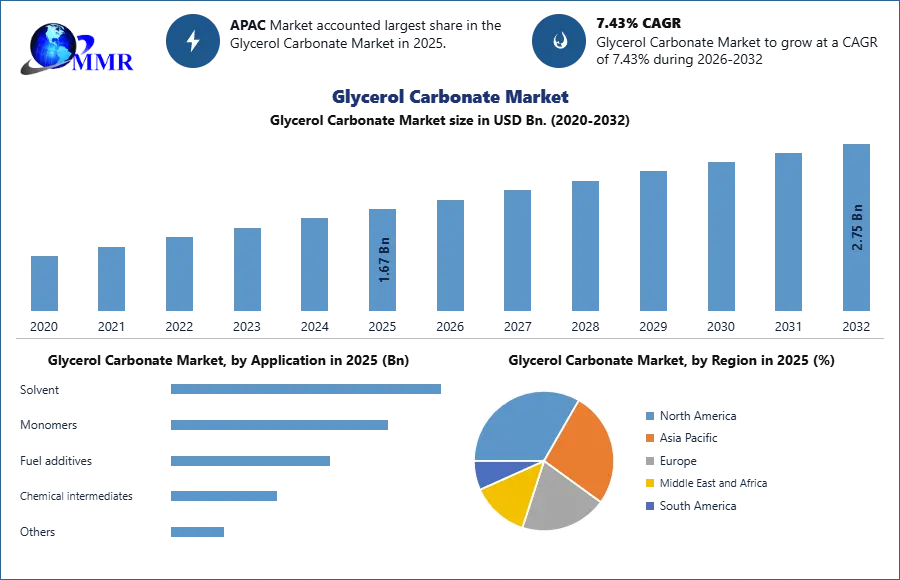
The Glycerol Carbonate Market size was valued at USD 1.66 Billion in 2025 and the total Glycerol Carbonate revenue is expected to grow at a CAGR of 7.43% from 2025 to 2032, reaching nearly USD 2.75 Billion.
Glycerol Carbonate Market Overview:
In the chemical industry, glycerol carbonate is a novel and fascinating substance. Cheap glycerol carbonate could be used to make novel polymeric materials like polycarbonates and polyurethanes. Glycerol is a by-product of biodiesel production, which uses natural vegetable oils and fats. The biodiesel industry's rapid expansion has increased glycerol waste. As a result, players in the glycerol carbonate market are capitalizing on this issue to process waste glycerol, which entails the reaction of carbon dioxide with methanol and other procedures, finally producing glycerol carbonate, a key chemical intermediate. Thus, glycerol carbonate is transformed into epoxy propanol (EP), which is used to make detergents, healthcare goods, and industrial paints and coatings on a huge scale.
This report evaluates the Glycerol Carbonate Market as the 2026 Middle East crisis destabilizes traditional petrochemical feedstocks. With crude prices nearing USD 120/bbl, the industry is accelerating the shift toward bio-based glycerol valorization to ensure chemical supply-chain resilience. We analyze how market leaders are leveraging advanced catalytic transesterification to replace petroleum derived intermediates, providing stakeholders with strategic frameworks to navigate surging energy costs and capitalize on the urgent demand for sustainable, carbon-neutral solvents.
To know about the Research Methodology :- Request Free Sample Report
Glycerol Carbonate Market Dynamics:
Rising need for polycarbonate (PC) and lithium batteries.
The growing demand for polycarbonate (PC) and lithium batteries from the various industries is driving and expected to drive the growth of the glycerol carbonate market over the forecast period respectively. Along with its biodegradability, polarity, and reactivity, glycerol carbonate is becoming a popular raw material for the manufacturing of polycarbonates, gasoline additives, and cleaning solvents. Because it does not produce toxic phenols or acids, it is an environmentally safe option for assembling polycarbonates.
With rapid advancements in polycarbonate production and lithium batteries, players in the glycerol carbonate market are unlocking income possibilities. Thus, the global glycerol carbonate market is expected to grow with a CAGR of 7.43% over the forecast period thanks to the high demand for glycerol carbonate in polycarbonate production and lithium batteries. Also, the growing demand for glycerol carbonate from paints and coatings industries to manufacture water-based organic paints is expected to drive market growth over the forecast period.
Involvement of hazardous gases for glycerol carbonate production.
Though glycerol carbonate is an organic compound, hazardous gases like carbon monoxide and phosgene are involved in its conventional production method leaving harmful sodium chloride (NaCl) as a by-product. Most of the manufacturers across the globe use phosgene, which may lead to death or severe health problems even exposed to low concentrations. So, any process dealing with phosgene requires an advanced level of safety, which is expected to increase the cost for production and acting like restrain for the growth of the market.
Volatile prices of oil and gas.
The price and availability of raw materials are the most important factors in determining the overall costs of glycerol carbonate products. Methanol, ethylene oxide, and carbon dioxide are among the basic ingredients needed to make glycerol carbonate. Most of these raw materials are derivatives based on crude oil that are subject to commodity price volatility. The rising global demand for crude oil, as well as the instability in the Middle East, are important drivers influencing glycerol carbonate costs.
The market is also impacted by high transportation costs, which are caused by growing fuel prices, as well as high manufacturing costs leading to higher energy expenses. The manufacturers have responded to rising production costs by ensuring that price increases are irregularly allocated, with end-users taking the burden of the cost. Thus, the glycerol carbonate market faces a challenge from volatile oil and gas prices.
Glycerol Carbonate Market Segment Analysis:
Based on Grade, the global glycerol carbonate market is segmented into four types as follows, food-grade, industrial grade, and pharmaceutical grade, and others. In 2025, the pharmaceutical grade segment was dominant and held 34% of the overall market share in terms of revenue. It's also useful for insecticides as a reagent and as a solvent in paints and coatings. The need for industrial-grade glycerol carbonate is expected to rise over the forecast period thanks to increased demand for polycarbonates from end-use sectors like automotive, electrical, and electronics.
Based on Application, the global glycerol carbonate market is segmented into five types as follows, solvents, monomers, fuel additives, chemical intermediates, and others. In 2025, the solvent segment held the largest market . Glycerol carbonate is a non-toxic substance that can be used as a solvent in the manufacture of a wide range of compounds. It has several advantages over traditional organic solvents. It is used as a solvent in a variety of products, including detergents, paints and coatings, personal care products, and lithium-ion batteries.
Glycerol Carbonate Market Regional Insights:
In 2025, Asia Pacific was the dominant region and held the highest share 56.24% of the global glycerol carbonate market. During the forecast period, it is also expected to grow with the highest CAGR of approximately 4.43%. The rising usage of glycerol carbonate in the production of polycarbonate in countries such as China, Japan, Korea, Thailand, Taiwan, Singapore, and Malaysia are driving demand in this region. The Asia Pacific region's growing demand for lithium-ion batteries from the electronics and automotive industries are expected to drive the lithium-ion battery electrolyte market, and thus the glycerol carbonate market.
The North American market held 18.72% of the total market in 2025 and is expected to grow at a moderate CAGR of approximately 3.12% over the forecast period, owing to government efforts to upgrade the region's public infrastructure. Furthermore, regional market growth has been pushed by the recovery of the automobile and development industries, as well as growing ventures for structures and frameworks. Because of the widespread use of glycerol carbonate in the pharmaceutical business, the United States is a major beneficiary in the region.
The objective of the report is to present a comprehensive analysis of the global market to the stakeholders in the industry. The past and current status of the industry with the forecasted market size and trends are presented in the report with the analysis of complicated data in simple language. The report covers all the aspects of the industry with a dedicated study of key players that include market leaders, followers, and new entrants.
PORTER, PESTEL analysis with the potential impact of micro-economic factors of the market have been presented in the report. External as well as internal factors that are supposed to affect the business positively or negatively have been analyzed, which will give a clear futuristic view of the industry to the decision-makers.
The report also helps in understanding the global market dynamics, structure by analyzing the market segments and project the global market size. Clear representation of competitive analysis of key players by product, price, financial position, product portfolio, growth strategies, and regional presence in the global market makes the report investor's guide.
Glycerol Carbonate Market Scope: Inquire before buying
| Glycerol Carbonate Market | |||
|---|---|---|---|
| Report Coverage | Details | ||
| Base Year: | 2025 | Forecast Period: | 2026-2032 |
| Historical Data: | 2020 to 2025 | Market Size in 2025: | 1.67 USD Bn. |
| Forecast Period 2026-2032 CAGR: | 7.43% | Market Size in 2032: | 2.75 USD Bn. |
| Segments Covered: | by Grade | Food grade Industrial grade Pharmaceutical grade Others |
|
| by Application | Solvent Monomers Fuel additives Chemical intermediates Others |
||
| by Source | Bio-based Synthetic/Petrochemica |
||
| by Form | Liquid Solid/Powder |
||
Glycerol Carbonate Market, by Region
North America (United States, Canada and Mexico)
Europe (UK, France, Germany, Italy, Spain, Sweden, Austria and the Rest of Europe)
Asia Pacific (China, South Korea, Japan, India, Australia, Indonesia, Malaysia, Vietnam, Taiwan, Bangladesh, Pakistan and the Rest of APAC)
South America (Brazil, Argentina Rest of South America)
Middle East & Africa (South Africa, GCC, Egypt, Nigeria and the Rest of ME&A)
Key Players / Competitors Profiles Covered in Brief in Global Glycerol Carbonate Market Report in Strategic Perspective:
- Huntsman Corporation
- UBE Corporation
- ANHUI MEISENBAO TECHNOLOGY CO., LTD
- Linyi Zhongtong Technology Co., Ltd.
- Catalynt
- Inkemia Green Chemicals Inc.
- TCI Chemicals (India) Pvt. Ltd.
- Carbone Scientific Co., Ltd.
- Acros Organics B.V.B.A.
- GLACONCHEMIE GmbH
- Cambridge Isotope Laboratories, Inc.
- Eurisotop
- Solvay S.A.
- BASF SE
- Lotte Chemical Corporation
- Ambeed, Inc
- Tokyo Chemical Industry Co., Ltd.
- Mitsubishi Chemical Corporation
- SABIC
- Dow
- Ferro Corporation
- Yancheng Jinxin Chemical
- Wuxi Jinneng Chemical
- Eastman Chemical Company
- Merck KGaA
Frequently Asked Questions
1.What is the projected Glycerol Carbonate Market size and growth rate?
Ans. The market was valued at USD 1.66 Billion in 2025 and is projected to reach USD 2.75 Billion by 2032, exhibiting a 7.43% CAGR.
2. Which region leads the Glycerol Carbonate Market share analysis?
Ans. Asia Pacific dominates with a 56.24% share, driven by surging demand for polycarbonate and lithium-ion batteries in China, Japan, and major Southeast Asian manufacturing hubs.
3. What are the primary Industry Growth Drivers for glycerol carbonate?
Ans. Rapid expansion in the lithium-ion battery electrolyte market and rising demand for non-toxic, biodegradable solvents in paints and coatings are fueling significant global market adoption.
4. How is technology addressing Glycerol Carbonate Market supply chain challenges?
Ans. Market leaders are adopting advanced catalytic transesterification to eliminate hazardous phosgene use, improving production safety and reducing costs associated with stringent environmental and health regulations.
5. What is the significance of bio-based sourcing in this market?
Ans. Utilizing waste glycerol from biodiesel production ensures feedstock security and sustainability, allowing manufacturers to bypass geopolitical energy shocks while meeting urgent demand for carbon-neutral intermediates.
6. Which application segment offers the highest income possibilities for players?
Ans. The solvent segment currently leads, as glycerol carbonate’s high polarity and reactivity make it an essential, environmentally safe component for modern polycarbonates and industrial detergents.