
Food Grade Gases Market – Global Market Size, Strategic Growth Drivers, Risk Assessment Framework, Regulatory Landscape Review, Competitive Intensity Mapping & Long-Term Industry Outlook to 2029
Overview
Food Grade Gases Market is expected to reach US$ 16.70 Bn. by 2029, at a CAGR of 6.72% during the forecast period.
According to Maximize Market Research, the Global Food Grade Gases market is expected to grow at a moderate growth rate and reach a significant market value by the end of the forecast period.
Food Grade Gases Market report is a comprehensive analysis of the industry, market, and key players. The report has covered the market by demand and supply-side by segments. The Global Food Grade Gases Market report also provides trends by market segments, technology, and investment with a competitive landscape.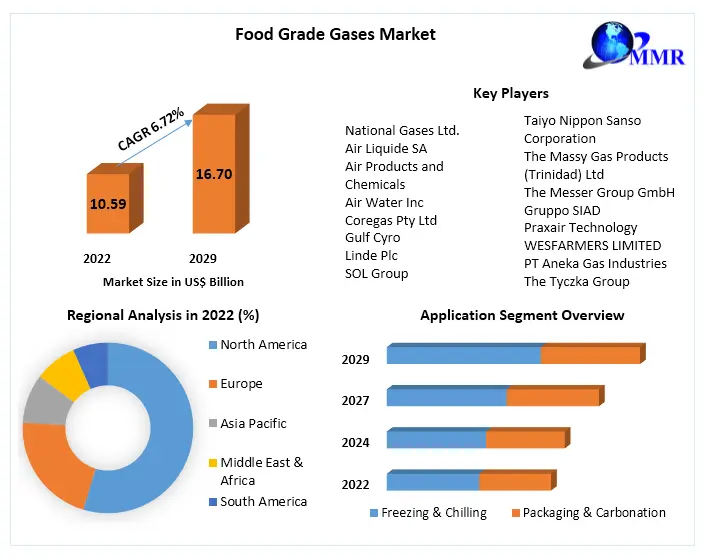 To know about the Research Methodology :- Request Free Sample Report
Food Grade Gases Market Overview:
To meet the food quality requirement, food grade gases are utilised as a processing aid or as an addition. Food-grade gases play an important part in the food packing and preservation processes. These gases are primarily used to freeze, chill, grind, and package a wide range of products, including bakery and dairy products, drinks, meat and poultry, fruits and vegetables, and ready-to-eat meals.
The market for food-grade gases has been largely spurred by the increased demand for convenience foods and carbonated beverages. Furthermore, with the introduction of new products in the food sector and developments in packaging technology, the demand for food-grade gases for diverse end-uses has increased.
Food Grade Gases Market Dynamics:
Drivers:
Growing customer worries about the contamination and safety of nutritious items has compelled corporations to use food-grade industrial gases in packing and storage. The growing importance of Modified Atmosphere Packaging (MAP) in the food and beverage industry for preventing microbial development is projected to drive market demand in the near future. The need for food-grade industrial gases is predicted to rise as NSF H1 standards are increasingly implemented in the food and beverage industry. Over the projected period, rising awareness of the importance of preserving fragrance and texture as well as extending shelf life in the nutrition industry is likely to have a favourable impact on the market.
On account of increased concerns about decreasing greenhouse gas (GHG) emissions, the European Commission and the United States Environmental Protection Agency (EPA) developed a number of regulations to minimise the use of fluorochemical gases such as HFC in the packaging of food and beverage goods. As a result, over the projection period, food-grade industrial gases are expected to replace fluorochemical gases in the nutrition industry. The use of vacuum pumps to remove moisture and oxygen from food and beverage packaging has seen a rising trend in recent years and is predicted to have a negative influence on the market over the projected period.
Increase Number of Microbreweries Across Globe:
Beers are carbonated with carbon dioxide, which adds a sparkle and tart flavour while also avoiding spoiling. CO2 reclamation equipment is generally used in large-scale breweries to recover carbon dioxide generated during the fermentation process. The Brewers of Europe said that European beer production hit an eight-year high in 2022. The expanding number of independent and microbreweries has aided the market's expansion.
Restraints:
In most nations in North America and Europe, legislation has been enacted to safeguard food items against deterioration and contamination caused by poor manufacturing and refrigerated storage practises. As a result, each country has designated agencies to inspect consumer health issues as well as the sort of material utilised to ensure that it is safe for use in food and beverage operations. Product traceability marking on the gas cylinder, valve, or valve guard is also required by law for all gas cylinders delivered to beverage makers. These regulations must be followed by food-grade gas producers.
Opportunities:
Food products that are healthful, convenient, natural, and sustainable are becoming more and more popular among consumers. As a result, food and beverage producers have been compelled to develop new and unique items. Food and beverage businesses use a number of marketing methods, including new goods, variety line extensions, packaging, and formulas. As more new products are introduced, the demand for packaging and storage of these products grows. For producers, the usage of food-grade gases will be a big potential.
Challenges:
Food-grade gases must be controlled and readily available at the point of application, and delivery methods are vital for system compatibility and safe transit. Bulk containers, cryogenic cylinders, gas cylinders, and glass bottles are among the storage containers used for this purpose. Food-grade gas manufacturers face significant difficulty in preventing danger and environmental hazards linked with their products.
Segment Analysis:
On the basis of type, the market is segregated into Carbon Dioxide, Nitrogen and Others. The carbon dioxide segment led the food grade gases market share in 2022 and is likely to continue to do so during the forecast for food grade gases. This is due to the addition of carbon dioxide to a variety of soft drinks to give them fizz and enhance their flavour.
Furthermore, CO2 gas is used to carbonate wines and beers, which contributes to the segment's growth. It also adds effervescence to the beer, which helps to elevate the aroma. It's also used to neutralise alkaline water in water treatment. In the food sector, liquid carbon dioxide is used to freeze birds, meats, fruits, and vegetables.
On the basis of application, the market is segregated into Freezing & Chilling and Packaging & Carbonation. In 2022, the packaging and carbonation category ruled the market. This is due to the inert nature of the gas, which maintains the packaged items' integrity by preventing undesirable chemical reactions such as oxidation or food spoiling. In addition, the use of modified atmosphere packaging (MAP) is becoming more popular, as it aids in blanketing food with food-grade nitrogen to extend the shelf life of fresh foods. Furthermore, by removing oxygen and replacing it with nitrogen, MAP helps to extend the shelf life of food.
On the basis of end-user, the market is segregated into Beverages, Meat & Seafood and Packaged Products. Due to an increase in the usage of liquid carbon dioxide in meat and seafood to enhance the shelf life of food products by lowering lipid oxidation and preventing microbiological development, the meat and seafood market is expected to develop at a CAGR of 3.0 per cent from 2023 to 2029.
Regional Analysis:
Because of the enormous volume consumption of meat, poultry, and seafood products, North America dominates the worldwide food-grade gases industry with a major market share. The consumption of frozen and packaged food products in the United States is likely to boost the segment's growth, as individuals in the country prefer packaged food or dining out over home cooking. Furthermore, the recent trend of consuming distinct flavour food inspired by foreign cuisine and protein-based dietary food is positively boosting product demand for food grade gases for frozen meat, poultry, and seafood, as well as packaged food goods.
Due to the rising demand for frozen and processed food items caused by changing consumer lifestyles and eating habits, the European food-grade industry is expected to rise at an exponential rate. Due to rising disposable income, a growing working population, and a shift in consumer preferences toward easy-to-consume food products, Asia-Pacific is expected to grow at a healthy rate.
Key Highlights:
Global Food Grade Gases Market analysis and forecast, in terms of value.
Comprehensive study and analysis of market drivers, restraints and opportunities influencing the growth of the Global Food Grade Gases Market
Global Food Grade Gases Market segmentation on the basis of type, source, end-user, and region (country-wise) has been provided.
The Global Food Grade Gases Market strategic analysis with respect to individual growth trends, future prospects along with the contribution of various sub-market stakeholders have been considered under the scope of study.
Global Food Grade Gases Market analysis and forecast for five major regions namely North America, Europe, Asia Pacific, the Middle East & Africa (MEA) and Latin America along with country-wise segmentation.
Profiles of key industry players, their strategic perspective, market positioning and analysis of core competencies are further profiled.
Competitive developments, investments, strategic expansion and competitive landscape of the key players operating in the Global Food Grade Gases Market are also profiled.
The report has considered the base year of 2022 and past four years trend. 2022 figures are at actuals, however due to different dynamics of year 2022, market forecast is not only dependent upon 2022, but on the basis of 2023-2029.
Food Grade Gases Market Scope: Inquire before buying
| Global Food Grade Gases Market | |||
|---|---|---|---|
| Report Coverage | Details | ||
| Base Year: | 2022 | Forecast Period: | 2023-2029 |
| Historical Data: | 2018 to 2022 | Market Size in 2022: | US $ 10.59 Bn. |
| Forecast Period 2023 to 2029 CAGR: | 6.72% | Market Size in 2029: | US $ 16.70 Bn. |
| Segments Covered: | by Type | Carbon Dioxide Nitrogen Others |
|
| by Application | Freezing & Chilling Packaging & Carbonation |
||
| by End-User | Beverages Meat & Seafood Packaged Products |
||
by Region
North America (United States, Canada and Mexico)
Europe (UK, France, Germany, Italy, Spain, Sweden, Austria and Rest of Europe)
Asia Pacific (China, South Korea, Japan, India, Australia, Indonesia, Malaysia, Vietnam, Taiwan, Bangladesh, Pakistan and Rest of APAC)
Middle East and Africa (South Africa, GCC, Egypt, Nigeria and Rest of ME&A)
South America (Brazil, Argentina Rest of South America)
Food Grade Gases Market Key Players are:
1. National Gases Ltd.
2. Air Liquide SA
3. Air Products and Chemicals
4. Air Water Inc
5. Coregas Pty Ltd
6. Gulf Cyro
7. Linde Plc
8. SOL Group
9. Taiyo Nippon Sanso Corporation
10.The Massy Gas Products (Trinidad) Ltd
11.The Messer Group GmbH
12.Gruppo SIAD
13.Praxair Technology
14.WESFARMERS LIMITED
15.PT Aneka Gas Industries
16.The Tyczka Group
17.Parker Hannifin Ltd
Frequently Asked Questions:
1. Which region has the largest share in Global Food Grade Gases Market?
Ans: North America region held the highest share in 2022.
2. What is the growth rate of Global Food Grade Gases Market?
Ans: The Global Food Grade Gases Market is growing at a CAGR of 6.72% during forecasting period 2023-2029.
3. What is scope of the Global Food Grade Gases market report?
Ans: Global Food Grade Gases Market report helps with the PESTEL, PORTER, COVID-19 Impact analysis, Recommendations for Investors & Leaders, and market estimation of the forecast period.
4. Who are the key players in Global Food Grade Gases market?
Ans: The important key players in the Global Food Grade Gases Market are – National Gases Ltd., Air Liquide SA, Air Products and Chemicals, Air Water Inc, Coregas Pty Ltd, Gulf Cyro, Linde Plc, SOL Group, Taiyo Nippon Sanso Corporation, The Massy Gas Products (Trinidad) Ltd, The Messer Group GmbH, Gruppo SIAD, Praxair Technology, WESFARMERS LIMITED, PT Aneka Gas Industries, The Tyczka Group, and Parker Hannifin Ltd
5. What is the study period of this market?
Ans: The Global Food Grade Gases Market is studied from 2022 to 2029.