
Fiber Optics Market Size by Fiber Type, Component, Cable Type, End-Use Industry, Region, Industry-Wide Analysis, Competitive Landscape Assessment & Long-Term Forecast to 2032
Overview
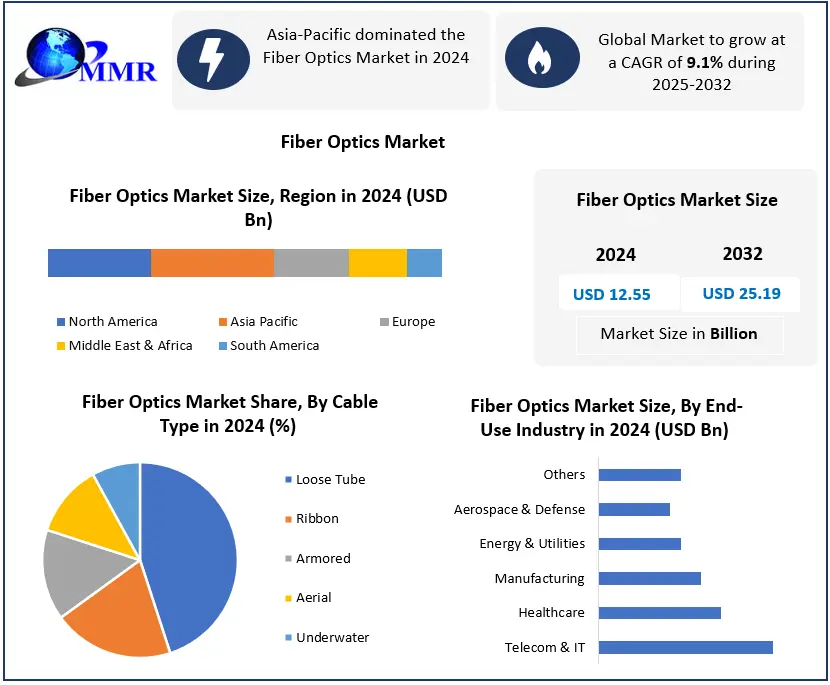
The Fiber Optics Market was valued at USD 12.55 Bn in 2024, and the total revenue of the Fiber Optics Market is expected to grow at a CAGR of 9.1% from 2025 to 2032, reaching USD 25.19 Bn by 2032.
Fiber Optics Market Overview:
Fiber optics, employing slender, flexible strands made of glass or plastic, facilitates data transmission through light pulses. These fibers control light waves along their core, enabling rapid and high-capacity data transfer across extended distances. These cables work by converting electrical signals into light pulses via transmitters, allowing the light to traverse the fiber core by bouncing off the cladding through total internal reflection. The global fiber optics market is experiencing an impressive surge, driven by the escalating demand for high-speed data transmission and the pervasive need for reliable, high-bandwidth communication networks across various industries. The proliferation of the Internet of Things (IoT) and the ongoing advancements in telecommunications infrastructure propel the fiber optics market demand.
 To know about the Research Methodology :- Request Free Sample Report
The deployment of fiber optic cables has become increasingly ubiquitous, catering to the escalating requirements of data-intensive applications, including video streaming, cloud computing, and the advent of 5G networks. Countries in the Asia-Pacific region, particularly China and India, are witnessing substantial fiber optics market growth due to significant investments in infrastructural development and the rapid expansion of internet connectivity. The fiber optics market is on a trajectory of consistent expansion, primarily owing to the indispensable role played by fiber optics in enabling faster data transmission, bolstered by key factors such as technological innovations, increasing demand for high-speed internet, and the continuous expansion of the telecommunications sector.
Key players in the fiber optics market, such as Corning Incorporated, Finisar (now part of II-VI Incorporated), OFS (Furukawa Electric Co. Ltd.), and CommScope driving innovation and development within the fiber optics industry. These companies have introduced groundbreaking solutions and products that cater to the evolving needs of various sectors. For instance, Corning Incorporated unveiled the Corning TXF™ Optical Fiber, targeting long-haul networks with heightened data rates and enhanced transmission capabilities. Meanwhile, Finisar, now under II-VI Incorporated, has contributed significantly to the advancement of optical communication components, offering high-speed optical transceivers crucial for enabling rapid data transmission in fiber optic networks.
OFS has concentrated on creating specialized optical fibers tailored to meet the unique demands of sectors such as telecommunications, medicine, and aerospace. CommScope's focus lies in developing and deploying fiber optic solutions for network infrastructure, featuring high-density fiber panels and connectivity solutions to ensure efficient data transmission. These industry leaders' commitment to research and development continues to drive the fiber optics market advancing, promising further innovation and growth in the fiber optics technology.
Fiber Optics Market Dynamics:
IoT Integration and Efficient Data Transmission Empowering Fiber Optics Market Demand
The insatiable global demand for high-speed internet drives the adoption of fiber optics market, meeting the need for rapid data transfer in an era reliant on bandwidth-intensive applications like video streaming and cloud computing. Simultaneously, telecommunications infrastructure expansion, exemplified by Verizon's Fios network for 5G support, emphasizes the pivotal role of fiber optics market trend in evolving networks. The growing data center and cloud computing landscape, exemplified by Amazon Web Services' utilization of fiber optics market demand in their expansive data center networks, necessitates robust connectivity. Additionally, the integration of Internet of Things (IoT) devices across industries necessitates reliable communication, showcasing fiber optics' role in transmitting copious data efficiently. Industrial automation's reliance on rapid communication, as seen in Siemens' use of fiber optics market growth in Industry 4.0 solutions, highlights its contribution to enhancing productivity. Moreover, its inherent security against interference and tapping heightens its appeal, especially in sectors like finance and healthcare.
Healthcare institutions, including the Mayo Clinic, leverage fiber optics for telehealth services, emphasizing its role in revolutionizing healthcare accessibility. Furthermore, in energy, General Electric utilizes fiber optics for smart grid communications, ensuring efficient energy management. The surge in video streaming services, championed by Netflix's investments in fiber optic networks, accentuates their role in enabling seamless content delivery. Besides this, government initiatives such as Australia's NBN project underscore the pivotal role of state support in driving fiber optic adoption, collectively spotlighting its diverse applications and indispensable significance in revolutionizing high-speed, secure, and reliable data transmission across diverse industries.
For instance, in November 2023, Physicists at Nanjing University, extended quantum storage times at telecom wavelengths, marking a quantum technology breakthrough. This achievement is pivotal for practical quantum network integration into existing fiber optic infrastructures. Quantum technologies harness quantum mechanics' principles for enhanced computational efficiency and communication security. In Nature Communications, they unveiled record-long quantum storage at telecom wavelengths, crucial for large-scale quantum network feasibility. Despite inherent signal losses in optical fibers, their work overcomes challenges, laying the foundations for reliable quantum information storage within fiber optic networks, and propelling quantum technology's integration into telecommunications infrastructure.
Barriers to Widespread Adoption Challenges Facing Fiber Optics Market Analysis
One significant obstacle revolves around the substantial costs and complexities associated with installation of fiber optics. While fiber optics promise rapid data transfer, the initial setup expenses for laying down the infrastructure can be prohibitive. For example, Google Fiber's expansion faced limitations due to high deployment costs, restricting availability to specific regions, thereby hampering broader accessibility. Additionally, the rapid pace of technological advancements poses a risk of potential obsolescence, requiring costly upgrades or replacements to keep pace with evolving technologies. Regulatory hurdles and policy constraints further slow down fiber optics market growth, as adherence to diverse regulations across different regions complicates infrastructure development and introduces delays. Moreover, emerging competition from advanced wireless technologies like 5G challenges fiber optics market dominance, especially in areas where fiber deployment is economically or logistically challenging. Physical barriers, environmental factors, and security concerns further compound these challenges, creating barriers to the widespread adoption of fiber optics. The fiber optics market also grapples with limitations in scalability, shortage of skilled professionals, difficulties in upgrading legacy infrastructure, and susceptibility to external factors like supply chain disruptions or geopolitical tensions, hindering its consistent fiber optics expansion and adaptation within various industries.
A Key Enabler for Smart City Connectivity for Fiber Optics Market
Smart city initiatives present a substantial opportunity for the fiber optics market due to their reliance on advanced communication networks for efficient data transmission and connectivity. In smart cities, various urban systems such as transportation, energy management, healthcare, public safety, and environmental monitoring require seamless and high-speed communication. Fiber optics, known for its capability to transmit vast amounts of data at high speeds over long distances, emerges as a fundamental component in enabling these smart city infrastructures to function effectively. These initiatives involve integrating various sensors, IoT devices, and data analytics platforms to enhance city operations and services. Fiber optics can serve as the backbone for these interconnected systems, facilitating real-time data exchange, enabling smart traffic management, monitoring air and water quality, improving energy efficiency, and enhancing public safety measures.
The reliability, high bandwidth, and low latency of fiber optic networks align perfectly with the demands of smart city applications. The scalability and future-proof nature of fiber optics make it an ideal choice for accommodating the increasing data requirements of evolving smart city technologies. As more cities worldwide embrace the concept of becoming "smart," the demand for fiber optic infrastructure to support these initiatives is poised to grow significantly. This presents a significant opportunity for the fiber optics market to contribute to the development and success of smart city projects, playing a crucial role in creating more efficient, connected, and sustainable urban environments.
For instance, in December 2023, Researchers achieved a groundbreaking feat in fiber optics, unveiling the first visible spectrum fiber laser producing femtosecond pulses. This innovation revolutionizes laser tech, promising diverse applications in biomedicine and materials processing. Overcoming historical challenges, this laser, comprehensive in Optics Letters, operates at 635nm, delivering compressed 168-femtosecond pulses at 0.73 kW peak power and 137 MHz repetition rate. Leveraging a lanthanide-doped fluoride fiber and a commercial blue laser diode as the energy source, this advancement heralds a new era of compact, efficient, and reliable ultrafast lasers, marking a significant leap in fiber optics' capabilities for scientific and industrial advancements.
Fiber Optic Speed Chart
| ISP | Fiber Optic Internet | Cable Internet |
| Cox | 1000 Mbps | 10-940 Mbps |
| Mediacom | 1000 Mbps | 60-1000 Mbps |
| Optimum | - | 300-940 Mbps |
| Xfinity | - | 25-2000 Mbps |
| SuddenLink | 100-1000 Mbps | 100-1,000 Mbps |
| Verizon Fios | 200-940 Mbps | - |
| Windstream | 1000 Mbps | - |
| Spectrum | - | 100-940 Mbps |
| Shentel | - | 50-1,000 Mbps |
Fiber Optics Market Segment Analysis:
Based on Component, the market has been divided into hardware, software, and services. Among these, the hardware sub-segment is projected to generate the maximum revenue. The hardware segment within the Fiber Optics Market encompasses a wide array of physical components vital for the establishment and operation of high-speed communication networks. This segment primarily includes fiber optic cables, connectors, transmitters, receivers, amplifiers, and related equipment. Fiber optic cables, made of glass or plastic, are the core component, transmitting data through light pulses. Connectors facilitate the connection between cables, ensuring seamless data transmission. Transmitters and receivers convert electrical signals into optical signals and vice versa, enabling the transmission and reception of data over long distances. Amplifiers boost the strength of optical signals for extended network reach. Hardware in the fiber optics domain serves as the fundamental infrastructure for telecommunications, internet connectivity, healthcare imaging, and various other industries reliant on high-speed data transmission, which propel fiber optics market trend.
Based on Fiber Type, the single-mode optical fiber dominated the market in 2024 due to its high bandwidth capacity and long-distance signal transmission capabilities. Telecom operators and data centers increasingly adopted single-mode fibers to meet the rising demand for high-speed internet, cloud services, and 5G infrastructure. The segment’s reliability and lower signal attenuation make it indispensable for backbone networks.
Fiber Optics Market Regional Insights:
Asia Pacific dominates the fiber optics market share, while Europe is expected to experience the most rapid growth during the forecast period. China, notably, has emerged as a key driver, demonstrating substantial demand for optical fiber cables. The nation's telecom operators have extensively deployed fiber optics across various applications, spanning intercity, intra-city, and mobile cellular systems. China's government bodies and corporations are embracing fiber optic systems not only in telecommunications but also within critical infrastructure such as electric power grids, pipelines, highways, railways, airports, and data centers. The advent of 5G technology is poised to further intensify the demand for fiber optics, not just in China but across several Asian countries, indicating a significant surge in the coming years.
Competitive Landscape:
On August 4, 2023, Nokia has sealed a pivotal agreement with Sanmina, a Wisconsin-based equipment manufacturer, aiming to manufacture fiber-optic broadband network equipment, strategically aligned with the United States' recently launched Broadband Equity, Access, and Deployment (BEAD) program. The partnership entails Nokia's collaboration with Sanmina to fabricate broadband network electronics at Sanmina's facility situated in Kenosha County, Wisconsin. Commencing production next year, this endeavor is poised to generate 200 new employment opportunities. Nokia further disclosed plans to expand its manufacturing portfolio to include optical modules within the United States, although specific details regarding this aspect remain limited at present.
Fiber Optics Market Scope: Inquire before buying
| Global Fiber Optics Market | |||
|---|---|---|---|
| Report Coverage | Details | ||
| Base Year: | 2024 | Forecast Period: | 2025-2032 |
| Historical Data: | 2019 to 2024 | Market Size in 2024: | USD 12.55 Bn. |
| Forecast Period 2025 to 2032 CAGR: | 9.1% | Market Size in 2032: | USD 25.19 Bn. |
| Segments Covered: | by Fiber Type | Single-Mode Optical Fiber Multi-Mode Optical Fiber Plastic Optical Fiber |
|
| by Component | Hardware Software Services |
||
| by Cable Type | Loose Tube Ribbon Armored Aerial Underwater |
||
| by End-Use Industry | Telecom & IT Healthcare Manufacturing Energy & Utilities Aerospace & Defense Others |
||
Fiber Optics Market, by Region
North America (United States, Canada and Mexico)
Europe (UK, France, Germany, Italy, Spain, Sweden, Austria and Rest of Europe)
Asia Pacific (China, South Korea, Japan, India, Australia, Indonesia, Malaysia, Vietnam, Taiwan, Bangladesh, Pakistan and Rest of APAC)
Middle East and Africa (South Africa, GCC, Egypt, Nigeria and Rest of ME&A)
South America (Brazil, Argentina Rest of South America)
Fiber Optics Market Key Players:
The fiber optics market is pivotal in advancing digital connectivity by enabling high-speed, long-distance data transmission across various sectors. Fiber optic technology, leveraging light pulses through glass or plastic fibers, surpassed traditional copper cables in terms of bandwidth, speed, and security. Its applications span from telecommunications and internet services to military, aerospace, and automotive industries, demonstrating its versatility and critical role in modern infrastructure. Key players such as Broadcom, Cisco Systems, and Fujitsu Optical Components are driving innovation and expanding global connectivity, reflecting the market's dynamic and competitive nature. As the demand for faster and more reliable data transmission grows, these companies are instrumental in developing and deploying advanced optical solutions.
North America
1. Adtell Integration (United States)
2. Adtran, Inc.(United States)
3. Broadcom, Inc. (United States)
4. Ciena Corporation (United States)
5. Cisco Systems, Inc. (United States)
6. CommScope (United States)
7. Corning, Inc.(United States)
8. Finisar Corporation (United States)
9. Lumentum Operations LLC (United States)
10. Optiwave Systems, Inc. (Canada)
Europe
11. ADVA Optical Networking (Germany)
12. HUBER+SUHNER AG (Switzerland)
Asia Pacific
13. Fujitsu Optical Components Ltd. (Japan)
14. Furukawa Electric (Japan)
15. Hamamatsu Photonics K.K. (Japan)
16. Hengtong (China)
17. Huawei Technologies Co., Ltd. (China)
18. Jiangsu Fasten Company Ltd. (China)
19. TongDing, Group Co., Ltd. (China)
20. ZTT International Limited (China)
FAQ:
1] What segments are covered in the Fiber Optics Market report?
Ans. The segments covered in the market report are based on the Fiber Type, Component, Cable Type and End-Use Industry.
2] Which region is expected to hold the highest share in the Fiber Optics Market?
Ans. The Asia-Pacific region is expected to hold the highest share in the market.
3] What is the market size of the Fiber Optics Market by 2032?
Ans. The market size of the Fiber Optics Market by 2032 is expected to reach nearly USD 25.19 Bn.
4] Who are the top key players in the Fiber Optics Market?
Ans. Lumentum Operations LLC (United States), Optiwave Systems, Inc. (Canada), and TongDing, Group Co., Ltd. are the top key players in the Fiber Optics Market.
5] What was the market size of the Fiber Optics Market in 2024?
Ans. The market size of the Fiber Optics Market in 2024 was valued at USD 12.55 Bn.