
Fenbendazole Market Size, Share, Growth, Trends, Analysis and Forecast by Animal Type, Form, Application, Distribution Channel and Region, 2026–2034
Overview
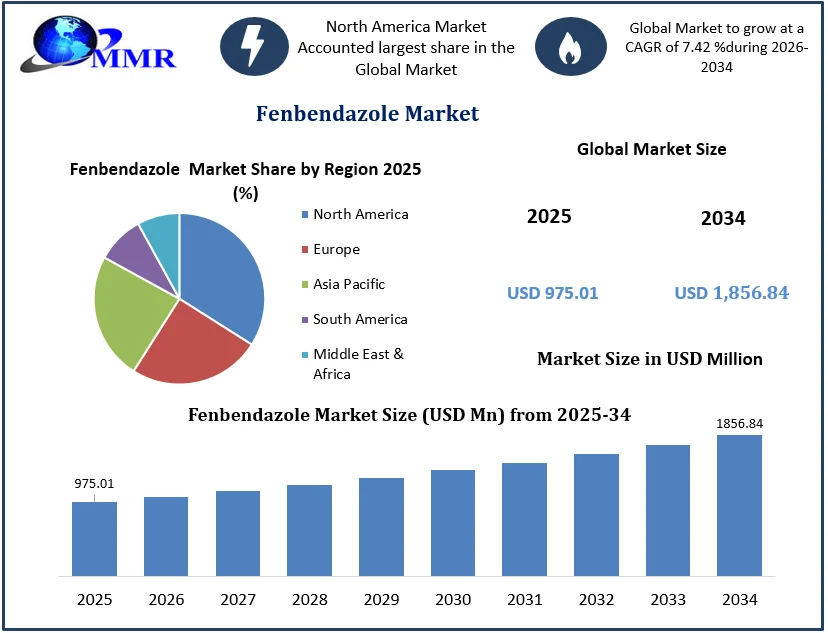
The Fenbendazole Market was valued at USD 975.01 million in 2025 and is estimated to reach USD 1,856.84 million by 2034. The fenbendazole market grows at a CAGR of 7.42% during the forecast period 2026–2034.
The Fenbendazole Market Growth is supported by increasing demand for veterinary anthelmintics, expanding companion animal healthcare, livestock parasite-control requirements, and greater emphasis on animal health and productivity.
Key Fenbendazole Market Highlights
• Market Expands Steadily: Fenbendazole market grows at a 7.42% CAGR, supported by rising veterinary parasite-control demand.
• Livestock Leads Demand: Livestock remains the largest animal-type segment, driven by large-scale deworming requirements.
• North America Leads: North America maintains a strong market position due to established veterinary care and branded products.
• Generic Competition Rises: New generic approvals increase price competition and supplier choice.
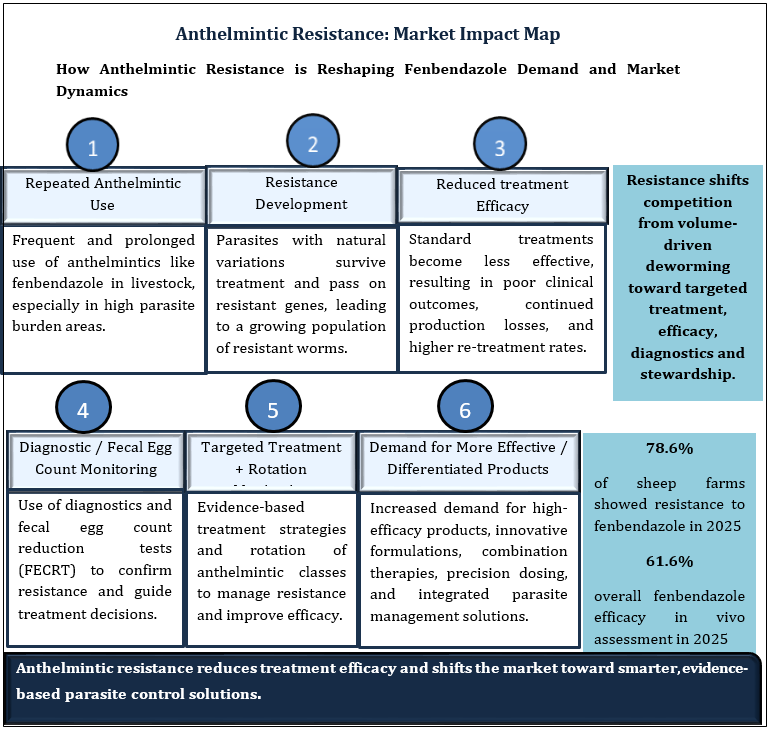
• Resistance Reshapes Demand: Growing anthelmintic resistance drives demand for targeted treatment, diagnostics, and higher-efficacy formulations.
Fenbendazole Market Overview
Fenbendazole is a broad-spectrum benzimidazole anthelmintic used in veterinary medicine to treat and control internal parasitic infections in animals. Fenbendazole-based products target parasites such as gastrointestinal worms, stomach worms, lungworms, and, under specific approved indications, tapeworms. The Fenbendazole Market covers the manufacturing, formulation, distribution, and sale of fenbendazole-based veterinary medicines used across livestock, equine, companion-animal, and specialty animal healthcare applications.
The Fenbendazole Market has an established presence in livestock parasite management. For example, U.S. FDA-approved fenbendazole products are indicated for beef and dairy cattle, goats, horses, swine, turkeys, and certain zoo and wildlife animals, depending on the formulation and label. This broad species coverage creates demand across livestock health, veterinary clinics, animal farms, and specialty animal-care facilities. Regulatory activity also continues to expand the availability of fenbendazole products. In January 2026, the U.S. FDA approved Defendazole, the first generic fenbendazole 10% oral suspension for beef and dairy cattle and goats. The product treats and controls multiple species of lungworms, stomach worms, and intestinal worms in cattle and stomach worms in goats. The approval also specifies an 8-day cattle withdrawal period, 48-hour milk discard period, and a 6-day goat withdrawal period, highlighting the importance of residue compliance in food-producing animals.
Antiparasitic resistance remains a key factor shaping the Fenbendazole Market. The FDA reports increasing antiparasitic resistance among grazing species, including cattle, sheep, goats, and horses, and promotes sustainable dewormer use to preserve treatment effectiveness. Consequently, the market increasingly emphasises appropriate dosing, veterinary supervision, resistance management, and targeted parasite-control programs. Overall, the combination of livestock health requirements, veterinary parasite management, product approvals, and growing emphasis on responsible anthelmintic use supports continued demand for fenbendazole-based veterinary products.
Fenbendazole Market Growth and Share Analysis
To know about the Research Methodology :- Request Free Sample Report
Fenbendazole Market Dynamics
Rising Need for Livestock Parasite Control to Drive the Fenbendazole Market
Growing emphasis on maintaining livestock health and productivity supports demand for fenbendazole-based anthelmintics. Internal parasites can cause disease and production losses in food-producing animals, making routine parasite management an important component of livestock healthcare. The increasing antiparasitic resistance in grazing species such as cattle, sheep, goats, and horses reinforces the need for effective and appropriately managed deworming programs. The scale of livestock production sustains the addressable market, with 86.2 million cattle and calves on U.S. farms as of January 1, 2026.
Anthelmintic Resistance Limits Treatment Effectiveness
The development of resistance to anthelmintic drugs can reduce treatment effectiveness and restrict the long-term use of individual active ingredients. WOAH identifies anthelmintic resistance as a global challenge affecting animal health, welfare, food-producing livestock, and food security. Resistance has developed to each currently marketed antiparasitic active ingredient for sheep and goats in the U.S., including fenbendazole. Consequently, inappropriate dosing, repeated use, and insufficient monitoring of resistance can limit the demand for fenbendazole in certain applications. Growth of Generic and Product Formulations creates opportunities
Generic fenbendazole products, alternative formulations, and broader veterinary access, boost Fenbendazole Market growth. Generic products can increase price competition and availability while allowing manufacturers to serve established parasite-control applications. The FDA's January 2026 approval of the first generic fenbendazole oral suspension for beef and dairy cattle and goats demonstrates continuing regulatory opportunities for additional fenbendazole-based products. This creates scope for manufacturers to compete through cost-efficient formulations, convenient dosage forms, species-specific products, and expanded distribution networks.
Fenbendazole Market Challenge: Balancing Accessibility with Responsible Anthelmintic Use
A major challenge is maintaining fenbendazole effectiveness while ensuring responsible use. WOAH emphasizes that prudent use of anthelmintics is necessary to manage resistance, while FDA guidance promotes sustainable dewormer use to preserve efficacy. Manufacturers and veterinarians therefore need to balance product availability and treatment frequency with appropriate dosing, resistance surveillance, targeted deworming, veterinary oversight, and compliance with withdrawal requirements. This can increase the complexity of product positioning and market expansion, particularly in livestock applications.
Fenbendazole Market Trends
• Targeted Parasite Management Gains Traction - Targeted Parasite Management Replaces Blanket Deworming - The Fenbendazole Market is shifting toward targeted parasite management as veterinarians and livestock producers seek to maintain treatment efficacy while limiting unnecessary anthelmintic exposure. The FDA treating an entire flock or herd can initially achieve an almost 100% parasite kill rate, but complete parasite elimination is not sustainable because it accelerates the development of antiparasitic resistance. This is encouraging greater emphasis on identifying infected or vulnerable animals and tailoring treatment according to parasite burden, animal condition, and treatment response.
• Anthelmintic Resistance Drives Demand for Better Treatment Practices - Anthelmintic resistance is increasingly influencing fenbendazole use, encouraging veterinarians and livestock producers to adopt more targeted treatment and monitoring practices. Fenbendazole resistance was 21% of adult-horse cases, 21% of sheep cases, and 19% of goat cases in 2025, highlighting the need for resistance monitoring and appropriate dewormer use.
• Veterinary Diagnostics Support Precision Deworming - The market is increasingly moving toward diagnostics-led parasite management, including fecal egg count testing and resistance-detection methods. WOAH identifies diagnosis of resistance and parasite epidemiology as important knowledge gaps, creating opportunities for veterinary diagnostics to become more closely integrated with anthelmintic treatment decisions.
• Responsible Anthelmintic Use Becomes a Market Priority - Veterinarians, livestock producers, and animal-health companies are placing greater emphasis on responsible anthelmintic use, veterinary oversight, surveillance, and sustainable animal-health practices. This trend is strengthening as international animal-health organizations focus on preserving the effectiveness of existing treatments while supporting sustainable livestock production.
Fenbendazole Market Segmentation Analysis
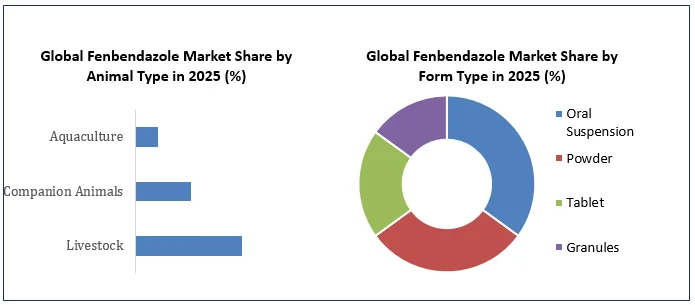
Livestock dominated the Fenbendazole Market in 2025, supported by the extensive use of fenbendazole for controlling gastrointestinal and respiratory parasites in food-producing animals. Cattle represent the strongest demand base within livestock because fenbendazole products are established for beef and dairy cattle and cover multiple parasite categories, including lungworms, stomach worms, and intestinal worms. The FDA's January 2026 approval of generic Defendazole reinforces the commercial importance of this segment, with the product approved for beef and dairy cattle and goats. The livestock segment is expected to maintain its leading position through 2034, although growth is likely to be increasingly shaped by resistance management and more targeted parasite-control practices. The breadth of approved applications supports recurring demand across cattle, sheep, goats, swine, and other food-producing animals. FDA records also show fenbendazole products approved as medicated-feed products for cattle, swine, and turkeys, demonstrating the importance of livestock-oriented delivery systems.
Companion animals represent the next important growth opportunity. Fenbendazole has established veterinary applications in dogs, including treatment and control of ascarids, hookworms, whipworms, and certain tapeworms. The segment expand steadily through the forecast period as veterinary parasite management becomes more structured and pet owners increasingly seek professional animal healthcare. However, its growth trajectory remains more fragmented than livestock because treatment volumes are distributed across individual veterinary cases rather than large-scale herd applications. Equine and other animals remain comparatively smaller segments, but the Fenbendazole Market segment analysis Fenbendazole Market segment analysis provide niche growth opportunities.
Global Fenbendazole Market segment analysis
Livestock → remains the largest segment; Companion Animals → offers stronger incremental growth potential; Equine & Other Animals → remain niche applications.
By Form
Liquid formulations dominated the Fenbendazole Market in 2025, particularly oral suspensions, because they provide flexible dosing and are well suited to livestock treatment. The approval of Defendazole as a fenbendazole oral suspension for beef and dairy cattle and goats illustrates the continued commercial relevance of this format. The product is available in 1-liter and 5-liter bottles, further demonstrating its suitability for farm-level administration.
The dominance of liquid formulations is also supported by the established Panacur/Safe-Guard suspension products. FDA records identify Panacur Suspension 10% among approved fenbendazole products, alongside granule formulations. The ability to administer a measured dose according to animal body weight makes oral suspension particularly relevant for livestock producers and veterinary professionals. Granules represent another important formulation, particularly where administration through feed or direct oral dosing is preferred. FDA records list Panacur Granules at 22.2%, while fenbendazole Type A medicated articles can be incorporated into Type B and Type C medicated feeds for livestock. This gives granule/feed-based formats a strong position in large-animal applications.
Powders and tablets are expected to remain smaller but commercially relevant formats, particularly in applications requiring convenient handling or smaller-volume dosing. Their growth should be supported by product differentiation and veterinary distribution, although they face stronger competition from established suspension and granule formats.
| Liquid formulations → retain leadership through 2034; Granules → maintain strong demand in livestock; Tablets & Powders → grow from smaller bases, particularly in companion-animal and specialized applications. |
Global Fenbendazole Market Regional Analysis
North America dominated the Fenbendazole Market in 2025 with the largest market share, supported by a well-developed veterinary pharmaceutical infrastructure, extensive livestock production, and established companion-animal healthcare channels. The U.S. market benefits from a strong regulatory pathway for veterinary medicines and a broad portfolio of approved fenbendazole products. The FDA's approval of the first generic fenbendazole oral suspension for cattle and goats has increased product availability and generic competition in the region. Demand is supported by both large-scale livestock production and professional veterinary care for pets. The opportunities are increasingly concentrated around generic formulations, convenient dosage forms, resistance-aware parasite management, and companion-animal applications.
In Europe, the demand for veterinary medicines is driven by its sophisticated animal-health ecosystem and stringent food-safety framework. AnimalhealthEurope reports that Europe accounted for 30.1% of global animal-medicines sales in 2025, making it the world's second-largest animal-medicines market. The region also has nearly 140 million pet-owning households, creating a substantial companion-animal healthcare base. Fenbendazole demand is additionally influenced by Europe's emphasis on veterinary drug stewardship and residue monitoring. In 2024, EU Member States, Iceland, and Norway tested 493,664 samples for veterinary medicinal-product residues, with only 0.13% found non-compliant. These highly developed regulatory and veterinary systems favor compliant, accurately dosed anthelmintic products. Therefore, the growth through 2034 is expected to remain steady, with product quality, regulatory compliance, and responsible parasite control becoming stronger purchasing considerations.
Asia Pacific offers the strongest structural growth opportunity, driven by its enormous production-animal base, expanding veterinary infrastructure, and increasing commercialization of livestock farming. China and India are particularly important because of their large cattle, dairy, poultry, and swine populations. Government investment is also strengthening animal-health infrastructure; for example, India's revised Livestock Health and Disease Control Programme received USD 0.41 Billion for 2024–25 and 2025–26.
The region is also experiencing a transition from traditional livestock care toward more organized disease prevention and veterinary treatment. China and India are expanding organized dairy and commercial livestock systems, increasing the need for consistent parasite-control programs. Consequently, Asia Pacific is expected to record faster fenbendazole demand growth than mature Western markets, particularly in cattle, swine, and other production-animal applications.
South America represents a livestock-driven growth market, with cattle production and large-scale agricultural activity creating a substantial requirement for veterinary pharmaceuticals and parasite-control products. Brazil is particularly important because of its extensive cattle industry and globally integrated beef-production sector. Demand is increasingly linked to maintaining herd productivity, animal health, and compliance with requirements associated with livestock trade. The region also provides opportunities for cost-effective generic fenbendazole products, particularly where producers prioritize affordability and broad-spectrum parasite management. Growth through 2034 is expected to remain healthy as commercial livestock operations expand and veterinary pharmaceutical distribution becomes more accessible.
Middle East & Africa offers long-term growth potential, particularly through livestock health programs and expanding veterinary access. Livestock plays an important role in food systems and rural economies across Africa, while cattle, sheep, and goats form major animal-health demand pools. This creates a natural requirement for affordable anthelmintics to manage internal parasites.
The opportunity is particularly visible in East Africa, where the cattle population is exceptionally large and livestock health directly affects household livelihoods and food security. However, market development remains constrained by uneven veterinary infrastructure, affordability challenges, distribution gaps, and differences in regulatory capacity. As veterinary services and livestock-health programs expand, demand for practical and cost-efficient fenbendazole formulations is expected to increase.
The regional opportunity is shifting from established treatment demand in North America and Europe toward volume-driven expansion in Asia Pacific and livestock-led opportunities in South America and the Middle East & Africa. This makes Asia Pacific particularly important for future fenbendazole manufacturers seeking incremental volume, while mature markets increasingly favor product differentiation, regulatory compliance, and responsible parasite-management solutions.
Fenbendazole Market Recent Developments
| Date | Companies / Organizations | Recent Development | Strategic Impact on the Market |
| Jan. 2026 | FDA / Defendazole sponsor | FDA approved Defendazole (fenbendazole) oral suspension, the first generic fenbendazole oral suspension for beef and dairy cattle and goats. | Increases generic competition and puts pricing pressure on established branded products while expanding access to fenbendazole-based treatments. |
| May 2024 | Merck Animal Health / FDA | FDA granted supplemental approval for Safe-Guard (fenbendazole) for wild quail, representing the first FDA-approved animal drug for this specific use. | Expands the addressable market into wildlife applications and demonstrates how species-specific approvals can differentiate established brands. |
| 2025 | Veterinary research institutions | Research reported fenbendazole/benzimidazole resistance in livestock, highlighting reduced parasite susceptibility in some populations. | Increases demand for improved parasite-management strategies, including treatment rotation, combination approaches and efficacy monitoring. |
| 2025–2026 | Academic and formulation researchers | Research continues into advanced fenbendazole delivery systems designed to address poor water solubility and improve drug release/bioavailability. | Creates opportunities for formulation-based differentiation, allowing manufacturers to compete beyond API price through improved delivery and dosing performance. |
| 2024–2026 | FDA / veterinary industry | FDA has continued to highlight safety concerns associated with extralabel fenbendazole use in dogs, including reported bone-marrow-related adverse events. | Raises the importance of regulatory compliance and evidence-based positioning, favoring manufacturers with stronger safety documentation and approved indications. |
Global Fenbendazole Market Competitive Landscape
The fenbendazole market is characterized by a fragmented supplier base and a two-level competitive structure, comprising established animal-health companies competing in branded finished formulations and pharmaceutical/API manufacturers competing for bulk fenbendazole supply. The competitive environment is therefore shaped less by technological differentiation of the molecule itself and more by brand strength, manufacturing economics, regulatory credentials, formulation capabilities, supply reliability, and distribution reach. Industry supplier databases identify a broad field of fenbendazole manufacturers and distributors, with a particularly large concentration in India, alongside manufacturers in China, the U.S., and Europe.
Established animal-health companies focus on finished-dose products and veterinary brand strength, using product registration, established veterinarian relationships, formulation convenience, and distribution networks to differentiate their offerings. Their competitive advantage is not simply the availability of fenbendazole but the ability to package it into trusted veterinary products with established dosing formats and regulatory support.
API manufacturers compete differently. Their focus is on cost-efficient synthesis, production capacity, batch consistency, pharmacopoeial compliance, GMP certification, and regulatory documentation. For example, suppliers listed for fenbendazole include manufacturers with combinations of GMP, CEP, USDMF, CoA and other regulatory credentials, indicating that qualification and documentation are important competitive barriers in higher-value supply contracts.
Price-Based vs Value-Based Competition
The market has a strong price-competition component at the API level, particularly where multiple manufacturers can supply comparable grades of fenbendazole. Indian and Chinese manufacturers can compete aggressively through manufacturing economics and bulk production, putting pressure on undifferentiated suppliers.
However, competition becomes increasingly value-based for regulated-market customers. Buyers may prioritize GMP status, regulatory files, quality consistency, auditability, supply continuity, and technical documentation over the lowest available quotation. This creates a meaningful distinction between a commodity-oriented supplier and a qualified strategic API supplier.
Competitive Positioning of Key Players
| Competitive Group | Representative Players | Primary Focus | Price Position | Main Differentiation |
| Branded animal-health players | Merck Animal Health and other veterinary pharmaceutical companies | Finished veterinary formulations | Premium | Brand recognition, product registration, veterinary trust and distribution |
| Integrated veterinary manufacturers | Alivira Animal Health, Huvepharma | APIs + veterinary formulations | Mid-to-premium | Vertical integration, broad portfolio and manufacturing control |
| Specialized API manufacturers | NGL Fine-Chem, Indian and Chinese API producers | Bulk fenbendazole/API supply | Low-to-mid | Manufacturing efficiency, GMP, quality consistency and regulatory files |
| API sourcing/CDMO companies | LGM Pharma, Rochem International | Sourcing, development and commercial supply | Mid-to-premium | Qualified supplier networks, regulatory support and supply-chain management |
| Regional distributors/traders | Jai Radhe Sales, Tenatra Exports and similar suppliers | Distribution/export | Competitive | Market access, sourcing flexibility and customer relationships |
The breadth of the supplier base illustrates the fragmented nature of API competition: PharmaCompass currently lists dozens of companies associated with fenbendazole supply, while Pharmaoffer identifies suppliers across multiple manufacturing countries and highlights differences in certifications and manufacturing origin.
Differentiation Strategies
The most important differentiation strategies in the market are:
Regulatory differentiation: Suppliers with USDMF, CEP/CoS, GMP, and other regulatory documentation can access customers in regulated markets more readily than suppliers competing only on price. This creates qualification barriers that help protect established suppliers from pure commodity competition.
Manufacturing-cost leadership: Indian and Chinese manufacturers increasingly compete through lower production costs, scalable capacity and flexible order quantities. This is particularly relevant for bulk/API customers seeking to reduce formulation costs.
Product and formulation differentiation: Finished-product companies can differentiate through oral suspensions, granules, pastes, tablets, and species-specific formulations, shifting competition away from the API itself toward convenience, dosing accuracy and end-user acceptance.
Supply reliability: Consistent batch quality, long-term contracts, traceability and dependable delivery are increasingly important for pharmaceutical manufacturers that cannot easily switch qualified API suppliers.
One-stop supply capability: Companies that can combine API sourcing, formulation development, analytical testing, regulatory assistance, and commercial manufacturing can capture greater value across the supply chain. LGM Pharma, for example, positions itself around end-to-end development and manufacturing capabilities rather than simply supplying an API.
The market is shifting from molecule-level competition to capability-based competition. While fenbendazole itself is a mature and relatively standardized anthelmintic, companies increasingly differentiate through manufacturing cost, regulatory readiness, formulation breadth, supply reliability, and veterinary-market access. This favors integrated and compliance-focused suppliers in high-value markets, while cost-efficient Indian and Chinese manufacturers continue to exert pressure on API pricing.
Fenbendazole Market Scope: Inquire before buying
| Fenbendazole Market | |||
|---|---|---|---|
| Report Coverage | Details | ||
| Base Year: | 2025 | Forecast Period: | 2026-2034 |
| Historical Data: | 2020 to 2025 | Market Size in 2025: | 975.01 USD Million |
| Forecast Period 2026-2034 CAGR: | 7.42% | Market Size in 2034: | 1856.84 USD Million |
| Segments Covered: | by Animal Type | Livestock Cattle Sheep & Goats Swine Poultry Companion Animals Dogs Cats Equine Horses Other Animals Zoo & Wildlife Animals Other Specialty Animals |
|
| by Form | Powder Tablet Liquid Formulations Oral Suspension Granules Other Forms |
||
| by Application | Roundworm Treatment Hookworm Treatment Whipworm Treatment Lungworm Treatment Tapeworm Treatment Other Parasitic Infections |
||
| by Distribution Channel | Veterinary Hospitals & Clinics Retail Pharmacies Online Pharmacies Other Distribution Channels |
||
Fenbendazole Market, by Region
North America (United States, Canada, and Mexico)
Europe (UK, France, Germany, Italy, Spain, Sweden, Austria, and the Rest of Europe)
Asia Pacific (China, South Korea, Japan, India, Australia, Indonesia, Malaysia, Vietnam, Taiwan, Bangladesh, Pakistan, and the Rest of APAC)
Middle East and Africa (South Africa, GCC, Egypt, Nigeria, and the Rest of ME&A)
South America (Brazil, Argentina, Rest of South America)
Key Players in the Fenbendazole Market by Region
North America
1. Merck Animal Health
2. LGM Pharma
3. Rochem International Inc.
4. Willow Birch Pharma
5. Medisca
6. ADM Animal Nutrition
7. Provimi
8. Ridley Feed Ingredients
Europe
9. Huvepharma
10. FIS – Fabbrica Italiana Sintetici
11. Suanfarma
12. Chr. Olesen
13. Euroasia Trans Continental
Asia-Pacific
India
14. Alivira Animal Health / SeQuent Scientific
15. NGL Fine-Chem
16. Indian Drugs & Chemicals
17. Lasa Supergenerics
18. Chemino Pharma
19. Emay Pharmaceuticals
20. Jai Radhe Sales
21. HRV Pharma
22. Tenatra Exports
23. Amgis Lifescience
24. D.H. Organics
25. Vaishali Pharma
26. Progress Life Sciences
27. Omshri Labs
China
28. Jiangsu Baozong & Baoda Pharmachem
29. Shaanxi Hanjiang Pharmaceutical Group
30. Hebei Veyong Pharmaceutical
31. Zhejiang Apeloa Kangyu Pharmaceutical
32. Anhui Sinotech Industrial
33. Qingdao Qingmei Biotech
34. Kekule Pharma
35. Atomgrid
South America
36. Merck Animal Health
37. Huvepharma
38. Alivira Animal Health
39. ADM / Provimi
Middle East & Africa
41. Alivira Animal Health
42. Huvepharma
43. Merck Animal Health
Frequently Asked Questions
1. What was the fenbendazole market size in 2025?
The fenbendazole market was valued at USD 975.01 million in 2025 and is estimated to grow at a 7.42% CAGR from 2026 to 2034, supported by continued demand for veterinary anthelmintics across livestock and companion-animal applications.
2. What are the key factors driving the fenbendazole market growth?
Key fenbendazole market growth drivers include rising livestock populations, increasing veterinary healthcare expenditure, growing awareness of parasite control, and continued use of fenbendazole to treat gastrointestinal nematodes in cattle, sheep, goats, pigs, horses, and other animals.
3. Which animal type dominates the fenbendazole market?
Livestock represents a major animal-type segment in the fenbendazole market, supported by the large-scale use of anthelmintics in cattle, sheep, goats, and swine production. Increasing emphasis on herd health, productivity, and parasite management supports continued demand from commercial livestock producers.
4. Which region was held the fenbendazole market in 2025?
North America held the global fenbendazole market in 2025, supported by established veterinary pharmaceutical companies, extensive livestock production, regulatory approvals, and developed animal-health distribution networks. Asia-Pacific is also gaining importance as both a consumption and manufacturing center.
5. Who are the key players in the fenbendazole market?
Key fenbendazole market players include Merck Animal Health, Huvepharma, Alivira Animal Health, SeQuent Scientific, NGL Fine-Chem, LGM Pharma, Rochem International, FIS – Fabbrica Italiana Sintetici, Suanfarma, and several Indian and Chinese API manufacturers. Competition centers on product quality, regulatory compliance, manufacturing cost, formulation capabilities, and distribution reach.
6. What are the major trends shaping the fenbendazole market?
Major fenbendazole market trends include increasing demand for convenient veterinary formulations, expansion of generic products, greater emphasis on GMP-compliant API manufacturing, development of improved drug-delivery systems, and growing concerns regarding anthelmintic resistance. These trends are encouraging manufacturers to compete through both cost efficiency and formulation/regulatory differentiation.