
Global Ethiprole Market Size by Crop Type, Insect Type, End-User, Distribution Channel, Region and Forecast 2034
Overview
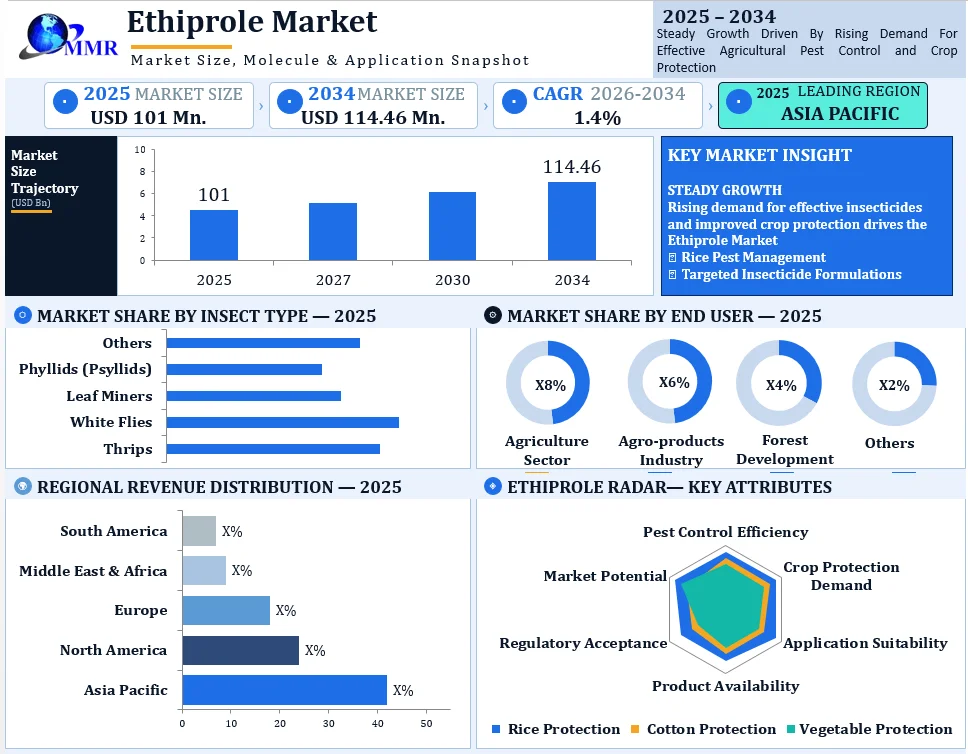
Global Ethiprole Market size was valued at USD 101 Mn. in 2025 and the total revenue is expected to grow at 1.4% through 2026 to 2034, reaching USD 114.46 Mn.
Global Ethiprole Market Overview:
The Ethiprole Market comprises the production, formulation, distribution, and application of ethiprole-based insecticides used to protect agricultural crops from damaging insect pests. Ethiprole is a synthetic phenylpyrazole insecticide that disrupts insect nervous system activity, supporting effective pest management in rice cultivation and other approved crop-protection applications. The market plays an important role in agricultural insect pest control, crop health management, and modern crop protection strategies, particularly where farmers require targeted solutions against resistant or difficult-to-control pests.
The Ethiprole Market is evolving with the growing need for effective crop protection, rising agricultural productivity requirements, increasing pest pressure, and the adoption of advanced insecticide formulations. Asia Pacific represents an important regional market because of its extensive rice cultivation, agricultural activity, and demand for insecticides targeting rice pests. Agrochemical manufacturers and crop-protection companies, including BASF and other established pesticide producers, compete across the broader insecticide industry through formulation development, product registration, and distribution networks; however, company-specific ethiprole participation should be verified. Government agricultural agencies and the Food and Agriculture Organization of the United Nations provide relevant data on crop production, pesticide management, and pest-control practices that help explain market demand. Farmers, commercial growers, agricultural distributors, and crop-protection service providers are key buyers, while regulatory requirements, pesticide resistance management, and environmental safety considerations continue to influence market expansion.
The Ethiprole Market research report by Maximize Market Research examines industry dynamics, market trends, competitive positioning, regional demand, and growth opportunities across the agricultural insecticide value chain. Opportunities include improved insecticide formulations, integrated pest management, expanding access to crop-protection products, and increasing demand for targeted pest-control solutions in major agricultural markets. The analysis helps stakeholders assess the competitive landscape, understand changing customer requirements, identify emerging regional opportunities, and develop informed strategies for sustainable growth in the ethiprole-based crop-protection industry.
Global Ethiprole Market Size, Growth and Share Analysis
To know about the Research Methodology :- Request Free Sample Report
Global Ethiprole Market Key Highlights
| Key Highlight | Insight |
|---|---|
| Ethiprole Market Size and Forecast | The Ethiprole Market is estimated at USD 101 million in 2025 and is projected to reach USD 114.46 million by 2034, growing at a 1.4% compound annual growth rate. This indicates modest forecast growth, with future performance influenced by pesticide registrations, agricultural demand, and product availability. |
| Asia Pacific Leads Regional Demand |
Asia Pacific is identified as the leading regional market, supported by extensive rice cultivation and demand for insecticides targeting planthoppers and other crop pests. China, India, Japan, Indonesia, Thailand, and Vietnam are important markets to assess for crop-protection demand and regulatory developments. |
| Crop Protection Demand Drives Market Development | The need to protect agricultural yields from damaging insect infestations supports demand for ethiprole-based insecticides. Crop-specific requirements across cotton, peanuts, soya beans, tea, sugarcane, and vegetables may influence potential demand, subject to approved uses and local pesticide registrations. |
| Regulatory Compliance and Resistance Management Shape Competition |
Pesticide registration requirements, residue monitoring, environmental safety concerns, and insecticide resistance management influence product adoption and manufacturer costs. Companies must demonstrate compliance, support responsible application practices, and maintain effective pest-control performance to strengthen their market position. |
| Formulation Development and Competitive Positioning Create Opportunities |
Manufacturers such as Bayer CropScience, Meghmani Organics, Hemani Industries, and other identified agrochemical suppliers compete through formulation capabilities, technical-grade supply, distribution networks, and product registrations. Improved formulations and integrated pest management practices may create opportunities, although company-specific market shares and regional sales require further verification. |
Global Ethiprole Market Dynamics:
Rising Demand for Effective Agricultural Pest Control Drive Ethiprole Market Growth
The Ethiprole Market is driven by the increasing need for effective agricultural insecticides that protect crop yields and manage persistent insect infestations, particularly in rice cultivation. Rice farmers face pressure from pests such as brown planthoppers and other sap-feeding insects that can reduce crop quality and agricultural productivity. Ethiprole-based insecticide solutions offer a targeted mode of action through interference with insect nervous system activity, supporting pest management when used according to approved agricultural practices. According to the Food and Agriculture Organization of the United Nations, rice remains a major staple crop for a substantial share of the global population, making effective rice pest management an important agricultural priority. Demand for crop protection chemicals, improved pesticide application practices, and insecticide resistance management is expected to influence Ethiprole Market development, particularly across major rice-producing countries in Asia.
Stringent Pesticide Registration and Environmental Safety Requirements Restraint Ethiprole Market Development
The Ethiprole Market faces restraints associated with pesticide registration procedures, environmental risk assessments, residue requirements, and restrictions on agricultural chemical use. Regulatory authorities evaluate insecticide products for human health risks, crop-specific applications, environmental persistence, and potential effects on non-target organisms before permitting commercial use. Ethiprole's potential toxicity to aquatic organisms creates additional considerations for pesticide handling, application near water bodies, and environmental protection measures. Manufacturers must allocate resources to regulatory documentation, product testing, compliance monitoring, and formulation improvements to maintain market access. Differences in pesticide approval requirements across agricultural countries can also delay product launches and limit distribution opportunities. These regulatory obligations, combined with farmer concerns about safe pesticide application and the cost of compliant crop protection products, may constrain the adoption of ethiprole-based insecticides in selected markets.
Advanced Insecticide Formulations and Integrated Pest Management Create New Ethiprole Market Opportunities
Opportunities in the Ethiprole Market are supported by the development of improved insecticide formulations, precision application methods, and integrated pest management strategies that combine chemical control with crop monitoring and other pest reduction practices. Rice-producing countries across Asia offer potential opportunities for registered ethiprole products targeting economically damaging insect pests. Manufacturers can strengthen their competitive position by improving formulation stability, application efficiency, packaging quality, and farmer education while maintaining compliance with local pesticide regulations. The International Rice Research Institute promotes research and practical approaches to sustainable rice production, providing relevant agricultural context for evaluating pest management needs and crop protection innovation. Greater attention to resistance management, pest surveillance, and responsible pesticide use can also encourage demand for complementary insecticide solutions. Companies that invest in evidence-based product development and responsible agricultural distribution may identify new opportunities within the crop protection chemicals industry.
Insecticide Resistance and Competition from Alternative Pest Control Solutions Challenge Ethiprole Market Competitiveness
The Ethiprole Market faces challenges from insecticide resistance, competition among chemical active ingredients, changing pest populations, and increasing expectations for environmentally responsible agriculture. Repeated use of insecticides with the same mode of action can increase selection pressure on pest populations, potentially reducing treatment effectiveness over time. The Insecticide Resistance Action Committee classifies ethiprole within the phenylpyrazole insecticide group, which acts on gamma-aminobutyric acid regulated chloride channels, making resistance management and appropriate rotation with insecticides from different mode-of-action groups important considerations. Manufacturers must also compete with alternative insecticide chemistries, biological pest control products, and integrated pest management practices that may offer different cost, efficacy, or environmental profiles. Variations in pest prevalence, crop prices, farmer purchasing power, and local registration status further complicate market planning. Maintaining product performance while meeting regulatory expectations and supporting responsible insecticide use remains a key challenge for long-term Ethiprole Market growth.
Global Ethiprole Market Key Trends
| Market trend | Description |
|---|---|
| Growing Demand for Rice Crop Protection Insecticides |
Demand for ethiprole-based insecticides is closely linked to rice pest management, particularly the control of brown planthoppers and other damaging insects. Rice-producing countries in Asia remain important markets for registered ethiprole formulations, as farmers seek to protect crop quality and reduce pest-related losses. |
| Increasing Focus on Alternative Insecticide Chemistry |
Agricultural companies and growers are evaluating different insecticide active ingredients to manage pests and diversify crop protection programmes. Ethiprole has been used as an alternative to fipronil in certain markets, creating interest in its role within phenylpyrazole insecticide portfolios. Product selection continues to depend on local registration, pest susceptibility, and approved crop uses. |
| Greater Attention to Insecticide Resistance Management |
Resistance management is becoming an important consideration in agricultural pest control. Ethiprole belongs to Insecticide Resistance Action Committee mode-of-action Group 2B, making appropriate application practices and rotation with suitable insecticides from different mode-of-action groups relevant to long-term pest management. This trend encourages manufacturers and agricultural advisers to promote responsible product use. |
| Increased Scrutiny of Pesticide Residues in Agricultural Commodities |
Food safety requirements and international agricultural trade are increasing the importance of pesticide residue monitoring in crops such as rice and tea. The European Food Safety Authority published an ethiprole assessment in 2024 addressing toxicological reference values and residue definitions. These developments highlight the importance of residue testing, analytical methods, and compliance with applicable market requirements. |
| Emphasis on Crop-Specific Formulations and Local Regulatory Compliance |
Ethiprole products are developed in formulations suited to particular agricultural uses, including suspension concentrates and granular products. Market access depends on approved crop applications, local pesticide regulations, distribution capabilities, and farmer requirements. Manufacturers that align product development with registered uses and local crop protection needs may be better positioned to serve established agricultural markets. |
Global Ethiprole Market Segment Analysis:
Based on Crop Type, Cotton is an important segment to monitor because insect infestations can affect crop development and fiber quality, while soya beans and peanuts require effective pest control to protect plant health and yield. Tea cultivation also presents crop protection needs associated with insect pests that damage leaves, whereas sugarcane growers focus on maintaining crop growth and productivity. Vegetable cultivation creates demand for targeted insect control to preserve marketable produce quality. However, the use of ethiprole varies according to pest susceptibility, product registration, and approved crop applications in each country, making regulatory compliance and crop-specific suitability important factors influencing segment demand.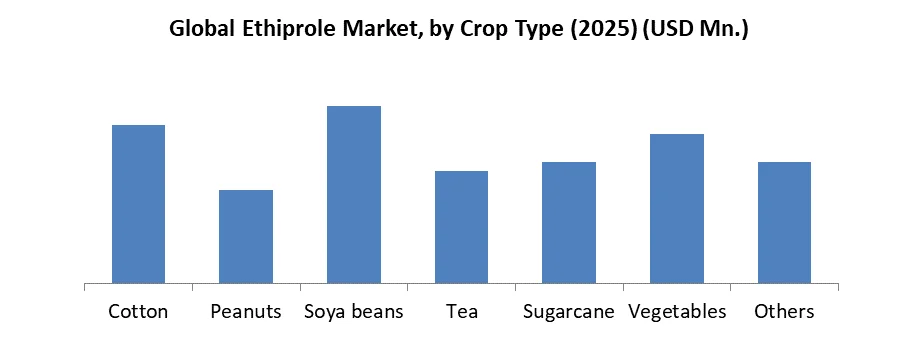
Based on Insect Type, Thrips and whiteflies are important insect categories to monitor because they damage plant tissues, weaken crops through feeding, and can contribute to disease transmission in susceptible crops. Leaf miners also create demand for targeted pest management because their larvae feed within leaf tissues, making control more difficult. Phyllids, commonly associated with sap-feeding psyllid-type insects in this market context, represent another pest-control category. Ethiprole is reported for use against several of these insects, although effectiveness depends on the specific pest, crop, formulation, and local product registration.
Global Ethiprole Market Regional Analysis
Asia Pacific is the leading region in Ethiprole Market, supported by rice cultivation and demand for insecticides targeting planthoppers and other crop pests. China, India, Japan, Indonesia, Thailand, and Vietnam are relevant markets for ethiprole-based rice protection. Agricultural production needs and pest management practices supported the region's importance, although pesticide registration and environmental safety requirements continued to influence product availability.
The North American Ethiprole Market was constrained by regulatory restrictions during the period. Published industry analysis identifies the United States and Canada as markets where ethiprole is not permitted for agricultural crop use. Consequently, the region's commercial potential differs substantially from that of Asian rice-producing countries, and pesticide approval remains a key consideration for any future market development.
The European market was shaped by pesticide safety assessments, environmental protection requirements, and scrutiny of chemical residues in agricultural commodities. These factors influence product registration, permitted applications, and market access. However, a verified annual ethiprole sales series for Europe from 2020 through 2025 was not available in the public sources reviewed, so a specific percentage decline cannot be substantiated.
South America offers potential demand linked to agricultural production, particularly in Brazil, where crop protection is important for commercial farming. Brazil is identified in published market research as a relevant market for ethiprole use. Actual sales performance between 2020 and 2025 would need to be validated against country-level pesticide registration, product availability, and sales data rather than inferred from growth in coffee, rubber, or soybean cultivation alone.
Demand across the Middle East and Africa depends on local crop-protection needs, pesticide registration, distribution networks, and access to approved insecticide formulations. The region is included in recent market research coverage, but reliable public annual revenue figures for ethiprole across the period were not available to confirm a specific growth rate or establish that the region consistently recorded the lowest growth.
Global Ethiprole Market Competitive Landscape
The Ethiprole Market is shaped by competition among established agrochemical manufacturers, specialty chemical suppliers, and regional insecticide producers that focus on product quality, formulation development, regulatory compliance, and distribution strength. Bayer CropScience is an important participant, with ethiprole-based crop protection products developed for selected agricultural markets, while Meghmani Organics Limited supplies ethiprole technical and formulations for crop protection applications. Other companies identified in market research include Rayfull Holding Co., Ltd., Jiangsu Yangnong Chemical Group Co., Ltd., Hemani Industries Limited, Parchem Fine & Specialty Chemicals, and Sumitomo Chemical Co., Ltd. Competition in the ethiprole insecticide industry is influenced by the availability of technical-grade active ingredients, formulation performance, crop-specific product registrations, pricing, and access to agricultural distribution networks. Manufacturers are also focusing on product portfolio development, research capabilities, and compliance with pesticide safety requirements to strengthen their competitive positioning. Asia Pacific remains a significant region for ethiprole-related manufacturing and agricultural demand, particularly because of its rice cultivation and crop protection needs.
| Region | Country | Key company | Competitive positioning and market relevance |
|---|---|---|---|
| Asia Pacific | China | Bayer CropScience (China operations) | Associated with ethiprole-based insecticide products and crop protection applications, including products developed for Asian agricultural markets. |
| Asia Pacific |
China | Rayfull Holding Co., Ltd. |
Identified in ethiprole market research as a relevant supplier, with a focus on agrochemical products and international market access. |
| Asia Pacific | India | Meghmani Organics Limited | Indian agrochemical manufacturer with pesticide production and formulation capabilities, supporting the broader crop protection chemicals supply chain. |
| Asia Pacific |
India | Hemani Industries Limited |
Participates in the Indian agrochemical industry and is identified in market research and Indian pesticide technical-material listings relevant to ethiprole. |
| North America | United States | Parchem Fine & Specialty Chemicals | Specialty chemical supplier listed in ethiprole market research; relevance is associated with chemical sourcing and distribution rather than confirmed local agricultural use. |
| Europe | Germany | BASF SE | Major crop protection and agricultural solutions company with research, formulation, and distribution capabilities; ethiprole-specific commercial activity should be confirmed by product and country. |
| South America | Brazil | UPL Limited | Established crop protection supplier with agricultural distribution and formulation capabilities; local ethiprole participation depends on registered products and approved uses. |
| Middle East and Africa |
South Africa |
Nufarm Limited |
International crop protection company with regional agricultural market experience; specific ethiprole product availability requires local registration verification. |
Global Ethirole Market Recent Development
| Month in 2026 | Company | Recent development |
|---|---|---|
| August 2026 | Bayer CropScience Limited | Bayer CropScience received approval in India for an ethiprole and benzpyrimoxan suspension concentrate formulation for rice pest management, targeting brown planthopper, white-backed planthopper and green leafhopper. The approval included residue and product stability requirements. |
| July 2026 | Bayer CropScience |
Bayer CropScience announced the launch of Trance, an insecticide for managing sucking pests in cotton. This is a broader crop protection development and is not confirmed as an ethiprole-based product. |
| May 2026 | Meghmani Organics Limited | Meghmani Organics discussed its financial performance and manufacturing operations in its FY2026 earnings call. The company continues to list ethiprole among its crop protection products, but no new ethiprole-specific launch was confirmed in the announcement. |
| August 2026 |
Meghmani Organics Limited |
Meghmani Organics published its annual report for the 2025–2026 financial year, documenting its broader crop protection portfolio, which includes ethiprole. No separate new ethiprole product announcement was identified. |
Global Ethiprole Market Scope: Inquire before buying
| Global Ethiprole Market | |||
|---|---|---|---|
| Report Coverage | Details | ||
| Base Year: | 2025 | Forecast Period: | 2026-2034 |
| Historical Data: | 2020 to 2025 | Market Size in 2025: | USD 101 Mn. |
| Forecast Period 2026 to 2034 CAGR: | 1.4% | Market Size in 2034: | USD 114.46 Mn. |
| Segments Covered: | by Crop Type | Cotton Peanuts Soya beans Tea Sugarcane Vegetables Others |
|
| by Insect Type | Thrips White Flies Leaf Miners Phyllids Others |
||
| by End-User | Agriculture Sector Forest Development Agro-products Industry Others |
||
| by Distribution Channel | Direct Sales Supermarket Specialty Store E-Commerce Others |
||
Global Ethiprole Market, by Region
North America (United States, Canada and Mexico)
Europe (UK, France, Germany, Italy, Spain, Sweden, Austria and Rest of Europe)
Asia Pacific (China, South Korea, Japan, India, Australia, Indonesia, Malaysia, Vietnam, Taiwan, Bangladesh, Pakistan and Rest of APAC)
Middle East and Africa (South Africa, GCC, Egypt, Nigeria and Rest of ME&A)
South America (Brazil, Argentina Rest of South America)
Global Ethiprole Market, Key Players are:
1. Bayer CropScience AG
2. Meghmani Organics Limited
3. Hemani Industries Limited
4. Rayfull Holding Co., Ltd.
5. Zhejiang Rayfull Chemicals Co., Ltd.
6. Jiangsu Tuoqiu Agrochemical Ltd.
7. Jiangsu Yangnong Chemical Group Co., Ltd.
8. Jiangsu Fengshan Group Co., Ltd.
9. Hunan Haili Chemical Industry Co., Ltd.
10. Shandong Dacheng Pesticide Co., Ltd.
11. Hebei Brilliant Chemical Co., Ltd.
12. Zhejiang Heteng Chemical Co., Ltd.
13. Zhejiang Heben Pesticide and Chemicals Co., Ltd.
14. Jiangsu Changqing Agrochemical Co., Ltd.
15. Jiangsu Huifeng Agrochemical Co., Ltd.
16. Jiangsu Flag Chemical Industry Co., Ltd.
17. Shanghai Skyblue Chemical Co., Ltd.
18. Jiangsu Luye Agrochemicals Co., Ltd.
19. Shandong Weifang Rainbow Chemical Co., Ltd.
20. Shandong Sino-Agri United Biotechnology Co., Ltd.
21. Hangzhou Sartort Chemical Co., Ltd.
22. Jiaxing Suns International Trade Co., Ltd.
23. Wuhan Sensedawn Science and Technology Co., Ltd.
24. Hangzhou Tianlong Biotechnology Co., Ltd.
25. Shandong Audis Biotechnology Co., Ltd.
26. Qingdao KYX Chemical Co., Ltd.
27. Parchem Fine and Specialty Chemicals
28. Sigma-Aldrich Corporation
29. B. Joshi Agrochem Pharma
30. ITAL Tiger LLC
31. Nufarm Limited
32. Lifesystems Limited
33. Hockley International Limited
34. Terra Nostra GmbH
35. Wetabau GmbH
36. DESINFECTA AG
37. Wellmax Agrochem Limited
38. Agrobase Co., Ltd.
39. BASF SE
40. FMC Corporation
41. Sumitomo Chemical Co., Ltd.
42. Syngenta Crop Protection AG
43. UPL Limited
44. Adama Agricultural Solutions Limited
45. Bharat Rasayan Limited
46. Gharda Chemicals Limited
47. Tagros Chemicals India Private Limited
48. PI Industries Limited
49. Rallis India Limited
50. Bhagiradha Chemicals and Industries Limited
Global Ethiprole Market – Frequently Asked Questions
1) What is the market share of the Global Ethiprole Market in 2025?
Answer: The Global Ethiprole Market was valued at the USD 101 Million in the year 2025.
2) Which is the dominating region for the Global Ethiprole Market?
Answer: The presence of a big Agriculture sector has resulted in making Asia-Pacific the biggest market for Ethiprole.
3) What are the opportunities for development in the Global Ethiprole Market?
Answer: The use of natural products in the manufacturing process holds an ample amount of opportunities for the development in the Global Ethiprole Market.
4) Which factor acts as the driving factor for the growth of the Global Ethiprole Market?
Answer: An increase in the demand for rapid production of consumable plant-based products acts as the major driving factor for the growth of the Global Ethiprole Market.
5) What factors are restraining the growth of the Global Ethiprole Market?
Answer: The harmful effects on the environment by the use of chemical insecticides acts as the major restraining factor for the growth of the Global Ethiprole Market.