
ERP Software Market – Industry Structure Evaluation, Demand Drivers Analysis, Regional Growth Analysis and Identification, Competitive Positioning Review & Global Market Size Forecast to 2032
Overview
The Global ERP Software Market was valued at USD 69.83 billion in 2025 and is projected to reach USD 149.4billion by 2032, expanding at a strong CAGR of 11.7% during the forecast period. Growth is fueled by rapid cloud ERP adoption, AI-powered automation, SaaS subscription models, and enterprise-wide digital transformation initiatives.
ERP Software Market (Enterprise Resource Planning Software Market) represents the backbone of enterprise-level digital transformation across manufacturing, BFSI, healthcare, retail, energy, and public administration sectors. ERP software integrates finance, human capital management (HCM), supply chain, procurement, inventory, compliance, analytics, and customer management into a unified data-driven ecosystem.
ERP Software Market Key Market Highlights
• Market Size Growth: The global ERP Software Market is valued at USD 69.83 billion in 2025 and is projected to reach USD 149.4billion by 2032, growing at a CAGR of 11.7%.
• Cloud ERP Dominance: Over 60% of new ERP deployments are cloud-based, reflecting rapid migration from legacy on-premise systems to SaaS ERP models.
• Enterprise Adoption: More than 72% of mid-to-large enterprises globally operate on integrated ERP systems, highlighting strong enterprise penetration.
• AI Integration Growth: AI-enabled ERP modules have reached 28% adoption among large enterprises, supporting automation, predictive analytics, and intelligent decision-making.
• Industry Demand: The manufacturing sector contributes around 24% of global ERP demand, making it the largest industry adopter.
• Regional Leadership: North America holds approximately 38% market share, with the United States contributing about 32% of global ERP revenue.
Globally, more than 72% of mid-to-large enterprises operate on integrated ERP systems, while SME penetration has crossed 48% in developed economies. Cloud-based ERP solutions account for over 60% of new deployments, reflecting structural migration from legacy on-premise platforms toward SaaS ERP models.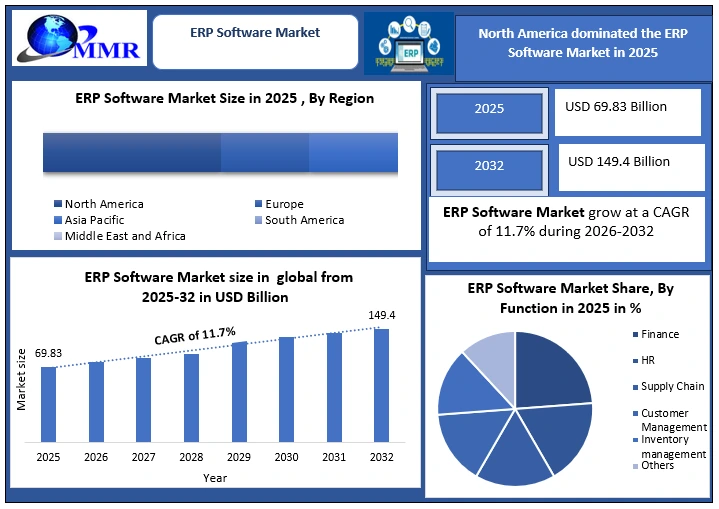
To know about the Research Methodology :- Request Free Sample Report
Digital Transformation Accelerating the ERP Software Market
The ERP Software Market, also known as the Enterprise Resource Planning Market, is primarily driven by accelerated cloud ERP adoption, AI-powered automation, and enterprise-wide digital transformation strategies. Over 60% of new ERP software deployments are cloud-based, reflecting strong growth in the global ERP Software Market and SaaS ERP Software Market. Organizations across manufacturing, BFSI, retail, and healthcare are investing in ERP solutions and ERP implementation services to improve operational efficiency, compliance reporting, and real-time analytics.
The rise of AI-powered ERP systems, predictive analytics, and Industry 4.0 integration is significantly boosting the ERP software market growth forecast 2032. Strategic expansions by SAP SE, AI-enabled enhancements from Oracle Corporation, and SME-focused cloud ERP solutions by Microsoft Corporation are strengthening global adoption.
ERP Software Market Key Growth Drivers:
• Rising demand for enterprise resource planning software in manufacturing
• Increased search for “best ERP software for manufacturing”
• Expansion of subscription-based ERP models
• Growing adoption of mobile and AI-integrated ERP platforms
• Government-backed digital compliance initiatives
These factors collectively enhance the ERP Software Market size expansion, positioning the industry for sustained double-digit transformation momentum.
Cost, Complexity, and Integration Barriers in ERP Implementation Limits the ERP Software Market Growth
The global ERP Software Market faces structural restraints related to high ERP implementation cost for small business and integration challenges. Deployment expenses range from USD 150,000 to over USD 1 million depending on customization and enterprise scale. Long deployment cycles (6–12 months) increase financial and operational risk, particularly for SMEs exploring cloud ERP solutions.
Data migration risks, cybersecurity concerns, and regulatory compliance requirements slow the adoption of enterprise resource planning software in developing economies. Many organizations searching for “ERP software cost for SMEs” hesitate due to vendor lock-in risks and recurring subscription commitments within the SaaS ERP Software Market.
ERP Software Market Key Restraining Factors:
• High customization and consulting expenses
• Limited skilled ERP professionals
• Integration with legacy IT infrastructure
• Data sovereignty and compliance complexities
• Post-implementation maintenance costs
These challenges moderate short-term ERP software market growth, especially in price-sensitive regions.
SME Digitization and Emerging Cloud ERP Expansion creates lucrative growth Opportunities to the ERP Software Market
SME digitization and expanding cloud ERP adoption represent a major growth opportunity in the global ERP Software Market. Subscription-based cloud ERP solutions reduce upfront costs by 50–70% and cut deployment timelines to weeks, encouraging rapid SME adoption. SMEs are expected to contribute over 35% of incremental market growth. Rising e-commerce, supply chain complexity, and GST-driven compliance needs further accelerate demand.
Real-world examples highlight this momentum: Indian SMEs using Zoho One reduced manual accounting by 60%; U.S. retailers adopting SAP Business One Cloud scaled users 10x with AI forecasting; logistics firms using Oracle NetSuite improved revenue by 25%; and European distributors leveraging Microsoft Dynamics 365 Business Central reduced invoicing errors by 80%.
ERP Software Market Emerging Opportunity Areas:
• Industry-specific ERP for manufacturing and healthcare
• AI-driven ERP analytics and automation tools
• Cross-border digital trade integration
• IoT-enabled smart factory ERP systems
• Regional partnerships and joint ventures
These structural growth opportunities position the ERP software market for sustained global expansion, reinforcing long-term demand across developed and emerging economies.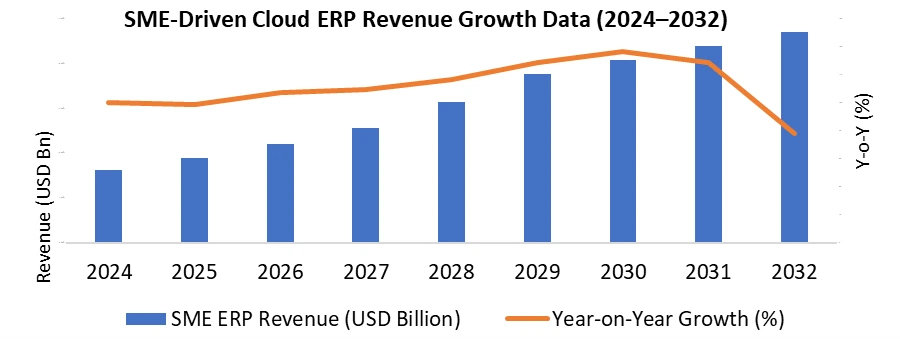
By Deployment Model: The cloud-based ERP segment leads the ERP Software Market in 2025 due to accelerated digital transformation, lower upfront costs, and flexible subscription pricing within the SaaS ERP Software Market. Over 60% of new ERP software deployments are cloud-based, reflecting strong enterprise demand for scalable, AI-powered ERP systems and remote accessibility. Cloud ERP enables real-time analytics, predictive forecasting, automated compliance reporting, and seamless integration with CRM, HR, and supply chain modules.
While on-premise ERP remains relevant for highly regulated industries requiring strict data control, and hybrid ERP supports gradual migration strategies, cloud ERP continues to dominate market share. Growth is further supported by AI integrations, ESG reporting modules, mobile ERP platforms, and SME-focused cloud ERP solutions, positioning cloud deployment as the primary growth engine in the global Enterprise Resource Planning Market.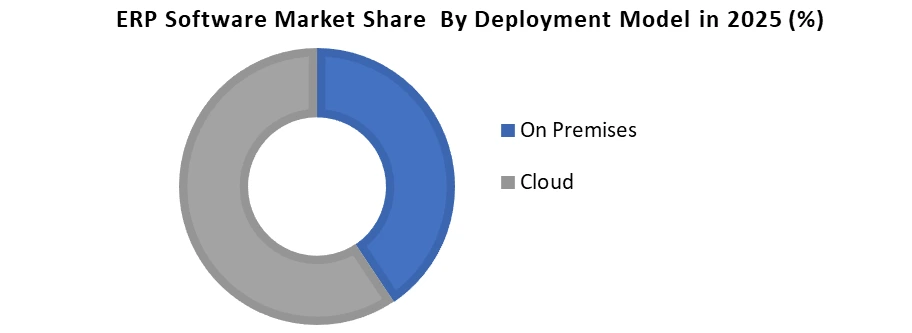
ERP Software Market: Regional Analysis
North America dominates the ERP Software Market, contributing nearly 38% of global revenue, with the United States alone accounting for about 32%, driven by strong cloud ERP adoption across manufacturing and BFSI sectors. Europe holds around 25–27% share, led by Germany and the United Kingdom, where Industry 4.0 integration and regulatory compliance upgrades fuel demand for advanced enterprise resource planning software.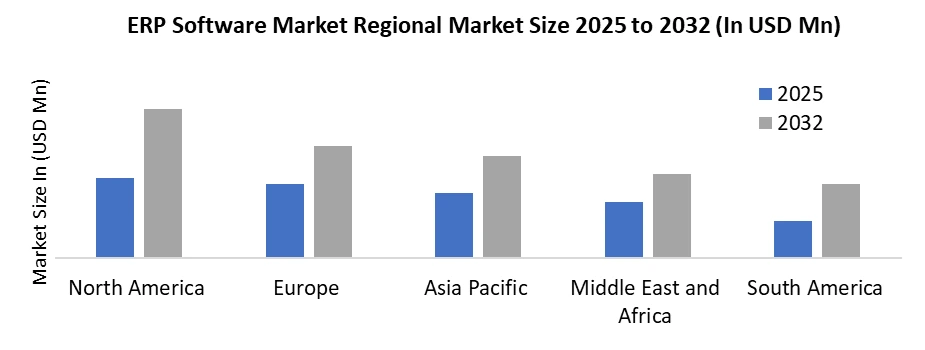 Asia-Pacific is the fastest-growing region (~11% CAGR), with China and India expanding rapidly due to SME digitization and manufacturing automation. Meanwhile, Latin America and the Middle East are emerging markets, supported by government digital initiatives and increasing adoption of SaaS-based ERP solutions.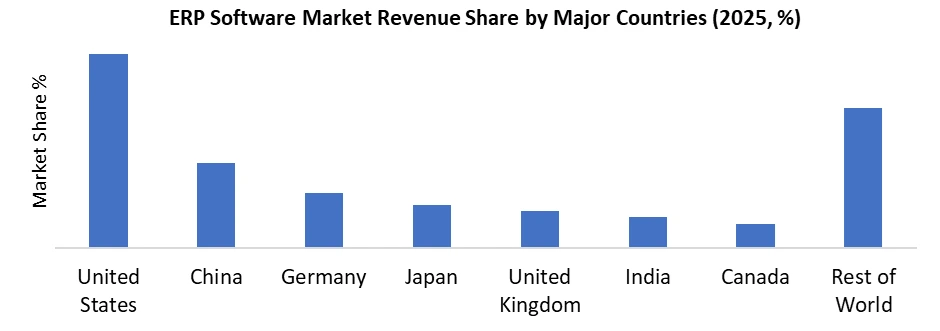
ERP Software Market: Competitive Landscape
The ERP software market is moderately consolidated, led by SAP SE, Oracle Corporation, Microsoft Corporation, Infor, and Workday Inc. SAP maintains the largest share, supported by 24,000+ RISE customers and its Cloud ERP Private 2025 upgrade featuring Joule AI agents. Oracle strengthens its Fusion Cloud ERP with advanced AI for financial forecasting and ESG tracking. Microsoft enhances Dynamics 365 through AI Copilot and MCP analytics servers for real-time insights. Infor differentiates via industry-specific AI and autonomous supply chain solutions, while Workday focuses on scalable HR and finance SaaS platforms. Cloud and hybrid ERP models are projected to account for 83% of deployments by 2026, intensifying AI-driven competition.
Strategic Outlook 2025–2032
| Company | Growth Strategy | Focus |
| SAP | S/4HANA cloud expansion | AI & ESG compliance |
| Oracle | Fusion Cloud ERP | Autonomous database |
| Microsoft | Dynamics 365 SME focus | AI Copilot |
| Workday | HR & Finance ERP | Cloud specialization |
| Infor | Industry-specific ERP | Manufacturing focus |
ERP Software Market Scope: Inquire before buying
| Global Market | |||
|---|---|---|---|
| Report Coverage | Details | ||
| Base Year: | 2025 | Forecast Period: | 2026-2032 |
| Historical Data: | 2020 to 2025 | Market Size in 2025: | USD 69.83 Bn. |
| Forecast Period 2026 to 2032 CAGR: | 11.7% | Market Size in 2032: | USD 149.4 Bn. |
| Segments Covered: | by Deployment | On-premise Cloud Hybrid |
|
| by Function | Finance HR Supply Chain Customer Management Inventory management Others |
||
| by Enterprise Size | Large Enterprises Medium Enterprises Small Enterprises |
||
| by Vertical | Manufacturing & Services BFSI Healthcare Retail Government Aerospace & Defense Telecom Others |
||
Profiles of Major ERP Software Companies, in strategic perspective, covered in the report
1. SAP SE
2. Oracle Corporation
3. Microsoft Corporation
4. Infor
5. Workday, Inc.
6. Sage Group
7. Epicor Software Corporation
8. Acumatica, Inc.
9. IFS AB
10. QAD Inc.
11. Unit4
12. TOTVS S.A.
13. Odoo S.A.
14. Syspro
15. Cetec ERP
16. Deltek, Inc.
17. Plex Systems (Rockwell Automation)
18. NetSuite (Oracle)
19. Hexagon AB
20. Genius ERP
21. Global Shop Solutions
22. Priority Software
23. ECI Software Solutions
24. Aptean
25. Zoho Corporation
26. Körber AG
27. Ramco Systems
28. abas ERP
Frequently Asked Questions
1. What is the current size and forecast of the ERP Software Market?
The global ERP Software Market size is estimated at USD 69.83 billion in 2025 and is projected to reach USD 149.4billion by 2032, growing at a 11.7% CAGR. Growth is driven by cloud ERP adoption, AI-powered automation, and enterprise digital transformation.
2. What are the key drivers of ERP Software Market growth?
Major ERP market growth drivers include rising demand for cloud ERP solutions, SaaS subscription models, AI-integrated ERP platforms, Industry 4.0 adoption, regulatory compliance requirements, and SME digital transformation.
3. What is Cloud ERP and why is it growing rapidly?
Cloud ERP software is a subscription-based enterprise resource planning system hosted on cloud infrastructure. It offers scalability, lower upfront costs, remote accessibility, faster implementation, and real-time analytics—making it the fastest-growing deployment model.
4. Who are the top ERP software vendors in 2025?
Leading ERP software companies include SAP, Oracle, Microsoft (Dynamics 365), Infor, and Workday. These vendors focus on AI integration, ESG reporting tools, predictive analytics, and industry-specific ERP solutions.
5. What industries are adopting ERP software the most?
High-demand sectors for enterprise resource planning software include manufacturing, BFSI, retail, healthcare, logistics, and IT services, with manufacturing remaining the largest adopter globally.