Enterprise Social Software Market Size by Deployment, Enterprise Size, Industry Vertical and Region – Segment-Level Market Assessment, Growth Opportunity Analysis, Competitive Mapping & Forecast to 2032

20.22%
CAGR (2026-2032)
24.57 USD Bn.
Forecast Market Size
321
Report Pages
131
Market Tables

Overview

Global Enterprise Social Software Market size was valued at USD 24.57 Billion in 2025, and the total Enterprise Social Software Market size is expected to grow at a CAGR of 20.22% from 2025 to 2032, reaching nearly USD 89.19 Billion by 2032.

Social media is a powerful channel for marketing and sales. It is an incredible software tool for customer who wants to stay connected with others. An increase in awareness about the social media is having a particularly disruptive affect on industries like entertainment, marketing, media. Enterprise software is taking up a large portion of the social media and marketing budget. An adoption of the enterprise social software offers many benefits for the organizations like enhanced innovation, higher engagement and better decision making.Enterprise Social Software Market GrowthTo know about the Research Methodology :- Request Free Sample Report

Enterprise Social Software Market, Dynamics:

Growth of Hybrid and Remote Work Models: The ESS industry is significantly influenced by the increasing trend toward remote and hybrid work patterns. Companies are depending more and more on workplace social platforms to guarantee employee engagement across geographically separated teams, foster real-time collaboration, and close communication gaps. Products like Microsoft Teams, Slack, and Workplace by Meta are now essential to day-to-day operations. These platforms facilitate productivity outside of traditional office environments by supporting live discussions, document sharing, and project management. In sectors like IT, banking, and professional services, in particular, the need for scalable, secure, and user-friendly ESS solutions is growing as businesses adopt flexible work arrangements over the long run.

Concerns about Data Privacy and Compliance: The adoption of enterprise social software is significantly hampered by data privacy and compliance, especially in regulated sectors like government, healthcare, and banking. It is imperative for businesses to make sure that their internal communication platforms adhere to regional data protection legislation such as the CCPA in California, the GDPR in Europe, or HIPAA in the United States. Financial penalties, brand impact, and legal threats can result from noncompliance with compliance rules. Concerns regarding cloud security, illegal access, and data sovereignty frequently impede or delay adoption of ESS platforms since they hold user data, proprietary material, and sensitive business conversations. For vendors to get past this obstacle, they must spend money on secure architectures and compliance certifications.

Growth in Developing Economies: Enterprise social software providers have an excellent opportunity to expand into emerging markets in the Middle East, Asia-Pacific, and Latin America. Collaboration technologies are becoming more accessible to small and medium-sized organizations in these areas due to rising internet penetration, increased investments in cloud infrastructure, and digital literacy. In addition to encouraging digital transformation, governments are fostering an atmosphere that is conducive to enterprise IT solutions. Multilingual interfaces, local customization, and reasonably priced subscription plans can all aid manufacturers in breaking into these highly promising markets. Globally, as remote and hybrid work grow more commonplace, ESS platforms that provide scalable, mobile-first solutions that are adapted to local requirements can see a substantial increase in market share.

Integration with Legacy Systems: Ensuring smooth integration with current business software stacks and legacy systems is a major challenge in the ESS market. For internal communication, document management, HR, and CRM, many businesses continue to use outdated, compartmentalized systems that are difficult to integrate with contemporary ESS platforms. User resistance, redundant work, and data fragmentation can result from integration gaps. In the absence of appropriate synchronization, real-time cooperation loses some of its utility. High relocation expenses, drawn-out implementation timelines, and operational disruptions are other potential challenges for businesses. In order to facilitate a smooth transition and optimize the benefits of ESS adoption, vendors must offer reliable APIs, migration tools, and technical supporting services.

Enterprise Social Software Market, Segment Analysis:

Based on the Deployment, the Cloud-based segment dominates the Enterprise Social Software market. Because cloud-based deployment is scalable, affordable, and accessible, the market for enterprise social software (ESS) is expanding quickly. Businesses from a variety of sectors are embracing cloud-based ESS systems more frequently in order to facilitate remote and hybrid work models and allow distant teams to collaborate easily. Both SMEs and large organizations can benefit from cloud solutions' quicker adoption, automatic updates, and improved data backup and recovery capabilities. On cloud infrastructure, AI, analytics, and mobile access can also be integrated more effectively. Businesses are moving from on-premises systems to cloud-based ESS platforms in order to increase productivity and agility as security and compliance capabilities get better.

Based on the Enterprise Size, the Large enterprises hold the largest share of the Enterprise Social Software market. Large businesses' intricate organizational structures and dispersed workforces contribute to the market for enterprise social software (ESS). To effectively manage knowledge, improve departmental and geographical collaboration, and expedite internal communication, these firms depend on ESS platforms. They choose safe, scalable, and adaptable solutions that interact with current corporate applications like ERP, CRM, and HRM systems since they have greater budgets and more stringent compliance standards. Additionally, ESS adoption is encouraged by the necessity of cross-functional coordination, employee engagement, and real-time project tracking. In order to facilitate hybrid work environments and enhance operational agility, large enterprises are making significant investments in cloud-based ESS tools as digital transformation picks up speed.
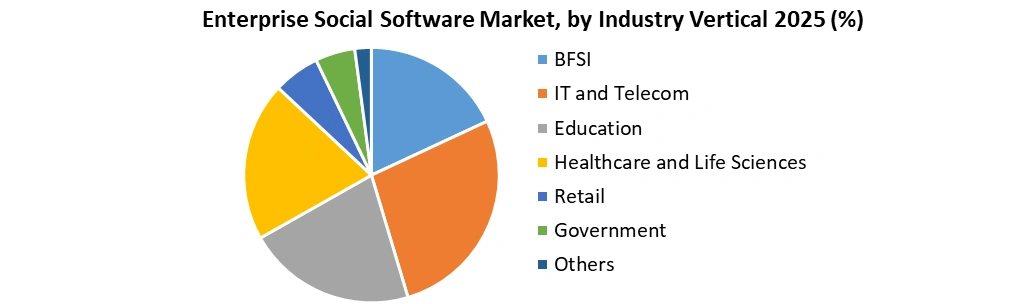
Enterprise Social Software Market by Industry Vertical

Based on the Industry Vertical, the IT and Telecom hold the largest share of the Enterprise Social Software market. Because of its highly digitized, fast-paced, and globally scattered work environment, the IT and telecom industry are one of the top adopters of enterprise social software. Businesses in this field employ ESS systems to facilitate agile workflows, improve real-time collaboration, and encourage team innovation. The industry's constant demands for project management, remote access, and cloud-based tool integration make ESS an essential part of day-to-day operations. Additionally, advanced capabilities like AI-driven analytics, API interfaces, and chat-based collaboration are being adopted early by telecom and IT companies. These businesses place a high value on worker efficiency, openness, and smooth communication in remote and hybrid environments, which is driving up demand.

Enterprise Social Software Market Recent Developments:

Date Company Recent Industry Development Impact
22 April 2026 Atlassian Corporation Plc Atlassian expanded its multi-year partnership with Google Cloud to embed Gemini 3 Flash models and deeper Google Workspace connections into its Rovo AI and Confluence platforms. This integration delivers advanced agentic AI workflows and intelligent content generation natively within enterprise collaboration networks to enhance cross-functional project tracking.
13 January 2026 Salesforce, Inc. Salesforce announced the general availability of the reimagined Slackbot as a deeply personal, context-aware AI teammate for work built directly into the Slack communication interface. The launch enhances enterprise-grade operational productivity by enabling users to trigger workflows, organize sidebars, and synthesize CRM data inside active chat conversations.
20 May 2025 Microsoft Corporation Microsoft updated its Viva Connections application within Microsoft Teams, deploying a native SharePoint News reader experience to replace the traditional feed across desktop and mobile platforms. The deployment streamlines internal corporate communications and boosts engagement by utilizing Copilot-driven summarization for top internal news items.
18 April 2025 Zimbra, Inc. Zimbra launched its Daffodil 10.1.7 patch update for the Zimbra Collaboration network ecosystem, introducing dedicated features such as a spy pixels blocker and idle session alerts. This upgrade directly bolsters enterprise communication security and messaging compliance across hybrid corporate workspaces.

Enterprise Social Software Market, Regional Insights:

North America dominated the Enterprise Social Software Market in 2025. The market for enterprise social software (ESS) is dominated by North America due to the region's high rate of digital adoption, large number of multinational tech companies, and well-established remote and hybrid work cultures. Businesses in a variety of sectors are using ESS platforms more frequently in an effort to improve information sharing, employee engagement, and collaboration. Because of its early investments in enterprise communication tools and cloud infrastructure, the U.S. leads the world in ESS adoption. Important vendors and ongoing advancements in AI, analytics, and API integrations are also found in the region. North America is anticipated to sustain consistent ESS market growth in the upcoming years as companies seek agility and worker decentralization continues.

The market for enterprise social software, or ESS, is expanding steadily in Europe due to the increasing acceptance of digital workplace solutions, stringent data governance regulations (such as GDPR), and the general trend toward hybrid work settings. Nations like Germany, the United Kingdom, and France are in the forefront of ESS adoption in a variety of sectors, including public services, automotive, and finance. For example, Volkswagen Group has improved information management and cross-departmental communication throughout its global operations by utilizing enterprise collaboration solutions. Secure, on-premise, and cloud-based ESS solutions are in high demand as a result of European enterprises' emphasis on data security and compliance. It is anticipated that ESS expenditures will continue to rise in Europe as long as employee engagement and digital efficiency are prioritized.

The enterprise social software (ESS) market in the Asia Pacific area is expanding significantly due to a growing number of remote workers, growing digital transformation projects, and rising cloud use by companies. Companies in nations like China, Singapore, and India are leading the way in implementing ESS solutions to improve cooperation, particularly in industries like manufacturing, IT, and education. For instance, in order to manage sizable, dispersed teams, Indian IT companies like Infosys and Wipro have implemented enterprise collaboration systems. The growth of mobile-first solutions and the emergence of regional SaaS providers both aid in market expansion. Asia Pacific offers ESS platforms significant development potential as SMEs and large corporations modernize internal communication.

Enterprise Social Software Market, Competitive Analysis:

Enterprise software key players provide the robust, powerful features to manage their brand at a large scale. Usually, key players are requiring a key set of features on a regular/daily basis, which can vary from organization to organization. Additionally, Key players are gradually stepped up their investment in innovations and marketing strategy across the globe, thanks to the adaption of enterprise social software, which are able to mitigate the impact on earnings and the profibility.

The objective of the report is to present a comprehensive analysis of the Global Enterprise Social Software Market including all the stakeholders of the industry. The past and current status of the industry with forecasted market size and trends are presented in the report with the analysis of complicated data in simple language.

The report covers all the aspects of the industry with a dedicated study of key players that includes market leaders, followers and new entrants by region. PORTER, SVOR, PESTEL analysis with the potential impact of micro-economic factors by region on the market has been presented in the report. External as well as internal factors that are supposed to affect the business positively or negatively have been analyzed, which will give a clear futuristic view of the industry to the decision-makers.

The report also helps in understanding Global Market dynamics, structure by analyzing the market segments and projects the Global Market size. Clear representation of competitive analysis of key players by Application, price, financial position, Product portfolio, growth strategies, and regional presence in the Global Market make the report investor’s guide.

Enterprise Social Software Market Scope: Inquire before buying

Global Enterprise Social Software Market
Report Coverage Details
Base Year: 2025 Forecast Period: 2026-2032
Historical Data: 2020 to 2025 Market Size in 2025: USD 24.57 Bn
Forecast Period 2026 to 2032 CAGR: 20.22% Market Size in 2032: USD 89.19 Bn
Segments Covered: by Deployment On-premise
Cloud-based
Hybrid
by Enterprise Size Small and Mid-sized Enterprises (SMEs)
Large Enterprises
by Industry Vertical BFSI
IT and Telecom
Education
Healthcare and Life Sciences
Retail
Government
Others

Enterprise Social Software Market, by Region

North America (United States, Canada and Mexico)
Europe (UK, France, Germany, Italy, Spain, Sweden, Austria, Turkey, Russia and Rest of Europe)
Asia Pacific (China, India, Japan, South Korea, Australia, ASEAN and Rest of APAC)
Middle East and Africa (South Africa, GCC, Egypt, Nigeria and Rest of ME&A)
South America (Brazil, Argentina, Columbia and Rest of South America)

Enterprise Social Software Key Players are

1. Microsoft Corporation
2. Google LLC
3. IBM Corporation
4. Khoros
5. Atlassian Corporation
6. Zoho Corporation
7. Meta Platforms, Inc.
8. Cisco Systems, Inc.
9. TIBCO Software Inc.
10. Aurea, Inc. (includes Jive Software)
11. Oracle Corporation
12. OpenText Corp
13. SAP SE
14. Salesforce
15. Synacor, Inc.
16. Atos
17. BroadVision (Clearvale)
18. MangoApps Inc.
19. Bitrix Inc. (Bitrix24)
20. Asana, Inc.
21. Igloo Software
22. M-Files Corporation
23. HCL Technologies
24. Monday.com Ltd.
25. Ryver, Inc.
26. Other Key Players

FAQs:

1. What are the growth drivers for the Enterprise Social Software Market?
Ans. Growing emphasis on knowledge management, the requirement for smooth internal communication, and the rise of remote and hybrid work styles are the factors driving the enterprise social software industry.

2. What are the major opportunities for the Enterprise Social Software Market growth?
Ans. The major opportunities for the enterprise social software market are growth in emerging economies, integration with workflow automation technologies, and AI-driven collaboration solutions.

3. Which region is expected to lead the Global Enterprise Social Software Market during the forecast period?
Ans. North America is expected to lead the Enterprise Social Software Market during the forecast period.

4. What is the projected market size and growth rate of the Enterprise Social Software Market?
Ans. The Enterprise Social Software Market size was valued at USD 24.57 Billion in 2025, and the total Enterprise Social Software Market size is expected to grow at a CAGR of 20.22% from 2025 to 2032, reaching nearly USD 89.19 Billion by 2032.

5. What segments are covered in the Enterprise Social Software Market report?
Ans. The segments covered in the Enterprise Social Software Market report are Deployment, Enterprise Size, Industry Vertical, and Region.

Table of Contents

1. Enterprise Social Software Market Introduction 1.1. Study Assumption and Market Definition 1.2. Scope of the Study 1.3. Executive Summary 2. Global Enterprise Social Software Market: Competitive Landscape 2.1. MMR Competition Matrix 2.2. Competitive Landscape 2.3. Key Players Benchmarking 2.3.1. Company Name 2.3.2. Business Segment 2.3.3. End-user Segment 2.3.4. Revenue (2025) 2.3.5. Company Locations 2.4. Leading Enterprise Social Software Market Companies, by market capitalization 2.5. Market Structure 2.5.1. Market Leaders 2.5.2. Market Followers 2.5.3. Emerging Players 2.6. Mergers and Acquisitions Details 3. Enterprise Social Software Market: Dynamics 3.1. Enterprise Social Software Market Trends by Region 3.1.1. North America Enterprise Social Software Market Trends 3.1.2. Europe Enterprise Social Software Market Trends 3.1.3. Asia Pacific Enterprise Social Software Market Trends 3.1.4. Middle East and Africa Enterprise Social Software Market Trends 3.1.5. South America Enterprise Social Software Market Trends 3.2. Enterprise Social Software Market Dynamics by Region 3.2.1. North America 3.2.1.1. North America Enterprise Social Software Market Drivers 3.2.1.2. North America Enterprise Social Software Market Restraints 3.2.1.3. North America Enterprise Social Software Market Opportunities 3.2.1.4. North America Enterprise Social Software Market Challenges 3.2.2. Europe 3.2.2.1. Europe Enterprise Social Software Market Drivers 3.2.2.2. Europe Enterprise Social Software Market Restraints 3.2.2.3. Europe Enterprise Social Software Market Opportunities 3.2.2.4. Europe Enterprise Social Software Market Challenges 3.2.3. Asia Pacific 3.2.3.1. Asia Pacific Enterprise Social Software Market Drivers 3.2.3.2. Asia Pacific Enterprise Social Software Market Restraints 3.2.3.3. Asia Pacific Enterprise Social Software Market Opportunities 3.2.3.4. Asia Pacific Enterprise Social Software Market Challenges 3.2.4. Middle East and Africa 3.2.4.1. Middle East and Africa Enterprise Social Software Market Drivers 3.2.4.2. Middle East and Africa Enterprise Social Software Market Restraints 3.2.4.3. Middle East and Africa Enterprise Social Software Market Opportunities 3.2.4.4. Middle East and Africa Enterprise Social Software Market Challenges 3.2.5. South America 3.2.5.1. South America Enterprise Social Software Market Drivers 3.2.5.2. South America Enterprise Social Software Market Restraints 3.2.5.3. South America Enterprise Social Software Market Opportunities 3.2.5.4. South America Enterprise Social Software Market Challenges 3.3. PORTER's Five Forces Analysis 3.4. PESTLE Analysis 3.5. Technology Roadmap 3.6. Regulatory Landscape by Region 3.6.1. North America 3.6.2. Europe 3.6.3. Asia Pacific 3.6.4. Middle East and Africa 3.6.5. South America 3.7. Key Opinion Leader Analysis For Enterprise Social Software Industry 3.8. Analysis of Government Schemes and Initiatives For Enterprise Social Software Industry 3.9. Enterprise Social Software Market Trade Analysis 3.10. The Global Pandemic Impact on Enterprise Social Software Market 4. Enterprise Social Software Market: Global Market Size and Forecast by Segmentation (in USD Billion) 2025-2032 4.1. Enterprise Social Software Market Size and Forecast, by Deployment (2025-2032) 4.1.1. On-premise 4.1.2. Cloud-based 4.1.3. Hybrid 4.2. Enterprise Social Software Market Size and Forecast, by Enterprise Size (2025-2032) 4.2.1. Small and Mid-sized Enterprises (SMEs) 4.2.2. Large Enterprises 4.3. Enterprise Social Software Market Size and Forecast, by Industry Vertical (2025-2032) 4.3.1. BFSI 4.3.2. IT and Telecom 4.3.3. Education 4.3.4. Healthcare and Life Sciences 4.3.5. Retail 4.3.6. Government 4.3.7. Others 4.4. Enterprise Social Software Market Size and Forecast, by Region (2025-2032) 4.4.1. North America 4.4.2. Europe 4.4.3. Asia Pacific 4.4.4. Middle East and Africa 4.4.5. South America 5. North America Enterprise Social Software Market Size and Forecast by Segmentation (in USD Billion) 2025-2032 5.1. North America Enterprise Social Software Market Size and Forecast, by Deployment (2025-2032) 5.1.1. On-premise 5.1.2. Cloud-based 5.1.3. Hybrid 5.2. North America Enterprise Social Software Market Size and Forecast, by Enterprise Size (2025-2032) 5.2.1. Small and Mid-sized Enterprises (SMEs) 5.2.2. Large Enterprises 5.3. North America Enterprise Social Software Market Size and Forecast, by Industry Vertical (2025-2032) 5.3.1. BFSI 5.3.2. IT and Telecom 5.3.3. Education 5.3.4. Healthcare and Life Sciences 5.3.5. Retail 5.3.6. Government 5.3.7. Others 5.4. North America Enterprise Social Software Market Size and Forecast, by Country (2025-2032) 5.4.1. United States 5.4.1.1. United States Enterprise Social Software Market Size and Forecast, by Deployment (2025-2032) 5.4.1.1.1. On-premise 5.4.1.1.2. Cloud-based 5.4.1.1.3. Hybrid 5.4.1.2. United States Enterprise Social Software Market Size and Forecast, by Enterprise Size (2025-2032) 5.4.1.2.1. Small and Mid-sized Enterprises (SMEs) 5.4.1.2.2. Large Enterprises 5.4.1.3. United States Enterprise Social Software Market Size and Forecast, by Industry Vertical (2025-2032) 5.4.1.3.1. BFSI 5.4.1.3.2. IT and Telecom 5.4.1.3.3. Education 5.4.1.3.4. Healthcare and Life Sciences 5.4.1.3.5. Retail 5.4.1.3.6. Government 5.4.1.3.7. Others 5.4.2. Canada 5.4.2.1. Canada Enterprise Social Software Market Size and Forecast, by Deployment (2025-2032) 5.4.2.1.1. On-premise 5.4.2.1.2. Cloud-based 5.4.2.1.3. Hybrid 5.4.2.2. Canada Enterprise Social Software Market Size and Forecast, by Enterprise Size (2025-2032) 5.4.2.2.1. Small and Mid-sized Enterprises (SMEs) 5.4.2.2.2. Large Enterprises 5.4.2.3. Canada Enterprise Social Software Market Size and Forecast, by Industry Vertical (2025-2032) 5.4.2.3.1. BFSI 5.4.2.3.2. IT and Telecom 5.4.2.3.3. Education 5.4.2.3.4. Healthcare and Life Sciences 5.4.2.3.5. Retail 5.4.2.3.6. Government 5.4.2.3.7. Others 5.4.3. Mexico 5.4.3.1. Mexico Enterprise Social Software Market Size and Forecast, by Deployment (2025-2032) 5.4.3.1.1. On-premise 5.4.3.1.2. Cloud-based 5.4.3.1.3. Hybrid 5.4.3.2. Mexico Enterprise Social Software Market Size and Forecast, by Enterprise Size (2025-2032) 5.4.3.2.1. Small and Mid-sized Enterprises (SMEs) 5.4.3.2.2. Large Enterprises 5.4.3.3. Mexico Enterprise Social Software Market Size and Forecast, by Industry Vertical (2025-2032) 5.4.3.3.1. BFSI 5.4.3.3.2. IT and Telecom 5.4.3.3.3. Education 5.4.3.3.4. Healthcare and Life Sciences 5.4.3.3.5. Retail 5.4.3.3.6. Government 5.4.3.3.7. Others 6. Europe Enterprise Social Software Market Size and Forecast by Segmentation (in USD Billion) 2025-2032 6.1. Europe Enterprise Social Software Market Size and Forecast, by Deployment (2025-2032) 6.2. Europe Enterprise Social Software Market Size and Forecast, by Enterprise Size (2025-2032) 6.3. Europe Enterprise Social Software Market Size and Forecast, by Industry Vertical (2025-2032) 6.4. Europe Enterprise Social Software Market Size and Forecast, by Country (2025-2032) 6.4.1. United Kingdom 6.4.1.1. United Kingdom Enterprise Social Software Market Size and Forecast, by Deployment (2025-2032) 6.4.1.2. United Kingdom Enterprise Social Software Market Size and Forecast, by Enterprise Size (2025-2032) 6.4.1.3. United Kingdom Enterprise Social Software Market Size and Forecast, by Industry Vertical (2025-2032) 6.4.2. France 6.4.2.1. France Enterprise Social Software Market Size and Forecast, by Deployment (2025-2032) 6.4.2.2. France Enterprise Social Software Market Size and Forecast, by Enterprise Size (2025-2032) 6.4.2.3. France Enterprise Social Software Market Size and Forecast, by Industry Vertical (2025-2032) 6.4.3. Germany 6.4.3.1. Germany Enterprise Social Software Market Size and Forecast, by Deployment (2025-2032) 6.4.3.2. Germany Enterprise Social Software Market Size and Forecast, by Enterprise Size (2025-2032) 6.4.3.3. Germany Enterprise Social Software Market Size and Forecast, by Industry Vertical (2025-2032) 6.4.4. Italy 6.4.4.1. Italy Enterprise Social Software Market Size and Forecast, by Deployment (2025-2032) 6.4.4.2. Italy Enterprise Social Software Market Size and Forecast, by Enterprise Size (2025-2032) 6.4.4.3. Italy Enterprise Social Software Market Size and Forecast, by Industry Vertical (2025-2032) 6.4.5. Spain 6.4.5.1. Spain Enterprise Social Software Market Size and Forecast, by Deployment (2025-2032) 6.4.5.2. Spain Enterprise Social Software Market Size and Forecast, by Enterprise Size (2025-2032) 6.4.5.3. Spain Enterprise Social Software Market Size and Forecast, by Industry Vertical (2025-2032) 6.4.6. Sweden 6.4.6.1. Sweden Enterprise Social Software Market Size and Forecast, by Deployment (2025-2032) 6.4.6.2. Sweden Enterprise Social Software Market Size and Forecast, by Enterprise Size (2025-2032) 6.4.6.3. Sweden Enterprise Social Software Market Size and Forecast, by Industry Vertical (2025-2032) 6.4.7. Austria 6.4.7.1. Austria Enterprise Social Software Market Size and Forecast, by Deployment (2025-2032) 6.4.7.2. Austria Enterprise Social Software Market Size and Forecast, by Enterprise Size (2025-2032) 6.4.7.3. Austria Enterprise Social Software Market Size and Forecast, by Industry Vertical (2025-2032) 6.4.8. Rest of Europe 6.4.8.1. Rest of Europe Enterprise Social Software Market Size and Forecast, by Deployment (2025-2032) 6.4.8.2. Rest of Europe Enterprise Social Software Market Size and Forecast, by Enterprise Size (2025-2032) 6.4.8.3. Rest of Europe Enterprise Social Software Market Size and Forecast, by Industry Vertical (2025-2032) 7. Asia Pacific Enterprise Social Software Market Size and Forecast by Segmentation (in USD Billion) 2025-2032 7.1. Asia Pacific Enterprise Social Software Market Size and Forecast, by Deployment (2025-2032) 7.2. Asia Pacific Enterprise Social Software Market Size and Forecast, by Enterprise Size (2025-2032) 7.3. Asia Pacific Enterprise Social Software Market Size and Forecast, by Industry Vertical (2025-2032) 7.4. Asia Pacific Enterprise Social Software Market Size and Forecast, by Country (2025-2032) 7.4.1. China 7.4.1.1. China Enterprise Social Software Market Size and Forecast, by Deployment (2025-2032) 7.4.1.2. China Enterprise Social Software Market Size and Forecast, by Enterprise Size (2025-2032) 7.4.1.3. China Enterprise Social Software Market Size and Forecast, by Industry Vertical (2025-2032) 7.4.2. S Korea 7.4.2.1. S Korea Enterprise Social Software Market Size and Forecast, by Deployment (2025-2032) 7.4.2.2. S Korea Enterprise Social Software Market Size and Forecast, by Enterprise Size (2025-2032) 7.4.2.3. S Korea Enterprise Social Software Market Size and Forecast, by Industry Vertical (2025-2032) 7.4.3. Japan 7.4.3.1. Japan Enterprise Social Software Market Size and Forecast, by Deployment (2025-2032) 7.4.3.2. Japan Enterprise Social Software Market Size and Forecast, by Enterprise Size (2025-2032) 7.4.3.3. Japan Enterprise Social Software Market Size and Forecast, by Industry Vertical (2025-2032) 7.4.4. India 7.4.4.1. India Enterprise Social Software Market Size and Forecast, by Deployment (2025-2032) 7.4.4.2. India Enterprise Social Software Market Size and Forecast, by Enterprise Size (2025-2032) 7.4.4.3. India Enterprise Social Software Market Size and Forecast, by Industry Vertical (2025-2032) 7.4.5. Australia 7.4.5.1. Australia Enterprise Social Software Market Size and Forecast, by Deployment (2025-2032) 7.4.5.2. Australia Enterprise Social Software Market Size and Forecast, by Enterprise Size (2025-2032) 7.4.5.3. Australia Enterprise Social Software Market Size and Forecast, by Industry Vertical (2025-2032) 7.4.6. Indonesia 7.4.6.1. Indonesia Enterprise Social Software Market Size and Forecast, by Deployment (2025-2032) 7.4.6.2. Indonesia Enterprise Social Software Market Size and Forecast, by Enterprise Size (2025-2032) 7.4.6.3. Indonesia Enterprise Social Software Market Size and Forecast, by Industry Vertical (2025-2032) 7.4.7. Malaysia 7.4.7.1. Malaysia Enterprise Social Software Market Size and Forecast, by Deployment (2025-2032) 7.4.7.2. Malaysia Enterprise Social Software Market Size and Forecast, by Enterprise Size (2025-2032) 7.4.7.3. Malaysia Enterprise Social Software Market Size and Forecast, by Industry Vertical (2025-2032) 7.4.8. Vietnam 7.4.8.1. Vietnam Enterprise Social Software Market Size and Forecast, by Deployment (2025-2032) 7.4.8.2. Vietnam Enterprise Social Software Market Size and Forecast, by Enterprise Size (2025-2032) 7.4.8.3. Vietnam Enterprise Social Software Market Size and Forecast, by Industry Vertical (2025-2032) 7.4.9. Taiwan 7.4.9.1. Taiwan Enterprise Social Software Market Size and Forecast, by Deployment (2025-2032) 7.4.9.2. Taiwan Enterprise Social Software Market Size and Forecast, by Enterprise Size (2025-2032) 7.4.9.3. Taiwan Enterprise Social Software Market Size and Forecast, by Industry Vertical (2025-2032) 7.4.10. Rest of Asia Pacific 7.4.10.1. Rest of Asia Pacific Enterprise Social Software Market Size and Forecast, by Deployment (2025-2032) 7.4.10.2. Rest of Asia Pacific Enterprise Social Software Market Size and Forecast, by Enterprise Size (2025-2032) 7.4.10.3. Rest of Asia Pacific Enterprise Social Software Market Size and Forecast, by Industry Vertical (2025-2032) 8. Middle East and Africa Enterprise Social Software Market Size and Forecast by Segmentation (in USD Billion) 2025-2032 8.1. Middle East and Africa Enterprise Social Software Market Size and Forecast, by Deployment (2025-2032) 8.2. Middle East and Africa Enterprise Social Software Market Size and Forecast, by Enterprise Size (2025-2032) 8.3. Middle East and Africa Enterprise Social Software Market Size and Forecast, by Industry Vertical (2025-2032) 8.4. Middle East and Africa Enterprise Social Software Market Size and Forecast, by Country (2025-2032) 8.4.1. South Africa 8.4.1.1. South Africa Enterprise Social Software Market Size and Forecast, by Deployment (2025-2032) 8.4.1.2. South Africa Enterprise Social Software Market Size and Forecast, by Enterprise Size (2025-2032) 8.4.1.3. South Africa Enterprise Social Software Market Size and Forecast, by Industry Vertical (2025-2032) 8.4.2. GCC 8.4.2.1. GCC Enterprise Social Software Market Size and Forecast, by Deployment (2025-2032) 8.4.2.2. GCC Enterprise Social Software Market Size and Forecast, by Enterprise Size (2025-2032) 8.4.2.3. GCC Enterprise Social Software Market Size and Forecast, by Industry Vertical (2025-2032) 8.4.3. Nigeria 8.4.3.1. Nigeria Enterprise Social Software Market Size and Forecast, by Deployment (2025-2032) 8.4.3.2. Nigeria Enterprise Social Software Market Size and Forecast, by Enterprise Size (2025-2032) 8.4.3.3. Nigeria Enterprise Social Software Market Size and Forecast, by Industry Vertical (2025-2032) 8.4.4. Rest of ME&A 8.4.4.1. Rest of ME&A Enterprise Social Software Market Size and Forecast, by Deployment (2025-2032) 8.4.4.2. Rest of ME&A Enterprise Social Software Market Size and Forecast, by Enterprise Size (2025-2032) 8.4.4.3. Rest of ME&A Enterprise Social Software Market Size and Forecast, by Industry Vertical (2025-2032) 9. South America Enterprise Social Software Market Size and Forecast by Segmentation (in USD Billion) 2025-2032 9.1. South America Enterprise Social Software Market Size and Forecast, by Deployment (2025-2032) 9.2. South America Enterprise Social Software Market Size and Forecast, by Enterprise Size (2025-2032) 9.3. South America Enterprise Social Software Market Size and Forecast, by Industry Vertical (2025-2032) 9.4. South America Enterprise Social Software Market Size and Forecast, by Country (2025-2032) 9.4.1. Brazil 9.4.1.1. Brazil Enterprise Social Software Market Size and Forecast, by Deployment (2025-2032) 9.4.1.2. Brazil Enterprise Social Software Market Size and Forecast, by Enterprise Size (2025-2032) 9.4.1.3. Brazil Enterprise Social Software Market Size and Forecast, by Industry Vertical (2025-2032) 9.4.2. Argentina 9.4.2.1. Argentina Enterprise Social Software Market Size and Forecast, by Deployment (2025-2032) 9.4.2.2. Argentina Enterprise Social Software Market Size and Forecast, by Enterprise Size (2025-2032) 9.4.2.3. Argentina Enterprise Social Software Market Size and Forecast, by Industry Vertical (2025-2032) 9.4.3. Rest Of South America 9.4.3.1. Rest Of South America Enterprise Social Software Market Size and Forecast, by Deployment (2025-2032) 9.4.3.2. Rest Of South America Enterprise Social Software Market Size and Forecast, by Enterprise Size (2025-2032) 9.4.3.3. Rest Of South America Enterprise Social Software Market Size and Forecast, by Industry Vertical (2025-2032) 10. Company Profile: Key Players 10.1. Microsoft Corporation 10.1.1. Company Overview 10.1.2. Business Portfolio 10.1.3. Financial Overview 10.1.4. SWOT Analysis 10.1.5. Strategic Analysis 10.1.6. Scale of Operation (small, medium, and large) 10.1.7. Details on Partnership 10.1.8. Regulatory Accreditations and Certifications Received by Them 10.1.9. Awards Received by the Firm 10.1.10. Recent Developments 10.2. Google LLC 10.3. IBM Corporation 10.4. Khoros 10.5. Atlassian Corporation 10.6. Zoho Corporation 10.7. Meta Platforms 10.8. Inc. 10.9. Cisco Systems 10.10. TIBCO Software Inc. 10.11. Aurea 10.12. Inc. (includes Jive Software) 10.13. Oracle Corporation 10.14. OpenText Corp 10.15. SAP SE 10.16. Salesforce 10.17. Synacor 10.18. Atos 10.19. BroadVision (Clearvale) 10.20. MangoApps Inc. 10.21. Bitrix Inc. (Bitrix24) 10.22. Asana 10.23. Igloo Software 10.24. M-Files Corporation 10.25. HCL Technologies 10.26. Monday.com Ltd. 10.27. Ryver 11. Key Findings 12. Industry Recommendations 13. Enterprise Social Software Market: Research Methodology 14. Terms and Glossary

Custom Market Research Services

We Will Customise The Research For You, In Case The Report Listed Above Does Not Meet With Your Requirements