
EHR EMR Market Size by Type, Component, Deployment Mode, Functionality, End User, Region, Industry-Wide Analysis, Competitive Landscape Assessment & Long-Term Forecast to 2032
Overview
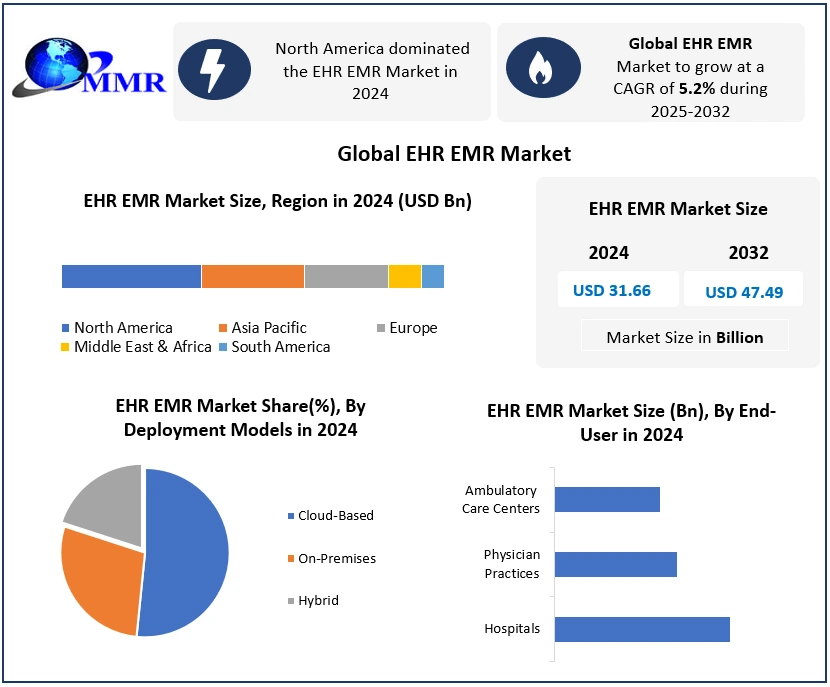
The EHR EMR Market was valued at USD 31.66 Bn in 2024, and is expected to grow at a CAGR of 5.2% from 2025 to 2032, reaching nearly USD 47.49 Bn in 2032
EHR EMR Market Overview
Electronic Health Records (EHR) and Electronic Medical Records (EMR) are digital platforms designed to electronically store, manage and retrieve patient health data, enabling improved clinical workflows, patient safety and regulatory compliance across healthcare environments. The Electronic Health Record (EHR) and Electronic Medical Record (EMR) market stands at the forefront of digital health transformation, viewed as a national infrastructure rather than an optional technology. According to the World Health Organization (WHO) and OECD digital health benchmarks, over 78% of high-income countries have now made EHR adoption mandatory for public hospitals. In comparison, 47% of middle-income countries have integrated EMRs into their national health strategies, reflecting a global policy shift.
 To know about the Research Methodology :- Request Free Sample Report
The EHR EMR market covers a wide array of software and service-based platforms tailored for hospitals, clinics, and ambulatory settings. The industry is driven due to high demand, global digital health mandates, increasing cloud adoption, and the need for interoperable systems, supplied by major vendors investing in scalable, compliance-driven infrastructure. North America led the Electronic Health Records (EHR) and Electronic Medical Records (EMR) in 2024, growth by regulatory mandates such as HITECH, high digital penetration, and rapid adoption of AI-powered and cloud-based EHR platforms across hospitals and health systems.
Global EHR EMR Market Dynamics
A Growing Number of Patients with Lifestyle and Chronic Diseases is expected to boost the EHR and EMR Market Growth
The surge in demand is an urgent need to effectively manage and remotely monitor individuals dealing with long-term health conditions. Chronic diseases such as cardiovascular ailments, cancer, and diabetes are on the rise. For example, United States, these conditions have been identified by the Centers for Disease Prevention and Control (CDC) as the leading causes of both mortality and disability. According to the MMR Study Report, they contribute significantly to the staggering annual healthcare costs, which amount to more than USD 3 trillion in the country's healthcare budget.
The growing number of patients with chronic and lifestyle-related disorders, healthcare providers are increasingly adopting EHR and EMR systems. This factor significantly boosts the EHR EMR Market. Electronic systems are important in delivering accurate and safe medical care to individuals dealing with these health issues. According to the MMR Study, there has been a substantial 42 % increase in the adoption and utilization of national EHR systems. This growth indicates a positive trend in leveraging advanced technologies to meet the rising demands for healthcare associated with chronic diseases. The EHR EMR market is experiencing a significant upswing, driven by the urgent necessity to effectively manage and monitor the health of a growing population grappling with lifestyle and chronic ailments.
Increasing Data Security and Privacy Concerns Limit the EHR EMR Market Growth
Data security and privacy concerns are paramount in the EHR and EMR Market, given the sensitive nature of patient information. As healthcare organizations transition to digital records, the risk of unauthorized access, data breaches, and privacy violations becomes pronounced. Patient data, encompassing medical history, treatments, and personal identifiers, serves as a lucrative target for cybercriminals within the evolving landscape of the EHR EMR Market. The consequences of security breaches extend beyond financial losses, significantly impacting patient trust and the reputation of healthcare providers.
The demands the establishment of a strong cybersecurity infrastructure, implementation of advanced encryption protocols, strict access controls, and continuous staff training within the EHR EMR markets. Failure to adequately protect patient data exposes individual privacy and poses broader implications for public health and the integrity of the healthcare system. As the HER EMR market struggles with ongoing technological advancements, a proactive and vigilant approach to data security becomes imperative for the sustained growth and acceptance of EHR/EMR systems. The industry must remain proactive in adapting to new threats and challenges, reinforcing the importance of a secure and resilient EHR EMR market that prioritises patient privacy and data integrity.
Mobile Health (Mhealth) Creates Lucrative Growth Opportunities for The EHR EMR Market
Mobile Health (mHealth) revolutionizes healthcare by raising the capabilities of mobile devices such as smartphones and tablets, transforming the EHR EMR market. This dynamic field integrates digital technologies to enhance healthcare services and information dissemination, offering real-time data collection, remote patient monitoring, and improved communication between healthcare providers and patients.
MHealth applications, a crucial component in the EHR-EMR market, enable features such as health monitoring, medication reminders, appointment scheduling, and telemedicine. Particularly beneficial in underserved areas, mHealth contributes to preventive care through health tracking, personalized education, and wellness promotion. The widespread global adoption of mobile devices, mHealth as a transformative force, is bridging gaps in healthcare accessibility and promoting better health outcomes within the evolving landscape of the EHR EMR market.
EHR EMR Market Segment Analysis
Based on the Component, the EHR EMR Market is segmented into Software, Services & Consulting, and Hardware. The Software segment dominated the Component segment of the EHR EMR Market in 2024 and maintained its dominance during the forecast period. Serving as the core infrastructure for digitizing medical records, EHR/EMR software enables secure storage, quick retrieval, and seamless sharing of patient data, which enhances clinical workflows and supports data-driven decision-making. Key features such as clinical documentation, e-prescribing, computerized physician order entry (CPOE), and interoperability streamline processes, improve care coordination, and reduce administrative inefficiencies.

The versatility allows deployment across diverse healthcare settings, from large multi-specialty hospitals to small clinics, making it widely adoptable. The rapid evolution of cloud-based solutions and artificial intelligence integration is enhancing efficiency, enabling advanced analytics, and improving patient engagement. Compliance with stringent healthcare regulations and data privacy standards makes software solutions a priority investment for providers aiming to improve care quality while maintaining operational efficiency. With the growing emphasis on connected care ecosystems, interoperability, and real-time access to health information, the software segment continues to be the primary growth driver of the HER EMR market. Ongoing innovation, regulatory mandates, and the rising demand for integrated healthcare delivery systems are expected to sustain EHR EMR Market dominance during the forecast period.
Based on functionality, the EHR EMR Market is segmented into General practice, Pediatrics, Cardiology, Oncology, Orthopedics, Obstetrics & Gynecology, Psychiatry/Behavioral Health, and Others. The General EMR segment held the largest share of the global HER EMR market in 2024. This dominance is primarily attributed to its broad applicability across diverse medical specialties and healthcare settings. General EMR solutions are designed to provide a comprehensive, all-inclusive platform that manages patient records, diagnostics, treatment histories, and administrative workflows under a unified interface. This versatility makes them the preferred choice for multi-specialty hospitals, integrated health networks, and large clinic chains, where cross-departmental coordination and data sharing are essential.
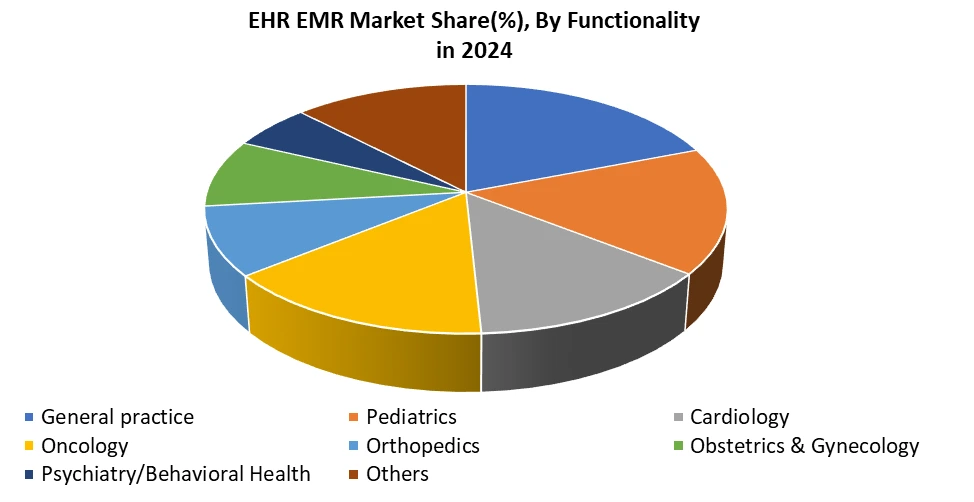
The rise of national health information exchange (HIE) standards and interoperability mandates has accelerated adoption, as general EMRs seamlessly integrate with external systems, improving continuity of care and compliance. The growing demand for centralized platforms that support cross-referrals, telemedicine integration, e-prescriptions, and AI-assisted diagnostics further strengthens the segment’s position. Healthcare providers benefit from the scalability and flexibility of general EMR systems, which allow them to adapt to changing patient volumes and regulatory requirements without switching platforms. The healthcare shifts toward value-based care and patient-centered models, the role of general EMRs in enabling real-time, collaborative, and data-driven decision-making continue to drive their EHR EMR Market leadership.
EHR EMR Market Regional Insights
The North America region dominated the EHR EMR Market in 2024 and maintained its dominance during the forecast period. The region is expected to experience widespread adoption of healthcare information technology, driven by supportive government initiatives and policies. In the United States, for instance, the Health Information Technology for Economic and Clinical Health (HITECH) Act incentivised healthcare providers to adopt EHR systems through financial incentives, fostering a rapid uptake. North America has a well-established and sophisticated healthcare infrastructure, enabling easier integration of EHR and EMR systems into existing healthcare workflows.
The region's advanced technological landscape, coupled with a strong emphasis on research and development, has facilitated the innovation and deployment of innovative EHR solutions. This factor significantly helps boost the EHR EMR Market growth. Also, a large and diverse healthcare ecosystem in North America, including hospitals, clinics, and private practices, has created a substantial demand for EHR and EMR systems to drive the EHR and EMR Market. The presence of major healthcare IT companies and a competitive market environment has also contributed to the growth and dominance of North America in this sector.
The U.S. Government Is Initiating to Improve Healthcare Through the Use of Health Information Technology.
| Initiative | Description |
| National Health Initiatives, Strategies & Action Plans | Organised by health topics, these plans address pressing health issues such as Alzheimer's disease, chronic disease, emergency preparedness, environmental health, health disparities, and healthcare quality. |
| National Health IT Priorities for Research | This policy and development agenda focuses on Precision Medicine and Patient-Centred Outcomes Research (PCOR). |
| 2020-2025 Federal Health IT Strategic Plan | Developed by the Office of the National Coordinator (ONC) in collaboration with more than 25 federal organisations, this plan outlines federal health IT goals and objectives, emphasising individuals' access to their electronic health information. |
| E-Health General Information | E-health initiatives, led by healthcare, government, and high-tech industries, aim to combine technology, the internet, and healthcare to improve medical care, enhance patient involvement, streamline operations, and control expenditures. |
| CMS Strategic Plan | The Centers for Medicare & Medicaid Services (CMS) strategic plan focuses on achieving a transformed and modernised CMS to support the transformation of the healthcare system, including secure electronic health records, improved care delivery, and better patient outcomes. |
EHR EMR Market Competitive Landscape
The EHR EMR market is growing due to competitors with distinct strategies. Epic Systems Corporation leads with a closed, highly integrated platform, offering customization for healthcare networks and academic centers. Cerner Corporation (Oracle Health) is modernizing through Oracle’s cloud infrastructure, enhancing its Millennium platform with real-time data access and AI analytics for multi-hospital systems. Dedalus S.p.A., a European leader, follows an acquisition-driven approach, acquiring DXC Technology’s healthcare software business, and is focused on harmonizing solutions across its extensive regional portfolio to strengthen EHR EMR Market presence and interoperability.
| Trend | Description |
| Government Health IT Initiatives are Shifting Focus Toward Precision Medicine | The explicit federal emphasis on Precision Medicine and Patient-Centred Outcomes Research (PCOR) as core pillars of Health IT strategies (e.g., National Health IT Priorities for Research) is a nuanced trend. This means future EHR/EMR systems will increasingly integrate genomic, lifestyle, and outcome data. |
| Cloud-based EHR Solutions | Increasing shift toward cloud infrastructure to enhance scalability, accessibility, and data sharing. |
| AI and Advanced Analytics | Integration of AI for clinical decision support, diagnostic assistance, and population health management. |
EHR EMR Market Recent Development
• On December 20, 2024, CompuGroup Medical US (CGM) Germany launched CGM AMBI, an ambient AI solution integrated into its CGM APRIMA EHR system. CGM AMBI listens to entire patient encounters—capturing inputs from doctors, nurses, patients, and family members—and automatically generates accurate, structured clinical notes and coding recommendations. Using advanced natural language processing and machine learning, it streamlines documentation, enhances workflow efficiency, and reduces administrative burdens on physicians. This enables healthcare providers to focus more on patient interaction, improving the quality of care and overall encounter experience. The solution marks a paradigm shift in EHR documentation, delivering high accuracy, speed, and syntax in real time.
• On October 22, 2024, Samsung SDS signed an MOU with Ansys Korea to strengthen its cloud business and competitiveness. Under the agreement, Ansys Korea’s simulation software will be deployed on the Samsung Cloud Platform (SCP), leveraging its GPU-centric AI infrastructure to significantly boost simulation speed up to 33 times faster than CPU environments, reducing product development cycles. Ansys will provide CAE solutions, technical support, and training, while both companies will collaborate on SaaS offerings via SCP’s Marketplace. They jointly explore opportunities in the defense and aerospace sectors, conduct proof-of-concept projects, and drive innovation in manufacturing through cloud-based services.
Global EHR EMR Market Scope: Inquire Before Buying
| Global EHR EMR Market | |||
|---|---|---|---|
| Report Coverage | Details | ||
| Base Year: | 2024 | Forecast Period: | 2025-2032 |
| Historical Data: | 2019 to 2024 | Market Size in 2024: | USD 31.66 Bn. |
| Forecast Period 2025 to 2032 CAGR: | 5.2% | Market Size in 2032: | USD 47.49 Bn. |
| Segments Covered: | by Type | Electronic Medical Records (EMR) Electronic Health Records (EHR) |
|
| by Component | Software Services & Consulting Hardware |
||
| by Deployment Mode | On-Premises Cloud-Based Hybrid |
||
| by Functionality | General practice Pediatrics Cardiology Oncology Orthopedics Obstetrics & Gynecology Psychiatry/Behavioral Health Others |
||
| by End User | Hospitals Physician Practices Ambulatory Care Centers Home healthcare providers |
||
EHR EMR Market, by Region
North America (United States, Canada, Mexico)
Europe (United Kingdom, France, Germany, Italy, Spain, Sweden, Russia, Rest of Europe)
Asia Pacific (China, South Korea, Japan, India, Australia, Indonesia, Malaysia, Philippines, Thailand, Vietnam, Rest of Asia Pacific)
Middle East and Africa (MEA) (South Africa, GCC, Nigeria, Rest of MEA)
South America (Brazil, Argentina, Colombia, Chile, Rest of South America)
EHR EMR Market Key Players
North America
1. Epic Systems Corporation (United States)
2. Cerner Corporation (United States)
3. Allscripts Healthcare Solutions, Inc. (United States)
4. eClinicalWorks (United States)
5. MEDITECH (United States)
6. NextGen Healthcare, Inc. (United States)
7. McKesson Corporation (United States)
8. Greenway Health, LLC (United States)
9. CPSI – Computer Programs and Systems, Inc. (United States)
Europe
10. Dedalus S.p.A. (Italy)
11. CompuGroup Medical SE & Co. KGaA (Germany)
12. TietoEVRY (Finland)
13. Agfa-Gevaert Group (Belgium)
14. Advanced Computer Software Group Ltd (United Kingdom)
15. Siemens Healthineers (Germany)
Asia Pacific
16. Fujitsu Limited (Japan)
17. Samsung SDS (South Korea)
18. NEC Corporation (Japan)
19. NTT DATA Corporation (Japan)
20. Telstra Health (Australia)
Middle East and Africa
21. Health Insights (Saudi Arabia)
22. Cerner Middle East (United Arab Emirates)
South America
23. MV Sistemas (Brazil)
24. Pixeon (Brazil)
FAQ:
1] What are the major Key players in the EHR EMR Market?
Ans. The top companies in the EHR EMR Market include Epic Systems Corporation, Cerner Corporation, Allscripts Healthcare Solutions, Inc., eClinicalWorks, MEDITECH, NextGen Healthcare, Inc., McKesson Corporation, and Dedalus S.p.A.
2] Which region is expected to hold the highest share in the Global EHR EMR Market?
Ans. The North America region is expected to hold the largest share of the EHR EMR Market.
3] What is the market size of the EHR EMR Market by 2032?
Ans. The market size of the EHR EMR Market by 2032 is expected to reach USD 47.49 billion.
4] What segments are covered in the Global EHR EMR Market report?
Ans. The segments covered in the EHR EMR Market report are based on Component, Deployment mode, Functionality, End-User, and Regions.
5] What was the market size of the EHR EMR Market in 2024?
Ans. The market size of the EHR EMR Market in 2024 was valued at USD 31.66 billion.