
Edible Beans Market – Global Market Size, Strategic Growth Drivers, Risk Assessment Framework, Regulatory Landscape Review, Competitive Intensity Mapping & Long-Term Industry Outlook to 2032
Overview
Edible Beans Market size was USD 17.40 Bn in 2024 and Global Edible Beans Market is expected to reach nearly USD 24.56 Bn by 2032 with a CAGR of 4.4% during the forecast period.
Edible Beans Market Overview:
Edible beans are globally consumed, nutrient-packed beans and pulses. The varieties of edible beans include kidney beans, black beans, and pinto beans. They have high protein, fibre, and mineral content and thus contributing to a nutritious diet. Rising health awareness and wellness trends favouring edible beans-for their protein, fibre, and mineral content-are driving demand for them. Consumers are making an increasingly conscious choice for beans as a plant-based, clean-label option in balanced diets and in functional food. The boom of functional and fortified foods is channelling the demand for edible beans, as they serve as great bases for high-protein snacks, energy bars, and supplements. This trend, therefore, supports research and development plus diversification, thus opening new avenues for marketing. In terms of segments, the growth is propounded by the soaring consumer preference toward organic beans, since increased health consciousness tends to favour organic foods, while conventional beans are still commanding due to their affordability and wide availability. Type-wise, kidney and black beans are going strong due to nutritional advantages and their use in cuisines worldwide. The markets, in terms of distribution, are increasingly tapped by supermarkets/ hypermarkets and online stores for better reach and assortment.
North America dominated the Edible Beans Market in 2024 due to high bean consumption driven by growing health awareness and plant-based diets. Companies like Faribault Foods are expanding product portfolios and improving supply chains to meet demand. Suma Wholefoods supports market growth by offering a wide range of organic and specialty beans through diverse retail channels.
Global edible beans market study provides an overview of current and future estimates of the market. The analysis highlights a detailed assessment of the market and displays market sizing trends by revenue and volume, current growth factors, expert opinions, facts, and industry-validated market development data. The report witnesses in-depth, significant, and inducing factors that outline the market and industry. The report focuses on edible beans market value at the top regions and countries of the world, which shows a regional development, including market size, share, revenue, and much more across the globe. This analysis and data are expected to help the market players to support their market end-user and develop their geographical reach.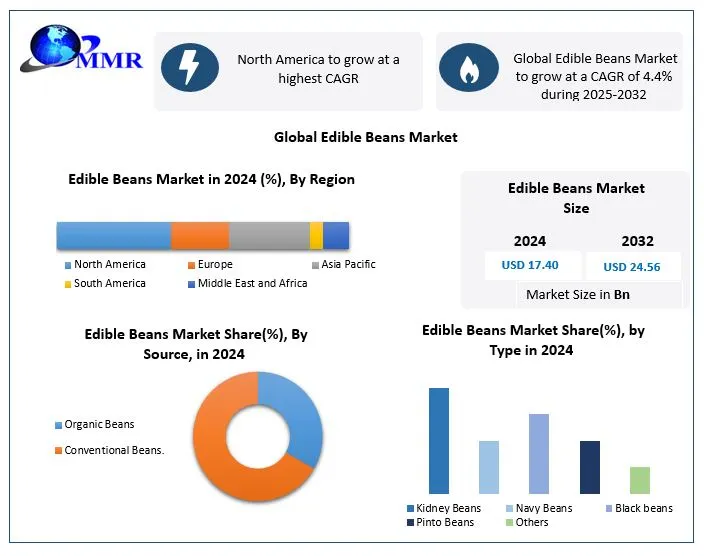 To Know About The Research Methodology :- Request Free Sample Report
Edible Beans Market Dynamics:
Rising Health & Wellness Trends to Drive the Edible Beans Market
Emerging demand in wellness and health are affecting the edible beans market significantly as customers are highly conscious of beans as a nutritional food high in protein, fiber, and low in fat. They also help in supporting cardiovascular well-being, promote digestive health, and assist in blood glucose control. Thus, beans emerged as a key feature of health-focused diets such as plant-based, vegan, gluten-free, and functional eating. Such a growing demand from lifestyle-driven and health-conscious consumers continues to drive the market's expansion globally.
Expansion in Functional and Fortified Foods to Create the Edible Beans Market Opportunity
Edible bean market is growing strongly by extending into functional and fortified food segments. Beans are increasingly utilized in the manufacture of high-protein snack foods, energy bars, breakfast cereals, and dietary supplements due to their compact nutritional package—high protein, high fiber, and micronutrient density. The trend aligns with consumers' requirements of clean-label, health-benefiting foods that can support active lifestyles and wellness goals. Food manufacturers are employing bean-based ingredients as an innovation and differentiation driver for their brands, opening up new revenue streams and product opportunities in the market for functional foods.
Weather Dependence and Climate Impact to Restrain the Edible Beans Market
Bean production is highly weather-sensitive and hence equally climate change-sensitive. Droughts, excessive rainfall, floods, and irregular temperature changes can significantly impact growing seasons, reduce crop yields, and impact the quality of beans. Additionally, unstable weather is also prone to escalate the frequency of pest attacks and plant diseases, further weakening production. These environmental uncertainties not only impact the supply chain and availability of edible beans but also lead to price volatility, which is still one of the key deterrents for farmers and suppliers alike. Weather dependence is still a key constraint in the sustainable growth of the edible beans market.
Edible Beans Market Segment Analysis:
Based on the Source, the Edible Beans Market is segmented into Organic Beans and Conventional Beans. In this, Conventional Beans dominated the market in 2024 and is expected to dominate the market in the forecast period also as Conventional Beans are Wider availability and lower cost compared to organic beans.
Based on Type, the Edible Beans Market is segmented into Kidney Beans, Navy Beans, Black beans, Pinto Beans and Others. In this, Kidney Beans dominated the market in 2024 and are expected to dominate the market in the forecast period, as Kidney Beans are highly globally used compared to other types of edible beans
Based on the Distribution channel, the Edible Beans Market is segmented into Supermarket/Hypermarket, Online Stores, speciality stores, Grocery Stores and Convenience Store. In this, Supermarket/Hypermarke dominated the market in 2024 and is expected to dominate the market in the forecast period also as Supermarket/Hypermarket offers a wide range of bean types at competitive prices. Compared to other distribution channels.
Edible Beans Market Regional Insights:
North America dominated the Edible Beans Market in 2024 due to the high consumption of Beans
North America is dominated in the global edible beans market in 2024 and expected to grow at a steady position during the forecast period, due to the high consumption of nutritional diets in North America as well as The increasing consumer demand for plant-based proteins, driven by rising vegan and vegetarian trends, has boosted bean consumption in the region, particularly in the U.S., which is one of the largest producers of kidney beans globally. Additionally, the fast-paced lifestyle has led to higher demand for ready-to-eat (RTE) and ready-to-cook (RTC) foods, where beans are a staple ingredient
Edible Beans Market Competitive Landscape
Faribault Foods is a leading manufacturer of canned vegetables, with a portfolio of bean products such as sauced, refried, and baked beans, sold extensively across North America. Organic and conventional canned beans, packaging and processing innovation (such as patented hydration processes for refried beans), propel market growth to satisfy demand for convenient, shelf-stable protein sources. Suma Wholefoods, the UK's ethical wholesaler, retails organic, vegan, and sustainably cultivated beans, responding to the fast-growing European demand for plant-based proteins. Its cooperative business model of equal pay and whole food focus appeals to consumer trends towards health-focused and ecologically sustainable diets, further propelling the edible beans market through foodservice and retail channels. Both companies propel market growth by satisfying regional preference—Faribault through mass-market distribution and Suma through niche, sustainable products—while riding health and sustainability trends worldwide.
The objective of the report is to present a comprehensive analysis of the Global Edible Beans Market to the stakeholders in the industry. The past and current status of the industry with forecasted market size and trends are presented in the report with the analysis of complicated data in simple language. The report covers all the aspects of the industry with a dedicated study of key players that includes market leaders, followers, and new entrants. PORTER, SVOR, PESTEL analysis with the potential impact of micro-economic factors of the market have been presented in the report. External as well as internal factors that are supposed to affect the business positively or negatively have been analyzed, which will give a clear futuristic view of the industry to the decision-makers.
The report also helps in understanding Global Edible Beans Market dynamics, structure by analyzing the market segments and project the Global Edible Beans Market size. Clear representation of competitive analysis of key players by product, price, financial position, product portfolio, growth strategies, and regional presence in the Global Edible Beans Market make the report investor’s guide.
Edible Beans Market Key Trends
• Rising Demand for Plant-Based Proteins- Increasing consumer preference for vegetarian, vegan, and flexitarian diets is driving demand for beans as a cost-effective, sustainable protein source
• Innovation in Bean-Based Products- Expansion of ready-to-eat (RTE) and ready-to-cook (RTC) bean products, such as snacks, soups, and sauces, to cater to busy lifestyles
• Sustainability and Climate-Resilient Farming- Adoption of drought-resistant bean varieties and precision agriculture techniques to combat climate change impacts on yields
Edible Beans Market Key Developments
| Year | Company Name | Recent Development |
| June 26, 2024 | Eden Foods, Inc. (USA) | Their Organic Black Beans won the Taste for Life Food Essentials Award for outstanding taste and packaging innovation |
| Nov 5, 2024 | Bonduelle (France) | Released their first frozen organic range (green beans & peas), 100% from French organic farms with 45% bio-sourced sugar‑cane packaging |
| Feb 5, 2024 | Ceres Organics (New Zealand) | Strengthened long-term partnerships with organic bean growers globally, including in Paraguay, to ensure sustainable sourcing. The company also invested in reducing transport emissions by optimizing shipping routes |
| April 11, 2024 | Etihad Mills (UAE) | Completed a grain‑cooling system efficiency project in Fujairah—installing 25 heat‑exchanger interventions to reduce electricity usage by 13.4%. While not bean-specific, it enhances grain quality and storage |
| Nov 23, 2024 | Señor Beans (Peru) | Participated in the 2024 Bean Breeders Workshop in Johannesburg, focusing on disease-resistant bean varieties and climate-smart agriculture to improve yields in Latin America |
Edible Beans Market Scope: Inquire before buying
| Edible Beans Market | |||
|---|---|---|---|
| Report Coverage | Details | ||
| Base Year: | 2024 | Forecast Period: | 2025-2032 |
| Historical Data: | 2019 to 2024 | Market Size in 2024: | USD 17.40 Bn. |
| Forecast Period 2025 to 2032 CAGR: | 4.4% | Market Size in 2032: | USD 24.56 Bn. |
| Segments Covered: | by Source | Organic Beans Conventional Beans |
|
| by Type | Kidney Beans Navy Beans Black Bean Pinto Beans Others |
||
| by Distribution Channel | Supermarket/Hypermarket Online Stores Specialty Stores Grocery Stores Convenience Store |
||
Edible Beans Market by Region
North America (United States, Canada, and Mexico)
Europe (UK, France, Germany, Italy, Spain, Sweden, Austria, and the Rest of Europe)
Asia Pacific (China, South Korea, Japan, India, Australia, Taiwan, Indonesia, Philippines, Malaysia, Vietnam, Thailand, Rest of Asia Pacific region)
Middle East & Africa (South Africa, GCC, Nigeria, Rest of ME&A)
South America (Brazil, Argentina, Rest of South America)
Edible Beans Market Key players
North America
1. Faribault Foods (Faribault, Minnesota, USA)
2. Bush Brothers & Company (Knoxville, Tennessee, USA)
3. Eden Foods, Inc. (Clinton, Michigan, USA)
4. Wild Oats Marketing, LLC. (Boulder, Colorado, USA)
5. The Kroger Co. (Cincinnati, Ohio, USA)
6. Green Valley Foods, LLC. (Watertown, Wisconsin, USA)
7. Trader Joe's (Monrovia, California, USA)
8. ADM (Archer Daniels Midland Company) (Chicago, Illinois, USA)
9. Star of the West Milling Company (Frankenmuth, Michigan, USA)
10. Central Valley Bean Coop (Buxton, North Dakota, USA)
11. Northarvest Bean (Fargo, North Dakota, USA)
12. Chippewa Valley Bean (Menomonie, Wisconsin, USA)
13. Michigan Bean Commission (Frankenmuth, Michigan, USA)
14. Mountain High Organics (New Milford, Connecticut, USA)
15. Treasure Valley Seed Company (Caldwell, Idaho, USA)
16. Kirsten Company LLC (Shakopee, Minnesota, USA)
17. Bonita Bean Company (Coolidge, Arizona, USA)
Europe
1. Suma Wholefoods (Elland, West Yorkshire, United Kingdom)
2. Bonduelle (France)
Asia Pacific
1.Pure & Sure (Bengaluru, Karnataka, India)
2. Ceres Organics (Auckland, New Zealand)
Middle East & Africa
1. Etihad Mills (UAE)
2. Agro Processors and Traders Ltd (Kenya)
3. Nile Agro Industries Ltd (Uganda)
South America
1. Compañía Argentina de Granos S.A. (Argentina)
2. Broto Legal Alimentos (Brazil)
3. Agrícola Famosa (Brazil)
4. Señor Beans (Peru)
Frequently Asked Questions:
1. Which region has the largest share in the Global Edible Beans Market?
Ans: The North America region held the highest share in 2024.
2. What is the growth rate of the Global Edible Beans Market?
Ans: The Global Edible Beans Market is growing at a CAGR of 4.4% during the forecasting period 2025-2032.
3. What is the scope of the Global Edible Beans market report?
Ans: The Global Edible Beans Market report provides insights into PESTEL, Porter's Five Forces, COVID-19 Impact analysis, Recommendations for investors and leaders, and market estimations for the forecast period.
4. Who are the key players in the Global Edible Beans market?
Ans: The important key players in the Global Edible Beans Market are – Faribault Foods, Bush Brothers & Company, Eden Foods, Inc. and Others
5. What is the Market Size of Edible Beans?
Ans: The Global Edible Beans Market size in 2024 was USD 17.40 Bn and is expected to be USD 24.56 Bn in 2032.