
Driving Stimulator Market Size – Industry Structure Evaluation, Demand Drivers Analysis, Regional Growth Analysis and Identification, Competitive Positioning Review & Global Market Size Forecast to 2034
Overview
Driving Simulator Market size was valued at USD 2.20 Bn. in 2025, and the total revenue is expected to grow at a CAGR of 8.1 % from 2026 to 2034. The Driving Simulator Market is reaching nearly USD 4.44 Bn. by 2034.
Driving Simulator Market Overview:
Driving simulators are a type of technology that is used to train drivers in a virtual environment. They can be used for both enjoyment and education. It helps to improve driving conditions by providing sufficient instruction to the driver. The simulator's sensors also keep track of the driver's reaction time, efficiency in dealing with circumstances, and attention. The sensors also give data that is used to better assess and develop the driver assistance system.
Furthermore, driving simulators have lately been made required in driving schools. A learner must log a certain number of hours on the simulator, pass the simulator exam, practice in a real vehicle on the road, and give a driving test before receiving a driver's license. Because it is impossible to reproduce real-time conditions that a driver would face on the road during normal practice, simulator training has proven to be effective in training drivers. As a result, the market for driving simulators is likely to rise.
The market is highly driven as it enhances safety, the people get trained, and the chances of mishap are decreased on the roadway, and the VR and AR integration improve training for drivers, whereas the market is segmented into vehicle, in which there are different types of vehicle stimulators, such as car, bus and truck thereafter for different vehicles we have driving and advanced driving stimulators based on human need.
The United States is one of the world's most technologically advanced markets, and the North America region also dominated the market in 2024 due to its strong Automotive and Autonomous Vehicle Sector. The market is highly competitive, with several established players and emerging companies competing for market share, and many Leading companies are investing heavily in R&D to develop more realistic and advanced simulators to increase their sales.
Driving Simulator Market Growth and Share Analysis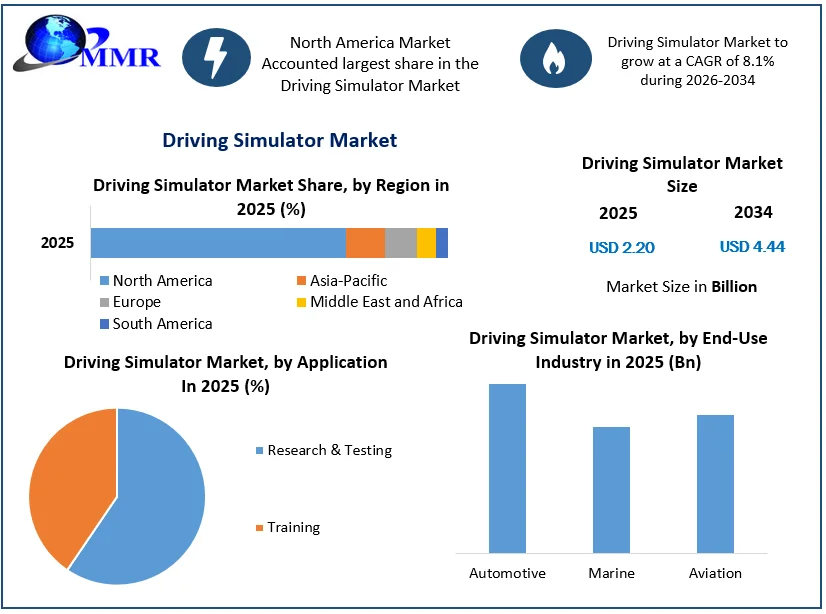
To know about the Research Methodology :- Request Free Sample Report
Driving Simulator Market Dynamics:
Enhanced Safety and Accident Reduction to Drive Market Growth
A shortage of qualified drivers - Today's industries, such as railways, aviation, automotive, marine, and defence, are experiencing a driver shortage. Because human error causes more than 90% of all accidents, a driving simulator is a much-needed advancement. The driving simulator is a device that uses a simulated environment to teach the driver how to avoid crashes from all angles. A 360-degree vision and a motion platform with up to 9 degrees of freedom allow the device to perform this role. This system aids the driver in maintaining control of the situation. As a result, a driving simulator is more efficient and significantly enhances safety. Real-time control's complexities - The driving simulator is a physics and statistics-based model for developing a system or process that goes through multiple phases of testing. The virtual model is a digitised, controlled environment, whereas the real world is uncontrolled.
Integration of VR and AR Technology creates the Driving Simulator Market opportunity.
AR/VR combined gives 360° simulations, which improve training for drivers and autonomous vehicle testing. Companies like Cruden had already been deploying VR-enabled simulators with dynamic environments, weather conditions, and traffic scenarios, and it also gives Cost-Effective Training. VR reduces the need for physical prototypes, lowering R&D costs for automotive OEMs. For example, XR Immersive Technologies partnered with Race Room to elevate VR racing experiences in 2024.
The cost of Implementation and Maintenance creates a challenge in the Driving Simulator Market.
The issues with driving simulators are their high initial and ongoing costs. Building a high-fidelity simulator necessitates substantial investments in hardware, software, and infrastructure. This involves obtaining simulation software licenses, obtaining high-quality motion platforms, screens, or VR headsets, and integrating intricate control systems. This creates a Slow Adoption in Emerging Markets in the driving stimulator market.
Driving Simulator Market Segment Analysis
Based on Vehicle type, the market is segmented into car simulator, truck, and bus driving simulator. In this segment, the car simulator has dominated the market in 2025 and is expected to dominate the market in the forecast period. The Real car elements are positioned in an ergonomically suitable position in the driving simulator cabin in automotive simulators. The driver's view screen is positioned directly in front of him. Depending on the use, the view screen for automotive simulators ranges from 120 to 180 degrees. A 1920 x 1080-pixel front display is generated by the high-resolution technology. The devices are equipped with an HD sound system, as well as 3D and Doppler Effect, to enhance the simulation effect. Graphic boards such as the Nvidia GTX are placed in automobile simulations to improve the real-world driving experience.
All driving characteristics are tracked by the software used in car simulators. Road surfaces such as cities, rural, mountains, motorways, expressways, and off-roads can all be represented. Motion and vibrations are generated in dynamic simulators using tiny 3-axis platforms with electric actuators. As a function of vehicle speed and road surface, this technology offers engine vibration and road texture feedback. For example, ECA Group offers a variety of innovative vehicle simulators, one of which includes automotive training systems. It has a set of instructional modules that were created with the help of professionals.
Based on the Simulator type, the market is segmented into Driving Training Simulator and Advanced Driving Simulator (Autonomous). In this segment, Advanced Driving Simulator has dominated the market in 2025 and is expected to dominate the market in the forecast period, and the advanced driving simulator segment is expected to hold the biggest market share. This is owing to its technological features, such as the 3600 viewing angle and motion platform, which provide a genuine experience. Advanced driving simulators aid in the development of intelligent highway designs and human behaviour studies since testing of technologically updated vehicle dynamics necessitates an augmented environment for analysis and study.
Based on Driving Training Stimulator, the market is segmented into Compact Simulator and Full-Scale Simulator In this segment, Full-Scale Simulator dominated the market in 2025 and is expected to dominate the market in the forecast period as it provide realistic driving environments which include motion platforms, real vehicle cockpits and advanced visual system and this is essential for professional and commercial driving training as well as it has advanced features training as well as it has advanced features such as AI, VR for performance tracking.
Driving Simulator Market Regional Analysis
The United States, which is one of the world's most technologically advanced markets, leads North America. In this region, the number of Level 2 and Level 3 autonomous cars equipped with advanced driver support systems such as collision detection, lane departure warning, and adaptive cruise control is rapidly increasing. Other higher-level autonomous vehicles are also garnering support from governments and businesses that are collaborating on various automated driving system projects.
Driving Simulator Market Competitive Analysis
National Instruments, based in Austin, recently announced the acquisition of monoDrive, a company that specialises in signal processing and Hi-Fi simulation software for autonomous vehicles and ADAS research. On NVIDIA DRIVE Sim, dSPACE introduced high-fidelity vehicle dynamics simulation in September 2023. The dSPACE ASM vehicle dynamics model allows you to mimic everything from the suspension to the tires and brakes to the entire vehicle powertrain and its interaction with the electronic control units that regulate steering, braking, and acceleration.
Driving Simulator Market Recent Development
| Date | Company | Development | Impact |
|---|---|---|---|
| 15 January 2025 | VI-grade | Launched its next-generation COMPACT NVH Simulator 2025 featuring enhanced real-time acoustic rendering for electric vehicles. | Accelerates vehicle noise and vibration testing cycles by up to 30% while lowering physical prototype dependency. |
| 18 February 2025 | Ansible Motion | Partnered with a major European OEM to deploy the Delta S3 Driver-in-the-Loop simulator for autonomous driving calibration. | Enhances ADAS validation efficiency and safety testing across complex urban simulation scenarios. |
| 12 May 2025 | AB Dynamics | Acquired an advanced motion-platform software developer to expand its aSIM simulator software ecosystem. | Strengthens market leadership in ultra-low latency hardware-in-the-loop (HIL) automotive testing. |
| 10 September 2025 | Moog Inc. | Unveiled a high-payload 6-DOF electric motion base engineered specifically for heavy commercial vehicle simulation. | Improves motion fidelity and power efficiency by 25% for truck and bus driver training platforms. |
| 14 January 2026 | Teledyne FLIR | Integrated thermal camera simulation plugins into leading automotive driving simulators. | Enables safer nighttime autonomous vehicle sensing verification in virtual test environments. |
Driving Simulator Market Scope: Inquire before buying
| Driving Stimulator Market | |||
|---|---|---|---|
| Report Coverage | Details | ||
| Base Year: | 2025 | Forecast Period: | 2026-2034 |
| Historical Data: | 2020 to 2025 | Market Size in 2025: | USD 2.20 Bn. |
| Forecast Period 2026 to 2034 CAGR: | 8.1% | Market Size in 2034: | USD 4.44 Bn. |
| Segments Covered: | by Simulator type | Driving Training Simulator Advanced Driving Simulator (Autonomous) |
|
| by Application | Research & Testing Training |
||
| by Driving training simulator | Compact Simulator Full-Scale Simulator |
||
| by Vehicle Type | Car Simulator Truck & Bus Driving Simulator |
||
| by End-Use Industry | Automotive Marine Aviation |
||
Driving Stimulator Market by Region
North America (United States, Canada, and Mexico)
Europe (UK, France, Germany, Italy, Spain, Sweden, Russia, and the Rest of Europe)
Asia Pacific (China, South Korea, India, Japan, Australia, Taiwan, Indonesia, Philippines, Malaysia, Vietnam, Thailand, Rest of Asia Pacific region)
Middle East and Africa (South Africa, GCC, Egypt, Nigeria, Rest of the Middle East and Africa)
South America (Brazil, Argentina, Rest of South America)
Key Players of Driving Simulator Market are:
The Driving Simulator Market involves developing, manufacturing, and selling the hardware and software used to create simulations of realistic driving conditions. These simulations are employed in different applications in auto-related studies, training drivers, and testing autonomous vehicles.
| Company Name | Headquarters | Core Competencies |
| VI-grade GmbH | Darmstadt, Germany | Driver-in-the-loop (DIL) simulators, vehicle dynamics simulation, automotive testing |
| Cruden B.V. | Amsterdam, Netherlands | Professional driving simulators, motorsport simulation, automotive R&D |
| IPG Automotive GmbH | Karlsruhe, Germany | CarMaker simulation software, virtual vehicle development, ADAS & autonomous driving validation |
| Ansible Motion Ltd. | Norwich, United Kingdom | Dynamic driving simulators, DIL simulators, automotive engineering |
| Mechanical Simulation Corporation | Ann Arbor, Michigan, U.S. | CarSim, TruckSim, BikeSim, vehicle dynamics simulation |
| Moog Inc. | East Aurora, New York, U.S. | Motion platforms, electric motion systems, simulator actuation |
| Bosch Rexroth AG | Lohr am Main, Germany | Motion control systems, hydraulic and electric simulator platforms |
| Virage Simulation Inc. | Montréal, Quebec, Canada | Driver training simulators, research simulators, custom simulation systems |
| CAE Inc. | Montreal, Quebec, Canada | Training simulators, transportation and defense simulation systems |
| Tecknotrove Simulator System Pvt. Ltd. | Mumbai, Maharashtra, India | Driving simulators, heavy equipment simulators, defense simulators |
| Dallara S.p.A. | Varano de' Melegari, Italy | Driver-in-the-loop simulators, motorsport simulation technologies |
| AB Dynamics plc | Bradford-on-Avon, United Kingdom | Driving robots, ADAS testing, simulation systems |
| rFpro | Bath, United Kingdom | High-fidelity driving simulation software, autonomous vehicle testing |
| dSPACE GmbH | Paderborn, Germany | Automotive simulation, Hardware-in-the-Loop (HIL), autonomous driving validation |
| Cognata Ltd. | Yokneam Illit, Israel | AI-based driving simulation, synthetic environments, ADAS validation |
| Applied Intuition, Inc. | Mountain View, California, U.S. | Autonomous vehicle simulation, validation software, digital testing |
| ECA Group | Toulon, France | Vehicle and defense simulation systems, training simulators |
| FAAC Incorporated | Ann Arbor, Michigan, U.S. | Driver training simulators, military and commercial simulation systems |
| L3Harris Technologies, Inc. | Melbourne, Florida, U.S. | Training and simulation systems, immersive simulation technologies |
| Thales Group | Meudon, France | Transportation simulation, defense training simulators, digital systems |
| ST Engineering | Singapore | Land vehicle simulators, military and commercial training systems |
| MTS Systems Corporation | Eden Prairie, Minnesota, U.S. | Vehicle testing systems, simulator actuators, durability testing |
| OKTAL (Sogeclair Simulation) | Toulouse, France | Real-time simulation, driving and transportation simulators |
| AutoSim AS | Tønsberg, Norway | Driving and transportation simulation software |
| NVIDIA Corporation | Santa Clara, California, U.S. | AI simulation, Omniverse, autonomous driving simulation platforms |
| Siemens Digital Industries Software | Plano, Texas, U.S. | Automotive digital twins, simulation software, virtual vehicle engineering |
| AVSimulation | Toulouse, France | SCANeR Studio, autonomous driving and traffic simulation software |
| Foretellix Ltd. | Tel Aviv, Israel | Autonomous driving verification, scenario generation, simulation |
| SimuRide (Simuride Ltd.) | Manchester, United Kingdom | Driving simulators, driver behavior research, training solutions |
| Realtime Technologies, Inc. | Royal Oak, Michigan, U.S. | Driving simulators, human factors research, automotive simulation |
Frequently Asked Questions:
1) What was the market size of the Global Driving Simulator Market in 2025?
Ans - Global Driving Simulator Market was worth USD 2.20 Bn. in 2025.
2) What is the market segment of the Driving Simulator Market?
Ans -The market segments are based on Simulator type, Application, Driving training simulator, and Vehicle type.
3) What is the forecast period considered for the Global Driving Simulator Market?
Ans -The forecast period for the Global Driving Simulator Market is 2026 to 2034.
4) What is the market size of the Global Driving Simulator Market in 2034?
Ans – The Global Driving Simulator Market is estimated as worth US$ 4.44 Bn.
5) Which region dominated the Global Driving Simulator Market in 2025?
Ans -In 2025, the North America region dominated the Global Driving Simulator Market.