Data Center Chip Market Size by Chip Type, Data Center, Industry, Region – Revenue Pool Analysis, Margin Structure Assessment, Capital Flow Trends, Competitive Benchmarking & Forecast to 2032

21.45%
CAGR (2026-2032)
12.81 USD Bn.
Market Size
304
Report Pages
153
Market Tables

Overview

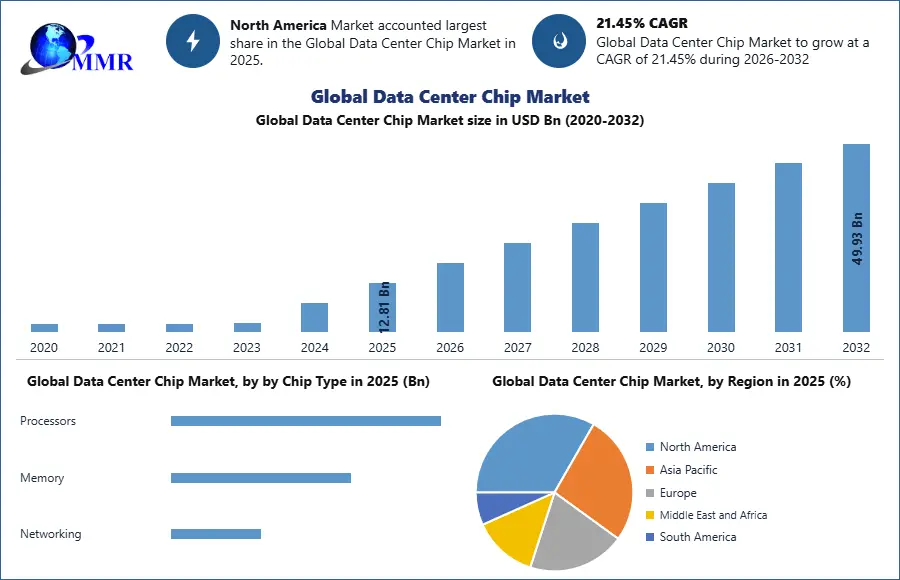
The Data Center Chip Market size was valued at USD 12.81 Billion in 2025 and the total Data Center Chip revenue is expected to grow at a CAGR of 21.45% from 2026to 2032, reaching nearly USD 49.94 Billion.

Global Data Center Chip Market Definition

Data center chips are the type of processor chips which are widely used for cloud computing, artificial intelligence applications and are also used to run various programs on a single chip.
Global Data Center Chip Market

To know about the Research Methodology :- Request Free Sample Report

Global data center chip market Dynamics

A growing adoption of data center chips from cloud computing companies and ongoing advancements in chip technology are the major driving factors behind the growth of the market. Increasing number of data centers across the globe, rising adoption of government regulations concerning localization of data centers, growing adoption of various smart computing devices, rising technological advancements in cloud computing, artificial intelligence based computing and escalating market for FPGA-based accelerators are expected to witness fast growth during the forecast period.

However, increased costs and ever-changing data center operations are the major restraining factors that cloud hamper the growth of the market.

Global Data Center Chip Market: Segmentation Analysis :

In 2025, the Chip Type segment is dominated by Central Processing Units (CPUs) and Graphics Processing Units (GPUs) due to their critical role in handling compute-intensive workloads across data centers. CPUs remain the backbone for general-purpose computing and server operations, while GPUs are witnessing the highest demand growth driven by artificial intelligence (AI), machine learning, and high-performance computing workloads. Field-Programmable Gate Arrays (FPGAs) are gaining traction for their flexibility and low-latency processing in specialized workloads, particularly in edge and networking applications. Application-Specific Integrated Circuits (ASICs) are increasingly adopted for custom, high-efficiency processing in AI and hyperscale environments. The “Others” category, including emerging chip architectures, shows steady but niche adoption.

Based on Memory, Double Data Rate (DDR) memory holds the largest share in 2025 due to its widespread use in standard server architectures and cost-effectiveness. However, High Bandwidth Memory (HBM) is the fastest-growing segment, driven by rising demand for high-speed data processing in AI workloads, GPUs, and advanced analytics. HBM offers superior bandwidth and performance, making it ideal for next-generation data centers. As data-intensive applications expand, the transition toward high-performance memory solutions continues to accelerate.

In the Networking segment, Network Interface Cards (NICs)/Network Adapters dominate in 2025 as they are essential for enabling communication between servers and external networks. Interconnects are experiencing strong growth due to increasing demand for low-latency, high-speed data transfer within hyperscale and cloud data centers. The “Others” segment, including switches and routers, continues to support overall infrastructure but grows at a moderate pace compared to advanced interconnect technologies. The overall trend is toward faster, more efficient networking solutions to support massive data flows.

Global Data Center Chip Market
Report Coverage Details
Base Year: 2025 Forecast Period: 2026-2032
Historical Data: 2020 to 2025 Market Size in 2025: 12.81 USD Bn
Forecast Period 2026-2032 CAGR: 21.45% Market Size in 2032: 49.93 USD Bn
Segments Covered: by Chip Type Processors
    Central Processing Units (CPUs)
    Graphics Processing Units (GPUs)
    Field-Programmable Gate Arrays (FPGAs)
    Application-Specific Integrated Circuits (ASICs)
    Others
Memory
    High Bandwidth Memory (HBM)
    Double Data Rate (DDR)
Networking
    Network Interface Cards (NICs)/Network Adapters
    Interconnects
    Others
by Data Center Type Small and Medium-Sized Data Centers
Large Data Centers
by Application Artificial Intelligence (AI)
Cloud Computing
Big Data Analytics
by End-use IT
Telecom
Healthcare
BFSI
Retail & E-commerce
Entertainment & Media
Energy
Others

Global Data Center Chip Market: Regional Analysis

Based on Region, North America leads the Global Data Center Chip Market in 2025, supported by the presence of major cloud providers, advanced semiconductor companies, and strong AI adoption. The region benefits from significant investments in hyperscale data centers and cutting-edge technologies. Asia Pacific is the fastest-growing region, driven by rapid digitalization, expansion of cloud services, and increasing data consumption in countries like China and India. Western Europe shows steady growth with strong regulatory frameworks and digital infrastructure investments. Eastern Europe, MEA, and South America exhibit moderate growth, influenced by gradual technology adoption and expanding data center ecosystems.

Recent Industry Developments (2025–2026)

Exact Date Company Development Impact
19 March 2026 AMD Expanded its strategic partnership with Samsung to secure HBM4 and DDR5 memory supply for future AI silicon. Secures a critical supply chain advantage for next-generation MI455X accelerators amidst global memory allocation constraints.
16 March 2026 Intel Confirmed Intel Xeon processors will serve as the host CPUs for NVIDIA DGX Rubin NVL8 systems. Reinforces Intel’s dominance in CPU orchestration for high-end AI infrastructure despite intense competition in GPU accelerators.
24 February 2026 Meta Platforms Entered a major agreement to purchase up to $60 billion worth of AI chips from AMD over five years. Signals a major shift toward multi-vendor AI hardware strategies, reducing reliance on a single primary chip supplier.
22 September 2025 NVIDIA Announced a strategic partnership with OpenAI to deploy 10 gigawatts of AI infrastructure using the Vera Rubin platform. Establishes a landmark scale for AI deployment, effectively setting the performance benchmark for superintelligence training.


The objective of the report is to present a comprehensive analysis of the Global Data Center Chip Market including all the stakeholders of the industry. The past and current status of the industry with forecasted market size and trends are presented in the report with the analysis of complicated data in simple language.

The report covers all the aspects of the industry with a dedicated study of key players that includes market leaders, followers, and new entrants. PORTER, SWOT, PESTEL analysis with the potential impact of micro-economic factors of the market have been presented in the report. External as well as internal factors that are supposed to affect the business positively or negatively have been analyzed, which will give a clear futuristic view of the industry to the decision-makers.

The report also helps in understanding Global Market dynamics, structure by analyzing the market segments and projects the Global Market. Clear representation of competitive analysis of key players by Application, price, financial position, Product portfolio, growth strategies, and regional presence in the Global Market make the report investor’s guide.

The Scope of Global Data Center Chip Market: Inquire before buying

Global Data Center Chip Market, by Region

North America (United States, Canada and Mexico)
Europe (UK, France, Germany, Italy, Spain, Sweden, Austria, Turkey, Russia and Rest of Europe)
Asia Pacific (China, India, Japan, South Korea, Australia, ASEAN and Rest of APAC)
Middle East and Africa (South Africa, GCC, Egypt, Nigeria and Rest of ME&A)
South America (Brazil, Argentina, Columbia and Rest of South America)

Key Players / Competitors Profiles Covered in Brief in Global Data Center Chip Market Report in Strategic Perspective:

  1. Intel Corporation
  2. GlobalFoundries
  3. Advanced Micro Devices Inc
  4. Taiwan Semiconductor Manufacturing Co. Ltd
  5. Samsung Electronics Co. Ltd
  6. Arm Limited
  7. Broadcom
  8. Xilinx, Inc
  9. Huawei Technologies Co. Ltd
  10. Nvidia Corporation
  11. IBM Corporation
  12. Google LLC
  13. Amazon.com Inc
  14. Qualcomm Inc
  15. Microsoft Corporation
  16. Meta Platforms, Inc
  17. Marvell Technology, Inc
  18. SK Hynix Inc
  19. Micron Technology, Inc
  20. Achronix Semiconductor Corporation
  21. Fujitsu Limited
  22. Cerebras Systems
  23. Graphcore
  24. Ampere Computing
  25. Groq, Inc

Table of Contents

1. Data Center Chip Market : Market Introduction 1.1. Executive Summary 1.2. Market Size (2025) & Forecast (2026-2032), 1.3. Market Size (USD Million) and Market Share (%) - By Segments, Regions and Country 2. Competitive Landscape 2.1. MMR Competition Matrix 2.2. Competitive Analysis of key players 2.3. Key Players Benchmarking 2.3.1 Company Name 2.3.2 Headquarters 2.3.3 Business Segments 2.3.4 Market Share (%) 2.3.5 Revenue (USD Million) – 2025 2.3.6 Growth Rate (%) 2.3.7 R&D Investment (% of Revenue) 2.3.8 Gross & Operating Margin (%) 2.3.9 Process Node Capability 2.3.10 Architecture & Instruction Set 2.3.11 AI & Acceleration Capabilities 2.3.12 Power Efficiency 2.3.13 Interconnect & Memory Support 2.3.14 Recent Developments 2.3.15 Geographical Presence 2.3.16 Strategic Partnerships & Alliances 2.4. Market Structure 2.4.1 Market Leaders 2.4.2 Market Followers 2.4.3 Emerging Players 2.5. Market Share & Leadership Dynamics 2.5.1 Market share distribution of top data center chip vendors 2.5.2 Year-over-year market share movement analysis 2.5.3 Leadership shifts driven by node migration, architectural innovation, and AI workload dominance 2.5.4 Penetration across hyperscale, enterprise, cloud service providers, and colocation data centers 2.5.5 Market concentration ratios and competitive intensity assessment 2.6. Strategic Positioning & Core Strength Assessment 2.6.1 Product portfolio breadth across CPUs, GPUs, AI accelerators, DPUs, and custom silicon 2.6.2 Leadership in advanced process nodes and chiplet architectures 2.6.3 Software ecosystem, compiler, and platform integration strength 2.6.4 Pricing power across hyperscale vs enterprise deployments 2.6.5 Differentiation through AI performance, scalability, and energy efficiency 2.7. Strategic Moves & Market Momentum Indicators 2.7.1 Capacity expansion and advanced-node foundry commitments 2.7.2 Mergers, acquisitions, and strategic investments 2.7.3 Hyperscaler co-design and custom silicon agreements 2.7.4 Launch of next-generation AI, HPC, and cloud-optimized chips 2.7.5 R&D focus on power efficiency, AI inference, and heterogeneous computing 3. Data Center Chip Market Dynamics 3.1. Data Center Chip Market Trends 3.2. Data Center Chip Market Dynamics 3.2.1 Drivers 3.2.2 Restraints 3.2.3 Opportunities 3.2.4 Challenges 3.3. PORTER’s Five Forces Analysis 3.4. PESTLE Analysis 4. Chip Architecture, Performance & Efficiency Benchmarking 4.1 CPU vs GPU vs ASIC vs FPGA architectural comparison 4.2 General-purpose vs domain-specific accelerator analysis 4.3 Performance benchmarking: FLOPS, TOPS, throughput, latency 4.4 Power efficiency metrics (performance per watt) 4.5 Advanced packaging: chiplets, 2.5D/3D integration, HBM coupling 5. Pricing, Cost Structure & Profitability Analysis 5.1 Pricing trends by chip type and workload 5.2 Cost structure by node, packaging, and memory integration 5.3 Margin comparison across AI accelerators, CPUs, and networking chips 5.4 ASP volatility and hyperscaler negotiation dynamics 5.5 Impact of advanced nodes and yield on profitability 6. Manufacturing, Yield & Supply Chain Analysis 6.1 Foundry dependency and node availability (TSMC, Samsung, Intel Foundry) 6.2 Yield optimization challenges at advanced nodes 6.3 Packaging, HBM, and substrate supply constraints 6.4 Supply chain risk assessment and geopolitical exposure 6.5 Impact of technology transitions on production efficiency 7. Deployment Models & Platform Integration Analysis 7.1 Standalone chips vs platform-level solutions 7.2 CPU–GPU–memory–network co-optimization strategies 7.3 Rack-scale and system-level integration trends 7.4 Vendor lock-in risks and qualification cycles 7.5 Open vs proprietary architectures 8. End-User Adoption & Demand Behavior Analysis 8.1 Hyperscale cloud provider adoption trends 8.2 Enterprise and private data center demand patterns 8.3 AI, HPC, and analytics-driven chip selection criteria 8.4 Willingness-to-pay analysis by workload 8.5 Buying behavior across regions and data center types 9. Reliability, Security & Lifecycle Assessment 9.1 Reliability and failure rate benchmarking 9.2 Thermal management and cooling compatibility 9.3 Security features: confidential computing, encryption, isolation 9.4 Lifecycle cost and upgrade modeling 9.5 RMA and field failure analysis 10. Aftermarket, Support & Lifecycle Economics 10.1 Software updates, firmware, and driver support models 10.2 Long-term platform support and compatibility 10.3 Total Cost of Ownership (TCO) analysis 10.4 Lifecycle extension strategies in hyperscale deployments 10.5 Aftermarket and services revenue contribution 11. Regional Semiconductor Infrastructure & Readiness Assessment 11.1 Regional fab and advanced packaging concentration 11.2 Government incentives and semiconductor policies 11.3 Export controls and technology access restrictions 11.4 Regional demand–supply balance 11.5 Infrastructure readiness and power availability 12. AI, Big Data & High-Performance Computing Impact 12.1 AI training vs inference chip demand split 12.2 Accelerator adoption across cloud and enterprise AI 12.3 Impact of generative AI on chip architectures 12.4 Storage, networking, and memory bandwidth requirements 12.5 Barriers to adoption in latency-sensitive workloads 13. Industry Consolidation, Vendor Landscape & Market Fluidity 13.1 Consolidation trends among chip designers and platform vendors 13.2 Ecosystem convergence between chips, software, and cloud services 13.3 Historical and forecasted market share shifts 13.4 Vendor switching dynamics among hyperscalers 13.5 Regional dominance of global vs regional players 14. Policy Framework, Trade Regulations & Market Impact 14.1 Semiconductor manufacturing incentives and subsidies 14.2 Export controls and AI chip restrictions 14.3 Environmental, energy-efficiency, and sustainability regulations 14.4 Intellectual property and licensing landscape 14.5 Impact of trade policies on pricing and supply chains 15. Data Center Chip Market Case Studies 15.1 Hyperscale AI accelerator deployment case study 15.2 CPU-to-accelerator workload migration case 15.3 Cost optimization through chiplet-based design 15.4 Energy efficiency improvement case study 15.5 ROI and payback period analysis 16. Investment, Growth Opportunities & Strategic Roadmap 16.1 High-growth chip segments and workloads 16.2 Capital expenditure trends in advanced chip design 16.3 Opportunities in AI-native and cloud-optimized chips 16.4 Strategic roadmap for emerging vendors 16.5 Long-term innovation and monetization strategies 17. Cross-Border Manufacturing & Global Supply Networks 17.1 Multi-country design, fabrication, and packaging strategies 17.2 Localization challenges and cost trade-offs 17.3 Global OEM and hyperscaler sourcing models 17.4 Data sovereignty and supply security constraints 17.5 Operational efficiency at global scale 18. Integration with Emerging Storage & Computing Architectures 18.1 CXL, composable infrastructure, and disaggregated computing 18.2 Chip integration with next-gen memory hierarchies 18.3 Storage-class memory and accelerator convergence 18.4 Edge data center and distributed compute enablement 18.5 Future role of data center chips in hybrid architectures 19. Global Data Center Chip Market :Size and Forecast By Segmentation (By Value in USD Million) (2025-2032) 19.1. Global Data Center Chip Market Size and Forecast, by Chip Type 19.1.1 Processors 19.1.2 Central Processing Units (CPUs) 19.1.3 Graphics Processing Units (GPUs) 19.1.4 Field-Programmable Gate Arrays (FPGAs) 19.1.5 Application-Specific Integrated Circuits (ASICs) 19.1.6 Others 19.1.7 Memory 19.1.8 High Bandwidth Memory (HBM) 19.1.9 Double Data Rate (DDR) 19.1.10 Networking 19.1.11 Network Interface Cards (NICs)/Network Adapters 19.1.12 Interconnects 19.1.13 Others 19.2. Global Data Center Chip Market Size and Forecast, by Data Center Type 19.2.1 Small and Medium-Sized Data Centers 19.2.2 Large Data Centers 19.3. Global Data Center Chip Market Size and Forecast, by Application 19.3.1 Artificial Intelligence (AI) 19.3.2 Cloud Computing 19.3.3 Big Data Analytics 19.4. Global Data Center Chip Market Size and Forecast, By End-use 19.4.1 IT 19.4.2 Telecom 19.4.3 Healthcare 19.4.4 BFSI 19.4.5 Retail & E-commerce 19.4.6 Entertainment & Media 19.4.7 Energy 19.4.8 Others 19.4. Global Data Center Chip Market Size and Forecast, By Region 19.4.1 North America 19.4.2 Europe 19.4.3 Asia Pacific 19.4.4 Middle East and Africa 19.4.5 South America 20. North America Data Center Chip Market Size and Forecast By Segmentation (By Value USD Million) (2025-2032) 20.1. North America Market Size and Forecast, by Chip Type 20.2. North America Market Size and Forecast, by Data Center Type 20.3. North America Market Size and Forecast, by Application 20.4. North America Market Size and Forecast, By End-use 20.4. North America Market Size and Forecast, By Country 20.4.1 United States 20.4.2 United States Market Size and Forecast, by Chip Type 20.4.3 United States Market Size and Forecast, by Data Center Type 20.4.4 United States Market Size and Forecast, by Application 20.4.5 United States Market Size and Forecast, by End-use 20.4.6 Canada 20.4.7 Mexico 21. Europe Data Center Chip Market Size and Forecast By Segmentation (By Value USD Million) (2025-2032) 21.1. Europe Market Size and Forecast, by Chip Type 21.2. Europe Market Size and Forecast, by Data Center Type 21.3. Europe Market Size and Forecast, by Application 21.4. Europe Market Size and Forecast, By End-use 21.4. Europe Market Size and Forecast, By Country 21.4.1 United Kingdom 21.4.2 France 21.4.3 Germany 21.4.4 Italy 21.4.5 Spain 21.4.6 Sweden 21.4.7 Russia 21.4.8 Rest of Europe 22. Asia Pacific Data Center Chip Market Size and Forecast By Segmentation (By Value USD Million) (2025-2032) 22.1. Asia Pacific Market Size and Forecast, by Chip Type 22.2. Asia Pacific Market Size and Forecast, by Data Center Type 22.3. Asia Pacific Market Size and Forecast, by Application 22.4. Asia Pacific Market Size and Forecast, By End-use 22.4. Asia Pacific Market Size and Forecast, By Country 22.4.1 China 22.4.2 Japan 22.4.3 South Korea 22.4.4 India 22.4.5 Australia 22.4.6 Malaysia 22.4.7 Thailand 22.4.8 Vietnam 22.4.9 Indonesia 22.4.10 Philippines 22.4.11 Rest of Asia Pacific 23. Middle East and Africa Data Center Chip Market Size and Forecast By Segmentation (By Value USD Million) (2025-2032) 23.1. Middle East and Africa Market Size and Forecast, by Chip Type 23.2. Middle East and Africa Market Size and Forecast, by Data Center Type 23.3. Middle East and Africa Market Size and Forecast, by Application 23.4. Middle East and Africa Market Size and Forecast, By End-use 23.4. Middle East and Africa Market Size and Forecast, By Country 23.4.1 South Africa 23.4.2 GCC 23.4.3 Nigeria 23.4.4 Egypt 23.4.5 Turkey 23.4.6 Rest of ME&A 24. South America Data Center Chip Market Size and Forecast By Segmentation (By Value USD Million) (2025-2032) 24.1. South America Market Size and Forecast, by Chip Type 24.2. South America Market Size and Forecast, by Data Center Type 24.3. South America Market Size and Forecast, by Application 24.4. America Market Size and Forecast, By End-use 24.4. America Market Size and Forecast, By Country 24.4.1 Brazil 24.4.2 Argentina Colombia 24.4.3 Chile 24.4.4 Peru 24.4.5 Rest Of South America 25. Company Profile: Key Players 25.1. Micron Technology Inc.. 25.1.1 Overview 25.1.2 Business Portfolio 25.1.3 Financial Overview 25.1.4 SWOT Analysis 25.1.5 Strategic Analysis 25.1.6 Recent Developments 25.2. Achronix Semiconductor Corporation 25.3. Advanced Micro Devices, Inc. 25.4. Arm Holdings 25.5. Amazon Web Services, Inc. (AWS) 25.6. Broadcom Inc. 25.7. Cisco Systems, Inc. 25.8. Fujitsu Limited 25.9. GlobalFoundries Inc. 25.10.IBM Corporation 25.11.Intel Corporation 25.12.AKCP 25.13.Tetra Tech 25.14.Flextronics 25.15.Lattice Semiconductor Corporation 25.16.Marvell Technology Inc. 25.17.Nvidia Corporation 25.18.Qualcomm Inc. 25.19.SambaNova Systems Inc. 25.20.SK Hynix Inc. 25.21.STMicroelectronics 25.22.Texas Instruments Incorporated 25.23.CoreSite 25.23.1 Others Key Players 26. Key Findings 27. Strategic Recommendations 28. Global Data Center Chip Market : Research Methodology

Custom Market Research Services

We Will Customise The Research For You, In Case The Report Listed Above Does Not Meet With Your Requirements