
Data Catalog Market – Global Market Size, Strategic Growth Drivers, Risk Assessment Framework, Regulatory Landscape Review, Competitive Intensity Mapping & Long-Term Industry Outlook to 2034
Overview
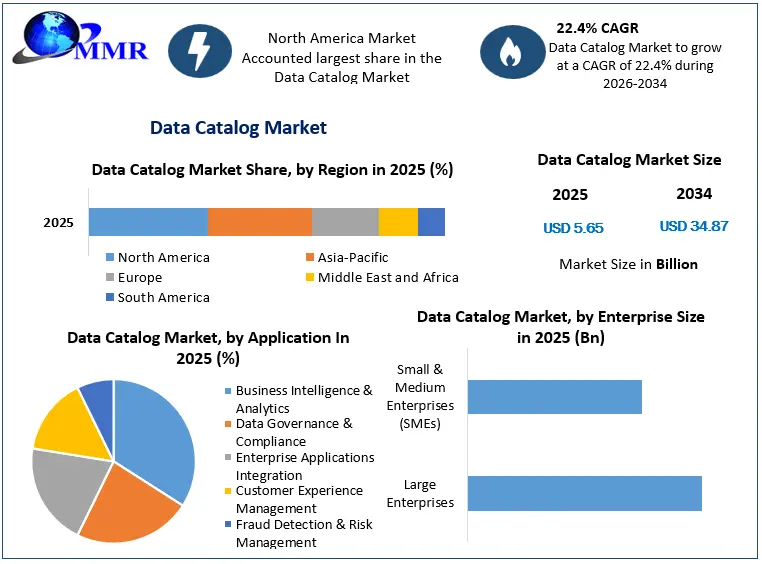
The Data Catalog Market was valued at USD 5.65 billion in 2025, and the total Global Data Catalog Market revenue is expected to grow at a CAGR of 22.4% and reach nearly USD 34.87 billion from 2026 to 2034.
Global Data Catalog Market Overview:
A Data Catalog is an integrated platform for data curation, bringing data supply and demand together. It offers users functions to register data, retrieve and use data; and assess and analyze data. A Data Catalog should provide a data inventory (for data supply) and features for data discovery (for data demand) as key components. Additional features should support data governance, data assessment, and data analytics, alongside appropriate features for catalog administration and data collaboration.
Data Catalog offers a powerful predicate-based search experience for technical and business metadata associated with a data entry. You must have permission to read the metadata for a data entry and apply for search and discovery on the metadata. Data Catalog does not index the data within a data entry. Data Catalog only indexes the metadata that desA data catalog built using a variety of tools and strategies. Using third-party tools or custom-building toolsets is an option, and both have benefits and disadvantages. Despite lower overall tool and licensing costs, acquiring, ingestion, and presenting a custom data catalog to users requires more time and effort. The time taken to acquire, process, and present metadata is reduced using third-party solutions as they offer ready-to-use functionality.
The total cost of the tool and the license is morecribes an asset. Continuous technological developments across the corporate segment create a positive outlook for the data catalog market on the global level. For example, the widespread integration of cloud-based technologies with the data catalog to help develop personalized data for data analysts positively influences the development of the market globally. It is expected to boost the growth of the global data catalog market. The advancement of self-analytic data and the intensification of data in new-age businesses are the main factors expected to act as a key trend in the growth of the global data catalog market.
Data Catalog Market Snapshot
To know about the Research Methodology :- Request Free Sample Report
Global Data Catalog Market Dynamics:
Empowering Data Management, Governance, and Digital Transformation
The data catalog market is being driven by various factors which include the increasing volume & complexity of data, the need for effective data management & governance, and the emergence of new technologies. With the aggressive growth of data, some businesses are struggling to keep up with the demands of managing & organizing their data assets. DCs represent a relatively new data management tool. The appearance of new technologies like cloud computing, big data analytics, and artificial intelligence is also driving the demand for data catalog solutions as the technologies require effective data management to be successful. Overall, the drivers are expected to continue to fuel the growth of the data catalog market through the forecast period. Interest in DCs is rising owing to their enabling function for metadata management, data governance, and data democratization. A group of standards, rules, and regulations that ensures proper reliability, accuracy, and consistency of data is known as data governance. It is also used for digital transformation driving corporate work, and informed decisions.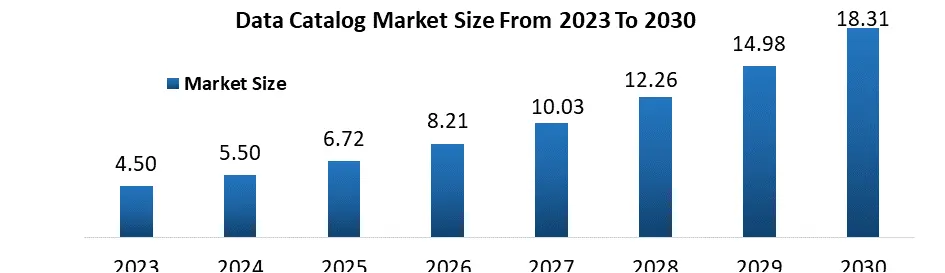 The Rise of Active Metadata and Modern Data Catalogs
Metadata has emerged as a critical aspect of cataloging. It represents an evolution from the conventional way of handling metadata, actively bridging the gap between data and applications by pushing the metadata where it needs to be. The approach goes beyond merely collecting and storing metadata in a passive catalog. The value and potential of active metadata have led to a clear delineation between traditional data catalogs and their modern counterparts. As businesses and data practitioners have recognized the significance of metadata modernization, an active metadata category has started to evolve distinctively.
To ensure seamless integration with a variety of data sources and other data management tools, modern data catalogs are providing open API support. The facilitates flexibility and adaptability, key characteristics in a constantly evolving data landscape. Companies have started leveraging ML and AI to automate metadata discovery, data classification, and data quality assessments. This enhances data catalog efficiency, ensuring data professionals spend less time cataloging and more time deriving valuable insights.
Addressing Unstructured Data Challenges in Modern Data Catalogs
Modern organizations deal with a wide variety of data types, formats, and sources. The diversity and complexities pose limitations to creating a unified data catalog are effectively organizes and manages all the different types of data. Unstructured data issues are a problem for businesses, which makes it challenging to adopt catalog solutions. Data scientists must manage the complexity of fuzzy data sets from numerous sources to acquire enterprise data for modeling or to deliver insights for their analytics teams, which is a challenging undertaking. Given the exponential growth of data, the situation cannot be sustained over the long term. Additionally, many businesses that invest in preserving legacy data or data warehouses end up with silos of fuzzy data sets from numerous diverse sources and repositories of underutilized data for extended periods. Such datasets frequently provide challenges for the implementation of data catalogs.
Global Data Catalog Market Segment Analysis:
Based on End Users, IT & Telecommunication is the fastest-growing segment with a market share of xx% in 2025. As technology develops, more consumers initiate transactions through more devices (such as smartphones), driving up the volume of transactions. Encourages using a data catalog, which gives data analysts a central location to examine and quickly locate all data assets. The comprehensive view allows team members to share ideas that improve the banking sector. The rapid data growth caused by adopting digital technology in the BFSI sector presents new management and compliance concerns.
Based on Component, the Solution segment is expected to dominate the Data Catalog Market during the forecast period. A data catalog solution is a software platform designed to organize, manage, and provide access to enterprise data assets. It enables data discovery, metadata management, business glossary creation, and self-service analytics. Solutions provide a centralized view of data, ensuring accuracy, quality, and compliance with regulations. They are increasingly adopted across industries such as BFSI, healthcare, retail, and IT because they empower business users to find relevant datasets quickly without relying solely on IT teams. With the growing importance of data governance and democratization, solutions form the core component of the market.
Global Data Catalog Market Regional Insight:
North America holds the largest market share of 38% in 2025. With the emphasis on innovations in the US and Canada, North America is considered the region that generates the most significant revenue. The data catalog markets in the countries are the most dynamic and competitive in the world. In the whole of North America, the widespread implementation of digital technology and the rising demand for business intelligence products have increased. The acceptance of self-service analytics, coupled with the rapid expansion of traditional organizations and the collection of huge amounts of data across all industries has created a huge demand for data catalog systems and services. Factors have propelled the growth of the data catalog market in the region.
In the United States, there's a big need for data catalogs. It is mostly owing to decision-making, is depends on using lots and lots of information or 'data'. Companies are seeing how important it is to use data. It helps to make operations better, get new ideas going, and learn things. A factor affecting the need for data catalogs in the U.S. is rules and laws made by government bodies. Groups are using data logs to help keep honesty and agreement with law rules as making private information safe becomes stricter.
Asia-Pacific has seen a sharp rise in the use of data analytics through the forecast period. The region's need for data catalogs is being driven by the region's growing usage of IoT, cloud, and smart technologies. Digital transformation is intimately linked to agility and creativity in China's unique and rapidly changing ecosystem. Businesses in China are becoming more aggressive, embracing digital transformation to stand out, generate income, improve customer experiences, and attract new clients.
Asian nations discovered innovative means to generate more economic momentum and develop their digital economy. A prime example is the "Make in India Campaign". Other examples are the "New Robot Strategy" in Japan; the "Thailand 4.0/Digital Thailand" national government and business transformation action plan, and the "AI Information Industry Development Strategy" in South Korea. The widespread digitalization in the region has contributed to the creation of a huge volume of datasets, which has been seen to be affecting the pace of growth of businesses. It has created a huge demand for data catalog services and thus has boosted the advancement of the market in this region.
Global Data Catalog Market Competitive Landscape:
1. In May 2023, precisely announced the launch of Precisely Data Integrity Suite, a unified data catalog system. It enables customers to quickly integrate data into the cloud, and gain easy access to other data capabilities
2. In October 2023, Informatica acquired data governance platform Akur8 in October 2023 to strengthen its data catalog offerings.
3. October 2023, Alation released its updated Data Governance Suite in October 2023, featuring enhanced data lineage tracking and security features.
4. In July 2023, RightData launched a new data catalog solution called DataMarket in July 2023. It promises a user-friendly interface for managing data assets and facilitating data analysis.
Data Catalog Market Recent Industry Developments:
| Date | Company | Development | Impact |
|---|---|---|---|
| 11 May 2026 | Alation | Launched Alation AI Governance, a new solution providing a system of record for AI model, agent, and tool compliance. | Enables enterprises to generate evidence-backed model cards and maintain live compliance posture to meet EU AI Act and NIST AI RMF standards. |
| 06 May 2026 | Collibra | Introduced the AI Command Center to provide real-time oversight and continuous control over enterprise agentic AI deployments. | Addresses agent sprawl by offering centralized governance and visibility to ensure AI agents operate within safe and compliant parameters. |
| 22 April 2026 | Collibra | Expanded its strategic partnership with Google Cloud to integrate business context and semantics directly into the Knowledge Catalog. | Accelerates data discovery and governance efficacy by ensuring metadata remains contextualized across Google Cloud’s data ecosystem. |
| 09 March 2026 | Alation | Achieved general availability of Curation Automation to automate metadata governance and business context enrichment at scale. | Reduces manual stewardship costs and increases metadata completeness by using agent-powered automation for continuous data cataloging. |
| 28 January 2026 | Collibra | Recognized as a Leader in the Gartner Magic Quadrant for Data and Analytics Governance Platforms. | Reinforces the platform's market position as a primary solution for unified governance and AI lifecycle visibility. |
| 09 December 2025 | Collibra | Joined Snowflake to support cross-ecosystem data and AI interoperability via the Open Semantic Interchange framework. | Standardizes fragmented data semantics across organizations through a vendor-neutral, universal semantic data framework. |
Data Catalog Market Scope: Inquiry Before Buying
| Global Data Catalog Market | |||
|---|---|---|---|
| Report Coverage | Details | ||
| Base Year: | 2025 | Forecast Period: | 2026-2034 |
| Historical Data: | 2020 to 2025 | Market Size in 2025: | USD 5.65 Bn. |
| Forecast Period 2026 to 2034 CAGR: | 22.4% | Market Size in 2034: | USD 34.87 Bn. |
| Segments Covered: | by Component | Solution Service |
|
| by Deployment Mode | Cloud On-premises |
||
| by Enterprise Size | Large Enterprises Small & Medium Enterprises (SMEs) |
||
| by Application | Business Intelligence & Analytics Data Governance & Compliance Enterprise Applications Integration Customer Experience Management Fraud Detection & Risk Management |
||
| by End User | BFSI IT & Telecom Healthcare Manufacturing Others |
||
Global Data Catalog Market, by region:
North America (United States, Canada, and Mexico)
Europe (UK, France, Germany, Italy, Spain, Sweden, Russia, and the Rest of Europe)
Asia Pacific (China, South Korea, Japan, India, Australia, Indonesia, Malaysia, Vietnam, Taiwan, Bangladesh, Pakistan, and the Rest of APAC)
Middle East and Africa (South Africa, GCC, Egypt, Nigeria, and the Rest of ME&A)
South America (Brazil, Argentina Rest of South America)
Global Data Catalog Market Key Players:
1. Collibra - Belgium
2. Alation - United States
3. Informatica - United States
4. IBM Corporation - United States
5. Waterline Data - United States
6. Zaloni - United States
7. Talend - United States
8. TIBCO Software - United States
9. Microsoft Corporation - United States
10. Dataiku - United States
11. Ataccama Corporation - Czech Republic
12. Denodo Technologies - United States
13. Adaptive Management - United States
14. Tamr - United States
15. Podium Data - United States
16. AWS (Amazon Web Services) - United States
17. Google LLC - United States
18. Cloudera, Inc. - United States
19. SAP SE - Germany
20. Hitachi Vantara - United States
Frequently Asked Questions:
1] What segments are covered in the Global Data Catalog Market report?
Ans. The segments covered in the Global Data Catalog Market report are based on Component, Deployment, enterprise size, application, and End Users.
2] Which region is expected to hold the highest share in the Global Data Catalog Market?
Ans. The North American region is expected to hold the highest share of the Global Data Catalog Market.
3] What is the Data Catalog market size of the Global Data Catalog Market by 2034?
Ans. The Data Catalog market size by 2034 will be USD 34.87 billion.
4] What is the forecast period for the Global Data Catalog Market?
Ans. The Forecast period for the Global Data Catalog Market is 2026- 2034.