
Dairy Protein Market- Industry Structure Evaluation, Demand Drivers Analysis, Regional Growth Analysis and Identification, Competitive Positioning Review & Global Market Size Forecast to 2032
Overview
The Dairy Protein Market size was valued at USD 14.96Billion in 2025 and the total Dairy Protein revenue is expected to grow at a CAGR of 6.82% from 2026 to 2032, reaching nearly USD 23.74 Billion.
Dairy Protein Market Overview:
Milk is the primary nutrition source for young infants before their bodies are ready to digest solid food products. Dairy protein is obtained from farm animals hence it can also be defined as an agricultural product. More than 6 billion people in the world consume dairy products and 800-900 million people are living in dairy farming households. Milk is used in a variety of dairy products like butter, yogurt, ice cream, cheese, curd, etc. These are the main products in the global dairy protein market.
The urban demand for dairy proteins grew as consumer purchasing power increased and daily protein became a required daily commodity (tea, coffee, etc.). Dairy proteins are made from the filtration of regular milk which gives different protein types i.e. isolates, concentrates, and caseinates. The concentrates and caseinates are discussed in detail in the dairy protein market report.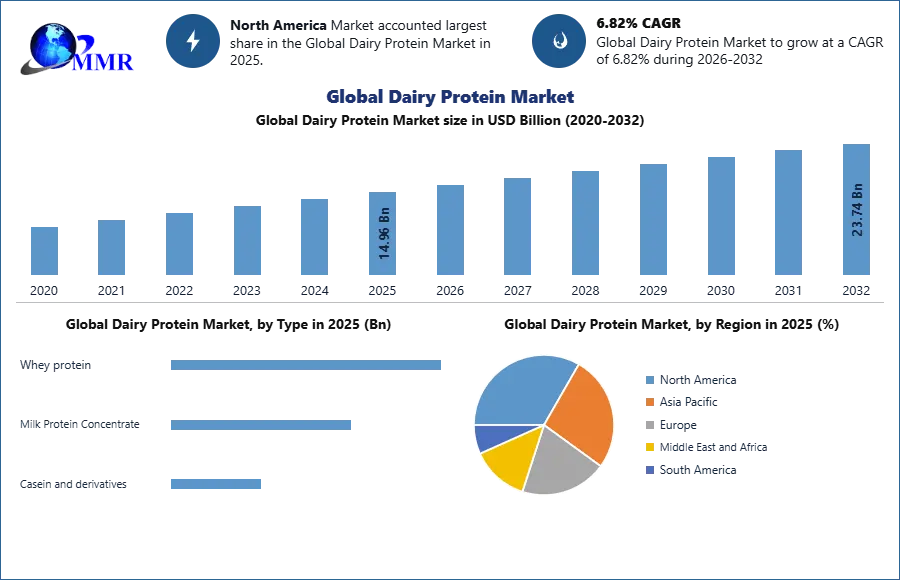 To know about the Research Methodology :- Request Free Sample Report
The global dairy protein market report provides extensive segmentation and regional insights. The market report presents a detailed view of the global dairy protein market by type, form, applications, major players, and key regions and countries, market share, and growth opportunities. The report also has a thorough analysis of the competitive landscape of the global dairy protein market.
Dairy Protein Market Dynamics:
A major driver for the global dairy protein market is the need for infant formula for newborns and babies who are in the pre or early weaning age. According to a study published by WHO, there were 29 infant deaths for every 1000 infants born in . One of the primary reasons behind this statistic was infant malnutrition. There is a high demand for infant formula whose mothers died in childbirth or for other reasons. These infants need other alternatives to breast milk. These factors are projected to drive the global dairy protein market. A2 milk is dairy milk and, as such, is jam-packed with important vitamins, minerals and macronutrients
Dairy milk is known for being a health-supporting drink that results in a silly white milk mustache after it is gulped down. According to the Dietary Guidelines for Americans, most adults in the U.S. should aim to include three servings of dairy daily to reap all of the benefits that milk and other dairy foods offer. Dairy companies have been peddling a type of milk known as A2. It began to gain traction after a couple of New Zealand scientists, Bob Elliott and Corran McLachlan, discovered in 1993 that the variety seemingly did not have the same health effects as regular supermarket brands which had been linked to diabetes and a range of other digestive issues.
While there’s been plenty of arguments over their validity, some studies have shown that the A2 milk market might be more digestible for people who experience symptoms of lactose intolerance. While the Asia Pacific region still dominates the burgeoning market, the A2 milk market is gaining a meaningful share of American dairy aisles Sales are expected to grow by 18.6% between 20245and 2032. The a2 Milk Company Limited, which launched in New Zealand over two decades ago, nearly doubled its US revenue between despite charging a premium and its distribution grew by almost 3,000 stores
The growth of the milk protein hydrolysate market. High costs associated with the research and development activities will further restrict the scope of growth for the milk protein hydrolysate market. The recent coronavirus outbreak has further adversely affected the demand and supply of milk protein hydrolysate.
Health-conscious consumers demand for Dairy Protein products
Sales of dairy products are expected to continue to increase in growth of the high protein yogurt market the total sales are expected to reach $11.4 Billion in and $14.5 billion by 2030. Consumers are looking for healthier options such as high-protein yogurt which supports digestive health Dairy proteins represent one of the essential ingredients in sports nutrition. In , protein powders alone accounted for 40% of the global sports nutrition market, ahead of dietary supplements associated with sports activities.
The dairy protein market is driven by the United States, which held more than a third of the global market share in , due to its highly developed fitness industry. However, analysts identify the Asia Pacific as the region with the highest growth potential, with a CAGR of 6.2% by 2030. This encouraging forecast reflects a greater understanding of the nutritional benefits of caseins and whey proteins as part of an active lifestyle on a global level. The high-protein yogurt market looks set to enjoy a bright future. Micellar Casein Market is a popular choice for athletes and bodybuilders looking to gain muscle mass.
This type of protein powder is made from milk that has been partially digested, making it easy for the body to absorb and use. Additionally, this type of protein powder is relatively low in calories and fat, making it a good option for those watching their weight. It will be necessary to carefully monitor the evolution of the plant-based protein market, which is also growing rapidly. This sector is expanding to meet the demands of flexitarian and vegetarian consumers who wish to diversify their protein intake.
A major challenge in the market is the negative impacts of the dairy protein market on climate change. The methane gas excreted by dairy animals is a threat to the global climate. This is expected to cause many countries to create regulation policies for their dairy protein production. This is projected to hamper the overall dairy protein market growth in the forecast period (2025-2032).
Dairy Protein Market Restraint
A major restraint in the global dairy protein market is the rise of the veganism movement. Veganism promotes restrictions on all animal-based products like meat and milk, unlike vegetarianism which promotes dairy products. The rise of veganism movements in developed countries like the U.S. Canada, and the EU is projected to hamper the global dairy protein market growth. The demand for the concentrate market has remained consistent among buyers. But, because of the coronavirus outbreak, the market hasn't been doing well. The sales of milk protein concentrate went down because production slowed down during lockdowns. Also, it was hard to get the product to the global market because the supply chain got messed up.
The global milk protein concentrate market is growing because more people want nutritious food. People are becoming more aware of the importance of healthy eating and are choosing foods that are good for their health. They are also taking protein supplements to increase their protein intake, which is boosting the market.
Dairy Protein Market Segment Analysis:
By Form, the segments are solid dairy protein and liquid dairy protein. The solid dairy protein segment dominated the global dairy protein market in the year 2025. This segment is projected to grow at a CAGR of 9.5% in the forecast period (2026-2032). The majority of dairy products are sold in solid form like cheese, butter, ice cream, etc. These products directly drive the growth of solid daily proteins in the global market. Solid dairy products have a higher shelf life than liquid dairy products is another reason why solid dairy proteins dominate the global market.
By Type, the segments are Whey protein, Milk Protein Concentrate (MPCs), and Casein and derivatives. Whey protein held the highest share in the global dairy protein market in 2024. Milk Protein Concentrate market segment is projected to grow at a CAGR of 5.5% in the forecast period (2026-2032). Dairy products contain many proteins and enzymes like casein. MPCs and whey proteins are more water-soluble than caseins. This is projected to hamper the growth of the casein segment in the aforementioned forecast period. Whey is the by-product of the milk curdling process and it is used in many commercial dairy products. Sweet whey is obtained from the processing of cheddar or Swiss cheese. The many commercial applications of whey protein are projected to drive the growth of this segment in the global dairy protein market in the same forecast period.
By Application, in the Dairy protein market, the segments are categorized into Food and Beverages, Infant Nutrition, Personal Care and Cosmetics, and Others. Food and Beverages held more than half of all global dairy protein market share in 2024. This segment is projected to grow at a CAGR of 8.3% in the forecast period (2025-2032). This growth can be attributed to dairy protein being a daily food commodity across the globe. The growth of other food and beverages markets (which are dairy-based) positively impacts the growth of this segment. This trend is expected to continue in the same forecast period. The infant nutrition segment is projected to be the key in the global dairy protein market. Many experimental infant nutrition formulas are in demand to replace colostrum (early-lactation milk that strengthens the immune system of the newborn). The use of milk-based texture modifiers and foaming agents is preferred by manufacturers as consumers are leaning towards organic-based cosmetic products rather than artificial agent-based cosmetics.
Dairy Protein Market Regional Insights:
The North American dominated the global dairy protein market in 2025. Commercial dairy farming which uses automated milking equipment is used in the countries of this region. This is projected to drive the growth of the dairy protein market in the forecast period (2026-2032) in this region. The Asia-Pacific region is projected to grow at a CAGR of 7.5% in the forecast period (2026-2032). The EU was responsible for 180 million metric tons of milk production in followed by the United States at 110 million metric tons.
India is the world’s leading producer of milk. Demand for the milk protein market in India has been consistently strong due to its nutritional properties and the use of various food and beverage products. Milk proteins are valued as a high-quality protein source
Australia has traditionally been a strong exporter of bulk protein commodities, exporting about 70% of what it produces Developed with government and industry, the Protein Roadmap for Unlocking Technology-led Growth Opportunities for Australia’ released in March identifies a $13 billion market opportunity for Australia to grow and diversify its high-quality protein products from various different sources. However, this country has a low export rate of other dairy protein products. New Zealand, Germany, and the Netherlands are the largest exporters of dairy protein products.
China is the biggest importer of whey protein in with US$ 810 million. The Netherlands was responsible for whey imports worth US$437 million in the same year followed by Germany with US$ 208 million. On the other hand, the U.S. and China were the leading importers of casein protein in with US$450 Million and US$175 million respectively. The high import rates of dairy proteins by these countries are projected to drive the growth of the dairy protein market in the forecast period (2026-2032).
Dairy Protein Market Recent Development:
| Exact Date | Company | Development | Impact |
|---|---|---|---|
| 18 February 2026 | Arla Foods Ingredients | The company launched a new whey protein isolate designed specifically for clear protein beverages to meet rising consumer demand for high-protein hydration. | This innovation enables manufacturers to create shelf-stable, transparent drinks with high protein content, enhancing market share in the functional beverage segment. |
| 12 January 2026 | Saputo Inc. | The company completed a $45 million expansion of its ingredient manufacturing plant to increase the production of specialty milk protein concentrates. | The increased capacity strengthens Saputo’s ability to supply the clinical nutrition and infant formula sectors with high-purity dairy proteins. |
| 14 October 2025 | Fonterra Co-operative Group | Fonterra announced a strategic partnership with a biotech firm to develop carbon-neutral whey protein using advanced filtration and renewable energy. | This collaboration addresses the growing demand for sustainable dairy ingredients, helping major food brands meet their ESG and carbon-reduction targets. |
| 05 August 2025 | Glanbia plc | Glanbia introduced a micellar casein platform that offers enhanced solubility and heat stability for ready-to-drink (RTD) protein shakes. | The new technology improves the sensory profile and texture of dairy-based RTDs, catering to the active lifestyle and sports nutrition markets. |
| 22 May 2025 | FrieslandCampina Ingredients | The company secured regulatory approval in the EU for a new bioactive whey protein ingredient targeting adult muscle health and recovery. | This approval allows for the commercialization of targeted nutrition solutions for the healthy aging demographic, a high-growth segment of the dairy protein market. |
The objective of the report is to present a comprehensive analysis of the global Dairy Protein market to the stakeholders in the industry. The past and current status of the industry with the forecasted market size and trends are presented in the report with the analysis of complicated data in simple language. The report covers all the aspects of the industry with a dedicated study of key players that include market leaders, followers, and new entrants.
PORTER, PESTEL analysis with the potential impact of micro-economic factors of the market have been presented in the report. External as well as internal factors that are supposed to affect the business positively or negatively have been analyzed, which will give a clear futuristic view of the industry to the decision-makers.
The report also helps in understanding the global Dairy Protein dynamics, structure by analyzing the market segments and projecting the global Dairy Protein market size. Clear representation of competitive analysis of key players by Form, price, financial position, product portfolio, growth strategies, and regional presence in the global Dairy Protein Industry make the report an investor’s guide.
Dairy Protein Market Scope: Inquire before buying
| Global Dairy Protein Market | |||
|---|---|---|---|
| Report Coverage | Details | ||
| Base Year: | 2025 | Forecast Period: | 2026-2032 |
| Historical Data: | 2020 to 2025 | Market Size in 2025: | 14.96 USD Billion |
| Forecast Period 2026-2032 CAGR: | 6.82% | Market Size in 2032: | 23.74 USD Billion |
| Segments Covered: | by Type | Whey protein Milk Protein Concentrate Casein and derivatives |
|
| by Form | Solid Liquid |
||
| by Distribution Channel | Offline Supermarkets and Hypermarkets Specialty Stores Others Online |
||
| by Application | Food and Beverages Infant Nutrition Personal Care and Cosmetics Other |
||
Dairy Protein Market, by Region
North America (United States, Canada and Mexico)
Europe (UK, France, Germany, Italy, Spain, Sweden, Austria and Rest of Europe)
Asia Pacific (China, South Korea, Japan, India, Australia, Indonesia, Malaysia, Vietnam, Taiwan, Bangladesh, Pakistan and Rest of APAC)
Middle East and Africa (South Africa, GCC, Egypt, Nigeria and Rest of ME&A)
South America (Brazil, Argentina Rest of South America)
Key Players are:
1. Arla Foods amba
2. Fonterra Co-operative Group Limited
3. Royal FrieslandCampina N.V.
4. Kerry Group plc
5. Glanbia plc
6. Lactalis Group
7. Saputo Inc.
8. Nestlé S.A.
9. Danone S.A.
10. Archer Daniels Midland Company
11. Hilmar Cheese Company Inc.
12. Agropur Cooperative
13. Carbery Group
14. Volac International Ltd.
15. Milk Specialties Global
16. United Dairymen of Arizona
17. Grassland Dairy Products Inc.
18. Schreiber Foods Inc.
19. LAÏTA Group
20. Ingredion Incorporate
21. Erie Foods International Inc
22. Dana Dairy Group Ltd.
23. Agri-Mark Inc.
24. Unternehmensgruppe Theo Müller
25. Tatura Milk Industries Ltd.
26. Anchor (Fonterra brand)
27. Arion Dairy Products B.V.
28. Idaho Milk Products
29. Leprino Foods Company
30. Valio Ltd.
Others