Cyberknife Technology Market Size by Application, End User, Region, Industry-Wide Analysis, Competitive Landscape Assessment & Long-Term Forecast to 2032

5.2%
CAGR (2026-2032)
1.31 USD Bn.
Market Size
325
Report Pages
144
Market Tables

Overview

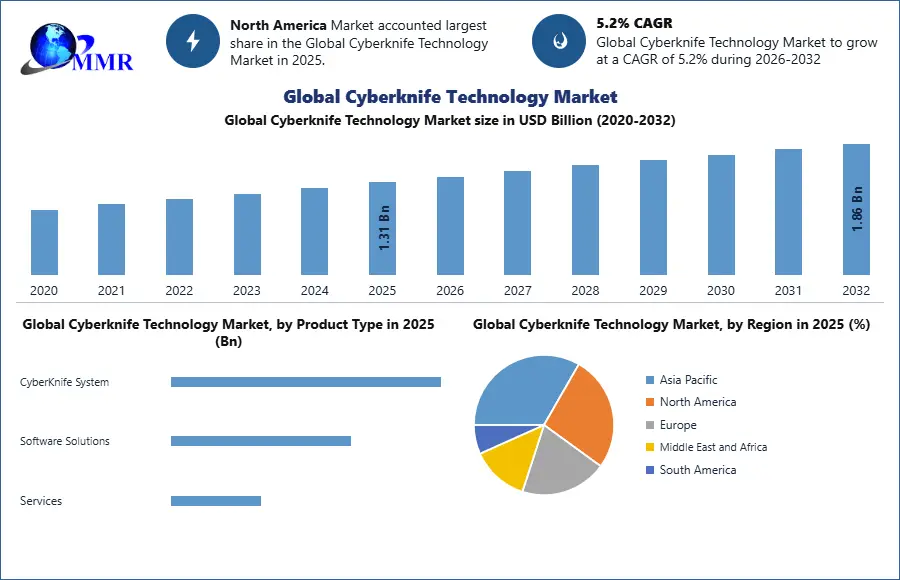
The Cyberknife Technology Market size was valued at USD 1.31 Billion in 2025and the total Cyberknife Technology revenue is expected to grow at a CAGR of 5.2% from 2026 to 2032, reaching nearly USD 1.86 Billion.

Global Cyberknife Technology Market Overview:

Cyberknife is a stereotactic radiosurgery (SRS) system. It is a non-invasive treatment for cancerous and non-cancerous tumours and other conditions where radiation therapy is indicated. It is used to treat conditions throughout the body, including the prostate, lung, brain, spine, head and neck, liver, pancreas, and kidney, and can be an alternative to surgery or for patients who have inoperable or surgically complex tumours. To know about the Research Methodology :- Request Free Sample Report
Global Cyberknife Technology Market Dynamics:

Rising Cancer Burden and Precision Radiation Demand Accelerate Global CyberKnife Technology Market Growth

The global CyberKnife technology market is expanding due to the increasing prevalence of cancer and growing preference for non-invasive radiosurgery solutions. CyberKnife systems offer highly precise stereotactic radiosurgery for treating tumors in the brain, spine, lung, prostate, and pancreas without traditional surgery. Rising incidences of lung cancer, brain tumors, and prostate cancer are increasing demand for advanced robotic radiation therapy systems. Healthcare providers are investing in image-guided radiation technologies to improve treatment accuracy and minimize damage to surrounding tissues. The market is also supported by the increasing elderly population, which often requires minimally invasive cancer therapies. Hospitals and oncology centers worldwide are expanding access to stereotactic body radiation therapy (SBRT), further supporting market demand. Government initiatives to improve cancer care infrastructure, particularly in developing countries, are also contributing to adoption. As healthcare institutions prioritize precision medicine, the global CyberKnife technology market continues to gain momentum across advanced cancer treatment applications.

High Equipment Costs and Limited Installation Infrastructure Restrict CyberKnife Technology Market Expansion

The CyberKnife technology market faces challenges due to the high capital investment required for system installation and maintenance. CyberKnife robotic radiosurgery systems involve substantial procurement costs, specialized shielding infrastructure, and highly trained personnel, which restrict adoption in small hospitals and cost-sensitive regions. The total ownership cost, including software upgrades, service contracts, and clinical training, remains a significant barrier for many healthcare providers. In emerging economies, reimbursement limitations and inadequate healthcare funding reduce accessibility to advanced radiation treatment systems. Installation also requires dedicated radiotherapy suites and compliance with strict radiation safety standards, increasing setup complexity. Limited availability of trained radiation oncologists and medical physicists further slows deployment. Healthcare institutions in developing countries often prioritize conventional radiotherapy systems due to lower operational costs. These financial and operational barriers can delay technology adoption despite clinical advantages, restraining the growth of the global CyberKnife technology market.

AI Integration and Real-Time Tumor Tracking Create New Opportunities in the CyberKnife Technology Market

The integration of artificial intelligence and real-time adaptive imaging is creating major opportunities in the global CyberKnife technology market. AI-powered treatment planning enhances targeting precision, improves workflow efficiency, and reduces treatment time for patients. Real-time tumor tracking allows CyberKnife systems to adjust radiation delivery according to patient movement, particularly in lung and abdominal cancers, improving treatment outcomes. Manufacturers are introducing software upgrades that support automated contouring, treatment optimization, and predictive analytics. These innovations are helping oncology centers deliver personalized radiation therapy while reducing clinician workload. Increasing research in AI-assisted radiosurgery and digital oncology platforms is expected to enhance system capabilities further. The growing use of cloud-based treatment planning and integrated imaging technologies is also strengthening market opportunities. As cancer treatment shifts toward personalized and data-driven approaches, AI-enabled robotic radiosurgery systems are expected to become central to next-generation oncology care, driving long-term CyberKnife technology market growth.

Global Cyberknife Technology Market Segment Analysis:

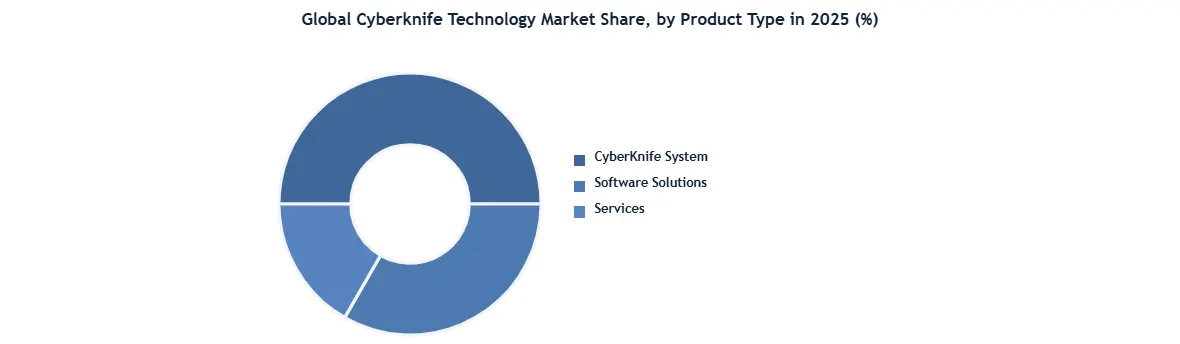
by Product Type : The CyberKnife system segment dominates the global CyberKnife technology market, as hospitals and specialized oncology centers continue investing in advanced robotic radiosurgery platforms for non-invasive cancer treatment. These systems are widely used for treating tumors in the brain, spine, prostate, lung, and liver through highly targeted stereotactic radiosurgery. Demand is rising due to increasing cancer incidence, preference for outpatient treatment, and the need for precision-based radiation delivery. In 2025, this segment held the largest revenue share because the core robotic platform represents the highest capital expenditure in installation. Growing adoption in tertiary care hospitals and dedicated cancer institutes, particularly in North America, Europe, and Asia-Pacific, supports segment dominance.

The software solutions segment is witnessing rapid growth due to the integration of treatment planning software, AI-enabled imaging, motion tracking, and radiation dose optimization tools. Software enhances tumor targeting accuracy, real-time tracking, and workflow efficiency. Increasing focus on adaptive radiotherapy and personalized treatment planning is accelerating adoption. Upgrades in cloud-based oncology software and predictive analytics are also expanding the segment.

The services segment includes installation, maintenance, training, technical support, and software upgrades. This segment is growing steadily as healthcare facilities require ongoing operational support for complex robotic radiosurgery systems. Service contracts and system maintenance are becoming essential due to the high-value and technologically advanced nature of CyberKnife platforms.
Global Cyberknife Technology Market Regional Insights:

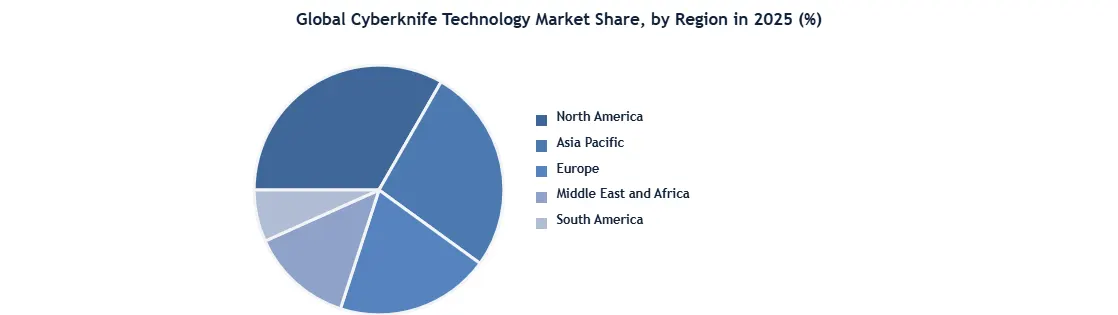
North America and Europe are projected to dominate the global Cyberknife market during forecast period.The market in these regions is expected to witness lucrative growth due to the increase in geriatric population, prevalence of chronic diseases and growing demand for less time consuming treatments, increase in the incidence of cancer, and a shift towards painless and non-invasive surgeries. As owing to the large patient population pool in the countries such as China and India, cyberknife market is projected to grow in the forecast period.Asia Pacific is expected to grow at a faster pace during forecast years.Owing to the large cancer patient population, rise in the incidence of cancer, and technological advancements, the APAC region is expected to grow at a higher rate. An increase in initiatives undertaken by governments to raise awareness about treatment options, growth in demand for sophisticated therapies and the increasing prevalence of cancer are some of the key factors responsible for the growth of the market for Cyber knife in APAC.

The report also helps in understanding Global Market dynamics, structure by analyzing the market segments and project the Global Cyberknife Technology Market size. Clear representation of competitive analysis of key players by product, price, financial position, product portfolio, growth strategies, and regional presence in the Global Cyberknife Technology Market make the report investor’s guide.
Global Cyberknife Technology Market, Recent Developments:

  • May 2025Accuray Incorporated presented new long-term clinical data at ESTRO 2025 showing strong outcomes for 5-session prostate bed treatment using its CyberKnife S7 System, supporting wider adoption in recurrent prostate cancer treatment.
  • September 2025Accuray Incorporated supported the launch of a new CyberKnife center at 5D Clinics Melbourne, marking the first patient treatment after full system installation in Melbourne, expanding access in Australia.
  • October 2025Accuray Incorporated showcased its advanced adaptive radiotherapy solutions and CyberKnife innovations at ASTRO 2025, including AI-supported imaging and workflow enhancements.
  • December 2025Accuray Incorporated announced the first phase of a strategic operational transformation plan to improve commercial execution and accelerate global deployment of its CyberKnife platform.
  • January 2026Accuray Incorporated highlighted expanded integration of AI in radiation oncology, including automated contouring and adaptive treatment planning for CyberKnife workflows.
  • April 2026Accuray Incorporated appointed a new Chief Commercial Officer to strengthen global sales strategy and accelerate adoption of CyberKnife systems in emerging oncology markets.

Global Cyberknife Technology Market Scope: Inquire before buying

Global Cyberknife Technology Market
Report Coverage Details
Base Year: 2025 Forecast Period: 2026-2032
Historical Data: 2020 to 2025 Market Size in 2025: 1.31 USD Billion
Forecast Period 2026-2032 CAGR: 5.2% Market Size in 2032: 1.86 USD Billion
Segments Covered: by Product Type CyberKnife System
Software Solutions
Services
by Procedure Type Stereotactic Radiosurgery
Stereotactic Body Radiation Therapy
Fractionated Stereotactic Radiation Therapy
by Cancer Type Breast Cancer
Prostate Cancer
Brain Cancer
Lung Cancer
Spine Tumors
Liver Cancer
Pancreatic Cancer
Others
by Application Oncology
Neurology
Pain Management
Pediatrics
Others
by End User Hospitals
Ambulatory Surgical Centers
Clinics
Research Institutes
Others

Global Cyberknife Technology Market, by Region:

North America (United States, Canada and Mexico)
Europe (UK, France, Germany, Italy, Spain, Sweden, Austria and Rest of Europe)
Asia Pacific (China, South Korea, Japan, India, Australia, Indonesia, Malaysia, Vietnam, Taiwan, Bangladesh, Pakistan and Rest of APAC)
Middle East and Africa (South Africa, GCC, Egypt, Nigeria and Rest of ME&A)
South America (Brazil, Argentina Rest of South America)

Global Cyberknife Technology Market, Key players:

  1. Accuray Incorporated
  2. Advanced Micro Devices
  3. IBA Group
  4. RaySearch Laboratories
  5. KUKA Robotics
  6. InterTerra Medical Technologies (India), Pvt. Ltd.
  7. Omega Hospitals
  8. El Camino Hospital
  9. HCG Oncology
  10. Elekta AB
  11. Brainlab AG
  12. Canon Medical Systems Corporation
  13. Huiheng Medical, Inc.
  14. Neusoft Medical Systems Co., Ltd.
  15. RefleXion Medical Inc.
  16. Shinva Medical Instrument Co. Ltd.
  17. Siemens Healthineers AG
  18. Zap Surgical Systems Inc.
    Others

Table of Contents

1. Cyberknife Technology Market : Executive Summary 1.1. Study Assumption and Market Definition 1.2. Scope of the Study 1.3. Executive Summary 1.3.1 Market Size (2025) & Forecast (2026-2032), 1.3.2 Market Size (Value USD Mn.) and Market Share (%) - By Segments, Regions and Country 2. Cyberknife Technology Market : Competitive Landscapes 2.1. MMR Competition Matrix 2.2. Key Players Benchmarking 2.2.1 Company Name 2.2.2 Headquarters 2.2.3 Component Provided 2.2.4 Level of Specialization (Robotic Radiosurgery Focus / Oncology Equipment / Full-Suite Radiation Therapy) 2.2.5 Innovation Capability (AI-based Treatment Planning, Motion Tracking, Imaging Integration) 2.2.6 Cloud Adoption Capability (%) 2.2.7 System Architecture (Conventional vs AI-enabled / Cloud-integrated Systems) 2.2.8 Interoperability Standards (DICOM, HL7, APIs) 2.2.9 Real-Time Tumor Tracking Capability 2.2.10 System Integration Capabilities 2.2.11 Compatibility with Existing Radiotherapy Infrastructure (LINAC, Imaging Systems) 2.2.12 Multi-Platform Integration (EHR, PACS, Oncology Systems 2.2.13 Scalability & Flexibility 2.2.14 Market Share (%) 2025 2.2.15 Revenue 2025 (USD Million) 2.2.16 Global Reach 2.3 Market Structure 2.3.1 Market Leaders 2.3.2 Market Followers 2.3.3 Emerging Players 2.4. Global CyberKnife Technology Market Share Analysis (2025) 2.4.1 Analysis of market share by top 10 players globally. 2.4.2 Regional contribution breakdown by revenue (%) for top players. 2.4.3 Comparative analysis of fragmented vs consolidated market share. 2.4.4 Distribution of market revenue by key players and their share. 2.4.5 Key regions contributing to global market dominance. 2.5. Technology Differentiation of Key Players 2.5.1 Analysis of AI-driven clinical decision support capabilities. 2.5.2 Comparison of cloud-based CyberKnife platforms. 2.5.3 Real-time data processing and analytics capabilities. 2.5.4 Cybersecurity and compliance technologies in market offerings. 2.5.5 Interoperability standards and integration across systems (EHR, LIS). 2.6. Solution Portfolio Comparison by Key Players 2.6.1 Detailed comparison of Hospital Information Systems (HIS) capabilities. 2.6.2 EHR/EMR, LIS, RIS, PACS offerings from key players. 2.6.3 Patient engagement and telehealth solutions across key vendors. 2.6.4 Analysis of revenue cycle management (RCM) systems. 2.6.5 End-to-end digital healthcare solutions portfolio comparison. 2.7. R&D and Innovation Strategy Analysis by Key Players 2.7.1 R&D investment analysis (percentage of revenue) by key players. 2.7.2 Focus areas for innovation: AI, cloud computing, and interoperability. 2.7.3 Overview of patents filed and technological innovations. 2.7.4 Strategic partnerships driving R&D and innovation in CyberKnife tech. 2.7.5 Evaluation of AI and predictive analytics in clinical decision support. 2.8. Mergers and Acquisitions Analysis 2.8.1 Strategic acquisitions in the CyberKnife technology market. 2.8.2 Impact of M&As on competitive landscape and market consolidation. 2.8.3 Technology acquisition strategies by leading players. 2.8.4 Cross-border M&A activities and regional market impact. 2.8.5 Analysis of strategic alignment and synergy creation through M&As. 3. Cyberknife Technology Market: Dynamics 3.1. Cyberknife Technology Market Trends 3.2. Cyberknife Technology Market Dynamics 3.2.1 Drivers 3.2.2 Restraints 3.2.3 Opportunities 3.2.4 Challenges 3.3. PORTER’s Five Forces Analysis 3.4. PESTLE Analysis 4. Global Supply Chain and Ecosystem Analysis 4.1 CyberKnife Technology Market Ecosystem Overview 4.1.1 Detailed breakdown of the value chain in the CyberKnife market 4.1.2 Role of software providers, hardware manufacturers, and integrators 4.1.3 Key players in CyberKnife system implementation and customization 4.1.4 Contribution of system integrators and consultants in market growth 4.1.5 Barriers to entry for new entrants in the CyberKnife ecosystem 4.2 OEM and End-User Value Capture 4.2.1 Overview of value capture by OEMs and their key customers 4.2.2 Impact of partnerships between manufacturers and healthcare providers 4.2.3 Value generated By Applications in hospitals, clinics, and ASCs 4.2.4 Market contributions from software providers and service vendors 4.2.5 Role of research institutions in shaping market demand 5. Technology Landscape 5.1 Key Technological Trends in CyberKnife Systems 5.1.1 Evolution of stereotactic radiosurgery and body radiation therapy 5.1.2 Integration of AI and machine learning in precision treatments 5.1.3 Role of cloud computing in enhancing system scalability 5.1.4 Emerging trends in real-time tumor tracking and treatment monitoring 5.1.5 Technological advancements driving treatment precision and patient outcomes 5.2 Emerging Technologies in CyberKnife Systems 5.2.1 Integration of Big Data and predictive analytics for personalized treatment 5.2.2 Role of 3D imaging and robotics in enhancing CyberKnife systems 5.2.3 Adoption of multi-platform integration for seamless workflows 5.2.4 Advancements in patient data storage, security, and privacy measures 5.2.5 Integration of IoT for remote monitoring and post-treatment care 5.3 Impact of Big Data Analytics on Patient Outcomes 5.3.1 Use of analytics in improving clinical decision-making 5.3.2 Predictive modeling and patient-specific data for targeted therapies 5.3.3 Data-driven insights to enhance treatment planning and monitoring 5.3.4 Big Data's role in streamlining hospital operations and administration 5.3.5 How data analytics can drive future advancements in CyberKnife technology 6. Pricing and Revenue Analysis (2025) 6.1 Historic Price Analysis of CyberKnife Systems (2020–2025) 6.1.1 Historical price trends for CyberKnife systems over the past five years 6.1.2 Price variations based on product type and regional markets 6.1.3 Impact of technological advancements on system pricing 6.1.4 Average selling price of CyberKnife equipment and solutions 6.1.5 Cost implications for healthcare facilities adopting CyberKnife systems 6.2 Regional Pricing Variations in CyberKnife Systems 6.2.1 Pricing variations across North America, Europe, and APAC 6.2.2 Impact of local regulations and economic conditions on pricing 6.2.3 Regional pricing comparison between hospitals, clinics, and surgical centers 6.2.4 Cost efficiency analysis for cloud-based vs. on-premise solutions 6.2.5 Price comparison of key players and their regional offerings 7. CyberKnife System Adoption Analysis 7.1 Adoption Rates in Developed and Developing Regions 7.1.1 Adoption of CyberKnife technology in North America and Europe 7.1.2 Challenges in adoption across APAC, LATAM, and emerging markets 7.1.3 Market growth and potential in underserved regions 7.1.4 Comparison of adoption rates for CyberKnife vs. traditional radiotherapy 7.1.5 Regional challenges in system infrastructure and patient accessibility 7.2 CyberKnife System Adoption By Application 7.2.1 Breakdown of adoption rates by hospitals, clinics, and research institutes 7.2.2 Focus on adoption in specialized cancer centers and surgical centers 7.2.3 Rate of adoption by small, medium, and large healthcare facilities 7.2.4 Adoption trends for cloud-based vs. on-premise systems in hospitals 7.2.5 Impact of patient demand and healthcare infrastructure on adoption 8. System Configuration and Integration 8.1 Centralized and Decentralized System Integration 8.1.1 Integration of EHR, PACS, and CyberKnife systems in one platform 8.1.2 Use of interoperability standards (HL7, FHIR, APIs) for secure data exchange 8.1.3 Hybrid and cloud-based deployment models for scalability 8.1.4 Real-time synchronization of data across healthcare systems 8.1.5 Integration of treatment data with patient management systems 8.2 System Architecture and Interoperability 8.2.1 Legacy vs. cloud-native architecture in CyberKnife systems 8.2.2 Key interoperability features in CyberKnife technology 8.2.3 Scalability and flexibility of CyberKnife system architecture 8.2.4 Integration with multi-platform healthcare solutions (EHR, LIS, PACS) 8.2.5 Real-time data exchange and system synchronization across platforms 9. Post-Implementation Support and Maintenance 9.1 Importance of Ongoing System Support and Updates 9.1.1 Breakdown of costs associated with post-installation maintenance 9.1.2 Strategies for ensuring system performance and updates 9.1.3 Importance of cybersecurity and data protection in system support 9.1.4 Availability of technical support and troubleshooting services 9.1.5 Post-implementation evaluation and feedback loops for system improvement 9.2 Cybersecurity and Data Protection Maintenance 9.2.1 Importance of real-time cybersecurity monitoring for HIS 9.2.2 Compliance with data privacy regulations in post-implementation phase 9.2.3 Cost of maintaining data security in CyberKnife systems 9.2.4 Strategies for mitigating data breaches and ensuring patient confidentiality 9.2.5 Support for adapting to new regulatory requirements in healthcare 10. Transition Toward Cloud Delivery Mode in CyberKnife Market 10.1 Growth of Cloud-Based CyberKnife Systems 10.1.1 Adoption rates of cloud-based solutions for CyberKnife systems 10.1.2 Benefits of cloud technology for scalability and access 10.1.3 Cloud-based solutions for remote treatment monitoring and support 10.1.4 Enhanced collaboration and data sharing capabilities through cloud 10.1.5 Market outlook for cloud adoption in the CyberKnife sector 11. CyberKnife Market: Technological Innovations and Future Trends 11.1 Emerging Technological Trends in CyberKnife Systems 11.1.1 Introduction of AI-powered tumor detection and real-time monitoring 11.1.2 Integration of deep learning algorithms for treatment optimization 11.1.3 Development of adaptive radiation therapy for personalized treatment plans 11.1.4 Advancements in patient positioning and robotic-assisted surgery 11.1.5 Future role of virtual reality (VR) and augmented reality (AR) in training 11.2 Impact of Cloud Computing on Future CyberKnife Systems 11.2.1 Increased accessibility and remote treatment capabilities through cloud platforms 11.2.2 Real-time data storage, retrieval, and analytics in cloud-based CyberKnife systems 11.2.3 Forecasted growth of hybrid cloud systems in radiation therapy 11.2.4 Impact on cost efficiency and treatment personalization 11.2.5 Cloud-based platforms for collaboration across multi-disciplinary teams 12. Patient-Centric Approaches in CyberKnife Treatment (2025) 12.1 Enhancing Patient Experience with CyberKnife Systems 12.1.1 Patient-centric design improvements in CyberKnife systems 12.1.2 Benefits of minimally invasive procedures on patient comfort 12.1.3 How CyberKnife reduces recovery time and hospital stays 12.1.4 Personalized treatment plans powered by AI and predictive analytics 12.1.5 Role of patient education and communication tools in the CyberKnife journey 12.2 Integration with Patient Portals and Digital Health Records 12.2.1 Seamless data sharing with Electronic Health Records (EHR) systems 12.2.2 Integration with patient portals for real-time tracking of progress 12.2.3 Empowering patients to monitor their treatment outcomes remotely 12.2.4 Use of wearable devices to enhance post-treatment care 12.2.5 Future integration with telemedicine platforms for continuous monitoring 13. Regulatory and Compliance Landscape for CyberKnife Systems 13.1 Global Regulatory Approvals and Certifications 13.1.1 Overview of major global regulatory bodies (FDA, CE, TGA) and their impact on the CyberKnife market 13.1.2 Key certifications for CyberKnife systems and their influence on market entry 13.1.3 Compliance with international medical device standards (ISO, IEC) 13.1.4 Regulatory approval challenges for new innovations in CyberKnife technology 13.1.5 Impact of regulatory timelines on the adoption and sales cycles 13.2 Compliance with Data Privacy and Security Standards 13.2.1 Impact of HIPAA, GDPR, and other data privacy regulations on CyberKnife systems 13.2.2 Ensuring patient data confidentiality and integrity in cloud-based solutions 13.2.3 Security certifications for CyberKnife software and hardware components 13.2.4 Addressing risks associated with cyber threats and data breaches in medical systems 13.2.5 Best practices for compliance and security in post-implementation phases 14. Economic Impact and Cost Analysis in CyberKnife Technology Adoption 14.1 Cost-Benefit Analysis of CyberKnife Systems for Healthcare Providers 14.1.1 Upfront costs vs. long-term savings and efficiencies in treatment 14.1.2 Analysis of cost savings from reduced hospitalization and shorter recovery times 14.1.3 Return on Investment (ROI) for hospitals adopting CyberKnife technology 14.1.4 Impact of reduced patient readmissions on overall healthcare expenditures 14.1.5 Total cost of ownership (TCO) and ongoing maintenance considerations 14.2 Funding and Financial Incentives for CyberKnife Adoption 14.2.1 Government grants and subsidies for adopting advanced radiotherapy systems 14.2.2 Private sector funding and venture capital investments in CyberKnife innovation 14.2.3 Financial challenges faced by healthcare providers in adopting high-cost systems 14.2.4 Payment models and insurance reimbursements for CyberKnife treatments 14.2.5 Incentive programs for healthcare facilities in emerging markets 15. Market Penetration and Expansion in Emerging Economies (2025–2032) 15.1 Adoption of CyberKnife Systems in Emerging Economies 15.1.1 Key challenges and opportunities for CyberKnife adoption in APAC, LATAM, and Africa 15.1.2 Government initiatives promoting the use of advanced medical technologies 15.1.3 Affordability and financing models for emerging markets 15.1.4 Role of international organizations in supporting healthcare infrastructure 15.1.5 Adoption forecasts for CyberKnife systems in underdeveloped healthcare regions 15.2 Expanding CyberKnife Technology in Rural and Underserved Areas 15.2.1 Reaching rural populations with mobile or compact CyberKnife units 15.2.2 Partnerships with non-governmental organizations (NGOs) to extend access 15.2.3 Community healthcare programs designed to raise awareness and adoption 15.2.4 Telemedicine and remote consultations in extending CyberKnife services 15.2.5 Innovative service delivery models for underserved regions 16. CyberKnife Systems in Multi-Disciplinary Cancer Care Networks (2025–2032) 16.1 Collaborative Approaches for CyberKnife Integration in Cancer Treatment Centers 16.1.1 Collaborative treatment planning across oncology, radiology, and surgical teams 16.1.2 Multi-disciplinary cancer care networks and CyberKnife technology synergy 16.1.3 Role of CyberKnife in comprehensive cancer treatment protocols 16.1.4 Best practices for integrating CyberKnife with other cancer treatments 16.1.5 Patient outcomes in multi-disciplinary care settings 16.2 CyberKnife in Clinical Trials and Research Applications 16.2.1 The role of CyberKnife technology in advancing cancer research 16.2.2 Clinical trials evaluating the efficacy of CyberKnife in specific cancer types 16.2.3 Use of CyberKnife in experimental treatments and trials for precision oncology 16.2.4 Academic partnerships and collaborations for next-generation treatment methods 16.2.5 Opportunities for CyberKnife systems in research institutions and academia 17. Impact of CyberKnife Technology on Healthcare Workforce 17.1 Training and Skill Development for Healthcare Providers 17.1.1 Requirements for medical professionals to operate CyberKnife systems 17.1.2 Training programs and certifications for radiation therapists and oncologists 17.1.3 Technological skillsets needed for adapting to advanced medical technologies 17.1.4 The role of simulation-based training in improving clinical outcomes 17.1.5 Impact of CyberKnife adoption on the roles of clinical staff in hospitals 17.2 Job Creation and Impact on Healthcare Jobs 17.2.1 Expansion of job opportunities in hospitals adopting CyberKnife systems 17.2.2 Role of support staff (technicians, engineers, and service personnel) 17.2.3 Job creation in cybersecurity and data management within healthcare facilities 17.2.4 Influence of automation and AI integration on workforce dynamics 17.2.5 The need for cross-disciplinary skill development in the healthcare workforce 18. CyberKnife Technology Market: Investment Landscape & Growth Opportunities 18.1 Investment Landscape in CyberKnife Technology 18.1.1 Venture capital, private equity, and funding trends for CyberKnife companies 18.1.2 Key market players attracting investment in the CyberKnife space 18.1.3 Overview of financial backing for emerging technologies and startups 18.1.4 Government and healthcare provider incentives to encourage innovation 18.1.5 Investment opportunities in research and development of CyberKnife systems 18.2 Growth Opportunities for CyberKnife Systems in Untapped Markets 18.2.1 Expansion potential in the Latin American, African, and Middle Eastern regions 18.2.2 Technological innovations to capture new customer segments (pediatrics, elderly) 18.2.3 Partnerships and joint ventures with local healthcare providers 18.2.4 Demand for advanced treatments in rural and underserved regions 18.2.5 Strategic initiatives to expand CyberKnife systems in non-oncology fields 19. Sustainability and Environmental Considerations in CyberKnife Systems 19.1 Environmental Impact of CyberKnife Technology 19.1.1 Reducing energy consumption through energy-efficient systems and cloud solutions 19.1.2 The carbon footprint of CyberKnife systems and initiatives for eco-friendly operations 19.1.3 Role of sustainable healthcare practices in CyberKnife system adoption 19.1.4 Innovations in green medical technologies and their impact on the market 19.1.5 Long-term environmental benefits of reducing hospital admissions with CyberKnife 19.2 Sustainability in CyberKnife System Manufacturing and Disposal 19.2.1 Sustainable sourcing of materials for CyberKnife systems 19.2.2 Recycling and disposal strategies for CyberKnife hardware and components 19.2.3 Life cycle analysis of CyberKnife systems and reducing environmental impact 19.2.4 Best practices for healthcare providers in managing the sustainability of CyberKnife units 19.2.5 Role of regulatory bodies in promoting sustainable healthcare technologies 20. Global Cyberknife Technology Market: Market Size and Forecast By Segmentation (By Value in USD Million) (2025-2032) 20.1. Global Cyberknife Technology Market Size and Forecast, By Product Type 20.1.1 CyberKnife System 20.1.2 Software Solutions 20.1.3 Services 20.2. Global Cyberknife Technology Market Size and Forecast, By Procedure Type 20.2.1 Stereotactic Radiosurgery 20.2.2 Stereotactic Body Radiation Therapy 20.2.3 Fractionated Stereotactic Radiation Therapy 20.3. Global Cyberknife Technology Market Size and Forecast, By Cancer Type 20.3.1 Breast Cancer 20.3.2 Prostate Cancer 20.3.3 Brain Cancer 20.3.4 Lung Cancer 20.3.5 Spine Tumors 20.3.6 Liver Cancer 20.3.7 Pancreatic Cancer 20.3.8 Others 20.4. Global Cyberknife Technology Market Size and Forecast, By Application 20.4.1 Oncology 20.4.2 Neurology 20.4.3 Pain Management 20.4.4 Pediatrics 20.4.5 Others 20.5. Global Cyberknife Technology Market Size and Forecast, By End User 20.5.1 Hospitals 20.5.2 Ambulatory Surgical Centers 20.5.3 Clinics 20.5.4 Research Institutes 20.5.5 Others 20.6. Global Cyberknife Technology Market Size and Forecast, By Region 20.6.1 North America 20.6.2 United States 20.6.3 Mexico 20.6.4 Canada 20.6.5 Europe 20.6.6 United Kingdom 20.6.7 France 20.6.8 Germany 20.6.9 Italy 20.6.10 Spain 20.6.11 Sweden 20.6.12 Russia 20.6.13 Rest of Europe 20.6.14 Asia Pacific 20.6.15 China 20.6.16 South Korea 20.6.17 Japan 20.6.18 India 20.6.19 Australia 20.6.20 New Zealand 20.6.21 Indonesia 20.6.22 Philippines 20.6.23 Malaysia 20.6.24 Vietnam 20.6.25 Thailand 20.6.26 Rest of Asia Pacific 20.6.27 Middle East and Africa 20.6.28 South Africa 20.6.29 GCC 20.6.30 Turkey 20.6.31 Egypt 20.6.32 Nigeria 20.6.33 Rest of ME&A 20.6.34 South America 20.6.35 Brazil 20.6.36 Argentina 20.6.37 Colombia 20.6.38 Chile 20.6.39 Rest Of South America 21. Company Profile: Key Players 21.1 Accuray Incorporated 21.1.1 Company Overview 21.1.2 Business Portfolio 21.1.3 Financial Overview 21.1.4 SWOT Analysis 21.1.5 Strategic Analysis 21.2. Advanced Micro Devices 21.3. IBA Group 21.4. RaySearch Laboratories 21.5. KUKA Robotics 21.6. InterTerra Medical Technologies (India), Pvt. Ltd. 21.7. Omega Hospitals 21.8. El Camino Hospital 21.9. HCG Oncology 21.10.Elekta AB 21.11.Brainlab AG 21.12.Canon Medical Systems Corporation 21.13.Huiheng Medical, Inc. 21.14.Neusoft Medical Systems Co., Ltd. 21.15.RefleXion Medical Inc. 21.16.Shinva Medical Instrument Co. Ltd. 21.17.Siemens Healthineers AG 21.18.Zap Surgical Systems Inc. 21.18.1 Others 22. Key Findings 23. Future Outlook and Opportunity Landscape 24. Cyberknife Technology Market: Research Methodology

Custom Market Research Services

We Will Customise The Research For You, In Case The Report Listed Above Does Not Meet With Your Requirements