
Composite Cylinder Market - Industry Structure Evaluation, Demand Drivers Analysis, Regional Growth Analysis and Identification, Competitive Positioning / Landscape Review & Global Market Size Forecast to 2032
Overview
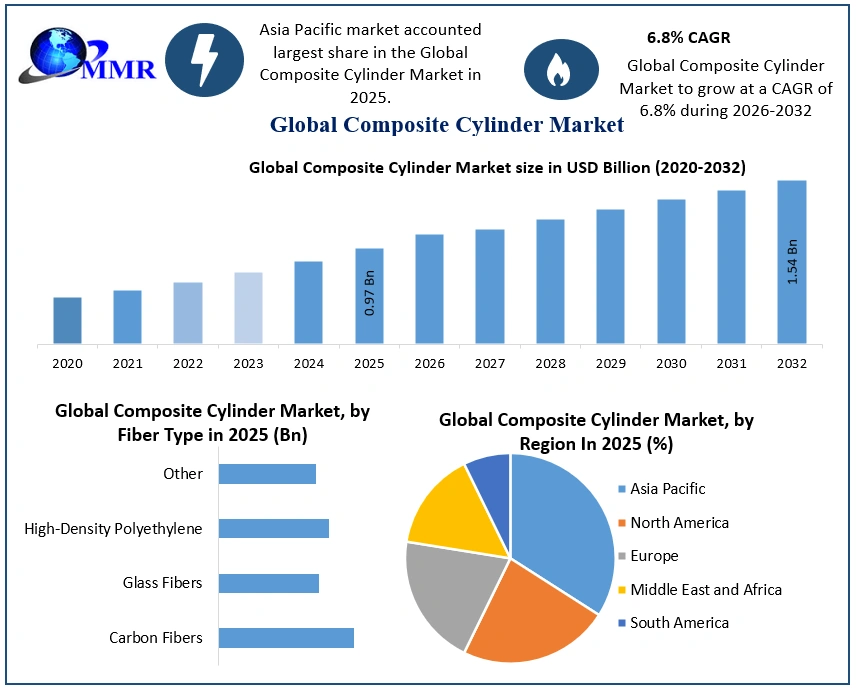
The Composite Cylinder Market size was valued at USD 0.97 Billion in 2025 and the total Composite Cylinder revenue is expected to grow at a CAGR of 6.8% from 2026 to 2032, reaching nearly USD 1.54 Billion by 2032.
Composite Cylinder Market Overview:
Composite materials in particular have a significant capability of producing materials with intriguing mechanical properties, particularly in terms of specific rigidity, impact resistance, high durability, and energy dissipation capabilities. Fiber-reinforced composite tanks are an excellent illustration of the benefits that fiber-reinforced composites may provide. They are made of tough fibers combined with resin or plastic. Initially, composite containers were created for aeronautical uses. Such containers are now applied in a wide range of industries, including water filtration plants and the petrochemical sector.
The most recent state-of-the-art composite pressure cylinders are compact and safe, but they are also rather pricey when opposed to steel cylinders. This is one of the primary reasons why composite containers for liquid petroleum gas storage and distribution have yet to be widely used.
To know about the Research Methodology :- Request Free Sample Report
In this report, the Composite Cylinder market's growth reasons, as well as the market's many segments (Fiber Type, Tank Type, End-User, and Region.), are discussed. Data has been given by market players, regions, and specific requirements. This market report includes a comprehensive overview of all the significant improvements that are presently prevailing in all market segments. Key data analysis is presented in the form of statistics, infographics, and presentations. The study discusses the Composite Cylinder market's Drivers, Restraints, Opportunities, and Challenges. The report helps to assess the market growth drivers and determines how to use these drivers as a tool. The report also helps to rectify and resolve issues related to the global Composite Cylinder market situation.
Composite Cylinder Market Dynamics:
The primary driver of the market is rapid and continuous growth among End-User sectors. Composite cylinders are widely used in the transit, electronics and communication, processing industry, and healthcare industries due to their benefits over conventional cylinders and diverse features. These sectors are quickly expanding, which is increasing demand for composite cylinders, particularly Type I and II. These sectors are expanding their need for materials with high thermal properties, reduced weight, high dimensional integrity, and outstanding chemical resistance.
Polymers are utilized to prolong the product's lifespan. One of the application areas is to decrease food spillage; consequently, it is very useful in the packaging sector. The composite cylinder is built of a polymer blend. It is a high-pressure vessel housed in a plastic coating. Because of the utilization of high-tech innovation and collaboration, the expense of this composite cylinder is substantially more than that of its metal counterpart. Increasing Liquified Petroleum Gas usage in developing economies has increased competition for composite cylinders throughout the years.
Composite cylinders can also be used instead of steel cylinders. This lowers the industrial production costs while increasing the company's revenue growth. As a result, several manufacturers are boosting their expenditure in the composite cylinder industry. Over the projection period, the government's favorable laws for the petrochemical industry are expected to drive the composite cylinder market. Furthermore, the composite cylinder polymers are detonation-proof, UV-resistant, and non-corrosive. These stain-resistant and transparent features aid in the detection or indication of gas in the cylinder, and as a result, its demand in the gas and oil industries is escalating.
Composite Cylinder Market Segment Analysis:
Based on End Users, The Composite Cylinder market is witnessing robust growth, driven by increasing demand across sectors like Aerospace & Defense, Oil & Gas, Transportation, Life Support, and Others. Aerospace & Defense remains a dominant segment due to the need for lightweight, high-strength materials in aircraft and military applications. Oil & Gas follows closely, with composite cylinders replacing traditional steel variants for safer gas storage. In Transportation, their use in CNG and hydrogen-powered vehicles is increasing rapidly. Life Support systems, including medical oxygen cylinders, are also experiencing rising demand, particularly post-pandemic. The others category includes industrial and recreational uses.

Composite Cylinder Market Regional Insights:
Asia Pacific is the largest market for composite cylinders, with a CAGR of 5.3% over the same period. The increasing advancement of the electrical and electronics industries is driving the growth of the composite cylinder market in the Asia Pacific. Rising local demand, along with more economical production facilities, is likely to drive market demand from a multitude of applications in the Asia Pacific. The growing population and demand, together with endeavors to develop new products and processes, are expected to make this area a suitable location for businesses to flourish. The region's booming electrical and electronics, vehicle, and consumer products sectors are driving up demand for composite pressure vessels.
One of the major APAC players in the composite cylinder market is Advanced Material Systems, founded in 2006, a leading designer and manufacturer of composite products based in Taiwan. The company's primary focus is on the design and mass manufacture of composite pressure cylinders for a wide range of applications. The company's strength is in combining significant expertise in mass manufacturing with great R&D skills. Their cylinders are presently in use all over the world, including North America, the United Kingdom, and Europe, as well as Australia, Dubai, the United Arab Emirates, South Korea, Malaysia, Singapore, China, and Taiwan.
The objective of the report is to present a comprehensive analysis of the Composite Cylinder market to the stakeholders in the industry. The past and current status of the industry with the forecasted market size and trends are presented in the report with the analysis of complicated data in simple language. The report covers all the aspects of the industry with a dedicated study of key players that include market leaders, followers, and new entrants.
PORTER, PESTEL analysis with the potential impact of micro-economic factors of the market have been presented in the report. External as well as internal factors that are supposed to affect the business positively or negatively have been analyzed, which will give a clear futuristic view of the industry to the decision-makers.
The report also helps in understanding the Composite Cylinder market dynamics, structure by analyzing the market segments and projecting the Composite Cylinder market size. Clear representation of competitive analysis of key players by product, price, financial position, product portfolio, growth strategies, and regional presence in the Composite Cylinder market make the report investor’s guide.
Composite Cylinder Market Scope: Inquiry Before Buying
| Composite Cylinder Market | |||
|---|---|---|---|
| Report Coverage | Details | ||
| Base Year: | 2025 | Forecast Period: | 2026-2032 |
| Historical Data: | 2020 to 2025 | Market Size in 2025: | USD 0.97 Bn. |
| Forecast Period 2026 to 2032 CAGR: | 6.8% | Market Size in 2032: | USD 1.54 Bn |
| Segments Covered: | by Fiber Type | Carbon Fibers Glass Fibers High-Density Polyethylene Other |
|
| by Gas Type | Liquefied Petroleum Gas (LPG) Compressed Natural Gas (CNG) Others |
||
| by Tank Type | Type II Type III Type IV |
||
| by End-User | Aerospace & Defense Oil & Gas Transportation Life Support Others |
||
Composite Cylinder Market, by Region
North America (United States, Canada and Mexico)
Europe (UK, France, Germany, Italy, Spain, Sweden, Austria and Rest of Europe)
Asia Pacific (China, South Korea, Japan, India, Australia, Indonesia, Malaysia, Vietnam, Taiwan, Bangladesh, Pakistan and Rest of APAC)
Middle East and Africa (South Africa, GCC, Egypt, Nigeria and Rest of ME&A)
South America (Brazil, Argentina Rest of South America)
Composite Cylinder Market, Key Players are:
1. Luxfer Gas Cylinders
2. Hexagon Composites ASA
3. Faber Industrie S.P.A.
4. Worthington Industries
5. Aburi Composites
6. Time Technoplast Limited
7. AMS Composite Cylinders
8. Amtrol-alfa
9. Dragerwerk
10. Everest Kanto Cylinder Ltd.
11. Supreme Industries Ltd.
12. Catalina Cylinders
13. Beijing Tianhai Industry Co., Ltd.
14. Quantum Fuel Systems LLC
15. Advanced Material Systems Co., Ltd.
16. Sinoma Science & Technology Co., Ltd.
17. EKC International FZE
18. CP Industries
19. Ragasco
20. Indoruss Synergy Pvt. Ltd.
21. Lifesafe Cylinders
22. SAFE GAS GLOBAL INC.
23. Green Fuel Energy Solutions
24. Others
FAQs:
1. Which is the potential market for the Composite Cylinder in terms of the region?
Ans. The Asia Pacific is the largest market for composite cylinders.
2. What are the opportunities for new market entrants?
Ans. Composite cylinders can also be used instead of steel cylinders. This lowers the industrial production costs while increasing the company's revenue growth.
3. What is expected to drive the growth of the Composite Cylinder market in the forecast period?
Ans. The primary driver of the market is rapid and continuous growth among End-User sectors.
4. What is the projected market size & growth rate of the Composite Cylinder Market?
Ans. The Composite Cylinder Market size was valued at USD 0.97 Billion in 2025 and the total Composite Cylinder revenue is expected to grow at a CAGR of 6.8% from 2026 to 2032, reaching nearly USD 1.54 Billion by 2032.
5. What segments are covered in the Composite Cylinder Market report?
Ans. The segments covered are Fiber Type, Tank Type, End-User and Region.