Commercial Vehicle Driver Information System Market Size by Component, Vehicle Type, Sales Channel, Region – Segment-Level Market Assessment, Growth Opportunity Analysis, Competitive Mapping & Forecast to 2032

20.34%
CAGR (2025-2032)
5.68 USD Bn.
Market Size
314
Report Pages
134
Market Tables

Overview

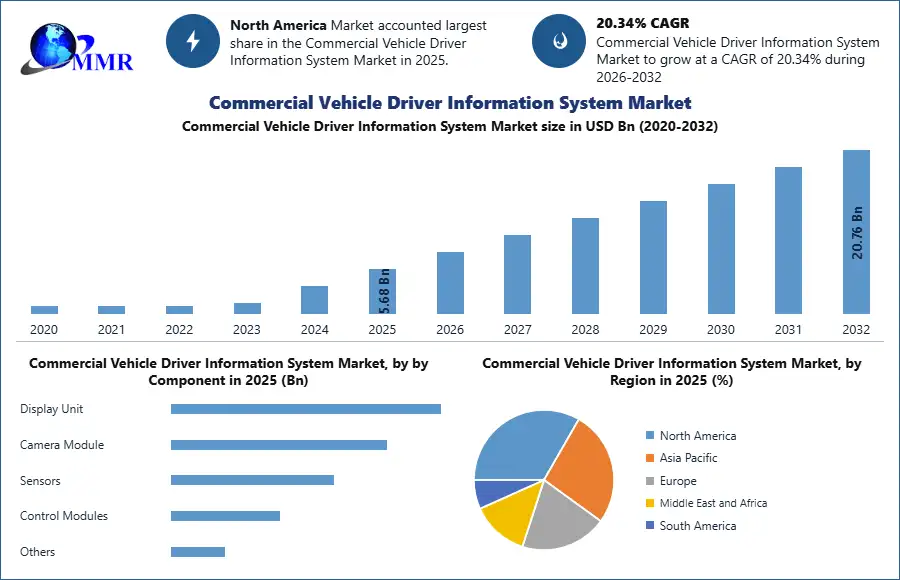
Commercial Vehicle Driver Information System Market size was valued at USD 5.68 billion in 2025, and the total revenue is expected to grow at CAGR of 20.34 % from 2025 to 2032, reaching nearly USD 20.76 billion.

Commercial Vehicle Driver Information System Market: Market Overview

In today’s transportation ecosystem, Commercial Vehicle Driver Information Systems (CVDIS) are transforming fleet operations by enhancing road safety, operational visibility, and driver behavior monitoring. With increasing regulatory pressure and the need for safer logistics infrastructure, these systems are seeing widespread adoption across both long-haul and regional transport fleets.

OEMs and fleet operators are leveraging these technologies to comply with safety mandates, reduce accidents, and improve driver efficiency. As advanced driver-assistance features such as forward collision warnings, automatic emergency braking, and lane departure alerts become standard, the CVDIS market is rapidly evolving toward smarter, AI-enabled platforms.

The MMR report provides comprehensive coverage of this transformation, including in-depth consumer and fleet operator insights, ADAS penetration comparisons between commercial and passenger vehicles, global and regional adoption rates, pricing and cost structure analyses, emerging innovation trends such as HUDs, AR interfaces, and biometric driver IDs, and the evolving manufacturing landscape impacted by supply chain disruptions. It also explores ESG considerations like CO₂ reductions through eco-driving tools, recent investments and M&A activity in the driver tech space, and the shifting regulatory landscape across key geographies, including mandates from EU, US, and India related to driver monitoring, alerts, and connected safety systems.
Commercial Vehicle Driver Information System MarketTo know about the Research Methodology :- Request Free Sample Report

Commercial Vehicle Driver Information System Market: Market Dynamics

The adoption of advanced technologies in the automotive industry and ensuring vehicle safety are major factors driving the growth of the market during the forecast period. Additionally, the increasing demand for advanced driver assistance systems (ADAS) in commercial vehicles for enhanced safety features, along with the growing need for driving comfort, further supports market expansion. The features of vehicle driver information systems are evaluated based on their contribution to accident reduction, traffic efficiency, and driver convenience, making them essential for commercial vehicle operators. Moreover, government-imposed safety regulations and standards across various countries are significantly contributing to market growth.

However, the high cost of commercial vehicle driver information systems may restrain market growth. The installation and integration costs increase the overall price of vehicles, which can limit adoption, particularly in cost-sensitive markets. Furthermore, the complex system architecture can impact vehicle maintenance and longevity, thereby hindering market expansion during the forecast period. In addition, concerns related to data security and system reliability, especially in connected and digital platforms, may pose challenges for widespread adoption, as any system failure or data breach could impact vehicle performance and driver safety.

Pricing Trends of Commercial Vehicle Driver Information System Cluster Type 

  • The increasing cost of advanced driver information systems is closely linked to the integration of technologies such as ADAS, sensors, cameras, and digital clusters, which significantly raise vehicle electronics content and overall system pricing.
  • The cost of automotive electronics and software content per vehicle has been rising steadily, particularly due to the shift toward connected, autonomous, shared, and electric (CASE) vehicles, impacting the pricing of driver information systems.
  • Advanced cockpit systems and integrated driver information platforms require high-performance processors and complex software integration, contributing to higher system and installation costs.
  • Commercial vehicle manufacturers are also facing increased production costs due to regulatory requirements and the growing adoption of safety technologies, which indirectly drives up the pricing of in-vehicle information systems.
  • While digitalization improves efficiency, the initial investment and integration cost of smart vehicle systems remain high, especially for fleet operators, influencing overall market pricing trends.
  • Furthermore, analysis from Maximize Market Research (MMR) suggests that the rising adoption of digital instrument clusters, telematics integration, and AI-based driver assistance systems is significantly increasing component and software costs, thereby elevating the overall pricing trend of commercial vehicle driver information systems.
Commercial Vehicle Driver Information System Market: Market Segmentation

In 2025, the Display Unit segment dominates the Commercial Vehicle Driver Information System market, as it serves as the primary interface for delivering real-time vehicle data, navigation, and driver alerts. Increasing demand for advanced dashboards and digital cockpits in commercial vehicles is driving this segment. Sensors and Camera Modules are also witnessing strong growth due to their critical role in enhancing driver awareness, safety, and ADAS integration. Meanwhile, Control Modules remain essential for system processing and integration but are comparatively mature, while other components support niche and auxiliary functionalities.

Based on Cluster Type, Digital Clusters represent the fastest-growing and most demanded segment in 2025. Their ability to provide customizable displays, real-time analytics, and integration with telematics and infotainment systems makes them highly preferred by fleet operators and OEMs. Hybrid Clusters are gaining traction as a transitional solution combining analog reliability with digital flexibility. In contrast, Analog Clusters continue to decline in adoption due to limited functionality and lack of advanced features.

By Propulsion Type, ICE Vehicles currently hold the largest market share in 2025, owing to their dominant presence in the global commercial vehicle fleet. However, Electric Vehicles (EVs) are the fastest-growing segment, driven by increasing electrification trends, regulatory support, and the need for advanced driver information systems tailored to battery monitoring, energy efficiency, and range optimization.

Commercial Vehicle Driver Information System Market
Report Coverage Details
Base Year: 2025 Forecast Period: 2026-2032
Historical Data: 2020 to 2025 Market Size in 2025: 5.68 USD Bn
Forecast Period 2026-2032 CAGR: 20.34% Market Size in 2032: 20.76 USD Bn
Segments Covered: by Component Display Unit
Camera Module
Sensors
Control Modules
Others
By Cluster Type Analog
Digital
Hybrid
By Propulsion Type ICE Vehicles
Electric Vehicles
by Vehicle Type Light Commercial Vehicles (LCVs)
    Small Vans
    Pickup Trucks
    Others
Heavy Commercial Vehicles (HCVs)
    Freight Trucks
    Long Haul Trucks
    Articulated Trucks
    Others
Buses & Coaches
    City Buses
    Luxury Coaches
    Others
by Sales Channel OEMs
Aftermarket

Commercial Vehicle Driver Information System Market: Regional Analysis

Based on Region, North America leads the Commercial Vehicle Driver Information System market in 2025, supported by high adoption of advanced vehicle technologies, stringent safety regulations, and strong presence of leading OEMs. Asia Pacific is the fastest-growing region, driven by rapid expansion in logistics, increasing commercial vehicle production, and growing adoption of digital and connected vehicle solutions in countries like China and India. Europe shows steady growth due to regulatory mandates and technological advancements, while regions such as MEA and South America exhibit moderate demand influenced by infrastructure development and gradual technology adoption.

The objective of the report is to present a comprehensive analysis of the Global Market including all the stakeholders of the industry. The past and current status of the industry with forecasted market size and trends are presented in the report with the analysis of complicated data in simple language. The report covers all the aspects of the industry with a dedicated study of key players that includes market leaders, followers, and new entrants.

PORTER, SVOR, PESTEL analysis with the potential impact of micro-economic factors of the market has been presented in the report. External as well as internal factors that are supposed to affect the business positively or negatively have been analyzed, which will give a clear futuristic view of the industry to the decision-makers.

The report also helps in understanding the Global  Market dynamics, structure by analyzing the market segments and projects the Global Market size. Clear representation of competitive analysis of key players by Provider type, price, financial position, Product portfolio, growth strategies, and regional presence in the Global Market make the report investor’s guide.

Scope of the Global Commercial Vehicle Driver Information System Market: Inquire before buying

Global Commercial Vehicle Driver Information System by Region

North America (United States, Canada and Mexico)
Europe (UK, France, Germany, Italy, Spain, Sweden, Austria and Rest of Europe)
Asia Pacific (China, South Korea, Japan, India, Australia, Indonesia, Malaysia, Vietnam, Taiwan, Bangladesh, Pakistan and Rest of APAC)
Middle East and Africa (South Africa, GCC, Egypt, Nigeria and Rest of ME&A)
South America (Brazil, Argentina Rest of South America)

Commercial Vehicle Driver Information System Key Companies are:

  1. Bosch Automotive Technologies
  2. Continental AG
  3. HARMAN International
  4. IAC Group
  5. Luxoft
  6. Nippon Seiki Co., Ltd.
  7. NVIDIA Corporation
  8. Panasonic Corporation
  9. Pricol Ltd.
  10. Renesas Electronics Corporation
  11. Simco Ltd.
  12. Spark Minda
  13. Stoneridge Inc.
  14. Valeo SA
  15. Visteon Corporation
  16. Yazaki Corporation
  17. Infineon Technologies
  18. NXP Semiconductors
  19. Mobileye
  20. Autoliv Inc.
  21. Daimler
  22. Ford
  23. Denso Corporation
  24. Japan Display Inc.
  25. Aisin Corporation
  26. Aptiv Plc
  27. EDGE3 Technologies
  28. Gentex Corporation
  29. Omron Corporation
  30. Texas Instruments Incorporated
  31. Toyota Industries Corporation

Table of Contents

1. Commercial Vehicle Driver Information System Market: Executive Summary 1.1. Executive Summary 1.2. Market Size (2025) & Forecast (2026-2032), 1.3. Market Size (Value in USD, Volume in 000'Units) and Market Share (%) – By Segments, Regions, and Country 2. Competitive Landscape 2.1. MMR Competition Matrix 2.2. Competitive Positioning Of Global Key Players 2.3. Key Players Benchmarking 2.3.1 Company Name 2.3.2 Headquarters 2.3.3 Instrument Cluster / DIS Product Portfolio 2.3.4 Core Technology Focus 2.3.5 Commercial Vehicle Segment Served 2.3.6 Revenue(USD) (2025) 2.3.7 Profit Margin (%) 2.3.8 YoY Growth (%) 2.3.9 Market Share (%) (2025) 2.3.10 R&D Intensity 2.3.11 Software & Semiconductor Integration Capability 2.3.12 Display & HMI Innovation 2.3.13 OEM Relationships 2.3.14 Global Manufacturing & Engineering Footprint 2.4. Market Structure 2.4.1 Market Leaders 2.4.2 Market Followers 2.4.3 Emerging Players 2.5. Mergers, Acquisitions & Strategic Deals (2020–2025) 2.5.1 Instrument cluster technology acquisitions 2.5.2 Semiconductor & software partnerships 2.5.3 OEM–Tier 1 long-term supply agreements 2.5.4 ADAS & cockpit domain controller collaborations 2.5.5 Digital cockpit platform investments 2.6. Regional Players Comparative Assessment 2.6.1 European Tier-1 leadership in premium clusters 2.6.2 Asian cost-competitive manufacturing ecosystems 2.6.3 North American software-defined cockpit strengths 2.6.4 Localization strategies for emerging markets 2.7. Top commercial vehicle instrument cluster manufacturers by revenue and market share (2025) 2.8. Strategic Investment Initiatives Across Players 2.8.1 Digital & fully reconfigurable cluster R&D 2.8.2 EV-specific instrument cluster platforms 2.8.3 Semiconductor self-reliance strategies 2.8.4 Software-defined vehicle (SDV) investments 2.9. Technology & R&D Landscape 2.9.1 Digital TFT / OLED cluster development 2.9.2 Functional safety & cybersecurity (ISO 26262) 2.9.3 AI-driven driver alerts & diagnostics 2.9.4 Over-the-air (OTA) update capabilities 3. Market Dynamics 3.1. Market Trends 3.2. Commercial Vehicle Driver Information System Market Dynamics 3.2.1 Drivers 3.2.2 Restraints 3.2.3 Opportunities 3.2.4 Challenges 3.3. PORTER’s Five Forces Analysis 3.4. PESTLE Analysis 3.5. Value Chain Analysis 3.6. Key Opinion Leader Analysis For the Global Industry 4. Technology Landscape and Innovation Analysis 4.1 Analog, hybrid, and fully digital instrument cluster architectures 4.2 TFT LCD, OLED, and next-generation display technologies 4.3 GPU, MCU, and SoC platforms enabling real-time rendering 4.4 Embedded software, middleware, and operating system evolution 4.5 Cybersecurity, functional safety, and ISO 26262 compliance 4.6 Integration with ADAS, telematics, and autonomous systems 4.7 AI-enabled driver alerts and predictive maintenance visualization 5. Pricing and Revenue Analysis 5.1 Pricing structure across analog, hybrid, and digital clusters 5.2 Regional pricing differences driven by regulation and technology 5.3 OEM contract pricing versus aftermarket pricing dynamics 5.4 Impact of semiconductor and display cost fluctuations 5.5 Long-term pricing trends in software-defined vehicle platforms 6. Supply Chain and Manufacturing Insights 6.1 Global sourcing of displays, semiconductors, and electronic components 6.2 Manufacturing hubs for commercial vehicle instrument clusters 6.3 Tier-1 supplier and OEM integration models 6.4 Inventory management and supply chain risk mitigation 6.5 Logistics challenges in serving global CV OEMs 7. End-Use and Application Analysis 7.1 Long-haul fleet operators prioritizing driver efficiency and safety 7.2 Urban logistics operators focusing on cost-effective cluster solutions 7.3 Public transport authorities adopting digital dashboards 7.4 Electric commercial vehicle operators demanding energy visualization 7.5 Fleet management companies leveraging connected cluster data 8. Trade and Export Intelligence (2025) 8.1 Global trade flows of instrument cluster components 8.2 Import dependence for displays and semiconductors 8.3 Tariffs and trade regulations impacting system costs 8.4 Regional compliance with automotive electronics standards 8.5 Supply chain exposure to geopolitical risks 9. Distribution and Procurement Channels 9.1 Direct OEM sourcing and long-term supply agreements 9.2 Tier-1 supplier-led distribution models 9.3 Aftermarket distributors and retrofit solution providers 9.4 Digital procurement platforms and supplier ecosystems 9.5 Fleet-driven bulk procurement strategies 10. Consumer and Fleet Operator Insights 10.1 Fleet decision-making criteria for driver information systems 10.2 Importance of usability, readability, and reliability 10.3 Impact of driver fatigue and safety considerations 10.4 Acceptance of digital and software-defined clusters 10.5 Future upgrade intentions among fleet operators 11. Investment and Growth Opportunitie 11.1 Private equity investments in automotive electronics platforms 11.2 Growth opportunities in electric commercial vehicle clusters 11.3 Expansion opportunities in emerging commercial vehicle markets 11.4 Software monetization through connected cluster features 11.5 Strategic opportunities in AI-driven driver assistance displays 12. Policy and Regulatory Environment 12.1 Commercial vehicle safety display regulations by region 12.2 Driver distraction and HMI compliance standards 12.3 Cybersecurity regulations for connected vehicle systems 12.4 Environmental regulations affecting electronic manufacturing 12.5 Data privacy and fleet data governance requirements 13. Sustainability and Environmental Impact 13.1 Energy-efficient display technologies for reduced power consumption 13.2 Sustainable sourcing of electronic and semiconductor materials 13.3 Carbon footprint of instrument cluster manufacturing 13.4 Circular economy approaches for electronic components 13.5 ESG initiatives by leading automotive technology suppliers 14. Product Lifecycle and Aftermarket Analysis 14.1 Instrument cluster lifecycle across commercial vehicle platforms 14.2 Failure rates and durability considerations in harsh environments 14.3 Repair, replacement, and software upgrade cycles 14.4 Retrofit demand for older commercial vehicle fleets 14.5 Subscription-based software feature upgrades 15. Strategic Partnerships and Ecosystem Analysis 15.1 OEM and Tier-1 supplier strategic collaborations 15.2 Semiconductor and display technology partnerships 15.3 Software and cloud platform alliances 15.4 ADAS and autonomous system integration partnerships 15.5 Cross-industry collaborations with AI and GPU vendors 16. Commercial Vehicle Driver Information System Market: Global Market Size and Forecast by Segmentation (by Value in USD Billion & Volume in 000'Units) (2025-2032) 16.1. Global Commercial Vehicle Driver Information System Market Size and Forecast, by Component 16.1.1 Display Unit 16.1.2 Camera Module 16.1.3 Sensors 16.1.4 Control Modules 16.1.5 Others 16.2. Global Commercial Vehicle Driver Information System Market Size and Forecast, By Cluster Type 16.2.1 Analog 16.2.2 Digital 16.2.3 Hybrid 16.3. Global Commercial Vehicle Driver Information System Market Size and Forecast, By Propulsion Type 16.3.1 ICE Vehicles 16.3.2 Electric Vehicles 16.4. Global Commercial Vehicle Driver Information System Market Size and Forecast, by Vehicle Type 16.4.1 Light Commercial Vehicles (LCVs) 16.4.2 Small Vans 16.4.3 Pickup Trucks 16.4.4 Others 16.4.5 Heavy Commercial Vehicles (HCVs) 16.4.6 Freight Trucks 16.4.7 Long Haul Trucks 16.4.8 Articulated Trucks 16.4.9 Others 16.4.10 Buses & Coaches 16.4.11 City Buses 16.4.12 Luxury Coaches 16.4.13 Others 16.5. Global Market Size and Forecast, by Sales Channel 16.5.1 OEMs 16.5.2 Aftermarket 16.6. Global Market Size and Forecast, by Region 16.6.1 North America 16.6.2 Europe 16.6.3 Asia Pacific 16.6.4 Middle East and Africa 16.6.5 South America 17. North America Commercial Vehicle Driver Information System Market Size and Forecast by Segmentation (by Value in USD Billion & Volume in 000'Units) (2025-2032) 17.1. North America Market Size and Forecast, by Component 17.2. North America Market Size and Forecast, By Cluster Type 17.3. North America Market Size and Forecast, By Propulsion Type 17.4. North America Market Size and Forecast, by Vehicle Type 17.5. North America Market Size and Forecast, by Sales Channel 17.5. North America Market Size and Forecast, by Country 17.5.1 United States 17.5.2  United States Market Size and Forecast, by Component 17.5.3  United States Market Size and Forecast, By Cluster Type 17.5.4  United States Market Size and Forecast, By Propulsion Type 17.5.5  United States Market Size and Forecast, by Vehicle Type 17.5.6  United States Market Size and Forecast, by Sales Channel 17.5.7 Canada 17.5.8 Mexico 18. Europe Commercial Vehicle Driver Information System Market Size and Forecast by Segmentation (by Value in USD Billion & Volume in 000'Units) (2025-2032) 18.1. Europe Market Size and Forecast, by Component 18.2. Europe Market Size and Forecast, By Cluster Type 18.3. Europe Market Size and Forecast, By Propulsion Type 18.4. Europe Market Size and Forecast, by Vehicle Type 18.5. Europe Market Size and Forecast, by Sales Channel 18.5. Europe Market Size and Forecast, by Country 18.5.1 United Kingdom 18.5.2 France 18.5.3 Germany 18.5.4 Italy 18.5.5 Spain 18.5.6 Netherlands 18.5.7 Belgium 18.5.8 Russia 18.5.9 Turkey 18.5.10 Sweden 18.5.11 Poland 18.5.12 Rest of Europe 19. Asia Pacific Commercial Vehicle Driver Information System Market Size and Forecast by Segmentation (by Value in USD Billion & Volume in 000'Units) (2025-2032) 19.1. Asia Pacific Market Size and Forecast, by Component 19.2. Asia Pacific Market Size and Forecast, By Cluster Type 19.3. Asia Pacific Market Size and Forecast, By Propulsion Type 19.4..Asia Pacific Market Size and Forecast, by Vehicle Type 19.5..Asia Pacific Market Size and Forecast, by Sales Channel 19.5..Asia Pacific Market Size and Forecast, by Country 19.5.1 China 19.5.2 South Korea 19.5.3 Japan 19.5.4 India 19.5.5 Taiwan 19.5.6 Australia 19.5.7 Indonesia 19.5.8 Philippines 19.5.9 Malaysia 19.5.10 Vietnam 19.5.11 Thailand 19.5.12 Rest of Asia Pacific 20. Middle East and Africa Commercial Vehicle Driver Information System Market Size and Forecast by Segmentation (by Value in USD Billion & Volume in 000'Units) (2025-2032) 20.1. Middle East and Africa Market Size and Forecast, by Component 20.2. Middle East and Africa Market Size and Forecast, By Cluster Type 20.3. Middle East and Africa Market Size and Forecast, By Propulsion Type 20.4. Middle East and Africa Market Size and Forecast, by Vehicle Type 20.5. Middle East and Africa Market Size and Forecast, by Sales Channel 20.5. Middle East and Africa Market Size and Forecast, by Country 20.5.1 South Africa 20.5.2 GCC 20.5.3 Egypt 20.5.4 Nigeria 20.5.5 Rest of ME&A 21. South America Commercial Vehicle Driver Information System Market Size and Forecast by Segmentation (by Value in USD Billion & Volume in 000'Units) (2025-2032) 21.1. South America Market Size and Forecast, by Component 21.2. South America Market Size and Forecast, By Cluster Type 21.3. South America Market Size and Forecast, By Propulsion Type 21.4. South America Market Size and Forecast, by Vehicle Type 21.5. South America Market Size and Forecast, by Sales Channel 21.5. South America Market Size and Forecast, by Country 21.5.1 Brazil 21.5.2 Argentina 21.5.3 Colombia 21.5.4 Chile 21.5.5 Rest Of South America 22. Company Profile: Key Players 22.1. Bosch Automotive Technologies 22.1.1 Company Overview 22.1.2 Business Portfolio 22.1.3 Financial Overview 22.1.4 SWOT Analysis 22.1.5 Strategic Analysis 22.1.6 Recent Developments 22.2. Continental AG 22.3. HARMAN International 22.4. IAC Group 22.5. Luxoft. 22.6. Nippon Seiki Co., Ltd. 22.7. NVIDIA Corporation 22.8. Panasonic Corporation 22.9. Pricol Ltd. 22.10.Renesas Electronics Corporation 22.11.Simco Ltd. 22.12.Spark Minda 22.13.Stoneridge Inc. 22.14.Valeo SA 22.15.Visteon Corporation 22.16.Yazaki Corporation 22.17.Infineon Technologies 22.18.NXP Semiconductors 22.19.Mobileye 22.20.Autoliv Inc 22.21.Daimler 22.22.Ford 22.23.Denso Corporation 22.24.Japan display Inc. 22.25.Aisin Corporation 22.26.Aptiv Plc 22.27.EDGE3 Technologies 22.28.Gentex Corporation 22.29.Omron Corporation 22.30.Texas Instruments Incorporated 22.31.Toyota Industries Corporation 22.31.1 Others Key Players 23. Key Findings 24. Analyst Recommendations 25. Research Methodology

Custom Market Research Services

We Will Customise The Research For You, In Case The Report Listed Above Does Not Meet With Your Requirements