
Collimator Market Size by Product Type, Material, End-User, and Region - Segment-Level Market Assessment, Growth Opportunity Analysis, Competitive Mapping & Forecast to 2032
Overview
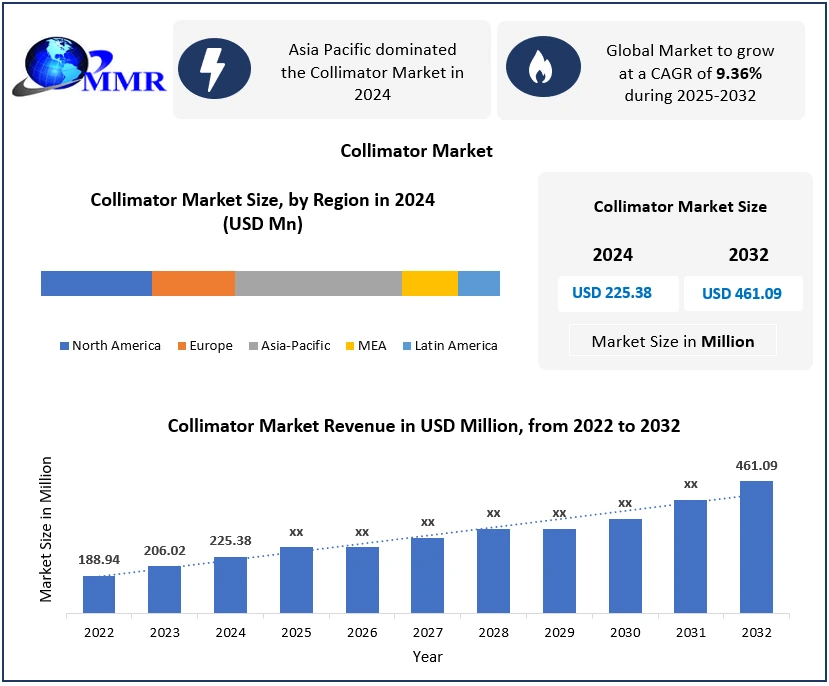
The Collimator Market was valued at USD 225.38 Mn in 2024, and the total revenue of the Global Collimator Market is expected to grow at a CAGR of 9.36% from 2025 to 2032, reaching nearly USD 461.09 Mn by 2032.
Collimator Market Overview:
Collimators are devices designed to narrow a beam of particles or waves, ensuring they travel parallel and remain focused on a specific target. This precise alignment prevents beam dispersion and maintains accuracy over distance. Collimators are widely used in medical imaging, astronomy, physics, and industrial applications. In medical imaging, they enhance X-ray and gamma-ray image quality by filtering scattered radiation, producing clearer and more precise diagnostic images. In physics and industrial applications, collimators ensure particle beams or optical paths are accurately directed for measurement and testing.
 To know about the Research Methodology :- Request Free Sample Report
The Collimator Market is growing steadily, driven by the rising demand for advanced medical imaging techniques such as X-ray, PET, CT, and SPECT scans, and the expanding use of non-destructive testing (NDT) for quality assurance in manufacturing. Increasing research activities in particle physics and materials science, which rely on precise beam alignment, also contribute to market growth. Technological innovations in collimator design and materials are enhancing performance, efficiency, and versatility, further propelling adoption globally.
The Asia-Pacific Region dominated the collimator market in 2024 due to expanding healthcare infrastructure, industrialization, and investments in fiber optics, spectrometer devices, and telescopes. Countries like China, India, Japan, and South Korea are witnessing robust growth, fueled by rising healthcare demand and technological adoption.
Key drivers and opportunities include precision medicine, the growth of diagnostic imaging, and expansion into emerging markets through cost-effective, innovative solutions. Collaborations between research institutions and manufacturers also open new application areas. Collimator industry-leading competitors include MKS Instruments, Inc. (USA), Coherent Corp. (USA), Edmund Optics Inc. (USA), and Jenoptik AG (Germany). They lead through product innovation, strategic acquisitions, R&D investments, and tailored solutions for healthcare, industrial, and defense applications.
Collimator Market Dynamics
Advanced Imaging & Industrial Applications to boost Collimator Market Growth
A key driver of the Collimator Market is the boosting demand for advanced medical imaging techniques, like X-ray, PET, CT, and SPECT scans, which command high-quality collimators to improve image clarity and reduce patient radiation exposure. Furthermore, the developing industrial emphasis on non-destructive testing (NDT) for quality assurance and safety in manufacturing processes considerably boosts the Collimator Market. The rising number of research activities in fields such as particle physics and materials science, which rely on precise beam alignment, further propels the Collimator Market growth. Technological advancements and innovations in collimator design and materials, improving performance and efficiency, also drive market growth.
High Costs and Regulatory Hurdles to Restrain the Collimator Market Growth
Despite these positive trends, Higher costs of collimator systems constrained to healthcare and research budgets limit the adoption of Collimator systems. Moreover, complexity in the integration of new collimator technologies in existing systems and stringent regulatory approval processes for medical devices decelerate the market growth. Limited awareness and indifference to the benefits of advanced collimators may further hinder market growth.
Emerging Markets and Innovation to Create New Opportunities in the Collimator Market
The continuing expansions in medical technology and the growing focus on precision medicine create a significant demand for high-performance collimators. Developing markets in Asia-Pacific, South America, the Middle East & Africa offer significant growth potential owing to their developing healthcare infrastructure and industrial sectors. Furthermore, the expansion of cost-effective and innovative collimator solutions tailored to the needs of these emerging Collimator Markets can present a competitive edge for manufacturers. Partnerships and Collaborations between research institutions and industry players lead to groundbreaking increases and broaden the application scope of collimators, thereby opening new avenues for growth.
Collimator Market Segment Analysis
Based on product type, the Collimator Market is segmented into Parallel Hole, Pinhole, Convergent, Divergent, Slant-hole, Fanbeam, and Other. Among these, Parallel Hole dominated the Collimator Market with a 26.60% share in 2024. Parallel hole collimators are a notable component in the market, particularly in medical imaging within nuclear medicine for SPECT (Single Photon Emission Computed Tomography) imaging. These collimators, integral to the Collimator Market, cover an array of parallel channels or holes that allow only those gamma rays traveling parallel to the channels to reach the detector, while hindering those that are scattered or traveling at different angles.
The high-resolution figures gained allow for precise localization of abnormalities, like tumors, lesions, and other pathological conditions. Furthermore, parallel hole collimators are versatile and can be tailored to different clinical needs by varying the shape, size, and length of the holes.
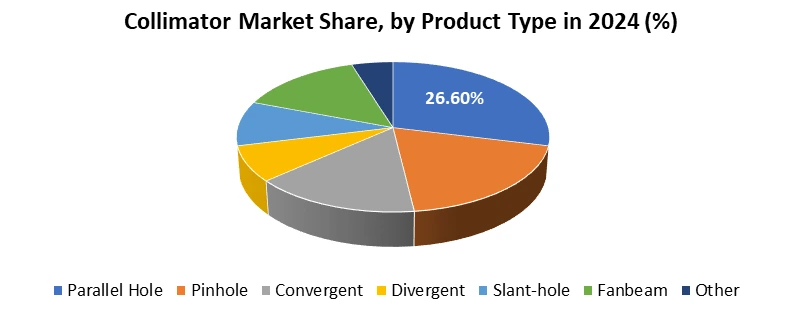
Pinhole segment is expected to hold the second largest share of nearly 20.8% Collimator Market. Recent developments in pinhole collimator technology have increased the market position. Innovations like multi-pinhole collimators, which combine multiple pinholes to enhance sensitivity without compromising resolution, have increased their performance. These technological advances make pinhole collimators more versatile and effective, driving their embracing across various imaging applications.
The growth of healthcare infrastructure, specifically in developing regions, is another factor contributing to the growth of the pinhole segment. As healthcare facilities upgrade their diagnostic capabilities, the demand for increased imaging technologies, with pinhole collimators, increases. This trend is expected to continue, further setting the pinhole segment's considerable share of the market.
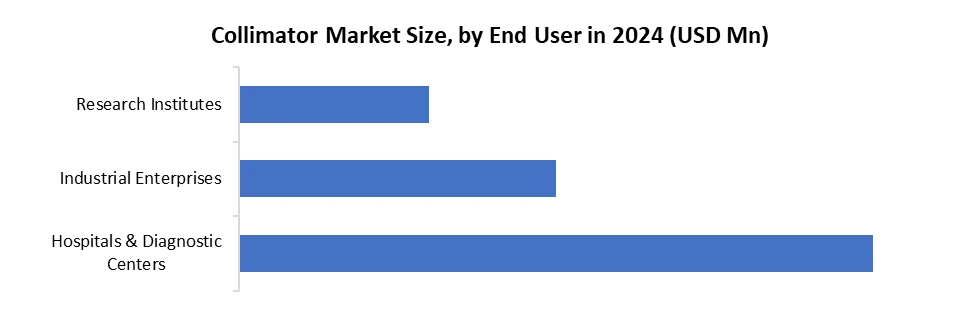
Based on End-User, the Collimator Market is segmented into Hospitals & Diagnostic Centers, Industrial Enterprises, and Research Institutes. The Hospitals and diagnostic centers dominated the end-user segment in 2024, contributing the largest market share. This is driven by the high deployment of nuclear imaging systems, routine diagnostic procedures, and increasing healthcare infrastructure globally. Growing demand for early disease detection, particularly in oncology and cardiology, has further reinforced the need for collimators in clinical settings. Moreover, ongoing upgrades to imaging technology in hospitals have maintained strong demand from this segment.
Collimator Market Regional Analysis
The Asia Pacific region is emerging as a significant Collimator Market, driven by the increasing demand for these devices in fibre optics, spectrometer devices, and telescopes. Developing economies like China, Japan, India, and South Korea are major contributors to global Collimator Market growth, with extensive investments in healthcare, telecommunications, and industrial sectors. Collimators are usually used in medical imaging to enhance the precision and quality of techniques like X-rays, CT scans, and SPECT, as well as in industrial radiography for non-destructive testing and quality control. The expanding healthcare infrastructure and booming manufacturing industries in these countries are driving the demand for high-quality collimators.
key players are investing heavily in research and development, focusing on innovations that improve the performance and versatility of collimators. These advancements are notably impacting applications in medical imaging, radionuclide imaging, scintillation imaging, nuclear power stations, calibration of optical devices, and industrial radiography. As a result, the APAC collimator market is expected to experience robust growth, driven by technological advancements and boosted adoption across various sectors.
Collimator Market Competitive Landscape
The Collimator market in 2024 is highly fragmented, characterized by intense competition among multinational corporations and specialized optical component manufacturers. Leading companies leverage product innovation, acquisitions, and strategic partnerships to maintain their market positions. According to industry reports, demand for high-precision optical components has surged in telecommunications, healthcare imaging, and defense applications, driving growth opportunities for both global and regional players.
MKS Instruments, Inc. (USA) dominates the high-power laser collimator segment with its Ophir® series, focusing on defense and industrial applications. Its strategy emphasizes technological innovation, precision measurement capabilities, and strategic acquisitions, strengthening its global presence and brand credibility.
Coherent Corp. (USA) maintains leadership in 2D and fiber optic collimators by offering solutions for AI, high-performance computing, and industrial laser systems. Strategic collaborations with research institutions and telecommunication providers enhance its market reach, while continuous R&D ensures next-generation product offerings.
Collimator Market Recent Developments
June 24, 2025 – MKS Instruments, Inc. (USA) announced the Ophir® 70K-W Power Laser Sensor for high-energy laser weapon systems. This sensor can measure up to 100 kW, supporting defense and industrial applications. The launch strengthens MKS’s position in high-power laser measurement technologies.
March 17, 2025 – Coherent Corp. (USA) launched a 2D Collimator Array for optical circuit switches. The new product enhances performance in AI and high-performance computing applications. It is designed to improve optical signal quality and system efficiency.
July 3, 2025 – Edmund Optics Inc. (USA) acquired Son-x to expand its manufacturing capabilities. This strategic move strengthens their global leadership in optical components. The acquisition also enables faster delivery and increased customization for industrial clients.
May 13, 2025 – Jenoptik AG (Germany) opened a micro-optics fabrication site in Dresden, consolidating all former operations in the city. The new site enhances production efficiency and technological capabilities. It supports the company’s growth in precision optics and laser applications.
Collimator Market Key Trends
Shift Toward Lightweight & Eco-Friendly Collimators
The collimator industry is steadily moving away from bulky, lead-based collimators toward lighter composites and eco-safe alloys. Hospitals and industrial buyers are beginning to prioritize not just performance but ease of handling, transport, and compliance with stricter environmental norms. This opens space for companies that deliver innovative, safe-to-dispose designs.
Collimators in Next-Gen Medical Imaging & Cancer Therapy
Precision oncology is driving demand for high-resolution multi-leaf collimators that can shape radiation beams with extreme accuracy. This allows doctors to target tumors while sparing healthy tissue. Similarly, compact collimators for portable diagnostic imaging are emerging, as healthcare shifts toward point-of-care and mobile solutions.
Miniaturization for Optics, LiDAR & Defense
As LiDAR, autonomous systems, and satellite optics scale up, collimators are being miniaturized for integration into drones, driverless vehicles, and compact defense optics. The push is for rugged, lightweight designs that maintain beam precision under harsh conditions—creating opportunities outside the traditional medical segment.
Collimator Market Scope: Inquiry Before Buying
| Global Collimator Market | |||
|---|---|---|---|
| Report Coverage | Details | ||
| Base Year: | 2024 | Forecast Period: | 2025-2032 |
| Historical Data: | 2019 to 2024 | Market Size in 2024: | USD 225.38 Mn. |
| Forecast Period 2025 to 2032 CAGR: | 9.36% | Market Size in 2032: | USD 461.09 Mn. |
| Segments Covered: | by Product Type | Parallel Hole Pinhole Convergent Divergent Slant-hole Fanbeam Other |
|
| by Material | Lead Tungsten |
||
| by End User | Hospitals & Diagnostic Centers Industrial Enterprises Research Institutes |
||
Collimator Market, Key Players:
North America (United States, Canada, and Mexico)
Europe (UK, France, Germany, Italy, Spain, Sweden, Austria, and the Rest of Europe)
Asia Pacific (China, South Korea, Japan, India, Australia, ASEAN, Indonesia, Philippines, Malaysia, Vietnam, Thailand, ASEAN, Rest of Asia Pacific)
Middle East & Africa (South Africa, GCC, Nigeria, Rest of ME&A)
South America (Brazil, Argentina, Rest of South America)
Collimator Market, Key Players:
North America
1. MKS Instruments, Inc. (USA)
2. Thorlabs, Inc. (USA)
3. Edmund Optics Inc. (USA)
4. Newport Corporation (USA)
5. Laser Components (USA)
6. II-VI Incorporated (USA)
7. Jenoptik AG (USA)
8. Coherent, Inc. (USA)
9. Optikos Corporation (USA)
10. OZ Optics Ltd. (Canada)
Europe
11. Jenoptik AG (Germany)
12. Laser Components (Germany)
13. Optikos Corporation (Germany)
14. Optowide Technologies (Germany)
15. ModuOptik (Germany)
16. Gooch & Housego PLC (UK)
17. Resonac Holdings Corporation (UK)
18. Thorlabs, Inc. (Germany)
19. Edmund Optics Inc. (Germany)
20. Laser Components (UK)
Asia-Pacific
21. Hubei Lucentfiber Optoelectronics (China)
22. Dezhou Zhenfei Optical Technology (China)
23. Xunhong Photonics (China)
24. IPG Photonics (China)
25. Optizone Technology (China)
26. OZ Optics Ltd. (China)
27. LightPath Technologies (China)
28. Gooch & Housego PLC (China)
29. Resonac Holdings Corporation (China)
30. Thorlabs, Inc. (China)
FAQs:
1. What are the growth drivers for the Collimator Market?
Ans. Increasing Demand for Laser and Optics Technologies: As applications in fields such as telecommunications, healthcare (medical diagnostics and therapies), military & defense (targeting and imaging), and industrial manufacturing (precision machining and 3D scanning) continue to grow, so does the demand for collimators.
2. What is the major Opportunity for the Collimator Market growth?
Ans. One major opportunity for the growth of the market is the increasing demand for precision optical components in emerging technologies and industries.
3. Which region is expected to lead the global Collimator Market during the forecast period?
Ans. APAC is expected to lead the Collimator Market during the forecast period.
4. What is the projected market size and growth rate of the Collimator Market?
Ans. The Collimator Market size was valued at USD 225.38 Million in 2024, and the total market revenue is expected to grow at a CAGR of 9.36% from 2025 to 2032, reaching nearly USD 461.09 Million.
5. What segments are covered in the Collimator Market report?
Ans. The segments covered in the market report are by Product Type, Material, End-User and Region.