
Cinnamon Market Size, Share, Growth & Forecast (2026–2032) | Clean-Label Foods, Plant-Based Dairy & Functional Beverage Trends
Overview
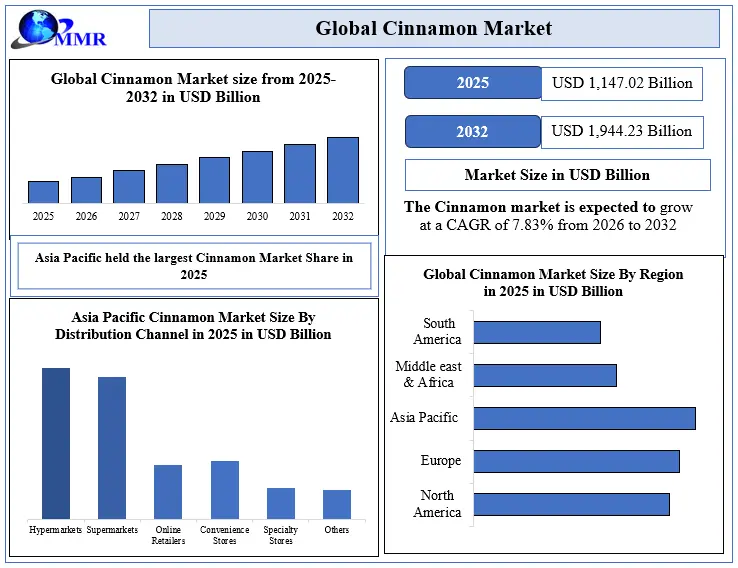
The Global Cinnamon Market is expected to grow from USD 1,147.02 Billion in 2025 to USD 1,944.23 Billion by 2032, at a CAGR of 7.83%, driven by rising demand for clean-label foods, plant-based dairy alternatives, functional beverages, nutraceutical applications, cosmetics & fragrance industries.
Cinnamon Market Overview:
Cinnamon, a natural spice from Cinnamomum species, is increasingly demanded in clean-label foods, plant-based dairy alternatives, functional beverages, nutraceuticals, and cosmetics. Rising consumer health awareness, preference for natural flavouring, and botanical ingredient adoption drive market growth. Regulatory scrutiny on coumarin, Asia Pacific dominance, and fragmented competition among Ceylon specialists, multinational spice brands, and regional processors shape industry dynamics and opportunities.
To know about the Research Methodology :- Request Free Sample Report
Cinnamon Market Key Highlights:
● Plant-Based Milk Adoption: 42.2% of U.S. households purchased refrigerated plant-based milk, with 40% repeat purchase in 2024, driving natural cinnamon flavour integration.
● Plant-Based Creamers & Yogurt: Plant-based creamers reached 14% household penetration, while plant-based yogurts accounted for 3.5% of total yogurt sales, supporting cinnamon flavor diversification.
● Cinnamon Production Growth: African cinnamon output increased from 3,725.99 tonnes in 2020 to 3,860.93 tonnes in 2021, reflecting rising global supply for food and nutraceutical applications.
● Export Expansion: Combined dried cinnamon exports from select Asian origins rose from 10,779 tonnes in 2022 to 14,020 tonnes in 2023, demonstrating increased international trade.
● Supplement Usage Trends: 57.6% of adults consumed dietary supplements in the past 30 days, with women aged 60+ showing over 80.2% usage, highlighting functional beverage opportunities.
● Tea & Beverage Consumption: Tea represents Nearly 8.7% of non-alcoholic beverage intake, while 40% household penetration for plant-based milk emphasizes scalable cinnamon-based functional formulations.
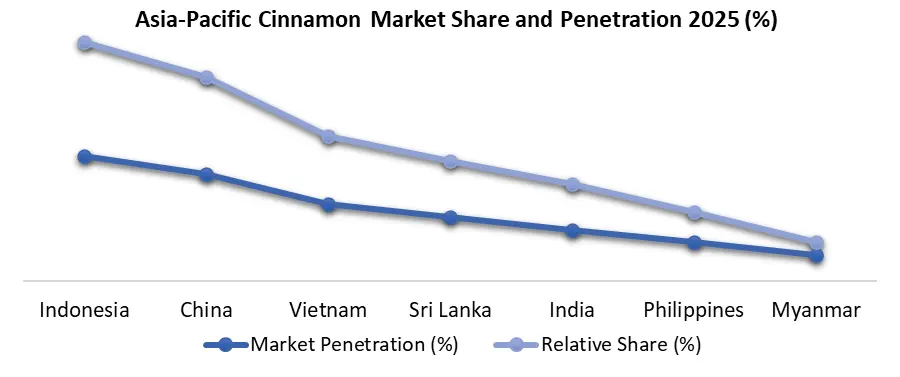
● Regional Dominance: Asia Pacific dominated the market and accounts for over 98% of global cinnamon supply, led by Indonesia (91,840 tonnes), China (89,990 tonnes), Vietnam (47,540 tonnes), and Sri Lanka (27,740 tonnes).
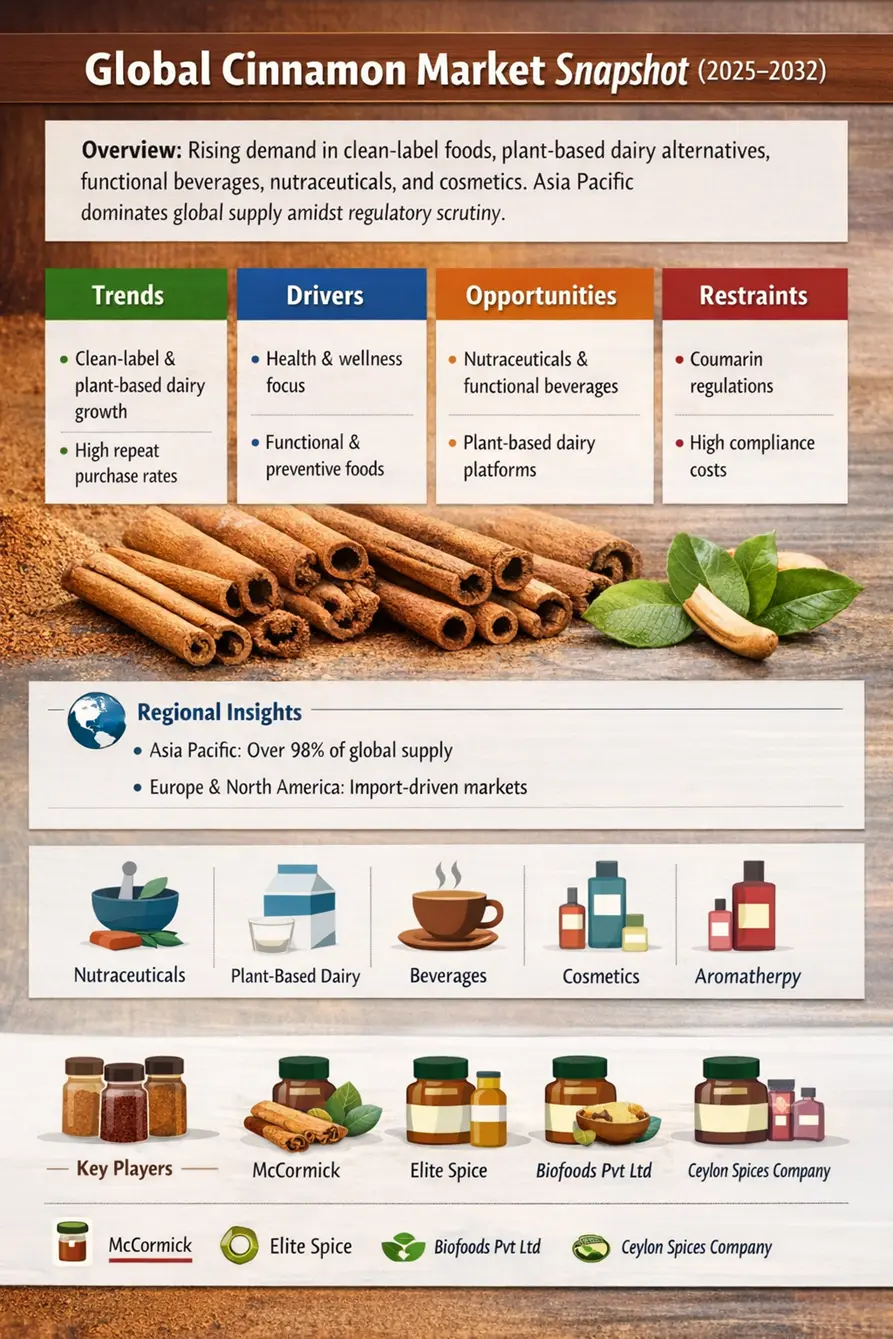
Trend: Growing consumer demand for clean-label and natural flavoring in plant-based dairy alternatives
The cinnamon market is being shaped by rising clean-label and natural flavor demand, particularly within plant-based dairy alternatives that emphasize ingredient transparency and minimal processing. In the U.S., 42.2% of households purchased refrigerated plant-based milk, demonstrating strong parallel consumption with conventional dairy. Consumer engagement remains sustained, with 40% of households purchasing plant-based milk in 2024 and a 76% repeat purchase rate, indicating stable long-term adoption rather than short-term trial behavior. These consumption patterns are driving increased incorporation of natural cinnamon flavoring in low-additive formulations. Product diversification further supports this trend, as plant-based creamers reached 14% household penetration in 2024, while plant-based yogurts accounted for 3.5% of total yogurt sales, expanding opportunities for cinnamon-based flavor innovation.
● Increased preference for clean-label, naturally flavored formulations
● Cinnamon adoption in plant-based dairy and beverage applications
● Stable consumer demand supported by high repeat purchase behavior
| Trend Factor | Metric | Level |
| Households purchasing refrigerated plant-based milk | 42.2% of U.S. households | High |
| Repeat purchase of plant-based milk | 76% repeat rate | High |
| Households purchasing plant-based milk | 40% | Medium |
| Household penetration of plant-based creamers | 14% | Medium |
| Household penetration of plant-based yogurts | 3.5% | Low |
Driver: Rising health and wellness awareness among consumers
Rising health and wellness awareness is driving demand for natural, clean-label spices with functional positioning, strengthening the role of cinnamon in health-oriented food systems. Cinnamon is a formally monitored agricultural commodity, reflecting its regulatory and nutritional relevance. cinnamon output in Africa increased from 3,725.99 tonnes in 2020 to 3,860.93 tonnes in 2021, while combined dried cinnamon exports from select Asian origins rose from 10,779 tonnes in 2022 to 14,020 tonnes in 2023, underscoring growing institutional and trade-level engagement.
Opportunity: Expansion of cinnamon-based nutraceuticals and functional beverages.
● Nutraceutical & Functional Beverage Demand: Rising consumer focus on health-oriented dietary formats drives cinnamon incorporation into supplements and functional drinks.
● High Supplement Consumption: With 57.6% of adults and over 80.2% of women aged 60+ using supplements, cinnamon-based products can target this engaged demographic.
● Non-Alcoholic Beverage Platforms: Tea and other beverages nearly 8.7% of intake provide scalable delivery systems for cinnamon as a clean-label functional ingredient.
● Plant-Based Dairy Adoption: 40% household penetration of plant-based milk enables cinnamon flavor innovation in dairy alternatives and creamers.
● Phytochemical & Preventive Health Positioning: Cinnamon’s natural bioactive compounds strengthen its role in preventive health formulations and wellness-focused product development across food and beverage sectors.
Restraint: Regulatory scrutiny over coumarin levels in cassia cinnamon
The cinnamon market faces a significant restraint from regulatory scrutiny over coumarin levels, particularly affecting cassia cinnamon used in food formulations. Finished-food regulations impose strict coumarin thresholds, including 50 mg/kg in traditional bakery, 20 mg/kg in breakfast cereals, 15 mg/kg in fine bakery products, and 5 mg/kg in desserts, increasing formulation complexity. Cassia cinnamon contains 0.8–10.63% coumarin by weight, compared with approximately 0.2% in Ceylon cinnamon, driving tighter species selection. Regulatory testing of 104 cinnamon samples showed over 66% non-compliance, elevating compliance costs and supplier qualification risks.
| Factor | Impact Level |
| Coumarin Threshold in Bakery Products | High |
| Coumarin Content in Cassia Cinnamon | High |
| Coumarin Content in Ceylon Cinnamon | Low |
| Non-Compliance in Samples Tested | High |
| Supplier Qualification & Compliance Cost | Medium |
Segmentation Analysis – Cinnamon Market
The segmentation of the cinnamon market reflects regulatory differentiation, compositional variation, and end-use specificity, with clear distinctions based on botanical type, application requirements, and compliance intensity. These segments guide sourcing, formulation, and channel strategies across food, nutraceutical, and cosmetic industries.
By Type: Cinnamon types are primarily segmented based on coumarin concentration and essential oil content, which determine regulatory acceptance and application suitability. Ceylon cinnamon, with coumarin typically below 0.004%, is preferred for food, nutraceutical, pediatric, and pharmaceutical uses. In contrast, cassia varieties, including Korintje and Saigon, exhibit higher coumarin levels and oil intensity, supporting industrial food processing and flavor-driven applications under stricter regulatory oversight.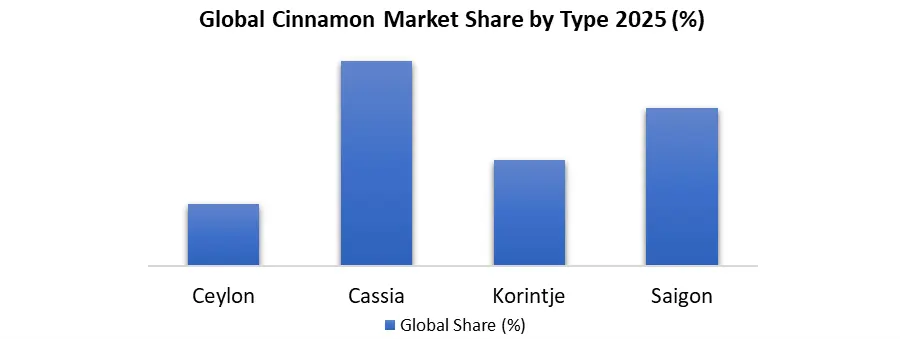 By Application: Application-based segmentation is driven by food safety limits, functional requirements, and formulation controls. Cinnamon is widely used across bakery, beverages, processed foods, pharmaceuticals, cosmetics, and aromatherapy. Regulatory thresholds, allergen labeling, and compound limits influence cinnamon selection and dosage across each application category.
Regional Insights – Cinnamon Market
The cinnamon market is geographically concentrated, with Asia Pacific emerging as the dominant global supply region, supported by favorable agro-climatic conditions and established spice value chains. This regional dominance underpins global trade flows and positions Asia Pacific as the primary sourcing hub for food, beverage, nutraceutical, and cosmetic applications. In contrast, Europe and North America function mainly as demand-driven import regions, characterized by stringent regulatory oversight, quality compliance requirements, and high dependence on external suppliers for cinnamon raw materials.
● Global cinnamon output: 238,403 tonnes
● Asia Pacific share: Over 98% of global supply
● Leading producers: Indonesia (91,840 tonnes), China (89,990 tonnes), Vietnam (47,540 tonnes), Sri Lanka (27,740 tonnes)
● Major exporters: China (52.10 million kg), Sri Lanka (18.64 million kg), Indonesia (13.27 million kg)
 Competitive Landscape – Cinnamon Market
● The cinnamon market is highly fragmented, comprising multinational spice brands, origin-focused exporters, regional processors, and domestic packaged-spice companies. Global players such as McCormick, B&G Foods, FUCHS, Frontier Co-op, and Penzeys compete alongside Sri Lanka–based Ceylon cinnamon specialists and Indian branded suppliers.
● Competition is driven by regulatory compliance capability, species purity, traceability, application specialization, and export eligibility, rather than market dominance. Suppliers with strong certification frameworks and quality assurance systems hold a competitive advantage across food, nutraceutical, and clean-label cinnamon applications.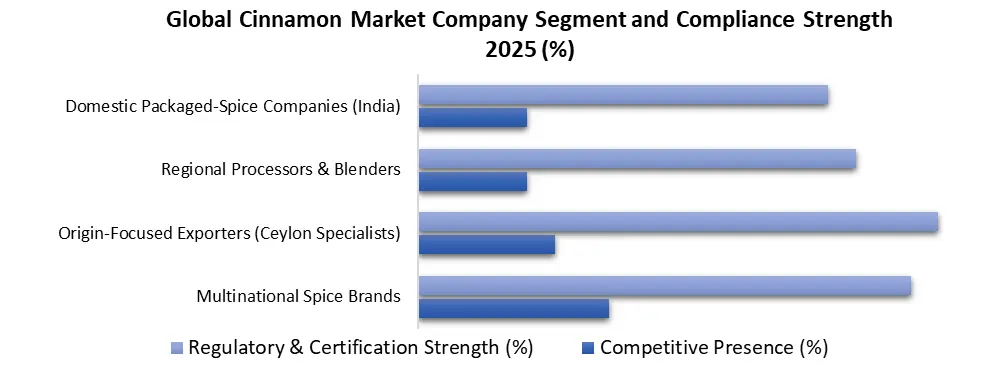
Cinnamon Market Recent Development
| Company | Year | Recent Development | Business Impact / Implication |
| McCormick & Company, Inc. | 2025 | EU Joint Research Centre identified over 66% non-compliance in tested retail cinnamon samples, including authenticity and coumarin issues | Requires tighter botanical authentication, routine coumarin testing, and enhanced supplier traceability systems to maintain EU market access |
| Elite Spice | 2025 | U.S. regulators detected lead levels ranging from 2.03–7.68 ppm in ground cinnamon products | Drives investment in heavy-metal monitoring, supplier audits, and strengthened preventive control programs |
| The Ceylon Spice Company | 2025 | Intensified EU enforcement of coumarin limits and species verification for cinnamon-containing foods | Necessitates laboratory-based species confirmation and low-coumarin validation to avoid shipment detentions or rejections |
| Biofoods Pvt Ltd | 2025 | Stricter enforcement of EU TRACES and U.S. FDA Prior Notice requirements for botanical imports | Increases pre-shipment documentation, traceability accuracy, and regulatory coordination for export continuity |
| First Spice Mixing Company Inc. | 2025 | Expanded FDA import surveillance and sampling for spices, including cinnamon | Leads to higher quality assurance costs, routine testing, and enhanced compliance readiness under food safety regulations |
Cinnamon Market Scope: Inquire before buying
| Cinnamon Market | |||
|---|---|---|---|
| Report Coverage | Details | ||
| Base Year: | 2025 | Forecast Period: | 2026-2032 |
| Historical Data: | 2020 to 2025 | Market Size in 2025: | USD 1147.02 Bn. |
| Forecast Period 2026 to 2032 CAGR: | 4.5% | Market Size in 2032: | USD 1944.23 Bn. |
| Segments Covered: | by Type | Ceylon Cassia Korintje Saigon |
|
| by Form | Powder Quills Oil Others |
||
| by Application | Essential Oils & Aroma Therapy Beverages Bakery Other Processed Food Pharmaceutical Cosmetics |
||
| by Distribution Channel | Hypermarkets Supermarkets Online Retailers Convenience Stores Specialty Stores Others |
||
Cinnamon Market Key Players:
1) McCormick & Company, Inc
2) Elite Spice
3) The Ceylon Spice Company
4) Rathna Ceylon Cinnamon
5) Sauer Brands
6) HDDES Group
7) Biofoods Pvt Ltd
8) PURE CINNAMON EXPORTS (PVT) LTD
9) Cinnatopia
10) First Spice Mixing Company Inc
11) SDS Spices
12) Organic Spices Inc.
13) B&G Foods, Inc.
14) The Watkins Co
15) Olam International
16) Penzeys Spice
17) Frontier Co-op.
18) EHL Ingredients
19) Bart Ingredients
20) FUCHS GmbH & Co. KG
21) Ceylon Exports and Trading Pvt Ltd
22) MDH Spices
23) Everest Spices
24) Eastern Condiments Pvt Ltd
25) Aachifoods
26) Indaroma-Inspired by Nature
27) Cassia Co-op
28) Vinasamex
29) Elmar spices
30) Visimex Corporation
31) Others
FAQs Cinnamon Market.
Q1: What is driving the growth of the global cinnamon market?
A1: Rising demand for clean-label foods, plant-based dairy, functional beverages, and nutraceutical applications is driving market growth.
Q2: Which region dominates global cinnamon supply?
A2: Asia Pacific dominates, contributing over 98% of global cinnamon production, led by Indonesia, China, Vietnam, and Sri Lanka.
Q3: What are the major challenges in the cinnamon market?
A3: Regulatory scrutiny over coumarin levels in cassia cinnamon, non-compliance risks, and supplier qualification costs are key market restraints.
Q4: What types of cinnamon are widely used in the market?
A4: Ceylon, Cassia, Korintje, and Saigon cinnamon are widely used, segmented by coumarin content, essential oil levels, and application suitability.
Q5: Who are the leading players in the global cinnamon market?
A5: Key players include McCormick, Elite Spice, The Ceylon Spice Company, Biofoods Pvt Ltd, and First Spice Mixing Company, among others.