
Global Smart Washing Machine Market by Product, by Capacity, by Application, by Connectivity, by Region and Forecast 2034
Overview
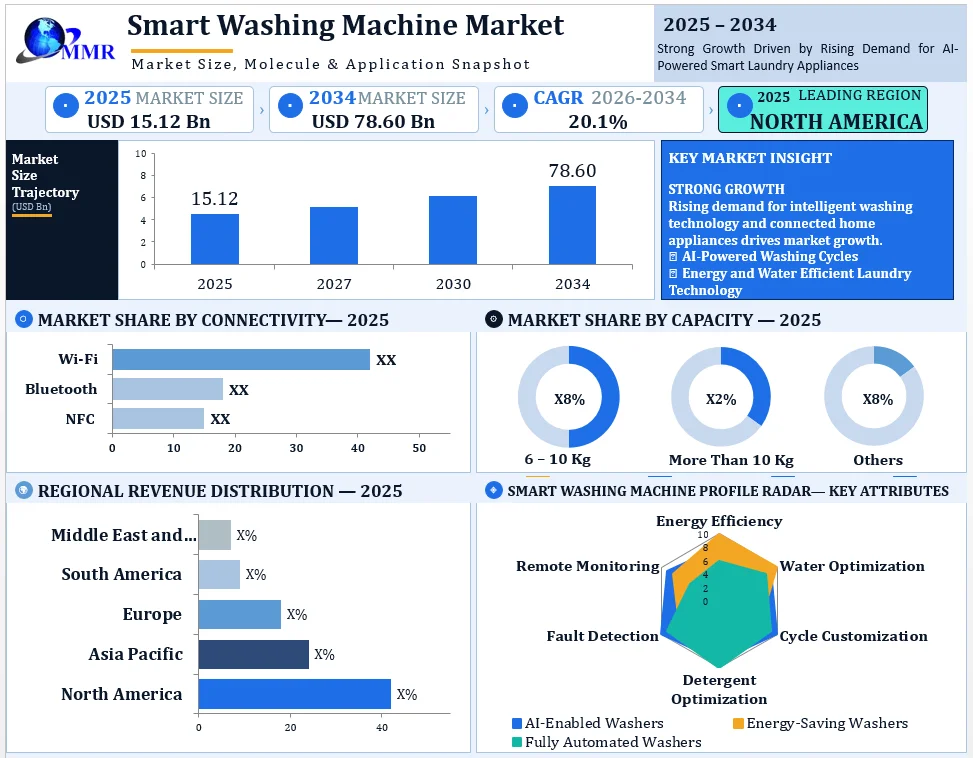
The Smart Washing Machine Market size was valued at USD 15.12 Billion in 2025 and the total Smart Washing Machine revenue is expected to grow at a CAGR of 20.1% from 2026 to 2034, reaching USD 78.60 Billion by 2034.
Global Smart Washing Machine Market Overview
The Smart Washing Machine Market comprises intelligent laundry appliances equipped with Wi-Fi connectivity, artificial intelligence, automated wash programs, sensor-based controls, and remote operation through mobile applications. These smart home appliances optimize water consumption, energy efficiency, detergent usage, and washing performance while improving convenience for households. Growing interest in connected home technology, sustainable living, and automated household chores is making smart washing machines an increasingly important part of the modern home appliance industry.
The Smart Washing Machine Market is growing as consumers increasingly adopt smart home appliances, energy-efficient laundry solutions, and connected devices that simplify everyday household activities. Leading manufacturers such as Samsung Electronics and LG Electronics are advancing the market through AI-powered washing cycles, smart diagnosis, remote monitoring, and intelligent fabric care technologies. North America represent important markets, supported by smart home adoption, urbanization, rising disposable incomes, and demand for premium appliances. Government initiatives promoting energy-efficient products, alongside appliance efficiency programs and standards from agencies such as the U.S. Department of Energy, are also influencing purchasing decisions. Households, apartment residents, technology-oriented consumers, and property developers are creating opportunities for manufacturers to deliver connected, resource-efficient, and user-friendly laundry solutions.
The MMR report evaluates market trends, consumer purchasing behavior, product innovation, competitive positioning, regional demand, and emerging investment opportunities to help manufacturers, investors, distributors, and retailers identify growth potential. It also examines affordability, connectivity concerns, and technology adoption barriers shaping the future of smart laundry appliances.
Global Smart Washing Machine Market Key Highlights
| Key Highlight |
Market Analysis |
|---|---|
| Strong Market Growth | The Smart Washing Machine Market was valued at USD 15.12 billion in 2025 and is projected to reach USD 78.60 billion by 2034, at a CAGR of 20.1% during the forecast period. Growing adoption of connected home appliances, artificial intelligence, and automated laundry technologies supports this growth outlook. |
| North America Leads the Market | North America holds the leading regional position, supported by smart home adoption, demand for premium appliances, and consumer preference for connected laundry solutions. The United States and Canada offer opportunities for manufacturers developing intelligent and energy-efficient washing machines. |
| Front Load Washing Machines Dominate | Front load washing machines accounted for approximately 60% of the market in 2025, driven by washing performance, water efficiency, and advanced fabric care features. Top load models remain competitive among consumers prioritizing affordability and ease of use. |
| Residential Applications Drive Demand | The residential segment accounted for approximately 65% of the market in 2025. Rising household incomes, urban living, and demand for convenient laundry management support adoption, while commercial laundries provide additional opportunities for connected washing technologies. |
| Artificial Intelligence and Connectivity Shape Competition |
Manufacturers such as Samsung Electronics, LG Electronics, Haier Smart Home, and Whirlpool Corporation are competing through artificial intelligence-enabled wash cycles, remote monitoring, automatic detergent dispensing, and smart home integration. Energy efficiency, affordable pricing, data privacy, and reliable connectivity remain important factors influencing future market competitiveness. |
Smart Washing Machine Market Size, Growth and Share Analysis
To know about the Research Methodology :- Request Free Sample Report
The report covers the detailed analysis of the Global Smart Washing Machine industry with the classifications of the market on the basis of Product Type, Capacity, Connectivity, Application, and region. Analysis of past market dynamics from 2025 to 2034 is given in the report, which will help readers to benchmark the past trends with current market scenarios with the key player's contribution in it.
The concept of smart homes or Home automation is one of the hot trends, being worked on for the development of urban areas, especially in developed and developing countries. A decade ago, thinking about controlling home appliances through technology, was just not possible, but thanks to the automation and Internet of Things (IoT), which have changed the way of living. A market study claims that about 12% of homes in the United States have several smart home appliances. The same study, also predicts that the utilization of smart home appliances would rise to 15% of households across the globe, by the end of 2025. Therefore, such smart advancements in the household sector, which are expected to rise exponentially, in recent times, could be one of the major reasons responsible for driving the market growth during the forecast period.
Sustainability and Data Privacy Concerns
Though the market for Smart Washing Machines is growing due to its automated version and rising preferences by consumers, across the globe. But, on the contrary, the industries have an underlying risk for hampering the market growth, due to the consumer’s preference towards sustainability approaches, in recent times. Smart washing machines are known to consume approximately 12,000 gallons of water annually, and while the world faces a major problem for water scarcity, the people are very much concerned about the same, and hence prefer not to use such appliances. Furthermore, as the smart devices are connected devices, they are meant to capture all the data from the devices they are connected to. With the rising rate of cyber threats across the globe, it becomes hard for consumers to connect their personal devices with any of such devices. Therefore, the threat of consumer’s data and people’s raising awareness of the environment are the two major factors, which could restrain the market growth of the smart washing machines, during the forecast period.
Global Smart Washing Machine Market Dynamics
Rising Demand for Energy-Efficient Smart Home Appliances Drive Smart Washing Machine Market Growth
The growing preference for smart home appliances, automated laundry solutions, and energy-efficient washing technology is a major driver of the Smart Washing Machine Market. Consumers increasingly seek washing machines with artificial intelligence, automatic load detection, customized wash cycles, remote operation, and intelligent detergent dispensing to simplify household chores and improve cleaning performance. Rising urbanization, smaller household sizes, and busy lifestyles are encouraging the adoption of connected washing machines that reduce manual intervention and optimize water and electricity consumption. Energy efficiency initiatives from government agencies, including the United States Department of Energy and the Environmental Protection Agency through its ENERGY STAR program, further encourage consumers to consider appliance efficiency when purchasing laundry equipment. Manufacturers such as Samsung Electronics and LG Electronics are strengthening product appeal through smart diagnostics, fabric care automation, and connected home integration, supporting demand among technology-conscious households and premium appliance buyers.
High Purchase Prices and Maintenance Costs Restrict Smart Washing Machine Market Adoption
The high initial cost of smart washing machines remains a major restraint, particularly for budget-conscious households, price-sensitive consumers, and buyers in developing economies. Advanced features such as artificial intelligence-based wash optimization, wireless connectivity, automatic detergent dispensing, and integrated diagnostic systems can increase retail prices compared with conventional washing machines. Consumers must also consider installation expenses, internet connectivity requirements, electronic component repairs, and potential software-related maintenance when evaluating the total cost of ownership. Although the United States Environmental Protection Agency reports that ENERGY STAR certified clothes washers use approximately 20 percent less energy and 30 percent less water than standard models, some consumers may hesitate to pay a premium when immediate savings are not clearly demonstrated. These affordability concerns can slow smart washing machine penetration in entry-level appliance categories and create pressure on manufacturers to balance technological innovation with competitive pricing.
Artificial Intelligence and Water-Saving Technology Create New Smart Washing Machine Market Opportunities
The integration of artificial intelligence, predictive maintenance, automatic fabric recognition, and resource-efficient washing technology presents significant opportunities for smart washing machine manufacturers. ENERGY STAR reports that certified full-sized clothes washers use approximately 14 gallons of water per load, compared with 20 gallons for standard machines, demonstrating the potential value of efficient laundry technology. Manufacturers can build on this demand by developing smart washing machines that adjust water levels according to load size, recommend suitable washing cycles, identify maintenance issues, and improve detergent utilization. Additional opportunities exist in emerging economies, where urban housing development, growing digital connectivity, and rising interest in convenient household appliances can support wider adoption. Partnerships with smart home platform providers, residential developers, appliance retailers, and utility companies can improve product accessibility and customer awareness. Affordable connected models, voice-controlled laundry management, and customized fabric care solutions also offer manufacturers opportunities to differentiate their products and attract first-time smart appliance buyers.
Data Privacy, Device Compatibility, and Reliable Connectivity Challenge Smart Washing Machine Market Development
Maintaining data security, seamless connectivity, and consistent appliance performance remains a significant challenge for the Smart Washing Machine Market. Connected washing machines may collect usage information through mobile applications, cloud platforms, and smart home ecosystems, creating concerns about data privacy, software updates, and unauthorized access. Compatibility issues between different operating systems, voice assistants, wireless networks, and connected home platforms can also complicate installation and everyday use. Manufacturers must ensure that smart features remain reliable during internet interruptions and that essential washing functions continue operating without dependence on cloud services. In addition, integrating sensors, electronic control systems, and artificial intelligence into appliances requires careful testing to maintain durability, cleaning performance, and repairability. The United States Department of Energy's appliance efficiency standards illustrate the importance of meeting established performance requirements, while manufacturers must also respond to changing consumer expectations for intuitive controls and dependable after-sales service. Addressing these technical and trust-related challenges will be essential to increasing consumer confidence and sustaining long-term demand.
Global Smart Washing Machine Market Trends
| Trend | Description |
|---|---|
| Artificial Intelligence Based Laundry Optimization |
Smart washing machine manufacturers are integrating artificial intelligence to recognize laundry conditions, recommend suitable wash programs, and adjust cleaning settings according to fabric type and load requirements. This trend is shifting product differentiation toward practical washing performance and personalized fabric care rather than connectivity alone. |
| Energy and Water Efficient Washing Technology | Demand for resource-efficient washing machines is encouraging manufacturers to develop intelligent load sensing, optimized wash cycles, and automatic water management. NielsenIQ identifies energy efficiency as a leading home appliance purchase consideration, making lower operating costs an important selling point for smart washing machine brands. |
| Remote Laundry Monitoring Through Mobile Applications |
Smartphone-connected washing machines allow users to start or monitor wash cycles, receive completion notifications, select programs, and identify maintenance alerts remotely. Manufacturers are improving application-based controls to provide greater convenience for busy households and consumers who prefer managing household appliances through connected home platforms. |
| Automated Detergent Dispensing and Fabric Care | Automatic detergent dispensing, fabric-specific wash settings, and sensor-based cycle adjustments are gaining attention as manufacturers seek to reduce manual intervention and improve garment care. These features appeal to households looking for consistent washing results, easier appliance operation, and more controlled detergent usage. |
| Compact and Multifunctional Laundry Appliances | Urban housing constraints are encouraging demand for space-conscious washing machines, washer-dryer combinations, and appliances with flexible installation options. Manufacturers are responding with multifunctional designs that combine washing convenience with drying capabilities, particularly for apartments and households with limited laundry space. |
| Connected Smart Home Ecosystem Integration | Smart washing machines are increasingly being designed to work alongside mobile applications, voice assistants, and other connected household devices. This trend is encouraging manufacturers to improve device compatibility, simplify appliance management, and deliver coordinated smart home experiences while making reliable connectivity and software support important purchase considerations. |
Global Smart Washing Machine Market Segment Analysis
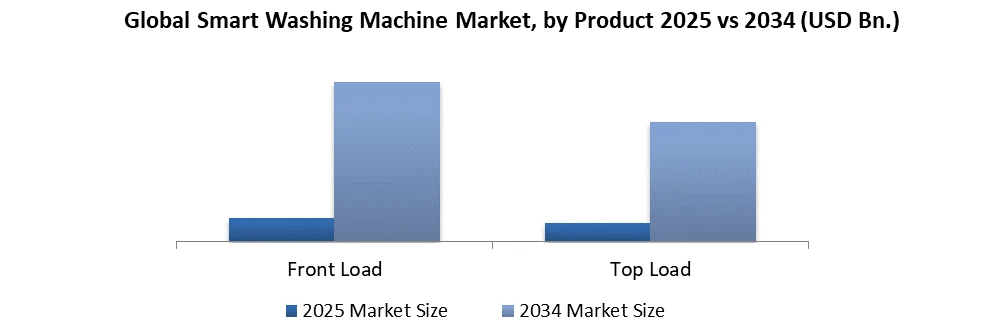
Front Load segment, by Product Type is expected to Account for the Largest Market Share during the Forecast Period.
The Front Load type of the washing machine is observed to have a larger market share, as compared to the top – load type of washing machine, and it is expected that the segment would continue to have its dominance accordingly, during the forecast period. The Front Load segment type, accounted for almost a 60% market share, in the year 2025, due to its enriching features, like higher wash quality, along with water-saving per load, among many others. However, it also holds true that the top load segment is not much behind, as people’s preferences are rising for this type, owing to the low costs and flexibility approaches by the type.
The Category ranging between 6 – 10 Kg is expected to Account for the Largest Market Share during the Forecast Period.
It is observed that the Smart Washing Machines ranging between 6 – 10 Kg capacity are highly preferred by the consumers. The basic reason for this could be attributed to the increasing nuclear family concept across the globe. Considering the technological aspects, this category of machines are known to use less amount of water and are reasonably priced, which grabs the consumer’s attention towards them and hence, are highly preferable as compared to the washing machines with a capacity of more than 10 Kg.
The Residential Segment is expected to Account for the Largest Market Share during the Forecast Period.
In 2025, the residential segment attributed a market share of almost 65% for the smart washing machines, thanks to the rising disposable incomes. Moreover, the residential segment could also be on rising due to the increasing number of developing countries, across the globe. Also, the target of turning the developing countries into the smarter countries is another factor for people easily adopting and utilizing the latest automated products, as far as the domestic appliances are considered. The commercial segment, on the other side, is also set to pave a good CAGR, over the forecast period, owing to the quick shift of people’s preferences for the coin laundry and latest online registering services for laundries.
Global Smart Washing Machine Market Regional Analysis
North America is the leading region in Smart Washing Machine Market, which has strong smart home adoption, consumer preference for premium household appliances, and increasing demand for connected laundry solutions. The United States and Canada contribute to regional growth through the adoption of artificial intelligence-enabled washing cycles, remote appliance monitoring, automatic detergent dispensing, and energy-efficient washing technologies. Established appliance brands, widespread retail distribution, and growing interest in convenient household automation reinforce North America's leading position in the market.
Asia Pacific represents a significant growth region for the Smart Washing Machine Market, driven by urbanization, rising disposable incomes, and the strong presence of home appliance manufacturers. China, Japan, South Korea, and India contribute to demand through smart appliance innovation, increasing digital connectivity, and wider availability of washing machines across different price categories. Growing interest in automated fabric care, intelligent wash programs, and resource-efficient appliances creates opportunities for manufacturers targeting both established and emerging consumer markets.
Europe maintains a strong presence in the Smart Washing Machine Market through demand for energy-efficient household appliances, sustainable laundry practices, and advanced washing technologies. Germany, the United Kingdom, France, and Italy contribute to regional adoption as consumers increasingly prioritize optimized water consumption, lower energy use, connected controls, and reliable washing performance. Manufacturers offering durable appliances with intelligent wash settings and smart home compatibility are well positioned to address evolving consumer preferences.
South America offers emerging opportunities in the Smart Washing Machine Market as urban households increasingly seek convenient laundry management and modern home appliances. Brazil and Mexico are important markets, supported by improving digital connectivity, broader e-commerce access, and growing interest in automated washing features. Affordable smart models, flexible purchasing options, and wider product distribution can help manufacturers reach consumers transitioning from conventional washing machines.
The Middle East and Africa region presents opportunities for the Smart Washing Machine Market through residential development, urbanization, and increasing demand for modern household equipment. The United Arab Emirates, Saudi Arabia, and South Africa offer potential for connected washing machines featuring remote monitoring, intelligent wash programs, and efficient resource management. Improved retail availability, dependable after-sales support, and competitively priced products can help manufacturers increase adoption across diverse consumer groups.
Global Smart Washing Machine Market Competitive Landscape
The Smart Washing Machine Market is characterized by strong competition among established home appliance manufacturers and emerging smart technology brands, with companies focusing on product innovation, energy efficiency, artificial intelligence, and connected home integration to strengthen their market positions. Samsung Electronics and LG Electronics differentiate their smart washing machines through intelligent wash cycles, mobile application connectivity, automated fabric care, and advanced appliance management features. Haier Smart Home, Whirlpool Corporation, and Midea Group compete through broad product portfolios, manufacturing capabilities, and offerings across different price categories, while Bosch, Siemens, and Electrolux emphasize premium laundry appliances, efficient washing performance, and connected control systems. Panasonic, IFB Industries, Hisense, Xiaomi, and TCL contribute to competitive differentiation through regional distribution networks, smart appliance technology, and consumer-focused product development. As competition intensifies, manufacturers are prioritizing water and energy efficiency, remote monitoring, automatic detergent dispensing, predictive maintenance, and seamless smart home compatibility. Brand reputation, competitive pricing, product durability, after-sales service, and technology accessibility remain important factors influencing purchasing decisions, while continued investment in research and development enables companies to respond to changing consumer preferences and capture emerging opportunities in the Smart Washing Machine Market.
Global Smart Washing Machine Market Recent Developments
| Month and Year | Company | Recent Development |
|---|---|---|
| March 2026 | Whirlpool | Whirlpool introduced its Xpert Care washing machine range featuring Ozone Air Refresh Technology, designed to support fabric care and refresh clothes while addressing everyday laundry needs. |
| April 2026 | Haier | Haier India launched the F11 washing machine series with an artificial intelligence colour touch panel, Ultra Fresh Air Technology, automatic detergent adjustment, and smart wash settings for Indian households. |
| May 2026 | Samsung | Samsung announced its upgraded Bespoke AI Laundry Combo with faster wash and dry cycles, improved artificial intelligence based fabric detection, and conversational voice controls through Bixby. |
| July 2026 | LG Electronics |
LG Electronics introduced its Professional Laundry lineup for commercial operations, combining artificial intelligence based weight detection, remote laundry management, and technologies designed to improve operational efficiency. |
| August 2026 | Midea | Midea introduced its 210 front load washing machine and 210 heat pump dryer range in Australia, featuring automatic detergent dosing, cold wash cycles, and Power Mix Technology for improved garment care. |
| September 2026 | Bosch | Bosch announced its Series 8 heat pump washer dryers featuring automatic detergent dosing, Smart Start scheduling, and automated lint removal. The company scheduled the product launch for March 2027. |
Smart Washing Machine Market Scope: Inquire before buying
| Smart Washing Machine Market | |||
|---|---|---|---|
| Report Coverage | Details | ||
| Base Year: | 2025 | Forecast Period: | 2026-2034 |
| Historical Data: | 2020 to 2025 | Market Size in 2025: | USD 15.12 Billion |
| Forecast Period 2026 to 2034 CAGR: | 20.1% | Market Size in 2034: | USD 78.60 Billion |
| Segments Covered: | by Product | Front Load Top Load |
|
| by Capacity | 6 - 10 Kg More Than 10 Kg Others |
||
| by Application | Residential Commercial |
||
| by Connectivity | Wi - Fi NFC (NEAR FIELD COMMUNICATIONS) Bluetooth |
||
Global Smart Washing Machine Market, by Region
North America (United States, Canada and Mexico)
Europe (UK, France, Germany, Italy, Spain, Sweden, Austria and Rest of Europe)
Asia Pacific (China, South Korea, Japan, India, Australia, Indonesia, Malaysia, Vietnam, Taiwan, Bangladesh, Pakistan and Rest of APAC)
Middle East and Africa (South Africa, GCC, Egypt, Nigeria and Rest of ME&A)
South America (Brazil, Argentina Rest of South America)
Smart Washing Machine Market Key Players are:
1. Samsung Electronics
2. LG Electronics
3. Whirlpool Corporation
4. Haier Smart Home
5. Electrolux Group
6. Panasonic Corporation
7. Robert Bosch GmbH
8. Siemens Home Appliances
9. Miele
10. IFB Industries Limited
11. Midea Group
12. Hisense Group
13. Arçelik
14. Beko
15. TCL Corporation
16. Xiaomi Corporation
17. Sharp Corporation
18. Godrej Appliances
19. Alliance Laundry Systems
20. Fisher and Paykel Appliances
21. Hitachi Global Life Solutions
22. GE Appliances
23. Maytag
24. Kenmore
25. Speed Queen
26. Amana
27. Frigidaire
28. Hotpoint
29. Indesit
30. Candy
31. Hoover
32. AEG
33. ASKO
34. Gorenje
35. Vestel
36. Toshiba
37. Dawlance
38. Orient Electronics
39. Onida
40. BPL
41. Kelvinator
42. Voltas
43. Lloyd
44. Videocon
45. Little Swan
46. Konka
47. AUX Group
48. Changhong
49. Sanyo
50. Brandt
Frequently Asked Questions:
1. Which region has the largest share in Global Smart Washing Machine Market?
Ans: Asia Pacific region holds the highest share in 2025.
2. What is the growth rate of Global Smart Washing Machine Market?
Ans: The Global Smart Washing Machine Market is growing at a CAGR of 20.1% during forecasting period 2026-2034.
3. What is scope of the Global Smart Washing Machine market report?
Ans: Global Smart Washing Machine Market report helps with the PESTEL, PORTER, COVID-19 Impact analysis, Recommendations for Investors & Leaders, and market estimation of the forecast period.
4. Who are the key players in Global Smart Washing Machine market?
Ans: The important key players in the Global Smart Washing Machine Market are – Honeywell International Inc., Sunbeam Products Inc., Xiaomi Corporation, Blueair, Miele, Whirlpool, Kenmore Applications, Sharp Corporation, Bosch, Speed Queen, Samsung, LG Electronics, IFB, Electrolux, GE Appliances, Haier, Godrej, Siemens, Panasonic, and TCL.
5. What is the study period of this market?
Ans: The Global Smart Washing Machine Market is studied from 2020 to 2034.
6. What was the Global Smart Washing Machine Market size in 2025?
Ans: The Global Smart Washing Machine Market size was USD 15.12 Billion in 2025.