
Global Cell Analysis Instruments Market by Instrument Type, by Application, by End-User, by Region and Forecast 2034
Overview
The Global Cell Analysis Instruments Market size was valued at USD 1.13 Billion in 2025 and the total Cell Analysis Instruments revenue is expected to grow at a CAGR of 4.2% from 2026 to 2034, surged to USD 1.63 Billion.
Global Cell Analysis Instruments Market Overview:
Cell analysis instruments are primarily used to measure cell count and viability, characterize cellular health, perform cell-based assays, and evaluate cellular responses under different experimental conditions. These instruments enable researchers to examine cell morphology, proliferation, viability, and functionality, supporting applications across pharmaceutical research, biotechnology, clinical diagnostics, and life sciences. Advanced cell analysis systems integrate cell imaging, automated sample processing, and real-time data collection to improve analytical accuracy, efficiency, and reproducibility. Technologies such as flow cytometry, fluorescence microscopy, high-content screening, and automated cell counters help researchers analyze cellular characteristics and identify variations within cell populations. These capabilities support drug discovery and development, cancer research, stem cell studies, immunology, and regenerative medicine. Furthermore, increasing demand for personalized medicine, cell-based therapies, and advanced diagnostic methods strengthens the adoption of cell analysis instruments. Continuous advancements in automation, image-processing software, and high-throughput analytical platforms further improve laboratory workflows and expand the applications of cell analysis instruments across research and clinical environments.
Global Cell Analysis Instruments Market: Key Highlights
• Market Growth: The Global Cell Analysis Instruments Market is valued at USD 1.13 billion in 2025 and is projected to reach USD 1.63 billion by 2034, growing at a CAGR of 4.2% during 2025–2034.
• Key Growth Drivers: Increasing demand for advanced cellular research, drug discovery, disease diagnostics, personalized medicine, and cell-based therapies drives market growth.
• Technological Advancements: Automation, artificial intelligence, single-cell analysis, spectral flow cytometry, and high-content imaging improve analytical accuracy and laboratory efficiency.
• Regional Leadership: North America leads the market, supported by advanced healthcare infrastructure, strong pharmaceutical and biotechnology industries, and substantial research and development investments.
• Competitive Landscape: Major players include Thermo Fisher Scientific Inc., Agilent Technologies, Inc., Danaher Corporation, Becton, Dickinson and Company, Merck KGaA, Sartorius AG, Bio-Rad Laboratories, Inc., and Revvity, Inc. These companies focus on product innovation, automation, advanced imaging, and integrated cell analysis solutions.
Global Cell Analysis Instruments Market Size, Growth and Share Analysis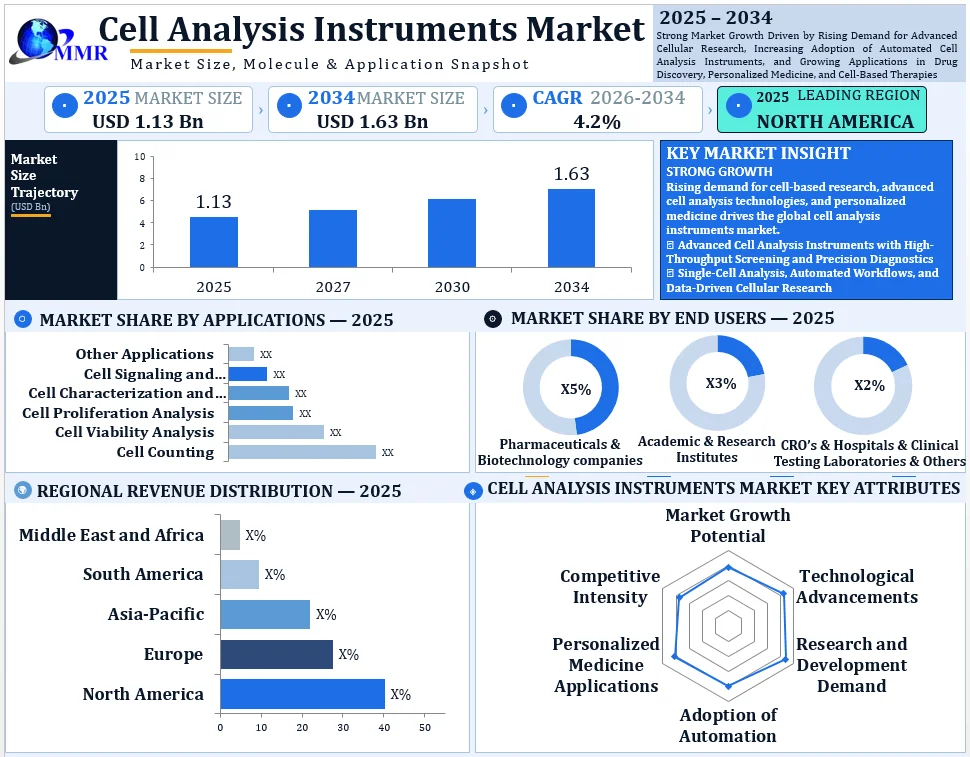
To know about the Research Methodology :- Request Free Sample Report
Global Cell Analysis Instruments Market Dynamics:
Global Cell Analysis Instruments Market Drivers
The global cell analysis instruments market experiences growth due to increasing demand for advanced cellular research, drug discovery, and disease diagnostics. The rising prevalence of cancer and other chronic diseases encourages pharmaceutical companies, biotechnology firms, and research institutions to adopt instruments that provide accurate information about cell viability, proliferation, morphology, and functionality. Technologies such as flow cytometry, automated cell counting, fluorescence microscopy, and high-content screening support detailed cellular investigations and improve laboratory efficiency.
The growing focus on personalized medicine and cell-based therapies further strengthens market demand. Pharmaceutical and biotechnology companies represent a major end-user segment, accounting for approximately 40.8% of the broader global cell analysis market in 2025. This share highlights the importance of drug development and biopharmaceutical research in driving demand for cell analysis technologies.
Global Cell Analysis Instruments Market Restraints
The high initial cost of advanced cell analysis instruments remains a significant restraint, particularly for small research laboratories, universities, and healthcare institutions with limited budgets. Sophisticated platforms, including advanced flow cytometers and high-content imaging systems, require substantial investment in equipment, installation, calibration, and maintenance. Laboratories also incur recurring expenses for reagents, consumables, software upgrades, and technical support.
Furthermore, operating advanced instruments requires trained personnel who can manage sample preparation, instrument calibration, and complex data interpretation. These financial and technical requirements limit adoption among resource-constrained laboratories and create challenges for organizations seeking to expand their analytical capabilities.
Global Cell Analysis Instruments Market Opportunities
Advancements in automation, artificial intelligence, single-cell analysis, and high-content imaging create significant opportunities in the global cell analysis instruments market. Automated platforms help laboratories process larger sample volumes, reduce manual intervention, and improve the consistency of experimental results. AI-enabled image analysis also supports the identification of cellular characteristics and the interpretation of complex biological data.
The increasing adoption of precision medicine, immunotherapy, stem cell research, and regenerative medicine further expands the application of cell analysis instruments. Single-cell analysis accounts for approximately 19.0% of the broader global cell analysis market in 2025, highlighting the importance of detailed cellular investigations in modern biomedical research. Continued innovation in single-cell technologies and automated analytical workflows creates opportunities for manufacturers to develop more efficient and accessible instruments.
Global Cell Analysis Instruments Market Challenges
The global cell analysis instruments market faces challenges related to technical complexity, data management, instrument standardization, and competition among technology providers. Advanced analytical platforms generate large volumes of cellular data, requiring suitable software, reliable data-processing systems, and skilled professionals for accurate interpretation. Differences in sample preparation, operating procedures, and instrument calibration also affect the reproducibility of results across laboratories.
Furthermore, research institutions and pharmaceutical companies evaluate instrument performance, accuracy, operating costs, and compatibility with existing laboratory workflows before making purchasing decisions. Manufacturers therefore focus on balancing technological innovation with affordability, ease of operation, and reliable technical support. Dependence on research budgets and funding availability also influences purchasing decisions, particularly among academic and government-funded institutions.
Global Cell Analysis Instruments Market Trends
• Increasing Adoption of Automation: Laboratories increasingly adopt automated cell analysis instruments to reduce manual intervention, improve measurement accuracy, and process larger sample volumes. Automated cell counters and high-throughput screening platforms support efficient laboratory workflows.
• Integration of Artificial Intelligence: Manufacturers integrate artificial intelligence (AI) and machine learning into cell imaging and analysis systems. These technologies support automated cell identification, image interpretation, and the analysis of complex cellular data.
• Growing Demand for Single-Cell Analysis: Researchers increasingly use single-cell analysis technologies to investigate cellular heterogeneity, identify rare cell populations, and understand disease mechanisms. These applications support advancements in cancer research, precision medicine, and drug development.
• Advancements in Flow Cytometry: Flow cytometry systems increasingly incorporate multiparametric and spectral analysis capabilities. These improvements enable researchers to examine multiple cellular characteristics simultaneously and support applications in immunology, oncology, and cell therapy research.
• Rising Adoption of High-Content Screening: Pharmaceutical and biotechnology companies increasingly use high-content screening instruments to evaluate cellular responses to drug candidates. Automated imaging and computational analysis support compound screening, toxicity assessment, and drug discovery.
• Increasing Demand for Cell-Based Therapies: The expansion of cell and gene therapy research increases the need for instruments that assess cell viability, identity, concentration, and functionality. These instruments support cell characterization and quality control during therapeutic development and manufacturing.
• Integration of Imaging and Data Analysis Software: Instrument manufacturers increasingly combine advanced imaging systems with analytical software to simplify data interpretation and improve reproducibility. Integrated platforms help researchers manage complex datasets and standardize experimental workflows.
• Expansion of Laboratory Infrastructure in Emerging Markets: Investments in biotechnology research, pharmaceutical manufacturing, and clinical diagnostics support the adoption of cell analysis instruments across emerging economies, particularly in Asia-Pacific. Research institutions and biotechnology companies increasingly require advanced analytical systems for drug development and disease research.
Global Cell Analysis Instruments Market Segment Analysis:
By Instrument Type
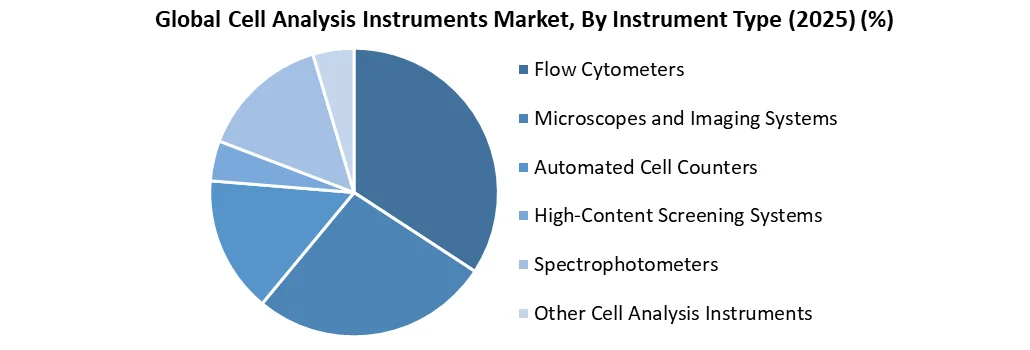
Flow cytometers analyze cellular characteristics and support applications in immunology, cancer research, and cell characterization. Microscopes and Imaging Systems: These instruments enable the visualization of cell morphology, structure, and behavior, supporting cellular research and drug discovery. These systems measure cell concentration and viability, improving accuracy and efficiency in laboratory workflows. These instruments combine automated imaging and data analysis to support drug discovery and toxicity assessment. Spectrophotometers: These instruments measure light absorption in biological samples and support cell-based assays and biochemical analysis. Other Cell Analysis Instruments: This category includes specialized instruments used for cellular investigations beyond the separately listed types.
By Application
Cell counting determines cell concentration for cell culture, research, and bioprocess monitoring. Cell Viability Analysis: This application evaluates cell health and identifies living and dead cells during research and drug testing. Cell proliferation analysis measures cellular growth and division, supporting cancer research and drug development. This application examines cellular properties to identify cell types and distinguish cell populations. Cell Signaling and Functional Analysis: This application investigates cellular responses, signaling pathways, and biological functions. Other Applications: This category covers specialized cellular investigations beyond the separately listed applications.
By End User
These organizations use cell analysis instruments for drug discovery, toxicity testing, and biopharmaceutical development. These institutions apply cell analysis technologies to investigate cellular mechanisms, diseases, and biological processes. CROs use these instruments to provide outsourced research, screening, and testing services. Hospitals and Diagnostic Laboratories: These facilities employ suitable cell analysis systems for clinical investigations and specialized diagnostic testing. Other End Users: This category includes government laboratories, public research centers, and industrial laboratories that conduct cellular analysis.
Global Cell Analysis Instruments Market Regional Insights:
North America is the leading region in the global cell analysis instruments market, supported by advanced healthcare infrastructure, substantial research and development investments, and the strong presence of pharmaceutical and biotechnology companies. The United States drives regional demand through extensive biomedical research, advanced laboratory facilities, and the adoption of technologies such as flow cytometry, automated cell analysis, and high-content screening. Increasing investments in drug discovery, cancer research, immunology, and cell-based therapies further strengthen the region's market position. North America accounts for approximately 40.21% of the global market revenue in 2025, reflecting its established research ecosystem and strong demand for advanced analytical instruments.
Europe represents a significant market for cell analysis instruments, driven by established pharmaceutical industries, advanced research infrastructure, and growing investments in biotechnology and life sciences. Germany, the United Kingdom, and France contribute to regional demand through pharmaceutical research, academic institutions, and biotechnology development. The increasing adoption of automated laboratory systems, advanced microscopy, and cellular analysis technologies supports market expansion. Furthermore, continued research into oncology, immunology, and regenerative medicine strengthens demand for reliable and high-performance cell analysis instruments.
Asia-Pacific represents a key growth region in the global cell analysis instruments market, supported by expanding biotechnology industries, increasing pharmaceutical research activities, and investments in healthcare infrastructure. China, Japan, India, and South Korea contribute to regional development through growing research capabilities, biopharmaceutical manufacturing, and the adoption of advanced laboratory technologies. Increasing government support for life sciences research and rising demand for cost-effective analytical solutions create opportunities for market participants. The expansion of academic research institutions and biotechnology companies further supports regional market growth.
South America demonstrates gradual growth in the cell analysis instruments market, supported by improvements in laboratory infrastructure, expanding pharmaceutical research, and increasing investments in healthcare and biotechnology. Brazil and Argentina contribute to regional demand through academic research, clinical laboratories, and pharmaceutical development activities. The growing focus on disease research, diagnostic capabilities, and laboratory modernization encourages the adoption of cell analysis technologies. However, budget limitations and the high cost of advanced instruments influence purchasing decisions across the region.
The Middle East and Africa represent an emerging market for cell analysis instruments, driven by investments in healthcare infrastructure, research facilities, and laboratory modernization. Countries such as Saudi Arabia, the United Arab Emirates, and South Africa support regional demand through expanding healthcare capabilities and growing interest in biotechnology research. Increasing attention to diagnostic services, academic research, and life sciences development encourages the adoption of modern analytical instruments. However, limited research funding and unequal access to advanced laboratory technologies continue to influence market penetration across the region.
Global Cell Analysis Instruments Market Competitive Landscape
The global cell analysis instruments market remains competitive, with established life sciences companies and specialized biotechnology manufacturers focusing on technological innovation, product development, and portfolio expansion. Key players include Thermo Fisher Scientific Inc., Becton, Dickinson and Company (BD), Danaher Corporation, Merck KGaA, Sartorius AG, Agilent Technologies, Inc., Bio-Rad Laboratories, Inc., Miltenyi Biotec, and Revvity, Inc. These companies compete through advanced flow cytometry systems, automated cell counters, microscopy and imaging platforms, and high-content screening technologies.
Thermo Fisher Scientific Inc. maintains a broad portfolio of life sciences instruments, reagents, and analytical solutions that support cellular research and drug development. Becton, Dickinson and Company (BD) focuses on flow cytometry and advanced cell analysis technologies, while Danaher Corporation, through Beckman Coulter Life Sciences, provides instruments for cellular characterization and laboratory research. Merck KGaA and Sartorius AG support cell analysis workflows through life sciences technologies, laboratory solutions, and products for biopharmaceutical research.
Other important participants, including Agilent Technologies, Inc., Bio-Rad Laboratories, Inc., Miltenyi Biotec, and Revvity, Inc., strengthen competition through specialized analytical platforms and solutions for cellular research. Market participants increasingly emphasize automation, advanced imaging, spectral flow cytometry, single-cell analysis, and data-processing capabilities to improve analytical performance and laboratory efficiency. Companies also focus on expanding their product portfolios, strengthening distribution networks, and developing integrated instrument and consumable solutions to address the evolving requirements of pharmaceutical companies, biotechnology firms, and research institutions.
Global Cell Analysis Instruments Market: Recent Developments
| Date | Company | Development | Impact |
|---|---|---|---|
| September 29, 2026 | Agilent Technologies, Inc. | Introduced the BioTek Gen5 AI Cell Identification Module, integrating AI-based cell identification and segmentation into compatible automated imaging workflows. |
Reduces manual image-analysis steps, improves consistency in cell counting, and supports more efficient cellular research and drug discovery. |
| September 14, 2026 | Becton, Dickinson and Company (BD) | Commercially launched the BD FACSDiscover A7 Cell Analyzer, featuring spectral flow cytometry, automated quality control, and integrated sample loading. |
Supports high-parameter cellular analysis, improves measurement consistency, and enhances research capabilities in immunology and disease studies. |
| July 1, 2026 | Agilent Technologies, Inc. | Launched an AI-driven analysis module for the xCELLigence RTCA eSight platform to simplify label-free cell imaging analysis through automated cell segmentation and AI-based analysis. |
Reduces manual analysis and supports consistent monitoring of cellular behavior in drug discovery and biopharmaceutical research. |
| June 2, 2026 | Cytek Biosciences, Inc. | Unveiled the Cytek Borealis seven-laser full-spectrum flow cytometer, featuring deep-ultraviolet and infrared detection capabilities and support for high-resolution 60-color panels. |
Expands high-dimensional cellular analysis and enables researchers to investigate complex cell populations with enhanced spectral detection capabilities. |
| June 2, 2026 | Cytek Biosciences, Inc. | Announced enhanced automation-ready configurations for its Cytek Aurora Evo flow cytometry platform, including hardware features and software integrations for robotic sample handling. |
Improves laboratory automation, increases workflow scalability, and reduces manual intervention in high-throughput research environments. |
| April 1, 2026 | Agilent Technologies, Inc. | Introduced the BioTek Cytation 9 Cell Imaging Multimode Reader, combining cell imaging with multimode microplate reading in a single platform. |
Streamlines cell-based and biochemical assays while supporting microscopy, cellular imaging, and high-content research workflows. |
| February 5, 2026 | Revvity, Inc. | Unveiled the Opera Phenix OptIQ high-content screening system with enhanced imaging sensitivity and AI-based image-analysis capabilities at SLAS 2026. |
Improves quantitative cellular imaging and supports high-throughput drug discovery, phenotypic screening, and analysis of complex biological models, including organoids. |
| January 29, 2026 | Beckman Coulter Life Sciences and Automata | Announced a strategic partnership to integrate cell analysis, genomic technologies, and liquid-handling systems with an AI-ready laboratory automation platform. |
Supports scalable experimentation, improves workflow consistency, and helps research laboratories automate complex experimental processes. |
Global Cell Analysis Instruments Market Scope: Inquire before buying
| Cell Analysis Instruments Market | |||
|---|---|---|---|
| Report Coverage | Details | ||
| Base Year: | 2025 | Forecast Period: | 2026-2034 |
| Historical Data: | 2020 to 2025 | Market Size in 2025: | 1.13 USD Billion |
| Forecast Period 2026-2034 CAGR: | 4.2% | Market Size in 2034: | 1.63 USD Billion |
| Segments Covered: | by Instrument Type | Flow Cytometers Microscopes and Imaging Systems Automated Cell Counters High-Content Screening Systems Spectrophotometers Other Cell Analysis Instruments |
|
| by Application | Cell Counting Cell Viability Analysis Cell Proliferation Analysis Cell Characterization and Identification Cell Signaling and Functional Analysis Other Applications |
||
| by End-User | Pharmaceutical and Biotechnology Companies Academic and Research Institutions Contract Research Organizations (CROs) Hospitals and Diagnostic Laboratories Others |
||
Global Ceiling Tile Lighting Market, by Region
North America (United States, Canada and Mexico)
Europe (UK, France, Germany, Italy, Spain, Sweden, Austria and Rest of Europe)
Asia Pacific (China, South Korea, Japan, India, Australia, Indonesia, Malaysia, Vietnam, Taiwan, Bangladesh, Pakistan and Rest of APAC)
Middle East and Africa (South Africa, GCC, Egypt, Nigeria and Rest of ME&A)
South America (Brazil, Argentina Rest of South America)
Global Cell Analysis Instruments Market Key Players
1. Agilent Technologies, Inc.
2. Merck KGaA
3. Thermo Fisher Scientific Inc.
4. GE HealthCare
5. Danaher Corporation
6. Sigma-Aldrich Corporation
7. Becton, Dickinson and Company
8. PerkinElmer, Inc. (Revvity, Inc.)
9. Olympus Corporation (EVIDENT)
10. Promega Corporation
11. Sartorius AG
12. Bio-Rad Laboratories, Inc.
13. Miltenyi Biotec
14. 10x Genomics, Inc.
15. Sysmex Corporation
16. DiaSorin S.p.A.
17. Terumo Corporation
18. STEMCELL Technologies Inc.
19. ChemoMetec A/S
20. Ruiyu Biotech (Countstar)
21. Beckman Coulter, Inc.
22. Leica Microsystems
23. Carl Zeiss AG
24. Nikon Corporation
25. Tecan Group Ltd.
26. QIAGEN N.V.
27. Corning Incorporated
28. Illumina, Inc.
29. Bruker Corporation
30. Sony Biotechnology Inc.
31. Bio-Techne Corporation
32. Avantor, Inc.
33. New England Biolabs, Inc.
34. NanoCellect Biomedical, Inc.
35. Nexcelom Bioscience LLC
36. Cell Biolabs, Inc.
37. Creative Bioarray
38. Meiji Techno Co., Ltd.
39. BioStatus Limited
40. Cytek Biosciences, Inc.
41. Abbott Laboratories
42. Siemens Healthineers AG
43. Fluidigm Corporation
44. Molecular Devices, LLC
45. Yokogawa Electric Corporation
46. PHC Holdings Corporation
47. Enzo Life Sciences, Inc.
48. Revvity Signals
49. Takara Bio Inc.
50. Lonza Group AG
Frequently Asked Questions:
1. What was the Global Cell Analysis Instruments Market size in 2025?
Ans: The Global Cell Analysis Instruments Market size was USD 1.13 Billion in 2025.
2. What is the Global Cell Analysis Instruments market growth?
Ans: The Cell Analysis Instruments Market size was valued at USD 1.13 Billion in 2025 and the total Cell Analysis Instruments revenue is expected to grow at a CAGR of 4.2% from 2026 to 2034, reaching nearly USD 1.63 Billion.
3. Which Application is expected to dominate the Global Cell Analysis Instruments market during the forecast period?
Ans: Cell counting is an important application segment in the Global Cell Analysis Instruments Market.
4. Who are the key players in the Global Cell Analysis Instruments market?
Ans: Some key players operating in the Cell Analysis Instruments market include Sigma Aldrich, Dickinson and Company, Becton, Danaher Corporation, and Thermo Fischer Scientific.
5. What is the key driving factor for the growth of the Cell Analysis Instruments market?
Ans: Key factors that are driving the Cell Analysis Instruments market growth are the rising burden of chronic diseases and the availability of well-established healthcare infrastructure & skilled professionals in the developed nations.