
Cars-as-a-Service (CaaS) Market – Industry Structure Evaluation, Demand Drivers Analysis, Regional Growth Analysis and Identification, Competitive Positioning Review & Global Market Size Forecast to 2032
Overview
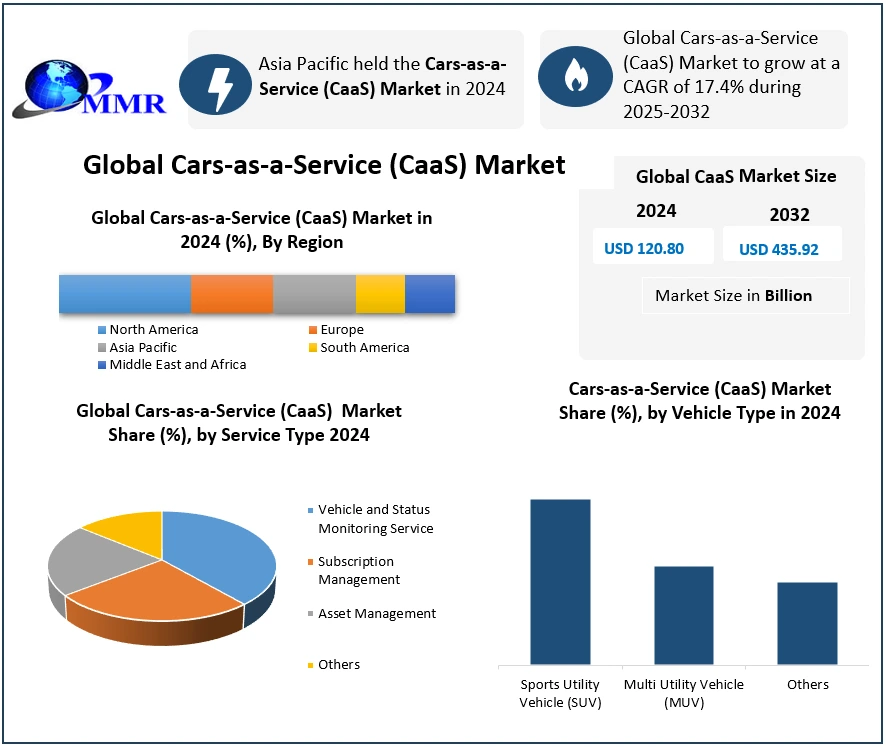
The Cars-as-a-Service (CaaS) Market was valued at USD 120.80 Bn in 2024 and is expected to grow at a CAGR of 17.4% to reach USD 435.92 Bn in the forecast period.
Cars-as-a-Service (CaaS) Market Overview
The rise of Car as a Service (CaaS) is revolutionizing the automotive industry by shifting the focus from traditional vehicle ownership to flexible, consumer-oriented mobility solutions. The advancements in connectivity, digitalization, and changing consumer expectations, particularly among millennials, have made CaaS a preferred alternative to rigid car leasing models. CaaS offers subscription-based access to vehicles, allowing users to switch or upgrade cars according to their needs. This new approach is prompting major automakers such as Volvo, General Motors, and Ford to pilot subscription services, anticipating a future where mobility takes precedence over ownership. As this model gains traction, the automotive manufacturing landscape undergoes a significant transformation, which boosts Cars-as-a-Service (CaaS) Market growth. Cars-as-a-Service (CaaS) Manufacturers need to refine their design processes, focusing on durability, modularity, and ease of maintenance to accommodate shared usage. Production strategies shift toward service-oriented platforms, while support systems are redesigned for real-time, digital-first customer engagement.
 To know about the Research Methodology :- Request Free Sample Report
Asia Pacific dominated the Cars-as-a-Service (CaaS) Market in 2024. The rapid urbanization, rising disposable incomes, and an increasing shift toward sustainable and flexible mobility solutions drive, Cars-as-a-Service (CaaS) industry growth. Major economies, such as China, India, and Japan, are emerging as key hotspots for CaaS adoption, where tech-savvy consumers are increasingly embracing subscription-based car access over traditional ownership. Leading mobility giants like DiDi Chuxing and Grab are not only disrupting conventional transportation models but also shaping the future of urban mobility through innovative, user-centric services. With growing congestion in metropolitan areas and heightened environmental awareness, the demand for on-demand, eco-friendly, and cost-effective car access is reaching new heights.
Global Cars-as-a-Service (CaaS) Market Dynamics
Market Driver: Growing Adoption of Circular Economy Principles
The increasingly focused on sustainability, resource efficiency, and carbon footprint reduction, CaaS aligns seamlessly with the goals of a circular economy by promoting shared mobility, optimized asset utilization, and extended product life cycles. Unlike traditional vehicle ownership, which results in underutilization and faster depreciation of assets, the CaaS model ensures that vehicles are used more efficiently through continuous deployment, regular maintenance, and eventual repurposing or recycling. CaaS platforms, powered by cloud-based technologies, enable real-time monitoring, predictive maintenance, and lifecycle management of vehicles, which reduces waste but also enhances operational efficiency.
In the Cars-as-a-Service (CaaS) Market, automakers and service providers can manage fleets more sustainably by integrating analytics, automation, and digital twins to track usage patterns, extend service life, and recover materials at the end of the vehicle’s life cycle. This model resonates with the rising tide of global environmental regulations and ESG (Environmental, Social, and Governance) standards, pushing both public and private sectors toward greener transport solutions.
Opportunity: Integration with Edge and 5G Technologies
The industries rapidly adopt decentralized and real-time architectures driven by the rise of IoT, autonomous vehicles, and smart city infrastructure, the need for fast, agile, and location-optimized computing solutions has become critical. CaaS platforms, which, in the Cars-as-a-Service (CaaS) Market, offer lightweight, portable, and containerized application environments, are perfectly suited for deployment at the network edge, where data is generated and consumed in real time. The solutions can bring applications closer to the source of data, such as connected vehicles, roadside infrastructure, or mobile devices, dramatically reducing latency, enhancing responsiveness, and enabling seamless performance of mission-critical tasks. The rollout of 5G further amplifies this capability by offering ultra-fast connectivity, low latency, and massive bandwidth, making it feasible to support complex workloads such as vehicle-to-everything (V2X) communication, remote diagnostics, predictive maintenance, and real-time navigation or safety systems.
Cars-as-a-Service (CaaS) Market Restraint: Complexity in Managing Multi-Cloud and Hybrid Environments
Organizations face challenges related to inconsistent container runtimes, fragmented networking capabilities, and difficulties in enforcing uniform security policies across diverse cloud infrastructures. These complexities create operational inefficiencies and increase the risk of misconfigurations or vulnerabilities. For businesses without advanced DevOps capabilities or a well-integrated cloud strategy, the burden of managing such a complex environment can be overwhelming.
Global CaaS Market Segment Analysis
Based on Service Type, the Cars-as-a-Service (CaaS) Marekt is segmented into Car Rental, Car Sharing, Ride-Hailing, Vehicle Leasing / Subscription and Others. Car Rental holds the largest share of the Cars-as-a-Service (CaaS) Market in 2024, and it remains dominant due to widespread adoption across both leisure and business users, supported by strong brand networks and global reach. However, Ride-Hailing services such as Uber, Lyft, and Ola are the fastest-growing segment, driven by convenience, smartphone penetration, and urbanization. Car Sharing also holds a significant market share, particularly in Europe and urban North America, due to space and cost efficiency. Leasing and subscription models are gaining popularity for their flexibility, particularly among younger users and corporations, but still represent a smaller portion.
Based on Vehicle Type, the market is categorized into the Sports Utility Vehicle (SUV), Multi Utility Vehicle (MUV) and Others. SUVs dominated the Cars-as-a-Service (CaaS) Market in 2024 with the largest share. SUVs have firmly established themselves as the dominant vehicle type in the Cars-as-a-Service (CaaS) Market. SUVs accounted for a record 58% of all vehicle transactions in the United States between January and October 2024. This trend is mirrored in the CaaS ecosystem, particularly in ride-hailing and vehicle subscription models, where SUVs are favored for their versatility, comfort, and ample space for passengers and luggage. In North America, SUVs represent over 60% of new CaaS fleet additions, while in Asia, they account for approximately 50% driven by rising urban mobility demand and the growing middle-class consumer base. Their broad appeal across both economy and premium segments makes SUVs a strategic choice for CaaS providers aiming to meet diverse user needs. Multi-Utility Vehicles (MUVs) make up less than 15% of new fleet acquisitions globally, with usage largely concentrated in corporate transport, airport shuttles, and niche services in developing nations. SUVs continue to dominate fleet strategies across key regions, reinforcing their central role in shaping the future of shared mobility.
Global Cars-as-a-Service (CaaS) Market Regional Insights
Asia Pacific dominates the Cars-as-a-Service (CaaS) Market and it has leadership is fueled by rapid urbanization, growing middle-class populations, increasing smartphone penetration, and rising demand for flexible, tech-enabled mobility solutions. Countries such as China, India, Japan, and South Korea are at the forefront of this transformation, with ride-hailing, car-sharing, and vehicle subscription services gaining immense traction. China alone accounts for a significant share of the regional market due to its vast urban population and strong government push for electric vehicle (EV) adoption.
Many ride-hailing fleets in Chinese cities now consist largely of EVs. India, with its congested metros and increasing youth population, is witnessing a surge in ride-hailing and car-sharing apps, making mobility more accessible and affordable. Asia Pacific benefits from supportive government policies promoting smart mobility, EV infrastructure development, and reduced vehicle ownership. Japan and South Korea are leveraging 5G and AI technologies to create efficient fleet management and predictive maintenance systems, enhancing user experience and operational efficiency.
Global Cars-as-a-Service (CaaS) Market Competitive Landscape
The Cars-as-a-Service (CaaS) market is highly competitive, with global players like Hertz, Sixt, Avis Budget, and Enterprise Holdings competing alongside emerging tech-driven mobility platforms such as Zoomcar, Revv, and Getaround. Key competition drivers include fleet size, vehicle variety, pricing models, and technology integration for seamless booking and fleet management. Partnerships with OEMs and ride-hailing services are expanding market reach. Startups leverage subscription-based models and AI-powered analytics to personalize offerings. Intense rivalry is pushing innovation in EV adoption, flexible rental plans, and value-added services, with customer experience and operational efficiency becoming major differentiators in sustaining market share.
Global Cars-as-a-Service (CaaS) Market Key Development
• July 31, 2025 – Lyft, Inc. completed its acquisition of FREENOW, creating one of the world’s leading multi-mobility platforms. The deal doubles Lyft’s addressable market to over 300 billion personal vehicle trips annually by integrating FREENOW’s strong European footprint over 180 cities in nine countries, with Lyft’s North American dominance. Riders will benefit from cross-Atlantic roaming, with app prompts linking both networks, and up to 50% off first rides in each other’s markets. For drivers, the merger promises more ride opportunities and enhanced local partnerships, especially in Europe’s taxi sector. The combined entity now operates in 11 countries and nearly 1,000 cities, offering rideshare, taxi, carsharing, and micro-mobility services.
• August 2025 – Uber Technologies announced a strategic partnership with May Mobility to deploy thousands of autonomous vehicles (AVs) on the Uber platform in the coming years. The collaboration will debut by late 2025 in Arlington, Texas, with expansion to additional U.S. markets in 2026. Customers will have the option to book May Mobility’s hybrid-electric Toyota Sienna Autono-MaaS vehicles, powered by its patented Multi-Policy Decision Making (MPDM) technology, designed to deliver human-like, real-time reasoning for complex road scenarios.
Key Trends of the Market
Rising Adoption of Subscription-Based Mobility Models
Automakers and mobility startups are increasingly embracing Car-as-a-Service (CaaS) platforms that offer bundled services such as vehicle access, insurance, and maintenance. These flexible subscription models are particularly appealing to younger, urban consumers who prioritize convenience, digital integration, and freedom from traditional vehicle ownership.
Shift Toward Integrated and Sustainable Mobility Ecosystems
CaaS platforms are expanding beyond just car usage to include e-scooters, e-bikes, and access to public transit, creating comprehensive multimodal solutions. This evolution supports sustainability efforts and urban mobility goals by reducing reliance on personal vehicles and encouraging shared, eco-friendly transportation options.
Cars-as-a-Service (CaaS) Market Scope: Inquire before buying
| Global Cars-as-a-Service (CaaS) Market | |||
|---|---|---|---|
| Report Coverage | Details | ||
| Base Year: | 2024 | Forecast Period: | 2025-2032 |
| Historical Data: | 2019 to 2024 | Market Size in 2024: | USD 120.80 Bn. |
| Forecast Period 2025 to 2032 CAGR: | 17.4% | Market Size in 2032: | USD 435.92 Bn. |
| Segments Covered: | by Service Type | Car Rental Car Sharing Ride-Hailing Vehicle Leasing / Subscription Others |
|
| by Propulsion Type | Internal Combustion Engine (ICE) Electric Vehicles (EVs) Hybrid Vehicles |
||
| by Vehicle Type | Sports Utility Vehicle (SUV) Multi Utility Vehicle (MUV) Others |
||
| by Business Model | Pay-per-Use One-Way Rentals Round-Trip Rentals Short-Term (Hourly/Daily) Others |
||
| by User Type | Individual Consumers Small & Medium Enterprises (SMEs) Large Enterprises Others |
||
Cars-as-a-Service (CaaS) Market, by Region
• North America (United States, Canada, Mexico)
• Europe (United Kingdom, France, Germany, Italy, Spain, Sweden, Russia, Rest of Europe)
• Asia Pacific (China, South Korea, Japan, India, Australia, Indonesia, Malaysia, Philippines, Thailand, Vietnam, Rest of Asia Pacific)
• Middle East and Africa (MEA) (South Africa, GCC, Nigeria, Rest of MEA)
• South America (Brazil, Argentina, Colombia, Chile, Rest of South America)
Cars-as-a-Service (CaaS) Market, Key Players
1. Uber Technologies Inc.
2. Lyft Inc.
3. Daimler AG
4. BMW Group
5. Avis Budget Group Inc.
6. Hertz Global Holdings Inc.
7. Enterprise Holdings Inc.
8. Sixt SE
9. ALD Automotive
10. LeasePlan Corporation N.V.
11. Arval BNP Paribas Group
12. Europcar Mobility Group
13. Getaround Inc.
14. Turo Inc.
15. Car2Go N.A., LLC
16. Zipcar, Inc.
17. Ola Cabs
18. Grab Holdings Inc.
19. Didi Chuxing Technology Co.
20. BlaBlaCar
21. Cluno GmbH
22. Porsche Drive
23. Hertz My Car
Frequently Asked Questions:
1. What are the growth drivers for the Cars-as-a-Service (CaaS) Market?
Ans. The increasing demand for flexible, on-demand mobility solutions, as consumers increasingly prefer access over ownership. Key factors include urbanization and congestion reduction initiatives, the growth of vehicle subscription models offering all-inclusive packages, and the integration of electric and autonomous vehicles that align with sustainability goals.
2. What are the major restraints for the Cars-as-a-Service (CaaS) Market growth?
Ans. The major restraints for the Cars-as-a-Service (CaaS) Market growth include high operational and maintenance costs for service providers, especially with the integration of electric and autonomous fleets.
3. Which region is expected to lead the global Cars-as-a-Service (CaaS) Market during the forecast period?
Ans. Asia Pacific is expected to lead the global Cars-as-a-Service (CaaS) Market during the forecast period.
4. What is the projected market size and growth rate of the Cars-as-a-Service (CaaS) Market?
Ans. The Cars-as-a-Service (CaaS) Market size was valued at USD 120.80 Billion in 2024, and the total revenue is expected to grow at a CAGR of 17.4% from 2024 to 2032, reaching nearly USD 435.92 Billion by 2032.
5. What segments are covered in the Cars-as-a-Service (CaaS) Market report?
Ans. The Cars-as-a-Service (CaaS) Market report covers Service Type, propulsion Type, Vehicle Type, Business Model, User Type and Region.