Global Cardamom Oil Market By Product Type, By Botanical Source, By Plant Part, By Extraction Method, By Grade, By Nature, By Application, By Distribution Channel, by Region and Forecast 2034

6.2%
CAGR (2026-2034)
0.24 USD Bn.
Forecast Market Size
300
Report Pages
140
Market Tables

Overview

The Global Cardamom Oil Market was valued at USD 0.24 billion in 2025 and is projected to reach USD 0.41 billion by 2034, growing at a CAGR of 6.2% during 2026–2034, according to Maximize Market Research (MMR). Cardamom oil is the volatile essential oil recovered, mainly by steam distillation, from the seeds and capsules of green cardamom (Elettaria cardamomum) and black cardamom (Amomum subulatum). Its sweet, spicy, eucalyptus-like aroma is built on alpha-terpinyl acetate and 1,8-cineole, which is why flavour houses, perfumers, personal care brands and herbal healthcare companies buy it as a high-impact natural ingredient.

This cardamom oil market analysis answers both sides of the search: what the Global Cardamom Oil Market is worth for producers, distillers and investors, and what buyers want to know, from how cardamom oil production works to the difference between green cardamom oil and black cardamom oil, the organic cardamom oil premium and the most important cardamom oil applications. This market overview and market analysis offer market insights into cardamom oil consumption, cardamom oil demand and cardamom oil supply, with a clear market summary and market outlook for stakeholders.

Food and beverage anchors the cardamom essential oil market and conventional natural oil dominates volume, but cardamom oil market growth is shifting toward organic cardamom oil, black cardamom oil, supercritical CO2 extracts, aromatherapy and wellness products, B2B online channels and Asia Pacific as clean-label and plant-based ingredients move from niche to mainstream. These industry trends and consumer behavior trends highlight emerging markets and growth prospects across the industry landscape.

Maximize Market Research provides comprehensive analysis of global cardamom oil market size, cardamom oil market share, product type, botanical source, plant part, extraction method, grade, nature, application, distribution channel and regional segmentation, the cardamom oil competitive landscape, strategic scenarios and growth opportunities. The report helps cardamom growers and aggregators, essential oil distillers, flavour and fragrance houses, ingredient distributors, certification and testing providers and investors decide which segments, channels and countries to prioritise through 2034. The market research findings also cover market segmentation, market dynamics, key players, market strategies and market entry options, along with the revenue generated by each segment.

2025 | BASE YEAR

2034 | FORECAST

GROWTH RATE

LARGEST REGION

USD 0.24 Bn

USD 0.41 Bn

6.2%

North America

Global Cardamom Oil Market Overview: Size, Share, Trends and Outlook to 2034

The market is measured at product level across natural cardamom oil sold worldwide as a bulk ingredient or finished essential oil for food and beverage, pharmaceutical and healthcare, personal care and cosmetics, fragrance and perfumery, aromatherapy and wellness, household and cleaning, and agricultural uses. It covers green cardamom oil and black cardamom oil, seed-derived and pod-derived oils, steam-distilled, hydro-distilled, hydro-steam-distilled and CO2-extracted oils, and conventional and organic grades. Cardamom oleoresin, whole and ground cardamom, and synthetic or nature-identical imitations are excluded.

Three shifts shape 2026–2034: demand is broadening from flavour into wellness, premium personal care and fine fragrance; value is moving toward organic, traceable and CO2-extracted grades; and growth is rotating toward Asia Pacific and the Middle East. Producers are answering raw material volatility with direct farmer sourcing, better oil recovery and standardised, GC-MS-verified grades. This market synopsis reflects the key growth drivers, market opportunities and challenges, along with economic factors, technological advancements and regulatory influences affecting cardamom oil demand and cardamom oil supply.
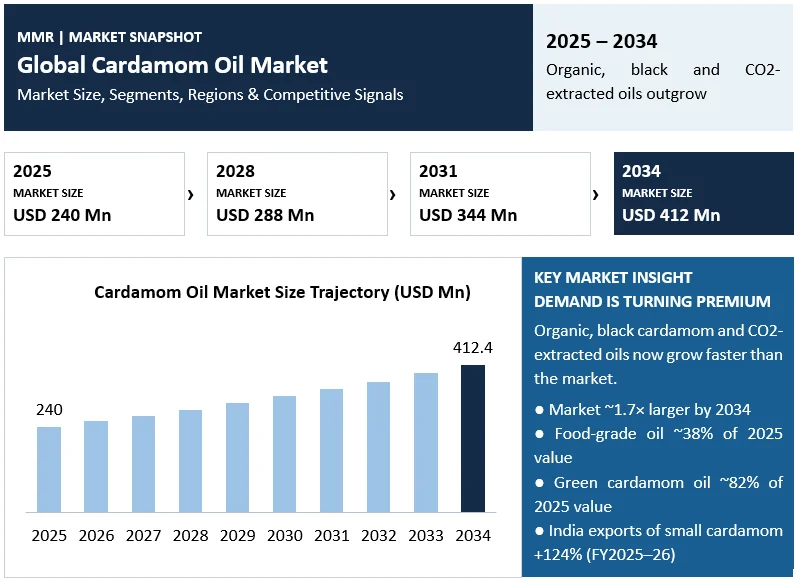
Cardamom Oil Market Growth

To know about the Research Methodology :- Request Free Sample Report
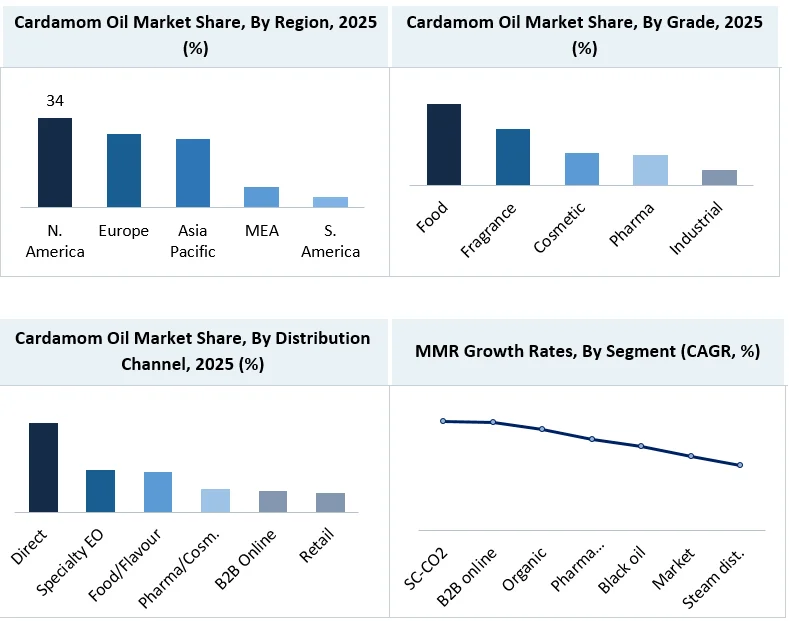
by region (2)

Key Findings: Eight Insights Shaping the Global Cardamom Oil Market

MMR’s analysis of published market data, company filings, trade data, quality standards and industry announcements points to eight findings that explain where cardamom oil market growth and value are created through 2034.

Sr.No.

Findings

Evidence

So what

1

The market
grows about 1.7× by 2034

USD 240 Mn
(2025) to USD 412 Mn (2034) at 6.2% CAGR

Distillation
capacity, raw cardamom sourcing and quality testing must scale together

2

Food and
beverage is the base, wellness the growth edge

Food-grade
oil ~38% of 2025 value; aromatherapy and wellness 8.1% CAGR

Flavour
volumes anchor demand while wellness lifts premium pricing

3

North America
is the largest region

34% share in
2025, led by US food, personal care and aromatherapy buyers

US ingredient
rules and brand standards set purity and labelling expectations

4

Asia Pacific
is the fastest-growing region

7.8% CAGR;
India is the main origin and a rising consumer of cardamom oil

Local
distillation and export capability decide share gains

5

Green
cardamom oil remains the core

Elettaria oil
~82% of 2025 value; black cardamom oil 7.0% CAGR

Defend the
green oil core, scale black oil in fragrance and ethnic cuisine

6

Organic and
CO2 grades outgrow the market

Organic 8.4%
and supercritical CO2 9.1% CAGR versus 6.2% for the market

Certification
and extraction investment unlock premium-priced grades

7

Raw material
supply is the key swing factor

Guatemala
output reported down by about 50%; India small cardamom exports up 124% in FY2025–26

Sourcing
contracts and traceability protect margin during price spikes

8

Quality and
authenticity become buying criteria

ISO 4733 and
GC-MS fingerprints separate genuine oil from adulterated blends

Certified,
batch-consistent suppliers win long-term industrial contracts

Global Cardamom Oil Market Dynamics: Growth Drivers, Restraints, Opportunities and Trends

Global Cardamom Oil Market Growth Drivers: Clean-Label Flavours, Natural Personal Care, Aromatherapy and Premium Fragrance

The Global Cardamom Oil Market is supported by the shift of food, beverage and personal care brands toward natural, plant-derived and clean-label ingredients. Cardamom oil delivers the aroma and flavour of the spice in a concentrated, standardised and stable form, which makes it practical for bakery, dairy desserts, ice cream, tea, coffee, functional beverages, syrups and sauces, where a few parts per million can define the flavour. In personal care, formulators use natural cardamom oil in skincare, hair care, soaps, body washes, deodorants and premium fragrance as consumers look for botanical ingredients with a sensory story. Food-grade oil accounts for about 38% of 2025 value, which gives the market a recurring base because flavour houses reorder against production plans and seasonal launches. These factors support steady cardamom oil market growth across food, beverage and personal care manufacturing, although buyers still test every lot for purity, aroma profile and price. Demand and supply dynamics, innovation in the industry and consumer preferences evolution act as market drivers and growth catalysts for cardamom oil consumption.

Wellness and premium positioning add new layers of demand. Aromatherapy and wellness products, including diffuser blends, massage oils, spa products, candles and incense, are projected to grow at about 8.1% CAGR, faster than the overall market. Pharmaceutical and healthcare buyers use cardamom oil in digestive formulations, herbal preparations, oral care and breath-freshening products and as a flavour and taste-masking ingredient, while research continues on its antimicrobial and antioxidant properties. Organic cardamom oil, about 17% of 2025 value, grows at 8.4% CAGR as buyers pay a premium for certified, traceable supply. On the production side, better steam distillation design, supercritical CO2 extraction (9.1% CAGR) and improved oil recovery make premium grades easier to produce at consistent quality, and Asia Pacific, projected at 7.8% CAGR, adds both raw material supply and rising domestic demand. Together these drivers keep the cardamom essential oil market growing faster than the underlying spice trade.

Global Cardamom Oil Market Restraints: Raw Material Volatility, Low Oil Yield, Adulteration and Substitutes

Raw material price volatility is the main restraint. Cardamom oil is distilled from a high-value spice, and the oil competes with whole cardamom for the same crop. Reported trade data show how tight supply can become: India’s small cardamom exports rose about 124% in volume to roughly 15,050 tonnes in 2025–26 while Guatemala’s output was reported to have fallen by about half, pushing buyers toward Indian auctions and supporting prices. When raw cardamom prices spike, distillers face squeezed margins or must pass costs to flavour and fragrance buyers, who can switch to ginger oil, clove oil, other spice oils or synthetic and nature-identical alternatives. Oil recovery is a second constraint: only a few percent of seed weight converts to oil, so seed freshness, distillation design and recovery efficiency decide cost per kilogram in cardamom oil production. Market constraints, market volatility, industry fluctuations and macroeconomic factors, along with environmental factors such as crop conditions, shape cardamom oil supply and market fluctuation analysis.

Authenticity, quality and compliance challenges also limit growth. Cardamom oil is a premium product and is exposed to adulteration with cheaper oils, synthetic linalyl acetate or terpinyl acetate and fractions of other spice oils, so buyers require GC-MS chemical fingerprints, specifications based on ISO 4733 for Elettaria cardamomum oil and a certificate of analysis for every batch. Food-grade, pharmaceutical-grade and cosmetic-grade oil must meet different flavouring, ingredient and safety rules, and cosmetic formulators in the European Union must declare fragrance allergens present in the oil, such as linalool and limonene. Organic certification adds audit, documentation and yield costs. Climate shocks in growing regions, labour costs, freight and currency swings add further uncertainty, and the fragmented farmer base makes traceability harder than for plantation crops.

What Are the Biggest Cardamom Oil Market Opportunities Through 2034?

Organic cardamom oil, black cardamom oil and CO2-extracted oils represent the most significant opportunities because they extend revenue beyond standard steam-distilled green cardamom oil. Organic grades, growing at 8.4% CAGR, answer demand for certified natural flavours and botanical personal care, while supercritical CO2 extraction (9.1% CAGR) captures fuller, fresher aroma profiles that perfumers and premium beverage brands value. Black cardamom oil, growing at 7.0% CAGR, offers a smoky, camphoraceous note for fragrance, savoury seasoning and ethnic cuisine, and the Amomum subulatum supply chain in India, Nepal and Bhutan remains under-developed for oil. Standardised oils with defined 1,8-cineole and alpha-terpinyl acetate ranges, plus encapsulated, water-soluble and emulsified formats, can move suppliers from commodity oil to application-ready ingredients.

Direct sourcing, new channels and emerging applications offer further routes to growth. Asia Pacific is projected to be the fastest-growing region at 7.8% CAGR as India, China, Japan, South Korea and Indonesia expand food, personal care and wellness demand, while Middle East & Africa (6.9% CAGR) benefits from cardamom-based food and beverage traditions and from the Gulf’s role as the leading destination for Indian cardamom exports, reported at roughly 70–76% of the total. B2B online platforms (about 9.0% CAGR) make it easier for small and mid-sized buyers to source certified oil, and contract manufacturing and private-label production let brands launch without owning distillation capacity. Spent cardamom biomass can be valorised, and research into natural pest control, food preservation and antimicrobial ingredients may open smaller industrial uses. Emerging trends, a market gap in application-ready ingredients and untapped market areas create attractive segment-specific opportunities.

Cardamom Oil Market Trends: Organic Sourcing, CO2 Extraction, Traceability and Wellness Adoption

Four cardamom oil market trends stand out through 2034. First, clean label and natural: food, beverage and personal care brands are replacing artificial flavours and synthetic fragrance notes with natural cardamom oil, and the natural cardamom oil market benefits from plant-based positioning. Second, organic and traceable sourcing: buyers ask for farm-to-bottle traceability, organic certification and sustainability audits, and suppliers respond with cooperative sourcing programmes and batch-level documentation. Third, extraction and analytical innovation: supercritical CO2 and low-temperature extraction, better oil recovery and GC-MS fingerprinting are raising quality and reducing adulteration risk. Fourth, wellness and premiumisation: aromatherapy, spa, luxury perfumery and functional beverages are widening the range of cardamom oil applications and supporting higher realisations per kilogram. Customer engagement dynamics and technology trends further support market trends analysis and industry evolution.

Global Cardamom Oil Market Analysis and Segmentation: By Product Type, Botanical Source, Plant Part, Extraction Method, Grade, Nature, Application and Distribution Channel

Cardamom Oil Market by Product Type and Extraction Method: Green Cardamom Oil, Black Cardamom Oil and Steam Distillation
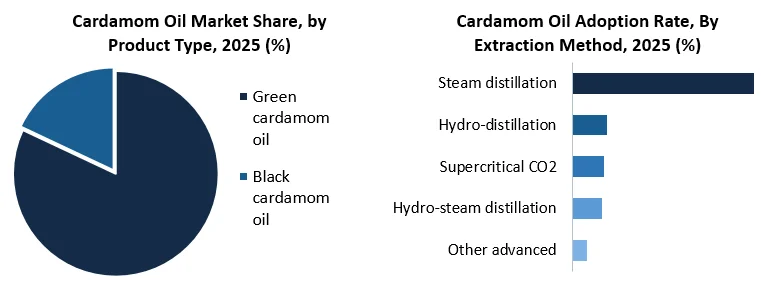
Cardamom Oil Market share by product type

Cardamom Oil Market by Grade, Application, Nature and Distribution Channel Analysis

Green cardamom oil is the largest product type at about 82% of 2025 value, driven by its use in food, beverage, fragrance and aromatherapy, while black cardamom oil holds about 18% and grows faster at 7.0% CAGR. By botanical source, Elettaria cardamomum accounts for about 82% and Amomum subulatum about 18%; by plant part, seed-derived oil holds about 74% and pod and capsule-derived oil about 26%. Steam distillation is used for about 62% of 2025 value, followed by hydro-distillation at 12%, supercritical CO2 extraction at 11%, hydro-steam distillation at 10% and other advanced methods at 5%. By grade, food-grade oil leads at about 38%, followed by fragrance-grade at 26%, cosmetic-grade at 15%, pharmaceutical-grade at 14% and industrial-grade at 7%. Conventional oil holds about 83% of value and organic cardamom oil about 17%, and direct sales are the largest channel at about 38%, while B2B online platforms are the fastest at about 9.0% CAGR. This market segment analysis covers product segmentation, industry segmentation, geographic segmentation, market share by segment and segment growth analysis.

Cardamom Oil Applications: Where Cardamom Oil Demand Sits
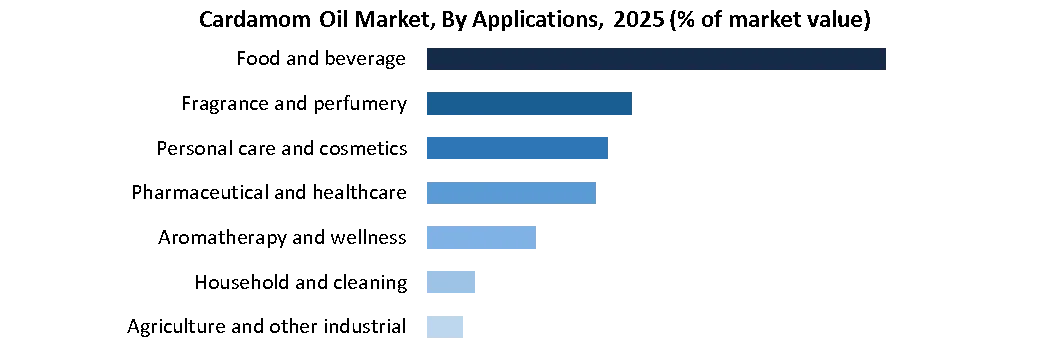
Cardamom Oil Market by application

Global Cardamom Oil Market Analysis by Region: North America, Europe, Asia Pacific, Middle East & Africa and South America

North America is the largest regional market, accounting for about 34% of global value in 2025. The United States is the principal anchor, supported by large food and beverage, flavour and fragrance, nutraceutical and aromatherapy industries, a strong direct-selling and e-commerce channel for essential oils, and the US operations of global ingredient houses and brands such as doTERRA, NOW Foods and Plant Therapy. Canada contributes through natural health products and Mexico through food processing and personal care. The region relies on imported cardamom and oil, so growth is projected at about 5.3% CAGR, led by organic grades, wellness products and premium beverages. Europe holds about 28% of 2025 value, supported by the flavour and fragrance clusters of Switzerland, France, Germany, the Netherlands and the United Kingdom, strong natural cosmetics and perfumery demand and strict ingredient and labelling rules; Europe is expected to grow at about 5.5% CAGR. Regional market trends, market performance by region and regional market share show how local consumer behavior and regional economic factors influence cardamom oil consumption.

Asia Pacific is projected to be the fastest-growing region, with a 7.8% CAGR through 2034. India is both a leading cardamom origin and a large consumer of flavours, herbal medicine and personal care, with spice extraction companies such as Synthite Industries and a large group of essential oil distillers and exporters. Sri Lanka, Nepal, Bhutan and Indonesia add cultivation and processing capacity, while China, Japan and South Korea contribute demand from food, cosmetics and wellness. Middle East & Africa holds about 8% of 2025 value, with growth of about 6.9% CAGR, supported by cardamom-based food and beverage traditions, Gulf buying of Indian cardamom and Tanzania’s role as an African origin. South America, about 4% of value, is projected to grow at about 6.4% CAGR; Guatemala, a leading cardamom supplier tracked with this region for company coverage, supplies raw cardamom and a small number of extractors, while Brazil, Argentina, Chile and Colombia are import-led natural ingredient markets. Regional competitive landscape, area-specific opportunities and geopolitical influences, including regional market challenges, shape the region-specific industry outlook.

Cardamom Oil Companies and Competitive Landscape: Who Are the Top Cardamom Oil Manufacturers and Players?

The cardamom oil competitive landscape includes several distinct groups rather than a single set of comparable companies. Global flavour and fragrance leaders such as Givaudan, dsm-firmenich, Symrise, MANE, Robertet and Döhler buy, process and formulate natural oils at global scale and supply them into food, beverage, personal care and fine fragrance. Spice extraction and essential oil specialists, led by India’s Synthite Industries and distillers such as Plant Lipids, Mane Kancor Ingredients and Norex Flavours, run distillation and extraction close to the raw material. Aromatherapy and natural wellness brands such as doTERRA, Plant Therapy, Mountain Rose Herbs, Eden Botanicals, Edens Garden and NOW Foods sell finished oils to consumers, while Guatemalan producers and cooperatives, including Nelixia, Extract S.A., FEDECOVERA and CARDEX, anchor the Guatemalan origin. These groups compete on different dimensions and should not be ranked as though they were identical producers. Competitor analysis, competitive intelligence and competitor profiling help assess competitive positioning and competitive advantage assessment among industry players.

Competition is increasingly shaped by secure access to raw cardamom, extraction know-how and verified quality. The largest flavour and fragrance houses compete on formulation, regulatory support and global supply: Givaudan reported 2025 sales of CHF 7.47 billion, dsm-firmenich net sales of EUR 9.03 billion from continuing operations and Symrise revenue of EUR 4.93 billion, although cardamom oil is a small part of their natural ingredient portfolios. Specialist distillers differentiate through origin, direct farmer relationships, organic certification, CO2 extraction, standardised oils and price, and aromatherapy brands compete on brand, purity claims and direct-to-consumer reach. The market is fragmented at producer level and more concentrated among flavour and fragrance buyers. Sourcing partnerships with farmer groups and investment in certified, traceable supply are likely to continue as raw material volatility rewards integrated players. Company revenue, company net sales, rival market share and competitive strategy review are central to strategic analysis and competitive benchmark analysis of the market.

Global Cardamom Oil Market Recent Developments, Raw Material Signals and Industry News | 2025–2026

Date

Development

Why it matters

Jan 2026

Givaudan reports
FY2025 sales of CHF 7.47 Bn and targets 4–6% like-for-like growth over five
years

Natural
flavour and fragrance demand stays healthy

Feb 2026

dsm-firmenich
agrees to sell its Animal Nutrition & Health business to CVC Capital
Partners and keeps a 20% stake

Refocus on
perfumery, beauty, taste and health

Feb 2026

dsm-firmenich
reports FY2025 continuing net sales of EUR 9.03 Bn with 3% organic growth

Taste and
perfumery buyers keep growing

Mar 2026

Symrise
reports FY2025 revenue of EUR 4.93 Bn and an adjusted EBITDA margin of 21.9%

Naturals and
beverages lead food growth

2026

Guatemala’s
cardamom output reported down by about 50%

Tight origin
supply supports raw material prices

Aug 2026

Banco de
Guatemala data show US$351 Mn of cardamom exports in January–July 2026
(preliminary)

Guatemala
stays a major supplier despite a smaller crop

Oct 2026

India eyes
record cardamom exports as Gulf buyers return; Gulf takes about 70–76% of
exports

Gulf demand
and shipping lanes influence origin pricing

FY2025–26

India exports
about 15,050 tonnes of small cardamom, up 124% in volume from 6,728 tonnes

Raw cardamom
supply shifts toward Indian origin

Global Cardamom Oil Market Scope: Inquire before buying

Global Cardamom Oil Market

Report Coverage

Details

Base Year:

2025

Forecast Period:

2026-2034

Historical Data:

2020 to 2025

Market Size in 2025:

USD 0.24 Billion

Forecast Period 2026 to 2034 CAGR:

6.2%

Market Size in 2034:

USD 0.41 Billion

Segments
Covered:

By Product Type

Green Cardamom Oil; Black Cardamom Oil

By Botanical Source

Elettaria cardamomum; Amomum subulatum

By Plant Part

Seed-Derived Cardamom Oil; Pod and
Capsule-Derived Cardamom Oil

By Extraction Method

Steam Distillation; Hydro-Distillation;
Hydro-Steam Distillation; Supercritical CO2 Extraction; Other Advanced Extraction
Methods

By Grade

Food-Grade Cardamom Oil;
Pharmaceutical-Grade Cardamom Oil; Cosmetic-Grade Cardamom Oil;
Fragrance-Grade Cardamom Oil; Industrial-Grade Cardamom Oil

By Nature

Organic Cardamom Oil; Conventional Cardamom
Oil

By Application

Food and Beverage; Pharmaceutical and
Healthcare; Personal Care and Cosmetics; Fragrance and Perfumery;
Aromatherapy and Wellness; Household and Cleaning Products; Agriculture and
Other Industrial Applications

By Distribution Channel

Direct Sales; Specialty Essential Oil
Distributors; Food and Flavour Ingredient Distributors; Pharmaceutical and
Cosmetic Ingredient Distributors; B2B Online Distribution Platforms; Retail
E-Commerce and Specialty Stores

Global Cardamom Oil Market, By Region

North America (United States, Canada, Mexico)
Europe (Germany, United Kingdom, France, Italy, Spain, Netherlands, Switzerland, Belgium, Sweden, Denmark, Poland, Austria, Rest of Europe)
Asia Pacific (India, China, Japan, South Korea, Australia, Indonesia, Sri Lanka, Nepal, Bhutan, Thailand, Rest of Asia Pacific)
Middle East & Africa (United Arab Emirates, Saudi Arabia, Oman, Qatar, South Africa, Tanzania, Rest of Middle East & Africa)
South America (Brazil, Argentina, Chile, Colombia, Rest of South America)

Global Cardamom Oil Market, Key Players

North America
1. Givaudan SA – USA Operations
2. dsm-firmenich – USA Operations
3. doTERRA International LLC
4. HBNO (Health and Beauty Natural Oils)
5. Vigon International
6. Plant Therapy Essential Oils
7. Mountain Rose Herbs
8. Eden Botanicals
9. Edens Garden
10. NOW Foods
11. Bio-Botanica Inc.
12. Apex Flavors Inc.
13. Robertet USA
14. Bontoux USA
15. A.G. Organica – North American Distribution
Europe
16. Givaudan SA – Switzerland
17. dsm-firmenich AG – Switzerland
18. Biolandes – France
19. Robertet SA – France
20. Bontoux SAS – France
21. MANE Group – France
22. Ventós SA – Spain
23. Treatt plc – United Kingdom
24. Ernesto Ventós SA – Spain
25. Symrise AG – Germany
26. Döhler GmbH – Germany
27. Aromsa – Turkey
28. Berjé Inc. – European Operations
Asia Pacific
29. Synthite Industries Ltd. – India
30. Plant Lipids Pvt. Ltd. – India
31. Mane Kancor Ingredients Pvt. Ltd. – India
32. Norex Flavours Private Limited – India
33. Botanic Healthcare – India
34. AOS Products Pvt. Ltd. – India
35. A.G. Organica Pvt. Ltd. – India
36. Aromaaz International – India
37. Moksha Lifestyle Products – India
38. India Essential Oils – India
39. Greenleaf Extractions Pvt. Ltd. – India
40. Rakesh Sandal Industries – India
41. A.G. Industries – India
42. Shubham Flavours & Fragrances – India
43. Reynolds India Ltd. – India
44. Avi Naturals – India
45. Natural Aroma Products Pvt. Ltd. – India
46. Kanwal Enterprises Pvt. Ltd. – India
47. Sunrise Agriland Development & Research Pvt. Ltd. – India
48. Herbo Nutra Extract Pvt. Ltd. – India
49. Vaibhav Perfumery – India
50. Hind Nature Oils & Chemicals – India
51. Joshi Agrochem Pharma Pvt. Ltd. – India
52. Misri Fumet Pvt. Ltd. – India
53. India Aroma Oils and Company – India
54. James Wild Herbs – India
55. Scapex Exports Pvt. Ltd. – India
56. Uni-Raj International – India
57. Sohuum Aroma Pvt. Ltd. – India
58. Flamingo Exports – India
59. Vikas Aromatics – India
60. Himveda Organic – India
61. Kiga Naturals Pvt. Ltd. – India
62. RV International – India
63. Bodhana Export Pvt. Ltd. – India
64. Gracious Organic LLP – India
65. Triveni Interchem Pvt. Ltd. – India
66. Kshipra Biotech Pvt. Ltd. – India
67. Lopa Sciences Pvt. Ltd. – India
68. Vedagreen Herbals Pvt. Ltd. – India
69. Aromacare Herbals – India
70. Rare Essential Oils Pvt. Ltd. – India
South America
71. Natex Guatemala – Guatemala
72. Nelixia – Guatemala
73. Extract, S.A. – Guatemala
74. FEDECOVERA – Guatemala
75. CARDEX – Guatemala
76. Del Trópico – Guatemala
77. Agroproducts Dinámica – Guatemala

Global Cardamom Oil Market FAQs: Frequently Asked Questions

What is the cardamom oil market size and forecast for the global cardamom oil market?
MMR values the Global Cardamom Oil Market at USD 0.24 billion (USD 240 million) in 2025, USD 255 million in 2026 and USD 0.41 billion (USD 412 million) by 2034, a 6.2% CAGR over 2026–2034. The 2034 value is about 1.7 times the 2025 base, and published cardamom oil market size estimates for 2025 for oil-only reports range from about USD 0.19 billion to USD 0.22 billion depending on scope. This market size view reflects cardamom oil demand, cardamom oil supply and cardamom oil consumption trends.

Which region and country is the largest cardamom oil market?
North America holds the largest cardamom oil market share at about 34% in 2025, anchored by the United States. Europe follows at about 28% and Asia Pacific at about 26%. Asia Pacific is the fastest-growing region at 7.8% CAGR, led by India, China, Japan and Indonesia. Geographic analysis and regional market performance confirm these regional insights.

Which cardamom oil segments are growing fastest?
Green cardamom oil is the largest product type at about 82% of 2025 value, while black cardamom oil grows faster at 7.0% CAGR. Supercritical CO2 extraction grows at 9.1%, B2B online distribution at about 9.0%, organic cardamom oil at 8.4%, aromatherapy and wellness at 8.1% and pharmaceutical-grade oil at 7.6%, all above the 6.2% market rate.

Who are the leading cardamom oil companies?
Leading names include Givaudan, dsm-firmenich, Symrise, MANE, Robertet and Döhler among flavour and fragrance leaders, Synthite Industries and other Indian extractors at origin, and aromatherapy brands such as doTERRA, Plant Therapy and NOW Foods, alongside Guatemalan producers such as Nelixia, Extract S.A. and FEDECOVERA. This is the core of the cardamom oil competitive landscape.

How is cardamom oil produced, and what is the difference between green and black cardamom oil?
Cardamom oil production starts with cleaning, drying and crushing the seeds or capsules, followed by steam distillation, hydro-distillation or supercritical CO2 extraction, then condensation, separation, filtration and storage. Green cardamom oil comes from Elettaria cardamomum and is sweet, floral and spicy, while black cardamom oil comes from Amomum subulatum and is smoky and camphoraceous.

Global Cardamom Oil Market Research Methodology

MMR sized the market top-down from a 2025 base of USD 0.24 billion (USD 240 million) and a 6.2% CAGR for 2026–2034, then triangulated against published market reports (oil-only 2025 estimates of roughly USD 0.19 to 0.22 billion and CAGRs of about 4% to 8%), company filings and press releases (Givaudan, dsm-firmenich, Symrise and others), trade data on cardamom exports from India and Guatemala, quality standards such as ISO 4733 and industry announcements through November 2026. Volume (about 480 metric tons in 2025) and average realisation (about USD 500 per kg) are MMR estimates. Segment shares and regional splits are MMR estimates anchored to published splits (for example North America as the largest region and food and beverage as the largest application) and are normalized so every segment sums to the market total. Annual values are constant-CAGR interpolation. Segment CAGRs are the effective rates after normalization.

Table of Contents

1. Executive Market Landscape and Industry Overview 1.1. Global Cardamom Oil Market Size (Value USD Billion & Volume in Metric Tons), 2025–2034 1.2. Evolution of Cardamom Oil from Traditional Spice Extraction to Commercial Essential Oil Production 1.3. Definition, Scope and Classification of Cardamom Oil 1.4. Role of Cardamom Oil in Food, Beverage, Pharmaceutical and Personal Care Industries 1.5. Importance of Botanical Origin, Chemical Composition and Essential Oil Purity 1.6. Growing Adoption of Natural Flavours, Fragrances and Plant-Based Ingredients 1.7. CAGR Analysis of Global Cardamom Oil Market During 2025–2034 2. Cardamom Oil Market Dynamics 2.1. Cardamom Oil Market Trends 2.2. Cardamom Oil Market Dynamics 2.2.1. Drivers 2.2.2. Restraints 2.2.3. Opportunities 2.2.4. Challenges 2.3. PORTER's Five Forces Analysis 2.4. PESTLE Analysis 3. Cardamom Oil Market Macroeconomic Factors 3.1. Global Spice Production and International Trade Trends 3.2. Cardamom Cultivation, Agricultural Output and Raw Material Availability 3.3. Global Food and Beverage Industry Growth and Ingredient Consumption 3.4. Consumer Expenditure on Natural Personal Care and Fragrance Products 3.5. Agricultural Input Costs, Labour Expenses and Cultivation Economics 3.6. International Trade Policies and Essential Oil Import-Export Regulations 3.7. Foreign Exchange Movements and Global Spice Commodity Price Fluctuations 4. Cardamom Oil Industry Trends & Emerging Technology Requirements 4.1. Increasing Demand for Natural and Clean-Label Flavouring Ingredients 4.2. Growing Preference for Plant-Derived Essential Oils in Personal Care 4.3. Expansion of Aromatherapy and Natural Wellness Product Applications 4.4. Increasing Adoption of Advanced Steam Distillation Technologies 4.5. Growing Demand for Traceable and Sustainably Sourced Cardamom 4.6. Development of Improved Oil Recovery and Extraction Efficiency 4.7. Increasing Commercialization of Organic and Premium-Grade Cardamom Oil 5. Cardamom Oil Botanical Architecture & Raw Material Ecosystem 5.1. Botanical Classification and Taxonomy of Cardamom Plants 5.2. Elettaria cardamomum and Small Green Cardamom Characteristics 5.3. Amomum subulatum and Large Black Cardamom Characteristics 5.4. Cardamom Seed, Pod and Capsule Raw Material Characteristics 5.5. Essential Oil-Producing Plant Components and Volatile Compound Distribution 5.6. Cultivation Conditions, Soil Requirements and Climatic Influences 5.7. Harvesting, Post-Harvest Handling and Raw Material Quality Preservation 6. Cardamom Oil Product Types, Composition & Quality Landscape 6.1. Green Cardamom Essential Oil 6.2. Black Cardamom Essential Oil 6.3. Cardamom Seed Essential Oil 6.4. Cardamom Pod and Capsule-Derived Essential Oil 6.5. Natural and Conventional Cardamom Essential Oil 6.6. Organic and Certified Cardamom Essential Oil 6.7. Standardized and Customized Cardamom Oil Formulations 7. Cardamom Oil Extraction Technologies & Processing Systems 7.1. Steam Distillation Technology for Cardamom Essential Oil Production 7.2. Hydro-Distillation and Water-Based Extraction Processes 7.3. Hydro-Steam Distillation and Integrated Extraction Systems 7.4. Supercritical Carbon Dioxide Extraction Technologies 7.5. Solvent-Based Extraction and Aromatic Compound Recovery 7.6. Microwave-Assisted and Advanced Essential Oil Extraction Technologies 7.7. Oil Separation, Condensation and Recovery Optimization 8. Cardamom Oil Manufacturing, Processing & Production Technologies 8.1. Raw Cardamom Cleaning, Sorting and Foreign Matter Removal 8.2. Cardamom Drying, Conditioning and Moisture Control 8.3. Seed Separation, Crushing and Raw Material Preparation 8.4. Distillation Equipment Design and Processing Operations 8.5. Essential Oil Condensation, Separation and Filtration 8.6. Oil Refinement, Stabilization and Post-Extraction Processing 8.7. Manufacturing Automation, Production Efficiency and Quality Assurance 9. Cardamom Oil Chemical Composition & Analytical Testing 9.1. 1,8-Cineole Concentration and Chemical Composition Analysis 9.2. Alpha-Terpinyl Acetate Content and Aroma Characteristics 9.3. Linalool, Linalyl Acetate and Terpene Compound Assessment 9.4. Sabinene, Limonene and Other Volatile Compound Analysis 9.5. Gas Chromatography-Mass Spectrometry (GC-MS) Testing 9.6. Refractive Index, Specific Gravity and Optical Rotation Assessment 9.7. Purity, Adulteration Detection and Chemical Fingerprinting 10. Cardamom Oil Grades, Purity & Product Standardization 10.1. Food-Grade Cardamom Essential Oil 10.2. Pharmaceutical and Therapeutic-Grade Cardamom Oil 10.3. Cosmetic and Personal Care-Grade Cardamom Oil 10.4. Fragrance and Perfumery-Grade Cardamom Oil 10.5. Industrial and Commercial-Grade Cardamom Oil 10.6. Organic, Natural and Certified Essential Oil Standards 10.7. Product Purity, Batch Consistency and Quality Certification Requirements 11. Cardamom Oil Formulation, Blending & Product Development 11.1. Pure Cardamom Essential Oil Formulations 11.2. Cardamom Oil Blends with Other Spice Essential Oils 11.3. Cardamom Oil Blends with Floral and Herbal Essential Oils 11.4. Encapsulated Cardamom Oil and Controlled-Release Formulations 11.5. Water-Soluble and Emulsified Cardamom Oil Formulations 11.6. Flavour and Fragrance Concentrate Development 11.7. Customized Cardamom Oil Formulations for Industrial Applications 12. Cardamom Oil Packaging, Storage & Shelf-Life Management 12.1. Amber Glass Bottles and Light-Protective Packaging 12.2. Aluminium Containers and Industrial Bulk Packaging 12.3. Stainless Steel Drums and Commercial Storage Solutions 12.4. Small-Volume Retail Packaging and Dropper-Based Containers 12.5. Oxygen, Light and Temperature Control During Storage 12.6. Oxidation Prevention and Essential Oil Stability Management 12.7. Shelf-Life Assessment, Batch Traceability and Inventory Management 13. Cardamom Oil Food & Beverage Applications 13.1. Bakery Products and Commercial Confectionery Applications 13.2. Dairy Products, Desserts and Ice Cream Flavouring 13.3. Tea, Coffee and Functional Beverage Formulations 13.4. Carbonated Drinks, Syrups and Non-Alcoholic Beverages 13.5. Processed Foods, Sauces and Culinary Seasoning Applications 13.6. Traditional Food Products and Ethnic Cuisine Applications 13.7. Food Flavour Concentrates and Industrial Ingredient Formulations 14. Cardamom Oil Pharmaceutical & Healthcare Applications 14.1. Digestive Health and Gastrointestinal Formulations 14.2. Herbal Medicines and Traditional Healthcare Preparations 14.3. Oral Care Products and Breath-Freshening Formulations 14.4. Pharmaceutical Flavouring and Taste-Masking Applications 14.5. Functional Healthcare Products and Herbal Preparations 14.6. Research-Based Antimicrobial and Antioxidant Applications 14.7. Pharmaceutical Ingredient Development and Formulation Research 15. Cardamom Oil Personal Care, Cosmetics & Skincare Applications 15.1. Skincare Products and Cosmetic Formulations 15.2. Hair Care Products and Essential Oil Blends 15.3. Body Lotions, Creams and Moisturizing Products 15.4. Soaps, Body Washes and Bathing Products 15.5. Deodorants and Personal Hygiene Formulations 15.6. Natural Cosmetics and Premium Beauty Products 15.7. Cosmetic Fragrance Development and Sensory Enhancement 16. Cardamom Oil Fragrance, Perfumery & Aromatherapy Applications 16.1. Fine Fragrances and Luxury Perfume Formulations 16.2. Home Fragrances, Diffusers and Air Freshening Products 16.3. Aromatherapy Oils and Essential Oil Blends 16.4. Incense Sticks, Candles and Fragrance Products 16.5. Spa, Massage and Wellness Product Formulations 16.6. Premium Fragrance Compounds and Niche Perfumery 16.7. Fragrance Fixatives, Aroma Enhancement and Blending Applications 17. Cardamom Oil Household, Cleaning & Industrial Applications 17.1. Household Cleaning and Natural Cleaning Formulations 17.2. Air Fresheners and Indoor Fragrance Products 17.3. Natural Surface Cleaning and Disinfection Formulations 17.4. Industrial Fragrance and Flavour Ingredient Applications 17.5. Institutional Hygiene and Commercial Cleaning Products 17.6. Specialty Chemical and Botanical Ingredient Applications 17.7. Emerging Applications in Natural and Bio-Based Products 18. Cardamom Oil Agriculture, Livestock & Other Emerging Applications 18.1. Botanical Pest Management and Plant-Based Repellent Formulations 18.2. Agricultural Research and Natural Crop Protection Applications 18.3. Veterinary Product and Animal Care Formulations 18.4. Feed Additives and Livestock Product Research 18.5. Food Preservation and Post-Harvest Protection Research 18.6. Antimicrobial and Bioactive Ingredient Research Applications 18.7. Emerging Industrial and Biotechnology Applications 19. Cardamom Oil Raw Material Procurement & Agricultural Supply Chain 19.1. Cardamom Farming and Cultivation Networks 19.2. Green Cardamom Production and Procurement Ecosystem 19.3. Black Cardamom Production and Procurement Ecosystem 19.4. Farmer Cooperatives and Agricultural Producer Networks 19.5. Spice Traders, Aggregators and Raw Material Procurement Channels 19.6. Raw Cardamom Quality Assessment and Supplier Qualification 19.7. Agricultural Traceability, Inventory Management and Supply Chain Resilience 20. Cardamom Oil Manufacturing Infrastructure & Production Ecosystem 20.1. Essential Oil Manufacturing Facilities and Processing Infrastructure 20.2. Industrial Distillation Equipment and Production Capacity 20.3. Raw Material Handling and Automated Processing Systems 20.4. Essential Oil Separation, Filtration and Storage Infrastructure 20.5. Manufacturing Capacity Utilization and Production Economics 20.6. Contract Manufacturing and Private-Label Production 20.7. Manufacturing Expansion, Technology Investments and Operational Efficiency 21. Cardamom Oil Supply Chain & Distribution Ecosystem 21.1. Cardamom Farmers and Primary Raw Material Suppliers 21.2. Spice Aggregators, Traders and Wholesale Procurement Networks 21.3. Essential Oil Extractors and Contract Manufacturers 21.4. Bulk Essential Oil Distributors and Ingredient Suppliers 21.5. Industrial Buyers and Direct B2B Procurement Networks 21.6. Specialty Ingredient Distributors and Regional Importers 21.7. Logistics, Warehousing and International Supply Chain Management 22. Cardamom Oil Pricing, Production Economics & Cost Structure 22.1. Green Cardamom Raw Material Pricing and Procurement Costs 22.2. Black Cardamom Raw Material Pricing and Procurement Costs 22.3. Essential Oil Extraction Costs and Processing Economics 22.4. Energy Consumption, Labour Expenses and Manufacturing Costs 22.5. Organic Certification and Quality Testing Expenditure 22.6. Bulk Cardamom Oil Pricing and Retail Product Pricing 22.7. Production Yield, Profitability and Total Cost Analysis 23. Cardamom Oil Distribution, Sales & Procurement Landscape 23.1. Direct Sales Through Essential Oil Manufacturers 23.2. Specialty Essential Oil Distributors and Ingredient Suppliers 23.3. Food Flavour and Fragrance Ingredient Distribution Networks 23.4. Pharmaceutical and Cosmetic Ingredient Supply Channels 23.5. B2B E-Commerce and Online Wholesale Platforms 23.6. Retail E-Commerce and Specialty Essential Oil Stores 23.7. Distributor Partnerships, Customer Acquisition and After-Sales Support 24. Cardamom Oil Market Adoption, Consumption & Customer Economics 24.1. Adoption Among Food and Beverage Manufacturers 24.2. Consumption Patterns Across Pharmaceutical and Healthcare Industries 24.3. Adoption Among Cosmetics and Personal Care Manufacturers 24.4. Demand from Fragrance, Perfumery and Aromatherapy Companies 24.5. Industrial Buyer Preferences for Oil Purity and Botanical Origin 24.6. Customer Procurement Volumes and Supplier Retention Trends 24.7. Natural Ingredient Adoption and Customer Willingness to Pay 25. Cardamom Oil Technology Innovation, R&D & Product Development 25.1. Advancements in Essential Oil Extraction and Recovery Technologies 25.2. Development of High-Purity and Standardized Cardamom Oil 25.3. Research in Supercritical CO2 and Low-Temperature Extraction 25.4. Innovation in Encapsulation and Controlled-Release Technologies 25.5. Development of Natural Flavour and Fragrance Formulations 25.6. Chemical Profiling, Adulteration Detection and Analytical Innovation 25.7. R&D Investments, Research Collaborations and Intellectual Property Development 26. Cardamom Oil Market Regulatory, Certification & Quality Standards 26.1. Food Safety and Food Flavouring Ingredient Regulations 26.2. Essential Oil Quality Standards and International Specifications 26.3. ISO Standards and Essential Oil Quality Requirements 26.4. Food-Grade and Pharmaceutical Ingredient Compliance Requirements 26.5. Cosmetic Ingredient Safety and Regulatory Requirements 26.6. Organic Certification and Sustainable Agricultural Standards 26.7. International Trade, Labelling and Import-Export Compliance 27. Cardamom Oil Sustainability, Environmental Impact & Ethical Sourcing 27.1. Sustainable Cardamom Cultivation and Agricultural Practices 27.2. Water Consumption and Environmental Impact of Cardamom Farming 27.3. Energy Efficiency in Essential Oil Distillation Processes 27.4. Utilization of Spent Cardamom Biomass and Agricultural Waste 27.5. Sustainable Packaging and Essential Oil Storage Solutions 27.6. Organic Farming, Responsible Sourcing and Farmer Welfare 27.7. Long-Term Sustainability Requirements for Essential Oil Manufacturing 28. Cardamom Oil Regional & Country-Level Market Landscape 28.1. North American Essential Oil Consumption and Natural Ingredient Demand 28.2. European Food, Fragrance and Personal Care Ingredient Markets 28.3. Asia-Pacific Cardamom Cultivation, Extraction and Consumption Landscape 28.4. Middle East & Africa Spice Trade and Essential Oil Demand 28.5. South American Natural Ingredient and Essential Oil Market Development 28.6. India, Guatemala, Sri Lanka, Nepal, Bhutan, Indonesia, Tanzania, Saudi Arabia, UAE, United States, Germany, United Kingdom, France, Japan and China 28.7. Regional Production Capacity, International Trade and Market Expansion Trends 29. Cardamom Oil Market: Market Size and Forecast by Segmentation (Value USD Billion & Volume in Metric Tons) (2025–2034) 29.1. Cardamom Oil Market Size and Forecast, By Product Type 29.1.1. Green Cardamom Oil 29.1.2. Black Cardamom Oil 29.2. Cardamom Oil Market Size and Forecast, By Botanical Source 29.2.1. Elettaria cardamomum 29.2.2. Amomum subulatum 29.3. Cardamom Oil Market Size and Forecast, By Plant Part 29.3.1. Seed-Derived Cardamom Oil 29.3.2. Pod and Capsule-Derived Cardamom Oil 29.4. Cardamom Oil Market Size and Forecast, By Extraction Method 29.4.1. Steam Distillation 29.4.2. Hydro-Distillation 29.4.3. Hydro-Steam Distillation 29.4.4. Supercritical CO2 Extraction 29.4.5. Other Advanced Extraction Methods 29.5. Cardamom Oil Market Size and Forecast, By Grade 29.5.1. Food-Grade Cardamom Oil 29.5.2. Pharmaceutical-Grade Cardamom Oil 29.5.3. Cosmetic-Grade Cardamom Oil 29.5.4. Fragrance-Grade Cardamom Oil 29.5.5. Industrial-Grade Cardamom Oil 29.6. Cardamom Oil Market Size and Forecast, By Nature 29.6.1. Organic Cardamom Oil 29.6.2. Conventional Cardamom Oil 29.7. Cardamom Oil Market Size and Forecast, By Application 29.7.1. Food and Beverage 29.7.2. Pharmaceutical and Healthcare 29.7.3. Personal Care and Cosmetics 29.7.4. Fragrance and Perfumery 29.7.5. Aromatherapy and Wellness 29.7.6. Household and Cleaning Products 29.7.7. Agriculture and Other Industrial Applications 29.8. Cardamom Oil Market Size and Forecast, By Distribution Channel 29.8.1. Direct Sales 29.8.2. Specialty Essential Oil Distributors 29.8.3. Food and Flavour Ingredient Distributors 29.8.4. Pharmaceutical and Cosmetic Ingredient Distributors 29.8.5. B2B Online Distribution Platforms 29.8.6. Retail E-Commerce and Specialty Stores 29.9. Cardamom Oil Market Size and Forecast, By Region 29.9.1. North America 29.9.1.1. United States 29.9.1.2. Canada 29.9.1.3. Mexico 29.9.2. Europe 29.9.2.1. Germany 29.9.2.2. United Kingdom 29.9.2.3. France 29.9.2.4. Italy 29.9.2.5. Spain 29.9.2.6. Netherlands 29.9.2.7. Switzerland 29.9.2.8. Belgium 29.9.2.9. Sweden 29.9.2.10. Denmark 29.9.2.11. Poland 29.9.2.12. Austria 29.9.2.13. Rest of Europe 29.9.3. Asia Pacific 29.9.3.1. India 29.9.3.2. China 29.9.3.3. Japan 29.9.3.4. South Korea 29.9.3.5. Australia 29.9.3.6. Indonesia 29.9.3.7. Sri Lanka 29.9.3.8. Nepal 29.9.3.9. Bhutan 29.9.3.10. Thailand 29.9.3.11. Rest of Asia Pacific 29.9.4. Middle East and Africa 29.9.4.1. United Arab Emirates 29.9.4.2. Saudi Arabia 29.9.4.3. Oman 29.9.4.4. Qatar 29.9.4.5. South Africa 29.9.4.6. Tanzania 29.9.4.7. Rest of Middle East and Africa 29.9.5. South America 29.9.5.1. Brazil 29.9.5.2. Argentina 29.9.5.3. Chile 29.9.5.4. Colombia 29.9.5.5. Rest of South America 30. Cardamom Oil Market Competitive Landscape 30.1. MMR Competition Matrix 30.2. Competitive Positioning of Leading Key Players [Revenue and Market Share (%)] 30.3. Key Players Benchmarking 30.3.1. Company Name 30.3.2. Headquarters 30.3.3. Cardamom Oil Product Portfolio 30.3.4. Botanical Origin and Raw Material Sourcing 30.3.5. Extraction Technologies and Manufacturing Capabilities 30.3.6. Product Grades, Purity and Chemical Composition 30.3.7. Food, Pharmaceutical and Fragrance Applications 30.3.8. Total Company Revenue (2025) 30.3.9. Cardamom Oil-Related Revenue (2025) 30.3.10. Geographic Presence 30.3.11. Distribution and Commercial Network 30.3.12. Strategic Partnerships and Supply Chain Collaborations 30.4. Market Structure 30.4.1. Established Essential Oil and Spice Extract Manufacturers 30.4.2. Specialized Cardamom Oil Producers 30.4.3. Regional Essential Oil Manufacturers 30.4.4. Emerging and Niche Essential Oil Suppliers 30.5. Growth Rate / Y-o-Y (%) of Companies 30.6. Profit Margin (%) of Companies 30.7. R&D Investments (%) of Companies 30.8. Revenue Vs. Net Earnings – Financial Health Benchmarking (2025) 30.9. Revenue Performance and Financial Analysis (2025) 30.10. Mergers and Acquisitions Details 30.11. Recent Key Developments 31. Cardamom Oil Manufacturers, Extractors & Processing Companies 31.1. Large-Scale Cardamom Essential Oil Manufacturers 31.2. Specialized Cardamom Oil Extraction Companies 31.3. Spice Oleoresin and Essential Oil Processing Companies 31.4. Organic and Natural Essential Oil Manufacturers 31.5. Contract Essential Oil Manufacturing Companies 31.6. Production Capacity and Manufacturing Infrastructure Benchmarking 31.7. Extraction Efficiency, Product Quality and Manufacturing Cost Benchmarking 32. Cardamom Oil Raw Material Producers & Agricultural Suppliers 32.1. Green Cardamom Cultivators and Agricultural Producers 32.2. Black Cardamom Cultivators and Agricultural Producers 32.3. Cardamom Seed and Pod Suppliers 32.4. Agricultural Cooperatives and Farmer Producer Organizations 32.5. Raw Cardamom Aggregators and Wholesale Traders 32.6. Organic and Certified Cardamom Raw Material Suppliers 32.7. Agricultural Sourcing, Traceability and Supplier Capability Benchmarking 33. Cardamom Oil Flavour, Fragrance & Ingredient Solution Providers 33.1. Natural Flavour and Fragrance Ingredient Manufacturers 33.2. Food Flavouring and Spice Extract Solution Providers 33.3. Pharmaceutical Flavour Ingredient Manufacturers 33.4. Cosmetic and Personal Care Ingredient Manufacturers 33.5. Fragrance Compound and Perfumery Ingredient Suppliers 33.6. Customized Essential Oil Blending and Formulation Companies 33.7. Product Portfolio, Application Expertise and Customer Network Benchmarking 34. Cardamom Oil Testing, Certification & Quality Assurance Providers 34.1. Essential Oil Chemical Analysis and Testing Laboratories 34.2. GC-MS and Chromatographic Testing Service Providers 34.3. Food Safety and Ingredient Quality Certification Organizations 34.4. Organic and Sustainable Agriculture Certification Providers 34.5. Essential Oil Purity and Adulteration Testing Companies 34.6. Regulatory Compliance and Product Documentation Services 34.7. Quality Testing Accuracy and Certification Capability Benchmarking 35. Cardamom Oil Distribution, Trading & Export Companies 35.1. Bulk Essential Oil Distributors and Wholesalers 35.2. Cardamom Oil Exporters and International Trading Companies 35.3. Specialty Natural Ingredient Distributors 35.4. Food and Beverage Ingredient Distribution Companies 35.5. Pharmaceutical and Cosmetic Ingredient Distributors 35.6. Online Essential Oil Retailers and B2B Marketplaces 35.7. Distribution Reach, Export Performance and Customer Network Benchmarking 36. Cardamom Oil End-Use Industry & Formulation Companies 36.1. Food and Beverage Flavour Manufacturers 36.2. Pharmaceutical and Herbal Product Manufacturers 36.3. Cosmetics and Personal Care Product Manufacturers 36.4. Fragrance and Perfumery Manufacturers 36.5. Aromatherapy and Essential Oil Product Brands 36.6. Household Cleaning and Hygiene Product Manufacturers 36.7. End-Use Industry Adoption and Ingredient Procurement Benchmarking 37. Cardamom Oil Manufacturers' Strategies & Expansion Plans 37.1. Expansion of Cardamom Essential Oil Product Portfolios 37.2. Investments in Advanced Extraction and Processing Technologies 37.3. Expansion of Organic and Premium-Grade Oil Production 37.4. Strategic Sourcing Partnerships with Cardamom Farmers 37.5. Expansion of Manufacturing and Distillation Facilities 37.6. Development of Customized Food and Fragrance Formulations 37.7. Geographic Expansion Across International Essential Oil Markets 37.8. Mergers, Acquisitions and Strategic Technology Collaborations 38. Cardamom Oil Industry SWOT, Investments & Strategic Developments 38.1. Competitive Strengths of Established Cardamom Oil Manufacturers 38.2. Raw Material Price Volatility and Production Limitations 38.3. Emerging Opportunities in Natural Flavours and Fragrances 38.4. Competitive Threats from Alternative Spice Essential Oils 38.5. Strategic Investments in Essential Oil Manufacturing Infrastructure 38.6. Investments in Sustainable Cultivation and Extraction Technologies 38.7. Major Product Launches, Partnerships and Industry Developments 39. Cardamom Oil Competitive Outlook & Market Positioning 39.1. Competitive Dynamics Across Green and Black Cardamom Oil 39.2. Market Concentration Across Global Manufacturing and Distribution Networks 39.3. Product Differentiation Through Botanical Origin and Chemical Composition 39.4. Competitive Positioning of Established Manufacturers and Emerging Suppliers 39.5. Expansion of Cardamom Oil Across Food, Fragrance and Healthcare Industries 39.6. Future Innovation in Essential Oil Extraction and Product Standardization 39.7. Long-Term Competitive Positioning of Leading Cardamom Oil Companies 40. Company Profile: Key Players 40.1 Detailed Profile Considering the Parameters 40.2 Overview 40.3 Business Portfolio 40.4 Cardamom Oil Product Portfolio 40.5 Botanical Origin and Raw Material Sourcing 40.6 Extraction and Manufacturing Technologies 40.7 Product Grades and Chemical Composition 40.8 Application and End-Use Industry Presence 40.9 Manufacturing and Production Capabilities 40.10 Financial Overview 40.11 Geographic Presence 40.12 SWOT Analysis 40.13 Strategic Analysis 40.14 Recent Developments 40.15 Key Players – Cardamom Oil Market (65+ Companies) 40.16 North America 1. Givaudan SA – USA Operations 2. dsm-firmenich – USA Operations 3. doTERRA International LLC 4. HBNO (Health and Beauty Natural Oils) 5. Vigon International 6. Plant Therapy Essential Oils 7. Mountain Rose Herbs 8. Eden Botanicals 9. Edens Garden 10. NOW Foods 11. Bio-Botanica Inc. 12. Apex Flavors Inc. 13. Robertet USA 14. Bontoux USA 15. A.G. Organica – North American Distribution 15.1 Europe 16. Givaudan SA – Switzerland 17. dsm-firmenich AG – Switzerland 18. Biolandes – France 19. Robertet SA – France 20. Bontoux SAS – France 21. MANE Group – France 22. Ventós SA – Spain 23. Treatt plc – United Kingdom 24. Ernesto Ventós SA – Spain 25. Symrise AG – Germany 26. Döhler GmbH – Germany 27. Aromsa – Turkey 28. Berjé Inc. – European Operations 28.1 Asia-Pacific 29. Synthite Industries Ltd. – India 30. Plant Lipids Pvt. Ltd. – India 31. Mane Kancor Ingredients Pvt. Ltd. – India 32. Norex Flavours Private Limited – India 33. Botanic Healthcare – India 34. AOS Products Pvt. Ltd. – India 35. A.G. Organica Pvt. Ltd. – India 36. Aromaaz International – India 37. Moksha Lifestyle Products – India 38. India Essential Oils – India 39. Greenleaf Extractions Pvt. Ltd. – India 40. Rakesh Sandal Industries – India 41. A.G. Industries – India 42. Shubham Flavours & Fragrances – India 43. Reynolds India Ltd. – India 44. Avi Naturals – India 45. Natural Aroma Products Pvt. Ltd. – India 46. Kanwal Enterprises Pvt. Ltd. – India 47. Sunrise Agriland Development & Research Pvt. Ltd. – India 48. Herbo Nutra Extract Pvt. Ltd. – India 49. Vaibhav Perfumery – India 50. Hind Nature Oils & Chemicals – India 51. Joshi Agrochem Pharma Pvt. Ltd. – India 52. Misri Fumet Pvt. Ltd. – India 53. India Aroma Oils and Company – India 54. James Wild Herbs – India 55. Scapex Exports Pvt. Ltd. – India 56. Uni-Raj International – India 57. Sohuum Aroma Pvt. Ltd. – India 58. Flamingo Exports – India 59. Vikas Aromatics – India 60. Himveda Organic – India 61. Kiga Naturals Pvt. Ltd. – India 62. RV International – India 63. Bodhana Export Pvt. Ltd. – India 64. Gracious Organic LLP – India 65. Triveni Interchem Pvt. Ltd. – India 66. Kshipra Biotech Pvt. Ltd. – India 67. Lopa Sciences Pvt. Ltd. – India 68. Vedagreen Herbals Pvt. Ltd. – India 69. Aromacare Herbals – India 70. Rare Essential Oils Pvt. Ltd. – India 71. Natex Guatemala – Guatemala 71.1 South America 72. Nelixia – Guatemala 73. Extract, S.A. – Guatemala 74. FEDECOVERA – Guatemala 75. CARDEX – Guatemala 76. Del Trópico – Guatemala 77. Agroproducts Dinámica – Guatemala 77.1 Others 41. Key Findings 42. Strategic Moves & Industry Outlook 43. Research Methodology

Custom Market Research Services

We Will Customise The Research For You, In Case The Report Listed Above Does Not Meet With Your Requirements