
Business Analytics Market – Global Market Size, Strategic Growth Drivers, Risk Assessment Framework, Regulatory Landscape Review, Competitive Intensity Mapping & Long-Term Industry Outlook to 2032
Overview
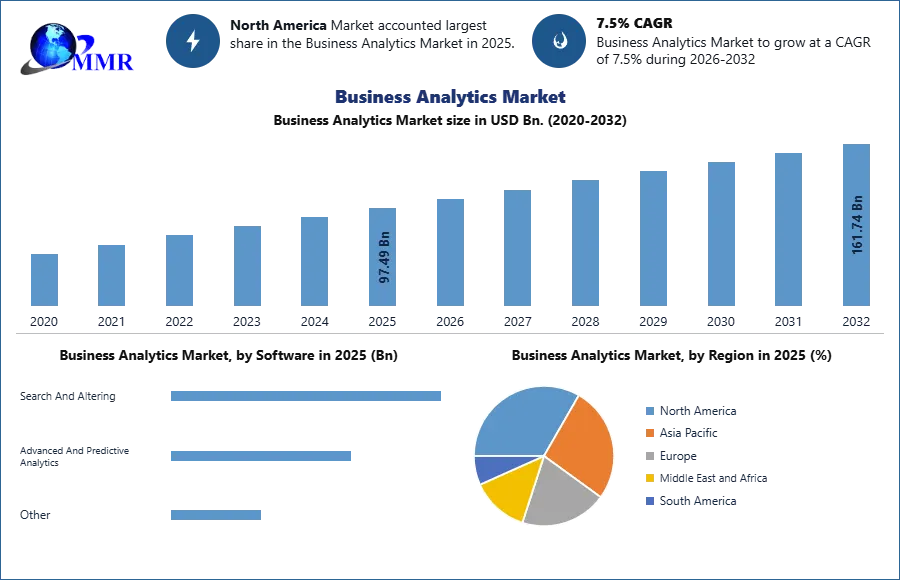
Business Analytics Market size was valued at USD 97.49 Bn. in 2025 and the total revenue is expected to grow at 7.5% through 2026 to 2032, reaching nearly USD 161.74 Bn.
Business Analytics Market Overview:
The global Business Analytics market was estimated at USD 97.49 Billion in 2025, and it is expected to reach USD 139.96 Billion by 2032, growing at a CAGR of 7.5% over the forecasting period of 2026-2032. The continuous and scientific study of organizational data using statistical and operational analysis is known as business analytics (BA). Data aggregation, data mining, text mining, data visualization, association, and sequence identification are some of the techniques used.
Organizations employ BA analytical tools to execute query reporting, predictive analysis, location intelligence, content analysis, data warehousing, and enterprise performance evaluation, as well as to analyse complex data sets, core trends, and micro-segment data. To give an accurate analysis, they also include principles of information systems, deep learning, and artificial intelligence (AI).
To know about the Research Methodology :- Request Free Sample Report
Business Analytics Market Dynamics:
Currently, in contemporary business analytics market, firms generate massive amounts of structured and unstructured data as a result of their day-to-day operations, resulting in big data trends. These data are linked to customers', products', and opponents' operations, as well as business's different digital platforms. All of these reasons have contributed to a rise in company demand for insights from all types of big data in order to provide customers with digitalized and personalised experiences. Analytics aids businesses in driving growth by providing deeper consumer insights and product and service innovation, as well as improving cost management through the optimization of operations, the reduction of errors, and improved financial performance monitoring. Furthermore, it aids firms in risk management by improving regulatory compliance and internal risk control. As a result, business analytics gives companies the ability to visualise, analyse, and make business choices based on vast amounts of data from a variety of sources in real time.
Advanced data cataloguing solutions are gaining appeal as hosted BI platforms and IoT devices flood out various types of data. For example, Alation, a startup focusing on cataloguing data in the enterprise, debuted an analytics tool within its Data Catalog service, to provide greater stewardship and governance for its customers. One of the most important trends in the business analytics market is visualisation and exploratory data analysis for business users. Business analytics is also being used by a number of key sectors to make critical business decisions.
Because traditional business analytics solutions lacked good data storage and visualisation features, new ML-powered business analytics platforms improve data visibility and comprehension. Furthermore, growing data has allowed startups to compete with blue-chip firms by developing personalised and superior analytics offerings. This is obvious in the fact that huge corporations have been known to buy startups. Startups have also altered data management methods in order to automate data circulation and improve the course of future research.
Changes in the corporate environment, the growing use of big data, and the growing demand for customer analytics are all drivers driving the business analytics market. High installation costs and apprehension about using business analytics are two main roadblocks to the market's growth. Rising demand for mobile analytics, as well as changing trends in analytics implementation, will provide new chances for providers to stay in this market for longer. Marketers in the ecosystem have a fundamental challenge: incompatibility across technologies spanning cross-organizational competences.
Business Analytics Market Segment Analysis:
The Business Analytics Market is segmented by Deployment Type, Software, Enterprise Size and Application.
Based on the Enterprise Size, the global Business Analytics market is sub-segmented into Large Enterprises and SMBs. The SMBs segment held the largest market share in 2025. Instead of using spreadsheet modelling and manual computations, these businesses are using advanced tools like descriptive, diagnostic, and predictive BA. Furthermore, the growing use of BA by finance-based security agencies for inspection, monitoring, and avoiding fraudulent activities involving high-value accounts is expected to propel the market even further.
Based on the Application, the global Business Analytics market is sub-segmented into Banking, Financial Services, and Insurance (BFSI), Education, Government, Retail, Healthcare, Media and Entertainment, Manufacturing and Telecom, and IT. The Banking, Financial Services, and Insurance (BFSI) segment held the largest market share in 2025. The banking and financial industries are undergoing significant changes as a result of technological advancements. With increased internet usage and the proliferation of mobile devices and apps, today's financial institutions face increased competition, shifting customer needs, and stringent control and risk management in a highly dynamic market. At the same time, technological advancements have resulted in the development of strong business analytics tools. Business analytical tools that the banking and finance industry can employ to mine client data for insights that can lead to more effective management and better business decisions.
Business Analytics Market Regional Insights:
North America held the largest market share in 2025. Microsoft, Oracle, and Salesforce.com, to mention a few, are all headquartered in the region. Models permitted the same example of data to support batch analytics, interactive analytics, global messaging, database, and file-based models in various sorts of businesses in the United States as rapid computation grew. According to a 2025 Alteryx analysis of 350 retailers and brand makers, nearly 81 percent of respondents are obtaining shopper information. While 76 percent believe that insight are crucial to their sales/revenue success. A simple data collection, on the other hand, is insufficient.
Europe will eventually follow North America in offering extensive market solutions for business analytics in its region. The Asia Pacific and MEA areas are in the middle of their development cycles, and business analytics usage is on the rise. Latin America is still in the early stages of technological development.
Recent Industry Developments (2025–2026)
| Exact Date | Company | Development | Impact |
|---|---|---|---|
| 22 January 2025 | IBM | Announced a pioneering end-to-end AI and Generative AI governance solution at the World Economic Forum to enhance compliance and ethical oversight. | Reduces operational risks and regulatory hurdles for enterprises scaling complex business analytics ecosystems. |
| 30 January 2025 | Microsoft | Formed a strategic collaboration with PwC to deploy autonomous AI agents capable of performing data analysis and aiding decision-making. | Accelerates the transition from passive reporting to active agentic intelligence within global consulting and audit markets. |
| 04 February 2025 | Oracle | Released the 25.R1 update for NetSuite Analytics Warehouse, introducing a secondary data refresh process to accelerate daily incremental updates. | Enhances real-time data availability for SMBs, providing faster access to predictive application outputs. |
| 20 May 2025 | SAP SE | Partnered with Accenture to launch ADVANCE, a cloud pathway integrating SAP Business Suite with AI-driven connected intelligence. | Enables high-growth organizations to achieve predictable analytics outcomes and modernized supply chains within six months. |
| 03 June 2025 | Snowflake Inc. | Unveiled Snowflake Intelligence at Summit 2025, an agentic experience allowing users to securely converse with data using natural language. | Promotes data democratization by allowing non-technical users to extract actionable insights from unstructured content. |
| 14 October 2025 | Salesforce | Launched the Agentforce 360 platform featuring Intelligent Context to ground AI agents in complex, unstructured business reality. | Improves CRM analytics accuracy by enabling agents to synthesize information from PDFs, flowcharts, and diagrams. |
The objective of the report is to present a comprehensive analysis of the global Market to the stakeholders in the industry. The past and current status of the industry with the forecasted market size and trends are presented in the report with the analysis of complicated data in simple language. The report covers all the aspects of the industry with a dedicated study of key players that include market leaders, followers, and new entrants.
PORTER, PESTEL analysis with the potential impact of micro-economic factors of the market has been presented in the report. External as well as internal factors that are supposed to affect the business positively or negatively have been analyzed, which will give a clear futuristic view of the industry to the decision-makers.
The reports also helps in understanding the global Business Analytics Market dynamic, structure by analyzing the market segments and project the global Business Analytics Market size. Clear representation of competitive analysis of key players by product, price, financial position, product portfolio, growth strategies, and regional presence in the global Business Analytics Market make the report investor’s guide.
Business Analytics Market Scope: Inquire before buying
| Business Analytics Market | |||
|---|---|---|---|
| Report Coverage | Details | ||
| Base Year: | 2025 | Forecast Period: | 2026-2032 |
| Historical Data: | 2020 to 2025 | Market Size in 2025: | 97.49 USD Bn. |
| Forecast Period 2026-2032 CAGR: | 7.5% | Market Size in 2032: | 161.74 USD Bn. |
| Segments Covered: | by Deployment Type | Cloud On-Premises |
|
| by Software | Search And Altering Advanced And Predictive Analytics Other |
||
| by Enterprise Size | Large Enterprises SMBs |
||
| by Application | Banking, Financial Services, and Insurance (BFSI) Education Government Retail Healthcare Media and Entertainment Manufacturing Telecom and IT |
||
Business Analytics Market, by Region
North America (United States, Canada and Mexico)
Europe (UK, France, Germany, Italy, Spain, Sweden, Austria and Rest of Europe)
Asia Pacific (China, South Korea, Japan, India, Australia, Indonesia, Malaysia, Vietnam, Taiwan, Bangladesh, Pakistan and Rest of APAC)
Middle East and Africa (South Africa, GCC, Egypt, Nigeria and Rest of ME&A)
South America (Brazil, Argentina Rest of South America)
Key Players / Competitors Profiles Covered in Brief in Global Business Analytics Market Report in Strategic Perspective:
- IBM
- Infor
- Tibco Software, Inc.
- Microsoft Corporation
- Microstrategy Incorporated
- Oracle Corporation
- QLIK Technologies, Inc.
- SAP SE
- SAS Institute, Inc.
- Tableau Software, Inc.
- Adobe Systems Incorporated
- Fair Isaac Corporation
- Amazon Web Services
- Teradata Corporation
- Salesforce.com Inc.
- Cloudability, Inc.
- Densify, Inc.
- Maxpanel Inc.
- Alteryx Inc.
- Informatica
- Domo Inc.
- Sisense Inc.
- ThoughtSpot
- Looker (Google Cloud)
- Snowflake Inc.
Frequently Asked Questions
1. What is the projected Business Analytics Market size and growth rate?
Ans. The market valuation was USD 97.49 Billion in 2025 and is projected to reach USD 161.74 Billion by 2032, exhibiting a steady 7.5% CAGR.
2. Which region leads the Business Analytics Market share analysis?
Ans. North America dominates the market, headquartered by giants like Microsoft and Oracle, utilizing rapid computation and advanced data models to support batch and interactive analytics.
3. How is Generative AI influencing Business Analytics Market Trends 2026?
Ans. The integration of autonomous AI agents and natural language processing is transforming passive reporting into active agentic intelligence, allowing non-technical users to converse with data.
4. What are the primary Industry Growth Drivers for analytics adoption?
Ans. Explosive growth in structured and unstructured big data, alongside the urgent need for personalized customer experiences and optimized financial performance, is fueling global market demand.
5. How does Business Analytics improve cost-effectiveness for modern enterprises?
Ans. Analytical tools optimize operations, reduce manual errors, and enhance financial monitoring, allowing firms to drive significant growth through deeper consumer insights and improved risk management.
6. What role do SMBs play in the Business Analytics Market Share?
Ans. SMBs hold the largest share, increasingly replacing manual spreadsheets with ML-powered predictive tools to automate data circulation and compete effectively against established blue-chip industry players.
7. What are the main Business Analytics Market supply chain challenges?
Ans. Significant roadblocks include high installation costs, technical incompatibility across cross-organizational competencies, and initial enterprise apprehension regarding the transition to complex, AI-driven data governance ecosystems.