
Bluetooth Hearing Aid Market Size by Product Type, Sales Channel, Application, Region, Industry-Wide Analysis, Competitive Landscape Assessment & Long-Term Forecast to 2034
Overview
x
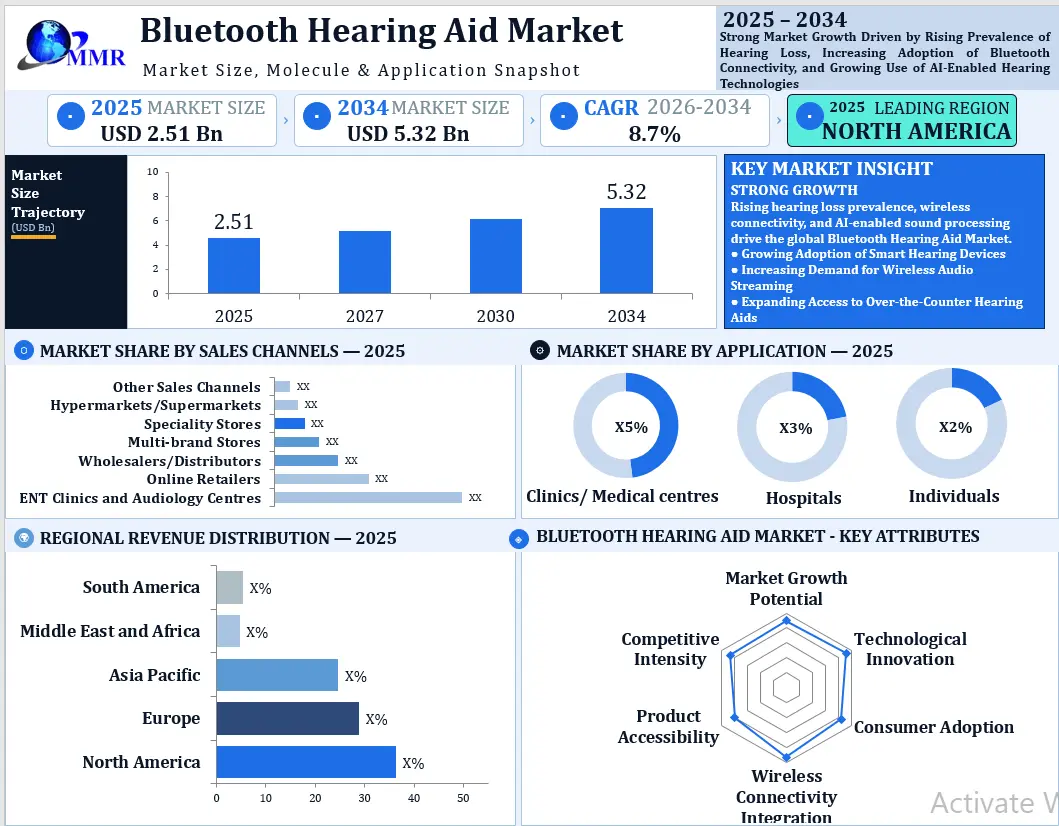
The Global Bluetooth Hearing Aid Market is valued at USD 2.51 billion in 2025 and is projected to reach USD 5.32 billion by 2034, growing at a CAGR of 8.7% during 2026–2034.
Global Bluetooth Hearing Aid Market Overview:
The Global Bluetooth Hearing Aid Market focuses on the development, manufacturing, and commercialization of hearing aids equipped with Bluetooth wireless connectivity, enabling users to stream audio directly from smartphones, tablets, televisions, computers, and other compatible electronic devices. These devices integrate sound amplification, digital signal processing, and wireless communication technologies to improve listening experiences, support clearer speech perception, and enhance accessibility for individuals with hearing loss. The market includes different product types, such as behind-the-ear (BTE), receiver-in-canal (RIC), in-the-ear (ITE), and completely-in-canal (CIC) hearing aids, along with sales channels covering retail stores, audiology clinics, hospitals, and online platforms.
This report provides a comprehensive analysis of the Global Bluetooth Hearing Aid Market by product type, sales channel, application, and region. It evaluates market size, growth trends, competitive positioning, and technological developments across North America, Asia Pacific, Europe, the Middle East and Africa, and South America. The analysis examines key market drivers, including the rising prevalence of hearing loss, an aging population, increasing awareness of hearing healthcare, growing smartphone adoption, and demand for wireless audio streaming and rechargeable hearing devices. It also assesses restraints such as high device costs, limited access to hearing healthcare in developing regions, connectivity compatibility issues, and consumer concerns regarding device usability. Furthermore, the report identifies emerging opportunities in artificial intelligence-enabled hearing aids, tele audiology, personalized sound processing, and direct-to-consumer distribution while evaluating competitive challenges related to regulatory requirements, product differentiation, and technological innovation.
Bluetooth Hearing Aid Market Growth and Share Analysis
 To know about the Research Methodology :- Request Free Sample Report
Global Bluetooth Hearing Aid Market: Key Highlights
- Market Size: The Global Bluetooth Hearing Aid Market is valued at USD 2.51 billion in 2025 and is projected to reach USD 5.32 billion by 2034.
- Market Growth: The market grows at a CAGR of 8.7% during the forecast period 2026–2034.
- Leading Region: North America leads the market with a 36.3% revenue share in 2025, supported by advanced hearing healthcare infrastructure and widespread adoption of connected hearing devices.
- Key Growth Driver: Rising hearing loss prevalence, an aging population, and increasing demand for wireless audio streaming support market expansion.
- Emerging Opportunity: AI-enabled sound processing, over-the-counter hearing aids, and Auracast broadcast audio technology create opportunities for product innovation and wider consumer access.
Global Bluetooth Hearing Aid Market Dynamics:
Global Bluetooth Hearing Aid Market Drivers
Rising Prevalence of Hearing Loss and Growing Demand for Hearing Solutions
The increasing prevalence of hearing loss drives demand for the Global Bluetooth Hearing Aid Market. According to the World Health Organization, more than 1.5 billion people worldwide live with hearing loss, and this number reaches an estimated 2.5 billion by 2050. Of these, approximately 700 million people require hearing rehabilitation. This growing need supports the adoption of Bluetooth-enabled hearing aids that combine sound amplification with wireless connectivity, smartphone integration, and direct audio streaming. Increasing awareness of hearing healthcare, an aging population, and demand for improved communication experiences strengthen market expansion.
Increasing Adoption of Wireless Connectivity and Advanced Hearing Aid Technology
Technological advancements in Bluetooth connectivity, digital signal processing, rechargeable batteries, and artificial intelligence support the adoption of connected hearing devices. Bluetooth-enabled hearing aids allow users to stream calls, music, television audio, and other media directly to their devices. The Bluetooth Special Interest Group highlights the development of LE Audio and Auracast broadcast audio, which supports more accessible audio experiences across compatible hearing aids and public venues. These innovations strengthen demand for smart hearing aids, multi-device connectivity, personalized sound processing, and wireless assistive listening solutions.
Global Bluetooth Hearing Aid Market Restraints
High Device Costs and Limited Access to Hearing Healthcare
The relatively high cost of advanced Bluetooth hearing aids restricts adoption among price-sensitive consumers, particularly in developing economies. Devices with premium wireless connectivity, artificial intelligence, rechargeable batteries, and personalized sound processing often require higher upfront expenditure than basic hearing aids. Limited access to audiologists, hearing assessments, device fitting, and after-sales support further constrains market penetration. According to the World Health Organization, access to hearing rehabilitation remains insufficient relative to the global need, creating affordability and accessibility barriers for Bluetooth hearing aid manufacturers.
Connectivity Compatibility and Battery Performance Limitations
Compatibility issues between hearing aids, smartphones, televisions, computers, and other electronic devices create challenges for users seeking seamless wireless audio streaming. Differences in Bluetooth protocols, operating systems, device specifications, and connectivity features can affect the user experience. Bluetooth connectivity also increases the importance of battery efficiency, particularly for users who rely on continuous streaming throughout the day. Manufacturers therefore need to balance wireless performance, audio quality, battery life, device size, and ease of use while maintaining reliable connectivity across compatible devices.
Global Bluetooth Hearing Aid Market Opportunities
Expansion of AI-Enabled Hearing Aids and Personalized Audio Processing
The integration of artificial intelligence, machine learning, and advanced digital signal processing creates opportunities for Bluetooth hearing aid manufacturers. AI-enabled devices can adapt sound settings to different acoustic environments, improve speech recognition in noisy surroundings, and support personalized listening experiences. According to Demant's 2025 annual report, approximately 13 million people receive hearing aid fittings involving around 23 million devices worldwide in 2025, highlighting the substantial existing user base for advanced hearing solutions. Continued product innovation creates opportunities for premium Bluetooth hearing aids, remote adjustments, and personalized hearing care services.
Growing Opportunities in Over-the-Counter Hearing Aids and Auracast Technology
The expansion of over-the-counter (OTC) hearing aids creates opportunities to reach consumers seeking more accessible and convenient hearing solutions. Bluetooth connectivity also enables integration with smartphones, tablets, televisions, and compatible public audio systems. Auracast broadcast audio technology expands the potential for compatible hearing aids to receive audio in public venues, including conference facilities, airports, educational institutions, and entertainment locations. The Bluetooth Special Interest Group reports that more than 34 million Bluetooth-enabled hearing aids and OTC hearing aids are expected to ship annually by 2030, indicating an opportunity for manufacturers developing compatible, connected hearing solutions.
Global Bluetooth Hearing Aid Market Challenges
Intense Competition and Continuous Technological Innovation
The Global Bluetooth Hearing Aid Market faces competition among established hearing aid manufacturers and emerging consumer audio technology providers. Companies invest in wireless connectivity, miniaturized components, rechargeable systems, AI-based sound processing, and improved speech clarity to differentiate their products. Rapid technological advancements increase research and development requirements and create pressure to introduce new features while maintaining product reliability and competitive pricing. Manufacturers also need to ensure that new Bluetooth hearing aids deliver meaningful improvements in everyday listening rather than relying solely on additional connectivity features.
Regulatory Compliance, Data Privacy, and Interoperability
Bluetooth hearing aid manufacturers must address medical device regulations, product safety requirements, wireless communication standards, and applicable data protection rules. Connected hearing aids increasingly interact with smartphone applications and digital hearing care platforms, making secure data transmission and user privacy important considerations. Differences in device compatibility and wireless standards can also complicate integration across manufacturers and electronic ecosystems. Maintaining interoperability, protecting user information, and ensuring consistent audio performance across supported devices remain important challenges for long-term market development.
Global Bluetooth Hearing Aid Market Segment Analysis:
Bluetooth Hearing Aid Market is segmented by Product Type, Sales Channel, and Application.
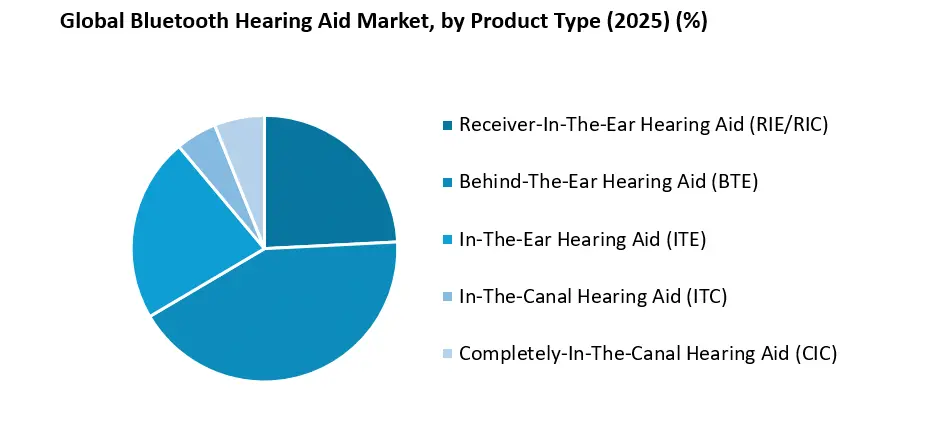
Based on the Product Type, the market is segmented into In-The-Ear Hearing Aid (ITE), In-The-Canal Hearing Aid (ITC), Behind-The-Ear Hearing Aid (BTE), Completely-In-The Canal Hearing Aid (CIC), and Receiver-In-The-Ear Hearing Aid (RIE). Behind-The-Ear Hearing Aid (BTE) segment is expected to hold the largest market share of xx% by 2034. Hearing aids with a small curved housing that fits securely behind the ear are known as behind-the-ear hearing aids.
These hearing aids can be modified by connecting them to external sound sources like infrared listening devices and auditory training equipment. Manufacturers are developing a new generation of Bluetooth enabled BTE devices to offer greater wireless connectivity, driven by demand for advanced versions. The development of new goods and technological research to improve hearing aids will result in an increase in market sales.
 Based on the Sales Channel, the market is segmented into Wholesalers/Distributors, Online Retailers, Multi-brand Stores, Speciality Stores, Hypermarkets/Supermarkets, ENT Clinics and Audiology Centres, and Other Sales Channel. Online Retailers sales channel segment is expected to grow rapidly at a CAGR of xx% during the forecast period 2026-2034. Despite the popularity of multi-brand stores, online sales are expected to increase. While it is true that patients and their families prefer to purchase hearing aids from physical locations, the tide is slowly shifting in favour of online channels.
Global Bluetooth Hearing Aid Market Regional Insights:
North America is the leading region in the Global Bluetooth Hearing Aid Market, supported by high hearing healthcare expenditure, established audiology networks, and widespread adoption of advanced digital hearing solutions. The United States and Canada contribute to regional demand through increasing awareness of hearing loss, an aging population, and growing preference for Bluetooth-enabled hearing aids with wireless audio streaming, smartphone connectivity, rechargeable batteries, and personalized sound processing. The availability of over-the-counter hearing aids in the United States also supports consumer access to connected hearing solutions.
Europe maintains a significant position in the Global Bluetooth Hearing Aid Market, driven by established hearing healthcare systems, an aging population, and increasing adoption of digitally connected hearing devices. Germany, the United Kingdom, France, and the Nordic countries contribute to regional demand through audiology clinics, hearing aid specialists, and healthcare reimbursement systems. Growing adoption of Bluetooth Low Energy, rechargeable hearing aids, noise reduction technology, and wireless connectivity strengthens the regional market. Increasing investment in artificial intelligence-enabled hearing aids, remote hearing care, and personalized audio solutions further supports market development.
Asia Pacific experiences growing demand in the Global Bluetooth Hearing Aid Market, supported by rising awareness of hearing health, expanding healthcare infrastructure, and increasing disposable incomes. China, Japan, India, South Korea, and Australia contribute to regional growth through expanding audiology services and rising demand for affordable digital hearing devices. The growing prevalence of age-related hearing loss and increasing smartphone adoption support demand for Bluetooth connectivity, direct audio streaming, rechargeable hearing aids, and application-based sound customization. Expanding retail distribution, e-commerce platforms, and local hearing aid manufacturing also improve product accessibility
South America demonstrates emerging growth opportunities in the Global Bluetooth Hearing Aid Market, driven by improving awareness of hearing impairment and gradual expansion of hearing healthcare services. Brazil and Argentina contribute to regional demand through audiology clinics, specialist healthcare providers, and distribution networks for digital hearing devices. Increasing interest in wireless audio streaming, smartphone-compatible hearing aids, rechargeable batteries, and discreet hearing aid designs supports adoption. However, affordability constraints and unequal access to hearing specialists influence purchasing decisions across the region. Wider availability of cost-effective Bluetooth hearing aids and online sales channels supports future market penetration.
Middle East and Africa represent an emerging market for Bluetooth hearing aids, supported by gradual improvements in healthcare infrastructure, growing awareness of hearing loss, and increasing access to specialized hearing services. Saudi Arabia, the United Arab Emirates, and South Africa contribute to regional demand through private healthcare facilities, audiology clinics, and medical device distribution networks. Adoption of Bluetooth-enabled hearing aids, digital sound processing, wireless connectivity, and rechargeable devices supports the development of modern hearing care services. However, high product costs and limited access to audiologists in some countries constrain adoption. Investments in healthcare infrastructure and wider distribution of affordable hearing devices create opportunities for market expansion.
Global Bluetooth Hearing Aid Market Competitive Landscape
The Global Bluetooth Hearing Aid Market features a competitive landscape shaped by established hearing healthcare manufacturers, technology-driven hearing aid developers, and emerging over-the-counter (OTC) device providers. Competition focuses on wireless connectivity, artificial intelligence (AI)-enabled sound processing, speech enhancement, battery efficiency, miniaturization, and compatibility with smartphones and other electronic devices. Major companies strengthen their market positions through product innovation, proprietary audio-processing technologies, extensive audiology networks, and investments in connected hearing care. The five leading hearing aid manufacturers—Sonova, Demant, WS Audiology, GN Store Nord, and Starkey—collectively account for more than 90% of the broader hearing aid market, although this concentration does not represent Bluetooth hearing aids exclusively.
Competitive Trends Shaping the Market
- AI-Driven Hearing Technology: Manufacturers focus on AI-powered speech clarity, adaptive noise reduction, and personalized sound processing to differentiate Bluetooth hearing aids.
- Consumer Electronics Competition: Smart earbuds with hearing assistance features expand competition beyond traditional hearing aid manufacturers, increasing pressure on pricing and innovation.
- Growth of OTC Hearing Aids: Online sales and direct-to-consumer distribution improve accessibility and attract price-sensitive consumers.
- Connectivity and Battery Efficiency: Reliable Bluetooth connectivity, longer battery life, and compatibility with smartphones and televisions become important competitive advantages.
Global Bluetooth Hearing Aid Market Recent Developments:
| Date | Company | Development | Impact |
|---|---|---|---|
| 20 August 2026 | GN Store Nord | GN Store Nord launched the ReSound Sensia hearing aid platform featuring AcoustIQ environment classification and binaural four-microphone beamforming. | The innovation enhances front-talker voice isolation and Bluetooth LE audio performance in complex acoustic settings. |
| 24 August 2026 | Sonova Holding AG | Sonova released the Phonak Audéo EON series powered by a new HYPERSONIC chip running third-generation Spheric Speech Clarity. | The device platform delivers 37% lower power consumption for continuous Bluetooth streaming and speech clarity in noise. |
| 24 August 2026 | Signia | Signia introduced the Pure Charge&Go MaX hearing aids on its Multi-adaptive Xperience (MaX) platform with integrated OneConnect Bluetooth Classic, LE Audio, and Auracast support. | The platform provides 54X greater processing power for multi-dimensional AI noise filtering and broadcast streaming. |
| 24 August 2026 | Demant A/S | Demant opened orders for Oticon Reveal hearing aids utilizing a Dual AI system designed to balance speech isolation with background spatial awareness. | The system achieves 60% stronger brain response for context preservation and seamless multi-device Bluetooth audio integration. |
| 01 October 2026 | Starkey Hearing Technologies | Starkey unveiled its Omega AI+ hearing aid line powered by the G4 processor featuring Quad DNN Architecture and expanded Bluetooth connectivity. | The launch expands 360-degree real-time noise reduction and direct streaming into custom rechargeable in-the-ear styles. |
Global Bluetooth Hearing Aid Market Scope: Inquiry Before Buying
| Global Bluetooth Hearing Aid Market | |||
|---|---|---|---|
| Report Coverage | Details | ||
| Base Year: | 2025 | Forecast Period: | 2026-2034 |
| Historical Data: | 2020 to 2025 | Market Size in 2025: | US $ 2.51 Bn. |
| Forecast Period 2026 to 2034 CAGR: | 8.7% | Market Size in 2034: | US $ 5.32 Bn. |
| Segments Covered: | by Product Type | In-The-Ear Hearing Aid (ITE) In-The-Canal Hearing Aid (ITC) Behind-The-Ear Hearing Aid (BTE) Completely-In-The Canal Hearing Aid (CIC) Receiver-In-The-Ear Hearing Aid (RIE) |
|
| by Sales Channel | Wholesalers/Distributors Online Retailers Multi-brand Stores Speciality Stores Hypermarkets/Supermarkets ENT Clinics and Audiology Centres Other Sales Channel |
||
| by Application | Hospitals Clinic/ Medical Centers Individual |
||
Global Bluetooth Hearing Aid Market, by Region
• North America (United States, Canada and Mexico)
• Europe (UK, France, Germany, Italy, Spain, Sweden, Austria and Rest of Europe)
• Asia Pacific (China, South Korea, Japan, India, Australia, Indonesia, Malaysia, Vietnam, Taiwan, Bangladesh, Pakistan and Rest of APAC)
• Middle East and Africa (South Africa, GCC, Egypt, Nigeria and Rest of ME&A)
• South America (Brazil, Argentina Rest of South America)
Global Bluetooth Hearing Aid Market Key Players are:
- Sonova Holding AG
- WS Audiology
- Demant A/S
- GN Store Nord A/S
- Starkey Laboratories, Inc.
- Cochlear Limited
- MED-EL
- Eargo, Inc.
- hearX Group
- Audina Hearing Instruments, Inc.
- IntriCon Corporation
- Ear Technology Corporation
- Benson Hearing
- Rion Co., Ltd.
- Arphi Electronics Private Limited
- Amplifon S.p.A.
- Beltone
- ReSound
- Interton
- Widex
- Signia
- Rexton
- Audio Service
- Oticon
- Bernafon
- Sonic Innovations
- Philips Hearing Solutions
- Unitron
- Hansaton
- Jabra Enhance
- Lexie Hearing
- Nuheara
- Lucid Hearing
- Etymotic Research
- Sound World Solutions
- ELEHEAR
- Sony
- Shenzhen Sunsky Technology
- Eartone Hearing Aid
- Miracle Hearing Aid
Frequently Asked Questions:
1. What is the Global Bluetooth Hearing Aid Market size in 2025?
Ans. The Global Bluetooth Hearing Aid Market is valued at USD 2.51 billion in 2025.
2. What is the projected market size by 2034?
Ans. The market is projected to reach USD 5.32 billion by 2034.
3. What is the expected CAGR of the Global Bluetooth Hearing Aid Market during 2026–2034?
Ans. The market is expected to grow at a CAGR of 8.7% during the forecast period.
4. Which region leads the Global Bluetooth Hearing Aid Market?
Ans. North America leads the market, accounting for 36.3% of global revenue in 2025.
5. What are the key factors driving the Global Bluetooth Hearing Aid Market?
Ans. The key growth drivers include rising hearing loss prevalence, an aging population, improved Bluetooth connectivity, AI-enabled sound processing, and increasing demand for wireless audio streaming.
6. Who are the key players in the Global Bluetooth Hearing Aid Market?
Ans. Key players include Sonova Holding AG, WS Audiology, Demant A/S, GN Store Nord A/S, Starkey Laboratories, Inc., and Cochlear Limited.