
Bare Metal Cloud Market Size by Service Type, Organization Size, Vertical, Region, Industry-Wide Analysis, Competitive Landscape Assessment & Long-Term Forecast to 2032
Overview
The Global Bare Metal Cloud Market size was valued at USD 11.66 Bn. in 2025, and the total Global Bare Metal Cloud Market revenue is expected to grow by 17.8% from 2025 to 2032, reaching nearly USD 36.71 Bn.
Global Bare Metal Cloud Market Overview
Bare Metal Cloud provides a cloud service model that uses dedicated physical servers without a hypervisor. Bare metal cloud provides high-performance, single-tenant infrastructure. It provides direct access to the physical hardware, configurations with lower latency, and a greater ability to control workloads. This makes Bare Metal Cloud especially useful for data-demanding workloads like artificial intelligence (AI), machine learning (ML), big data analytics, gaming, and financial modeling.
The market is growing steadily as organizations look for scalable, secure, and high-performance systems. This growth is mainly driven by the rising demand for new servers in regulated industries like healthcare and BFSI, the need for better data security and compliance, and the fast adoption of hybrid cloud setups. Bare metal solutions are popular because they offer better performance by avoiding hypervisor overhead. However, there are still challenges, such as high setup and maintenance costs, less flexibility compared to virtual environments, and difficulty integrating with existing systems.
This report covered global market trends, emerging market technology, and geographical trends that are influencing the adoption of bare metal cloud services. North America continues to be the largest and fastest-growing market for bare metal cloud implementations because of its early adoption of cloud computing, a large concentration of large-scale hardware manufacturers, and well-established IT infrastructure. North America is benefiting from the largest workforce driving digital transformation, data localization mandates, and increased enterprise workloads. Two prominent players in the bare metal cloud service market include IBM Cloud (USA) and Oracle (USA), which both provide secure, high-performance bare metal cloud platforms for mission-critical operations.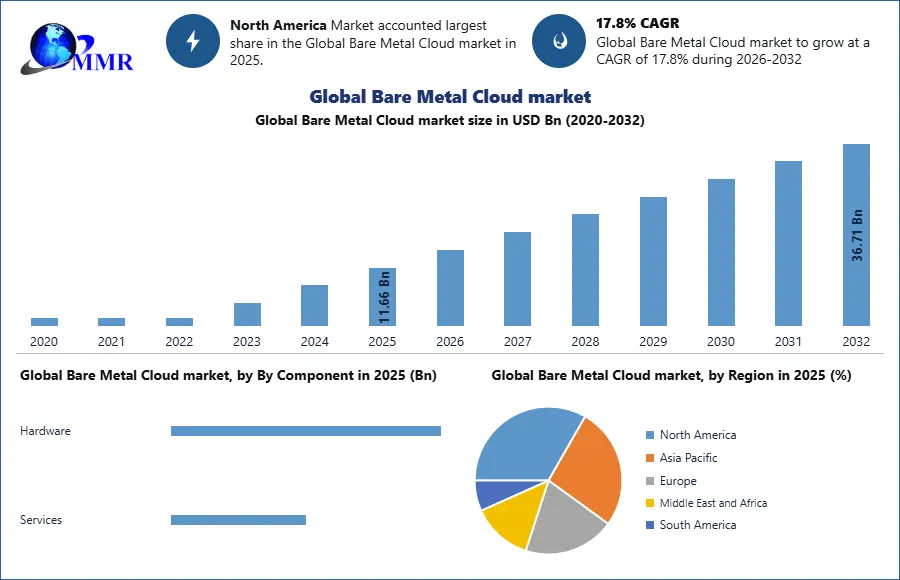 To know about the Research Methodology:- Request Free Sample Report
Global Bare Metal Cloud Market Dynamics
Increasing Demand for Hybrid Cloud Adoption Trends to Drive Bare Metal Cloud Market Growth
The growth is the escalating demand for high-performance computing solutions across various industries. Organizations worldwide, including those in the healthcare, finance, and technology sectors, require substantial computational power, memory, and storage to support their mission-critical applications and workloads. Bare metal cloud services offer dedicated hardware resources, ensuring reliable performance and scalability for businesses with demanding computing requirements. By providing dedicated servers without virtualization layers, bare metal cloud providers enable users to maximize their resources' utilization and achieve optimal performance for their applications, which is expected to boost the Bare Metal Cloud Market growth. The need for enhanced security and compliance standards is another driving force behind the adoption of bare metal cloud solutions. With dedicated hardware resources, organizations have better control over their security measures and ensure compliance with industry regulations.
This level of control and visibility into the underlying infrastructure gives businesses confidence in their data protection measures, making bare metal cloud an attractive option for handling sensitive workloads and critical data. The growing trend of hybrid cloud adoption is fueling the demand for bare metal cloud services, which is expected to propel the Bare Metal Cloud Market growth.
Persistent Need for High-Performance to Restrain Bare Metal Cloud Market
The prevalence of stringent cloud regulations impacts the market's growth trajectory. Compliance with data protection laws like GDPR necessitates robust measures to ensure data privacy and security, adding complexity and cost to bare metal cloud deployments. Moreover, the implementation of isolation measures is essential to safeguard data and ensure consistent performance. However, this process is challenging and resource-intensive for bare metal cloud providers.
Another restraint is the requirement for extensive practice and restoration of bare metal infrastructure by vendors. This process demands significant investment in resources and training to effectively manage and maintain bare metal infrastructure, posing a barrier to Bare Metal Cloud Market growth. The persistent demand for high-performance workloads on traditional public clouds drives the need for bare metal cloud solutions. While this presents an opportunity for market growth, providers ensure that their offerings meet the performance requirements of demanding applications and workloads.
Integration challenges also hinder Bare Metal Cloud Market adoption, particularly in hybrid cloud environments. The complexity of integrating bare metal cloud solutions with on-premises infrastructure and other cloud resources poses technical challenges for organizations. Compatibility issues and interoperability concerns further complicate the integration process, slowing down adoption rates. Regulated industries such as healthcare and finance face barriers to adopting bare metal cloud solutions due to stringent compliance requirements. Providers demonstrate compliance with industry regulations and provide assurances regarding data privacy and security to gain traction in these sectors.
Enabling 5G and Edge Computing with Bare Metal Cloud to Create Bare Metal Cloud Market Opportunity
Hybrid cloud adoption presents another avenue for growth, as organizations seek to leverage the benefits of both on-premises and public cloud environments. Bare metal cloud providers capitalize on this trend by offering seamless integration and hybrid cloud solutions, providing flexibility and scalability to businesses of all sizes. Growth into emerging markets, particularly in regions like Asia-Pacific and Latin America, offers untapped potential for bare metal cloud adoption, which significantly boosts the Bare Metal Cloud Market growth. As these markets undergo rapid digital transformation, there is a growing need for reliable and scalable cloud infrastructure to support evolving business needs. Moreover, specialized workloads in industries such as entertainment and gaming require high-performance infrastructure for HD streaming, multiplayer gaming, and content delivery networks, making bare metal cloud solutions an attractive option.
Global Market Segment Analysis
In 2025, Large Enterprises represent the dominant segment in the Bare Metal Cloud market, owing to their need for high-performance computing, data security, and scalable infrastructure for mission-critical workloads. These organizations often deploy bare metal solutions for big data analytics, AI workloads, and enterprise-grade applications. Small & Medium-Sized Enterprises (SMEs) are gradually increasing adoption, particularly as service providers offer cost-effective and flexible bare metal solutions, but their overall market share remains smaller compared to large enterprises.
Based on Deployment Model, Public Cloud-based Bare Metal solutions lead the market in 2025 due to their scalability, cost efficiency, and ease of deployment. Enterprises prefer public cloud bare metal offerings for rapid provisioning and global accessibility. Private Cloud deployments are favored by organizations with strict security, compliance, and data sovereignty requirements, particularly in regulated industries. Hybrid Cloud is the fastest-growing segment, as businesses seek to balance performance, flexibility, and security by combining on-premise infrastructure with public cloud environments.
In terms of Infrastructure, Virtual Public Cloud (VPC) leads the market in 2025, as it provides enhanced control, isolation, and security within public cloud environments, making it suitable for enterprise workloads. Classic Infrastructure continues to be utilized by organizations with legacy systems and traditional deployment models, but its growth is comparatively slower. The shift toward more flexible and secure infrastructure environments is driving increased adoption of VPC-based bare metal solutions.
Global Bare Metal Cloud Market Regional Insights
Government Funding
| Government | Program | Funding | Focus Area |
| United States | Indiana Enterprise Center (AWS data hub) | USD 0.076 Bn. | Data center expansion, high-performance cloud infrastructure (businessmarketinsights.com, apnews.com) |
| New Jersey | AI Data Center Tax Credit Program | USD 0.50 Bn. | Attract AI/data center investment. |
| Multiple U.S. States | State-level tax incentives (TX, VA, OH, etc.) | USD 0.10 Bn. | Sales/property tax breaks to promote facility builds |
| Canada | Digital Government Strategy & Grants | USD 2.6 Bn. | Supports modern cloud solutions for the public sector |
Global Bare Metal Cloud Market Competitive Landscape
The Global Bare Metal Cloud Market is highly competitive, driven by the demand for high-performance, secure, and customizable infrastructure. The need for powerful computational capacity, fueled by industries such as AI/ML, gaming, financial services, and big data analytics, is rapidly growing.
IBM Corporation (USA) is a major player in this market, offering bare metal servers with specifications similar to traditional enterprise-grade servers. IBM Cloud provides bare metal solutions that support hybrid cloud and AI strategies. In 2024, IBM reported approximately USD XX billion in cloud revenue, with a significant portion generated from its bare metal offerings.
Oracle Corporation (USA) is another key player, primarily through its Oracle Cloud Infrastructure (OCI). OCI bare metal servers are designed to optimize workloads and databases for enterprise customers, delivering high performance and efficiency. In 2024, Oracle's cloud infrastructure revenue reached approximately USD 6.6 billion.
Other companies are also expanding globally by building new data centers to enhance service delivery and computing performance.
Global Bare Metal Cloud Market Recent Development
| Company & Headquarters | Date | Recent Development |
| IBM Corporation (USA) | March 12, 2025 | Launched enhanced IBM Cloud Bare Metal Servers powered by Intel Sapphire Rapids CPUs for AI workloads. |
| Oracle Corporation (USA) | April 22, 2025 | Expanded Oracle Cloud Infrastructure (OCI) with bare metal GPU instances to support large AI models. |
| Equinix, Inc. (USA) | January 30, 2025 | Rolled out automated provisioning in Equinix Metal to accelerate hybrid cloud deployment timelines. |
| OVHcloud (France) | May 8, 2025 | Introduced water-cooled bare metal servers to improve energy efficiency and reduce data center footprint |
| Lumen Technologies (USA) | February 18, 2025 | Partnered with NVIDIA to offer AI-as-a-Service using Lumen Edge Bare Metal for low-latency inferencing. |
Global Bare Metal Cloud Market Trends
• Growing Demand for High-Performance Workloads.
Public cloud options are acceptable for performance-intensive workloads (e.g., AI/ML, gaming applications, financial modeling, and real-time analytics), and bare metal cloud is increasingly the preferred option because of its low latency and direct access to hardware.
NVIDIA has established an AI infrastructure ecosystem with partners like IBM Cloud and Oracle Cloud, offering bare metal GPU servers. These servers are configured specifically to deliver optimal performance for machine learning and deep learning workloads.
• Adoption by Regulated Industries for Compliance and Security
Healthcare, BFSI, and government organizations are shifting workloads to bare metal environments to meet compliance and data residency requirements while avoiding virtualization.
A major European bank has been using IBM Bare Metal Servers because they need to be confident they are serving their PCI-DSS requirements, and assurance of properly securing payments and isolating workloads from other users is key.
• Hybrid and Multi-Cloud Utilizing Bare Metal Platforms
The use of bare metal platforms for hybrid and multi-cloud environments. Many organizations deploy bare metal as part of a hybrid or multi-cloud strategy to help find the right balance of scale, control, and cost.
Equinix Metal enables companies to deploy physical servers on demand, connecting to public cloud providers like AWS and Azure, promoting hybrid-cloud style agility.
Bare Metal Cloud Market Scope : Inquire before buying
| Global Bare Metal Cloud market | |||
|---|---|---|---|
| Report Coverage | Details | ||
| Base Year: | 2025 | Forecast Period: | 2026-2032 |
| Historical Data: | 2020 to 2025 | Market Size in 2025: | 11.66 USD Bn |
| Forecast Period 2026-2032 CAGR: | 17.8% | Market Size in 2032: | 36.71 USD Bn |
| Segments Covered: | By Component | Hardware Bare Metal Compute Bare Metal Network Bare Metal Storage Services Integration & Migration Consulting & Assessment Managed & Support Services |
|
| By Organization Size | Large Enterprises Small & Medium-Sized Enterprises (SMEs) |
||
| By Deployment Model | Public Cloud Private Cloud Hybrid Cloud |
||
| By Infrastructure | Virtual Public Cloud Classic Infrastructure |
||
| By Application | AI & Machine Learning Servers Render Farms NoSQL & Relational Databases Others |
||
| By Industry Vertical | BFSI IT and Telecom Retail and Consumer Goods Healthcare and Life Sciences Manufacturing Government Others |
||
Global Bare Metal Cloud Market by Region
North America (United States, Canada and Mexico)
Europe (United Kingdom, France, Germany, Italy, Spain, Sweden, Russia, Rest of Europe)
Asia Pacific (China, Japan, South Korea, India, Australia, Malaysia, Thailand, Vietnam, Indonesia, Philippines, Rest of APAC)
Middle East and Africa (South Africa, GCC, Nigeria, Egypt, Turkey, Rest of MEA)
South America (Brazil, Argentina, Colombia, Chile, Peru, Rest of South America)
Global Bare Metal Cloud Market Key Players
- Liquid Web
- Atlantic.Net
- Amazon Web Services, Inc.
- Microsoft Azure
- Google Cloud
- Equinix Metal
- IBM Cloud
- Oracle Cloud
- OVHcloud
- Rackspace
- Scaleway
- Vultr
- PhoenixNAP
- Alibaba Cloud
- DigitalOcean
- Hivelocity
- OpenMetal
- Servers.com
- Cherry Servers
- RedSwitches
- Lumen Technologies
- SirviS