
Autonomous Delivery Robots Market – Industry Structure Evaluation, Demand Drivers Analysis, Regional Growth Analysis and Identification, Competitive Positioning Review & Global Market Size Forecast to 2032
Overview
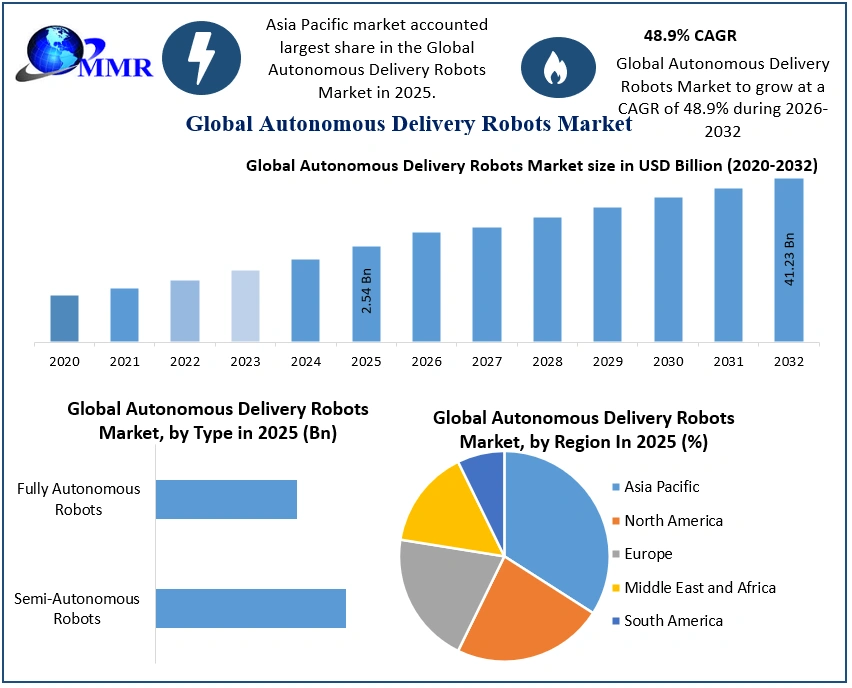
The Autonomous Delivery Robots Market size was valued at USD 2.54 Billion in 2025 and the total Autonomous Delivery Robots revenue is expected to grow at a CAGR of 48.9% from 2026 to 2032, reaching nearly USD 41.23 Billion by 2032.
Autonomous delivery robotics technology is one of the emerging technologies, which have potential to revolutionize the delivery system in various end user industries. Autonomous delivery robots have designed to perform delivery tasks with a high degree of autonomy. The autonomous delivery robot are programmed, and equipped with GPS, camera, motors, and sensors to deliver the goods, courier, and food.
To know about the Research Methodology :- Request Free Sample Report
The report study has analyzed revenue impact of the COVID-19 pandemic on the sales revenue of the market leader, market followers and market disrupters in the report and same is reflected in our analysis.
Autonomous Delivery Robots Market Dynamics:
An introduction of autonomous delivery robots (ADR) is expected to revolutionize the last mile delivery systems. A cheaper and efficient way of delivery are expected to increase the demand for the autonomous delivery robots across the globe. Despite the delivery robots have less adoption across the developing economies, they are expected to have high growth during the forecast period because of its various advantages. Key players in other industries like retail stores, restaurants, pharmacies, and healthcare organizations are looking at last-mile delivery robots as an efficient way to improve customer service and differentiate themselves to their customer base.
On the other hand, despite the global autonomous delivery robots market is expected to grow, several challenges persist for automated last-mile deliveries. Many trials of autonomous last-mile delivery robots are occurring in fair-weather locations is one of the challenges. In addition, municipalities are focusing on the regulating the use of these autonomous delivery robots on city sidewalks. For instance, the city of San Francisco banned delivery robots from its sidewalks and forcing companies to test their robots in other cities.
Impact of COVID-19 Pandemic:
Novel coronavirus COVID-19 has pushed key players from their comfort zones. In the current market scenario, human to human interaction is fatal in many areas. Everything is dependent on one-touch away services through mobile apps, and autonomous delivery providers, which can facilitate customers with the superior service and delivery experiences. Despite the coronavirus outbreak may have limited business for many companies, the demand for autonomous delivery robots are booming. Robotic delivery services offer contactless delivery and highly sought-after service under rules of social distancing.
The autonomous delivery robots were already in use in some areas like airports, universities, hotels and large corporate campuses. Some of the prominent key players like Starship Technologies, Amazon Scout are experiencing a surge of interest by many end user industries like restaurants, grocery stores, and other delivery service companies. The pandemic has forced traditional restaurants to close and placed more pressure on end user industries. The demand for contactless delivery has increased exponentially, autonomous delivery robots key players are focusing on expanding their customer base. For instance, Starship Technologies is sending its autonomous delivery robots to more cities and has announced that it had closed US$ 40 Mn in Series funding.
Autonomous Delivery Robots Market Regional Analysis:
Autonomous Delivery Robots in China:
In China, The start-up UDI has delivered food through self-driving vans during the lockdown of the COVID-19 pandemic. The vans and delivery robots are relying on technology like cameras, lidars, and deep-learning algorithms. Autonomous delivery vehicles offers contactless delivery and viable answer to closing the gap between the global desires for speed deliveries and the labor shortage in a logistics system. Also, Chinese company JD.com has focused to offer quickly to fast-track service by its autonomous delivery systems, which helps to resemble mini electric vans to make medical deliveries during the pandemic outbreak.
North America region is expected to contribute xx% share in the global autonomous delivery robots market. The maximum growth in the market is attributed to the presence of the high number of startups and manufacturers, which are working toward the growth of the autonomous delivery robots technology. In the region, many retail and hospitality key players are partnering with manufacturers to have an experience of the prototypes. The region has a high degree of demand from the hospitality sector, which are assisting many prime hospitality establishments to form attraction from media. In region, prominent key players have already started operating through autonomous delivery robots. For instance, in 2021, Amazon has officially introduced its last-mile delivery robots. It was designed to automate ferry parcels from urban distribution points to Amazon Prime customers.
Autonomous Delivery Robots Market Competitive Analysis:
Many key companies are focusing to form strategic collaborative initiatives to increase their market share. The companies are also acquiring start-ups and partnering with other players to strengthen their product capabilities. For instance, in 2021, Nuro has partnered with Walmart to test the delivery of groceries using the delivery robot. In the market, vendors have to extend their last-mile delivery services with efficiency.
The movements of goods from the transportation hub to the final destination is known as last-mile delivery. The last mile logistics key players are currently focusing on delivering items to end-users at less time. The prominent key companies have already create robots, which serve enclosed premises like corporate campuses, hospitals, and universities. Furthermore, start-up key players are trying to develop their particular niche of service in autonomous delivery robots.
The objective of the report is to present a comprehensive analysis of the Global Autonomous Delivery Robots Market including all the stakeholders of the industry. The past and current status of the industry with forecasted market size and trends are presented in the report with the analysis of complicated data in simple language. The report covers all the aspects of the industry with a dedicated study of key players that includes market leaders, followers and new entrants by region. PORTER, SVOR, PESTEL analysis with the potential impact of micro-economic factors by region on the market has been presented in the report. External as well as internal factors that are supposed to affect the business positively or negatively have been analyzed, which will give a clear futuristic view of the industry to the decision-makers.
The report also helps in understanding Global Autonomous Delivery Robots Market dynamics, structure by analyzing the market segments and projects the Global Autonomous Delivery Robots Market size. Clear representation of competitive analysis of key players by Application, price, financial position, Product portfolio, growth strategies, and regional presence in the Global Autonomous Delivery Robots Market make the report investor’s guide.
Autonomous Delivery Robots Market Scope: Inquire before buying
| Autonomous Delivery Robots Market | |||
|---|---|---|---|
| Report Coverage | Details | ||
| Base Year: | 2025 | Forecast Period: | 2026-2032 |
| Historical Data: | 2020 to 2025 | Market Size in 2025: | USD 2.54 Mn. |
| Forecast Period 2026 to 2032 CAGR: | 48.90% | Market Size in 2032: | USD 41.23 Mn. |
| Segments Covered: | by Type | Semi-Autonomous Robots Fully Autonomous Robots |
|
| by End User | Hospitality Retail Logistics Healthcare Others |
||
Autonomous Delivery Robots Market, by Region
North America (United States, Canada and Mexico)
Europe (UK, France, Germany, Italy, Spain, Sweden, Austria and Rest of Europe)
Asia Pacific (China, South Korea, Japan, India, Australia, Indonesia, Malaysia, Vietnam, Taiwan, Bangladesh, Pakistan and Rest of APAC)
Middle East and Africa (South Africa, GCC, Egypt, Nigeria and Rest of ME&A)
South America (Brazil, Argentina Rest of South America)
Autonomous Delivery Robots Market, Key players
1. Starship Technologies
2. Robby Technologies
3. Savioke, Inc.
4. Nuro Inc.
5. Eliport
6. Marble Robot Inc.
7. TeleRetail (Aitonomi AG)
8. Dispatch Inc. (Acquired by Amazon)
9. Aethon Inc.
10.Kiwibot
11.Postmates Inc.
12.Segway Robotics Inc.
13.Neolix
14.Box Bot Inc
15.ANYbotics AG
16.Robomart Inc.
17.Effidence
18.Udlev Inc.
19.Cleveron AS
Frequently Asked Questions:
1. Which region has the largest share in Global Autonomous Delivery Robots Market?
Ans: North America region held the highest share in 2025.
2. What is the growth rate of Global Autonomous Delivery Robots Market?
Ans: The Global Autonomous Delivery Robots Market is expected to grow at a CAGR of 48.9% during forecast period 2026-2032.
3. What is scope of the Global Autonomous Delivery Robots market report?
Ans: Global Autonomous Delivery Robots Market report helps with the PESTEL, PORTER, COVID-19 Impact analysis, Recommendations for Investors & Leaders, and market estimation of the forecast period.
4. Who are the key players in Global Autonomous Delivery Robots market?
Ans: The important key players in the Global Autonomous Delivery Robots Market are – , Starship Technologies, Robby Technologies, Savioke, Inc., Nuro Inc., Eliport, Marble Robot Inc., TeleRetail (Aitonomi AG), Dispatch Inc. (Acquired by Amazon), Aethon Inc., Kiwibot, Postmates Inc., Segway Robotics Inc., Neolix, Box Bot Inc, ANYbotics AG, Robomart Inc., Effidence, Udlev Inc., and Cleveron AS.
5. What is the study period of this market?
Ans: The Global Autonomous Delivery Robots Market is studied from 2025 to 2032.