
Audio Equipment Market - Industry Structure Evaluation, Demand Drivers Analysis, Regional Growth Analysis and Identification, Competitive Positioning / Landscape Review & Global Market Size Forecast to 2032
Overview
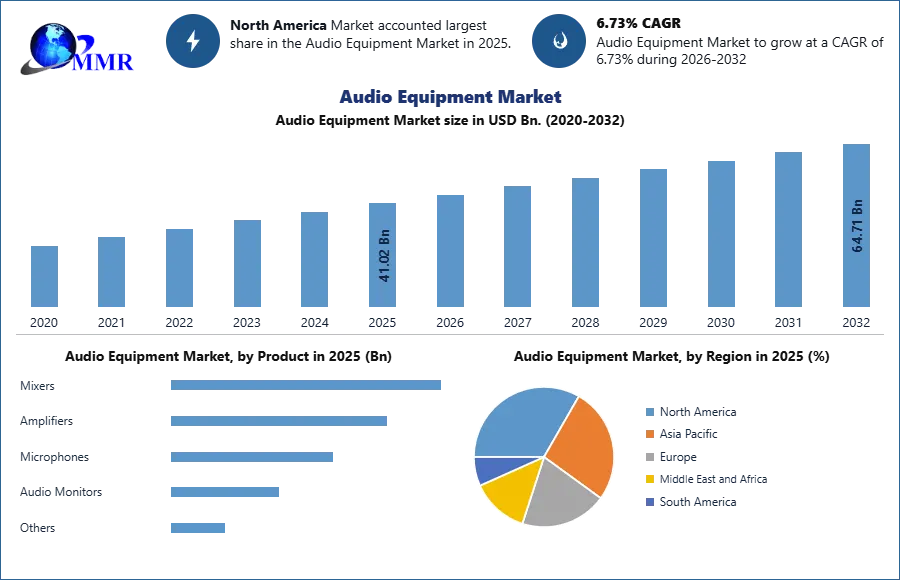
The Audio Equipment Market size was valued at USD 41.02 Billion in 2025 and the total Audio Equipment revenue is expected to grow at a CAGR of 6.73% from 2026 to 2032, reaching nearly USD 64.71 Billion.
Audio equipment industry comprises enterprises that operate by manufacturing, producing and providing audio devices and related materials that are meant for various audio uses in various industries. Any device used to record, recreate, or process sound is considered audio equipment. Speaker systems, instrument amplifiers, microphones, stereos, tape recorders, mixing consoles, radios, and AV receivers are examples of audio equipment. The manufacturing, distribution, and retailing of various audio equipment for use in automobiles, home entertainment systems, or special events make up the audio equipment industry. Audio equipment is designed by audio product engineers, whom the manufacturing companies rely on for continual product innovation.
In order to take advantage of high-speed data streaming, internet-only entertainment, and cutting-edge music storage technology, more people are calling for faster web connectivity. Technologies for speech recognition are becoming more crucial as various sectors try to include voice recognition to draw clients. According to MMR Analysts, technological advancements, product innovation, and consumer desire for high-quality content are driving market growth across the world. Thanx to extensive urbanisation and rising disposable income, South America, the Middle East, and Asia-Pacific are all experiencing tremendous growth.
This report analyzes the Audio Equipment Market as the 2026 Middle East crisis triggers a historic cost shock to high-fidelity manufacturing and professional sound reinforcement. With the Strait of Hormuz disruption driving crude toward $118/bbl, the cost of petroleum-based plastic resins and epoxy used in high-end speakers and chipsets has spiked by 40–70%. We explore how industry leaders are leveraging "Self-Optimizing" soundscapes and USB-C digital-native audio to bypass 25-day maritime delays and skyrocketing logistics surcharges. By evaluating the surge in content creator microphones and TWS (True Wireless Stereo) innovation, this study provides stakeholders with strategic frameworks to maintain resilience in a high-inflation landscape where 20% chipset price hikes are redefining retail premiumization.
To know about the Research Methodology :- Request Free Sample Report
Research Methodology:
The report is the outcome of a complex research methodology that involved extensive secondary research, demanding primary interviews with industry stakeholders, validation and triangulation utilizing Maximize Market Research's own database, and statistical techniques. Analysts have performed thorough primary and secondary research to gain swiveling insights into the audio equipment market. As a result, report were better able to comprehend current market dynamics, the supply-demand imbalance, pricing trends, product preferences, customer behaviors and other factors. Primary research was used to further validate the findings with industry professionals and opinion leaders from other nations. Through a variety of market estimation and data validation procedures, the data is further collated and validated. In addition, we have a model for internally generated data that forecasts market growth until 2032.
Audio Equipment Market Dynamics:
Growing Adoption of Audio Equipment across the World
Audio equipment retailers buy audio products from manufacturers and distributors and then sell them to customers inside their physical stores. The home entertainment market's PCs and game consoles, which are increasingly able to produce audio without the need for extra audio equipment accessories, as well as the many audio equipment producers are always in rivalry with one another. The demand for audio equipment is influenced by consumer personal income and how rapidly new developments in audio equipment are identified.
Modern studios, complexes, bedroom studios, specialized home studios, semi-pro studios, and pro studios all make considerable use of audio equipment including DAW, audio interface, audio monitors, and others for improved sound quality. For instance, Sony's 360-reality audio provides a superior audio experience to the user in the creation of motion pictures, graphics & animations, and video games. Therefore, the market benefits from the newest features and improvements in professional audio equipment.
Growing Demand For Audio Equipment
One of the most popular types of audio and sound equipment worldwide is headphones and earbuds. Vendors have sent more and more headphones over the world over time. In , 549 million headphones were supplied, a significant increase from the numbers recorded in . Shipments of wearable bands and true wireless stereo (TWS) headsets are expected to rise even more in the upcoming years, in part due to the widespread use of Apple's AirPods. There are now more affordable solutions available from businesses like Xiaomi and Jabra in addition to new TWS offerings from rival manufacturers like Sony and Bose.
The market for audio equipment is growing thanks to factors such the increase in demand for HD and ultra HD sound quality, the increased adoption of Wi-Fi and Bluetooth based devices, and the simplicity of network connectivity. Remote access to these devices is made possible by improvements in audio equipment communication via a smart network or other local area network. As a result, the development in wireless communication has increased the demand for devices that house professional audio equipment. In addition, the market for professional audio equipment is presented with attractive potential by the increase in investment in the development of voice-enabled smart interactive gadgets.
Rising Expenditure on Audio Equipment
The need for professional audio equipment is expected to rise as a result of the rising trend of increased expenditures on international festivals and music events. It is expected that the growing number of trade exhibits, motion picture and television productions, exhibitions, music performances, and sporting events would increase demand for a variety of cutting-edge audio amplifiers. For instance, 32 million people attend at least one music festival each year in the US.
The market is being driven by the increase in automotive audio equipment. Without sacrificing any of the features or functionality of the car, a premium system can replace the factory amp with a small group of amplifiers and a sound processor. The demand for cars is expected to rise effectively with an increase in manufacturing. However, the market's growth is constrained by costly setup and maintenance costs.
Audio Equipment Market Segment Analysis:
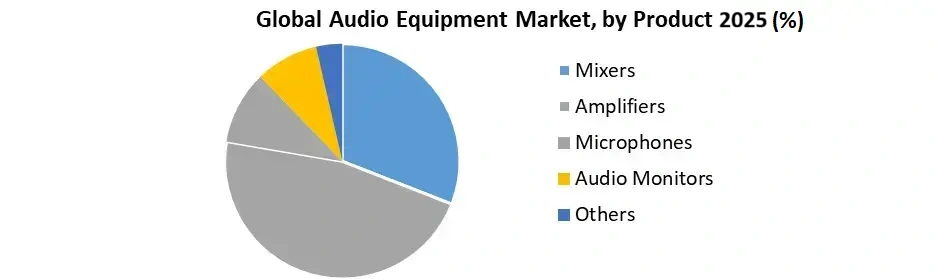
By Product, the Audio Equipment Market is segmented into Mixers, Amplifiers, Microphones, Audio Monitors, and Others. Microphone segment held the largest market share in 2025. Manufacturers are evaluating the need for better audio in these settings as a result of the fact that practically everything is now done from home, including TV productions, education, health and wellness, and regular employment. As a result, new products are being introduced to the market.
For instance, Shure announced the release of its new MV5C Home Office Microphone in October , which is intended for professionals and executives who work from home. The company said in introducing the new mic that it would meet the demands of professionals of all levels in the new era of virtual collaboration with a product that offers the best audio quality by putting the user's voice and not the surroundings first. Audio accessories are meeting the market's growing demand. The products listed for professional sound reproduction in installation, broadcast, film, and field applications are miniature microphones and accessories. Players are making investments to expand their technology as demand increases.
Audio Equipment Market Regional Insights:
In 2025, North America dominated the market with the largest market share, followed by the Asia Pacific. The increased use of e-commerce platforms to buy entertainment devices is expected to propel the North American audio equipment market to grow at a significant rate through the forecast period. The Department of Commerce's Census Bureau estimates that the U.S. retail e-commerce industry generated USD 250.0 billion in sales in May , an increase of 2.4% from Q4 . The estimated e-commerce market for Q1 grew 6.6% from Q1 . Manufacturers of audio equipment are distributing a wide range of products online in order to increase their global customer base.
Thanks to the presence of a strong IT infrastructure, internet channels are gaining market share overall. Due to the substantial presence of major e-commerce businesses like eBay Inc. and Etsy, the region is expected to increase during the forecast period. As more online merchants offer various discounts and package offers that provide a practical benefit to save money on audio equipment, the market statistics for that equipment is expected to improve.
Asia Pacific is expected to grow at a rapid rate through the forecast period. The high acceptance of smart homes, particularly in India, Japan, and Australia, are the primary driver of the region’s growth. Governments are also encouraging the construction of smart cities in the area, which is facilitating business growth. As more customers pick integrated media devices that can be controlled remotely and are always connected to other devices, the business is expected to grow through the forecast period.
Recent Industry Developments (2025–2026)
| Exact Date | Company | Development | Impact |
|---|---|---|---|
| 27 January 2026 | Sennheiser | The company launched the CX 80U earbuds and HD 400U headphones featuring native USB-C connectivity and 24-bit/96 kHz digital audio support. | The move addresses the total phase-out of 3.5mm jacks in mobile devices, ensuring lossless digital audio transmission for the mass consumer market. |
| 10 November 2025 | Bose Professional | Bose Professional unveiled the DesignMax Luna DML88P, a pendant loudspeaker system utilizing a proprietary Ring Array configuration for 140° coverage. | The system optimizes commercial audio installations by replacing traditional pendant-and-subwoofer setups with a single, high-fidelity architectural solution. |
| 23 September 2025 | HARMAN International | HARMAN completed the strategic acquisition of Sound United, integrating brands like Bowers & Wilkins and Denon into its portfolio. | This consolidation creates one of the most comprehensive audio portfolios in the industry, significantly increasing HARMAN's share in the luxury home audio market. |
| 03 April 2025 | Sony | Sony announced the 2025 BRAVIA Theatre lineup, including the Theatre Bar 9 and Theatre Quad featuring 360 Spatial Sound Mapping. | The launch sets a new benchmark for home cinema systems by aligning consumer hardware with professional-grade cinematic sound standards. |
Audio Equipment Market Competitive Landscape
To diversify their product lines and provide highly optimised gadgets, the companies are involved in product development and innovation operations. For instance, Sonos, Inc. purchased Mayht Holding BV (Mayht) in April ; Mayht develops cutting-edge audio transducer solutions. These gadgets are essential parts of speakers that produce sound. Without sacrificing quality, Mayht reengineered them for lighter and smaller form factors. Mayht wants to develop a speaker technology that will make it possible to squeeze more parts into a smaller space while using less electricity. Enhancing competitive advantage and speeding their future roadmap are the main concerns of market participants.
The sales of smart speakers, which are speakers with built-in voice assistants, have surged along with their popularity in recent years. In , Google was the second-largest vendor in terms of units shipped, after Amazon. By the end of , analysts expected that these two titans will have shipped a total of 74.5 million units, surpassing Apple's five million sales, their closest competitor.
To generate a sizable profit, practically all independent companies in the audio equipment market around the world rely on efficient manufacturing procedures and successful marketing and distribution plans. Small businesses stay competitive by concentrating their efforts on offering specialised parts and products for various systems in order to appeal to a certain clientele. Large companies with a strong foothold in the market have benefits in their production, distribution, and advertising procedures that offer them a competitive edge in the audio equipment market.
Audio Equipment Market Scope: Inquire before buying
| Audio Equipment Market | |||
|---|---|---|---|
| Report Coverage | Details | ||
| Base Year: | 2025 | Forecast Period: | 2026-2032 |
| Historical Data: | 2020 to 2025 | Market Size in 2025: | 41.02 USD Bn. |
| Forecast Period 2026-2032 CAGR: | 6.73% | Market Size in 2032: | 64.71 USD Bn. |
| Segments Covered: | by Product | Mixers Amplifiers Microphones Audio Monitors Others |
|
| by Type | Wired Wireless |
||
| by Distribution Channel | Hypermarkets/Supermarkets Online Retail Others |
||
| by End User | Commercial Automotive Home Entertainment Other |
||
Audio Equipment Market, by Region
North America (United States, Canada and Mexico)
Europe (UK, France, Germany, Italy, Spain, Sweden, Austria, Turkey, Russia and Rest of Europe)
Asia Pacific (China, India, Japan, South Korea, Australia, ASEAN and Rest of APAC)
Middle East and Africa (South Africa, GCC, Egypt, Nigeria and Rest of ME&A)
South America (Brazil, Argentina, Columbia and Rest of South America)
Key Players / Competitors Profiles Covered in Brief in Global Audio Equipment Market Report in Strategic Perspective:
- Yamaha Corporation
- Pioneer Corporation
- Alpine Electronics, Inc.
- Sony Group Corporation
- Panasonic
- JVCKenwood Corporation
- Allen & Heath
- Sound United (D+M Group)
- VOXX International Corporation
- Bose Corporation
- Harman International Industries
- Samsung Electronics Co., Ltd.
- Apple Inc.
- Sennheiser electronic GmbH & Co. KG
- Logitech International S.A.
- Sonos, Inc.
- Bang & Olufsen A/S
- Audio-Technica Corporation
- Shure Incorporated
- Bowers & Wilkins
- LG
- Dolby Laboratories, Inc.
- Nortek Control
- Creative Technology Ltd.
- Edifier International Limited
Frequently Asked Questions
1. How large is the Audio Equipment Market and its growth forecast?
Ans. The Audio Equipment Market valuation hits USD 41.02 billion in 2025, reaching USD 64.71 billion by 2032 via a 6.73% CAGR, fueled by premium sound demand.
2. Which region leads the Audio Equipment Market share analysis currently?
Ans. North America dominates the Audio Equipment Market share analysis, driven by robust e-commerce infrastructure, high disposable income, and rising consumer demand for advanced home entertainment systems.
3. What are the primary Audio Equipment Industry growth drivers through 2032?
Ans. Technological advancements like 360-degree spatial audio, rising music festival attendance, and automotive premium sound system integration act as vital Audio Equipment Industry growth drivers globally.
4. How is wireless connectivity impacting Audio Equipment Market trends 2026?
Ans. Audio Equipment Market trends 2026 show massive shifts toward TWS headsets and Bluetooth-enabled devices, as consumers prioritize seamless network connectivity and mobile-friendly digital audio interfaces.
5. What role does the Microphone segment play in market expansion?
Ans. Microphones held the largest product share in 2025, boosted by remote work transitions, professional home-office setups, and specialized virtual collaboration tools for high-fidelity vocal reproduction.
6. How are Recent Industry Developments shaping the competitive landscape?
Ans. Strategic acquisitions like HARMAN’s Sound United deal and Sennheiser’s USB-C innovations illustrate a competitive landscape focused on brand consolidation and adapting to hardware port transitions.
7. Which distribution channels are accelerating Audio Equipment Market revenue?
Ans. Online retail is rapidly gaining market share, supported by major e-commerce platforms offering discounts and bundled packages, significantly boosting overall global Audio Equipment Market revenue.