
AI in Fintech Market : Size by Component, Deployment Mode, Application and Region – Segment-Level Market Assessment, Growth Opportunity Analysis, Competitive Mapping & Forecast to 2032
Overview
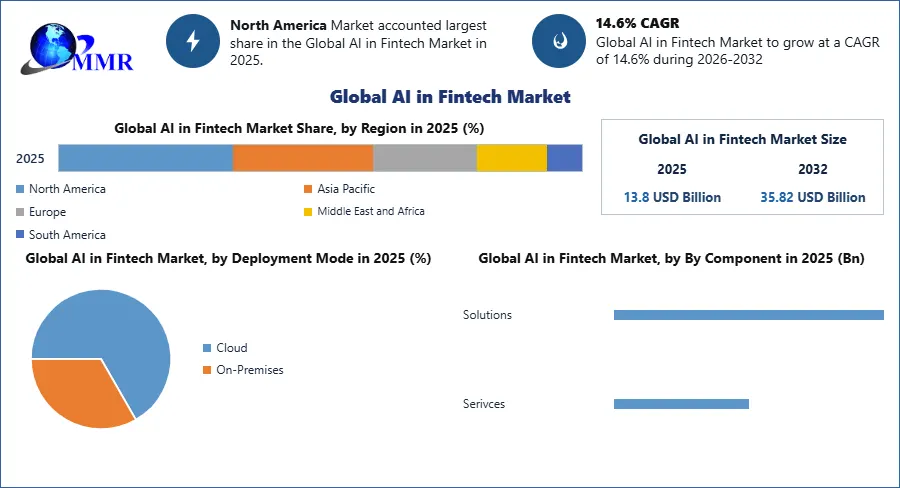
AI in Fintech Market was valued at USD 13.8 Bn in 2025 and is expected to reach USD 35.82 Bn by 2032, at a CAGR of 14.6% during the forecast period 2026-2032.
AI in Fintech Market Overview
AI in Fintech are application of advanced technology, particularly machine learning and data analytics, to enhance and streamline various financial processes and services. Fintech, short for financial technology, encompasses a broad range of innovations that leverage technology to improve and automate financial activities. Artificial Intelligence in Fintech is used to develop sophisticated fraud detection algorithms that can analyze patterns, detect anomalies, and identify potential fraudulent activities in real-time. Behavioral biometrics and machine learning help in creating robust authentication systems, making transactions more secure.
The AI in Fintech market has witnessed significant growth and adoption in recent years, driven by the increasing need for advanced analytics, automation, and improved customer experiences in the financial sector. Fintech companies, traditional financial institutions, and other stakeholders are leveraging AI technologies to enhance various aspects of financial services.
 To know about the Research Methodology:-Request Free Sample Report
AI in Fintech Market Dynamics
Automation for Operational Efficiency to boost AI in Fintech Market growth
AI in Fintech is the pursuit of operational efficiency through automation. AI technologies, including machine learning and robotic process automation (RPA), enable the automation of routine and time-consuming tasks. This includes customer service inquiries, transaction processing, and compliance checks. Automation not only reduces operational costs but also accelerates processes, allowing financial institutions to focus on more complex and strategic aspects of their business, which is expected to boost the AI in Fintech Market growth. The financial industry generates massive volumes of data daily, encompassing transaction records, customer information, market trends, and more. AI excels at processing and analyzing these vast datasets, extracting meaningful insights that can inform strategic decision-making. The ability to derive actionable intelligence from data empowers Fintech companies to enhance risk management, fraud detection, and customer engagement.
AI facilitates the delivery of highly personalized financial services by leveraging customer data and behavioral patterns. Advanced algorithms analyze individual preferences, spending habits, and investment behaviors to tailor financial products and advice significantly boosts the AI in Fintech Market growth. Robo-advisors, powered by AI, offer personalized investment strategies, making wealth management more accessible and adaptable to the unique needs of each customer. The financial industry operates within a complex regulatory framework that requires meticulous adherence to compliance standards. AI tools, often categorized as Regtech (Regulatory Technology), automate compliance processes. These tools help in interpreting regulatory texts, monitoring transactions for suspicious activities, and generating accurate and timely regulatory reports. This not only ensures compliance but also reduces the risk of regulatory penalties. The increasing sophistication of cyber threats necessitates robust security measures within the financial sector. AI is instrumental in developing advanced fraud detection systems that can identify anomalies, detect fraudulent activities, and enhance overall cybersecurity. Behavioral biometrics, machine learning algorithms, and anomaly detection contribute to creating a secure environment for financial transactions.
Data Privacy Concerns to limit the AI in Fintech Market growth
The use of AI in Fintech is the handling of sensitive financial data. As AI systems rely heavily on vast datasets for training and decision-making, there is an inherent risk of privacy breaches. Financial institutions navigate a delicate balance between leveraging customer data for personalization and ensuring robust data protection measures. Compliance with stringent data protection regulations becomes paramount to maintain customer trust and regulatory compliance, which significantly limits the AI in Fintech Market growth. The financial industry operates within a highly regulated environment, and compliance with evolving regulations is a constant challenge. The deployment of AI systems in Fintech, especially those involved in decision-making processes, raises concerns about transparency, accountability, and adherence to regulatory frameworks. Striking a balance between innovation and compliance requires ongoing efforts to align AI practices with regulatory expectations.
The inherent complexity of some AI algorithms, particularly deep learning models, makes them challenging to interpret or explain. This lack of interpretability, often referred to as the "black box" problem, poses challenges in understanding how AI systems arrive at specific decisions. In financial services, where transparency is crucial for building trust, the lack of explainability is a significant restraint. Addressing this challenge is essential for regulatory acceptance and user confidence. AI models trained on historical data may inadvertently inherit biases present in that data. In the context of Fintech, biased algorithms can lead to discriminatory outcomes, affecting credit scoring, lending decisions, and other financial services, which limits the AI in Fintech Market growth. Addressing bias and ensuring fairness in AI algorithms is a critical challenge that requires ongoing efforts to develop fair and unbiased models, as well as robust mechanisms for detecting and mitigating bias.
AI in Fintech Market Segment Analysis
In the component segmentation (Solutions vs. Services), solutions represent the dominating segment in 2025. From a technical perspective, solutions account for the larger market share (approximately 60–65%) due to their role as core functional architectures that enable data processing, automation, and decision-making capabilities. These include integrated software platforms, AI-driven analytics systems, and cloud-based infrastructures that provide scalable and real-time operational efficiency. The increasing adoption of advanced technologies such as machine learning, big data analytics, and IoT significantly enhances the demand for robust solution frameworks. Furthermore, enterprises prioritize end-to-end digital transformation, where solutions act as the primary value-generating layer, while services remain supportive. Continuous innovation in software capabilities, interoperability, and system integration further strengthens the dominance of solutions in 2025.
AI in Fintech Market Regional Analysis
AI in Fintech Market Competitive Landscape
| Exact Date | Company | Development | Impact |
|---|---|---|---|
| 15 January 2025 | Microsoft Corporation | Launched AI-powered Copilot for Financial Services to enhance automation and risk analytics in fintech operations. | Improves decision-making accuracy and operational efficiency across banking and financial platforms. |
| 28 February 2025 | Amazon Web Services (AWS) | Introduced Generative AI solutions for fintech enabling fraud detection and personalized financial insights. | Accelerates AI adoption and real-time analytics capabilities in financial institutions. |
| 10 April 2025 | Visa Inc. | Expanded its AI-based fraud prevention platform with advanced machine learning algorithms. | Enhances transaction security and fraud detection rates across global payment networks. |
| 22 June 2025 | Ant Group | Deployed AI-driven risk management system to strengthen credit assessment and lending accuracy. | Boosts credit scoring precision and financial inclusion in digital banking ecosystems. |
| 05 September 2025 | Accenture plc | Partnered with fintech firms to deliver AI-enabled financial analytics platforms for enterprise clients. | Strengthens end-to-end digital transformation and predictive analytics in finance. |
| 18 January 2026 | NVIDIA Corporation | Launched next-generation AI chips optimized for fintech workloads including real-time fraud detection. | Enhances processing speed and scalability for AI-driven financial applications. |
AI in Fintech Market Scope: Inquire before buying
| Global AI in Fintech Market | |||
|---|---|---|---|
| Report Coverage | Details | ||
| Base Year: | 2025 | Forecast Period: | 2026-2032 |
| Historical Data: | 2020 to 2025 | Market Size in 2025: | 13.8 USD Billion |
| Forecast Period 2026-2032 CAGR: | 14.6% | Market Size in 2032: | 35.82 USD Billion |
| Segments Covered: | By Component | Solutions Serivces |
|
| by Deployment Mode | Cloud On-Premises |
||
| By Application | Virtual Assistant Bussiness Analytics & Reporting Customer Behavioral Analytics Others |
||
AI in Fintech Market by Region
North America (United States, Canada and Mexico)
Europe (UK, France, Germany, Italy, Spain, Sweden, Austria and Rest of Europe)
Asia Pacific (China, South Korea, Japan, India, Australia, Indonesia, Malaysia, Vietnam, Taiwan, Bangladesh, Pakistan and Rest of APAC)
Middle East and Africa (South Africa, GCC, Egypt, Nigeria and Rest of ME&A)
South America (Brazil, Argentina Rest of South America)
AI in Fintech Market Key Players
- IBM Corporation
- Microsoft Corporation
- Google LLC
- Amazon Web Services (AWS)
- Accenture plc
- NVIDIA Corporation
- Palantir Technologies
- Oracle Corporation
- SAP SE
- Infosys Limited
- JPMorgan Chase & Co.
- Goldman Sachs Group Inc.
- Wells Fargo & Co
- Mastercard Incorporated
- Visa Inc.
- Intuit Inc.
- HSBC Holdings plc
- BNP Paribas
- Banco Santander S.A.
- Revolut Ltd.
- N26 GmbH
- Ant Group
- Tencent Holdings Ltd.
- SoftBank Group Corp.
- Ping An Insurance (Group) Co.
- Rakuten Group, Inc.
- Itaú Unibanco
- Banco Santander Brasil
- Nubank
- First Abu Dhabi Bank (FAB)