Agricultural Biologicals Market Size by Product, Crop Types, Source, Mode of Application, Region – Segment-Level Market Assessment, Growth Opportunity Analysis, Competitive Mapping & Forecast to 2032

13.5%
CAGR (2026-2032)
18.83 USD Bn.
Market Size
311
Report Pages
136
Market Tables

Overview

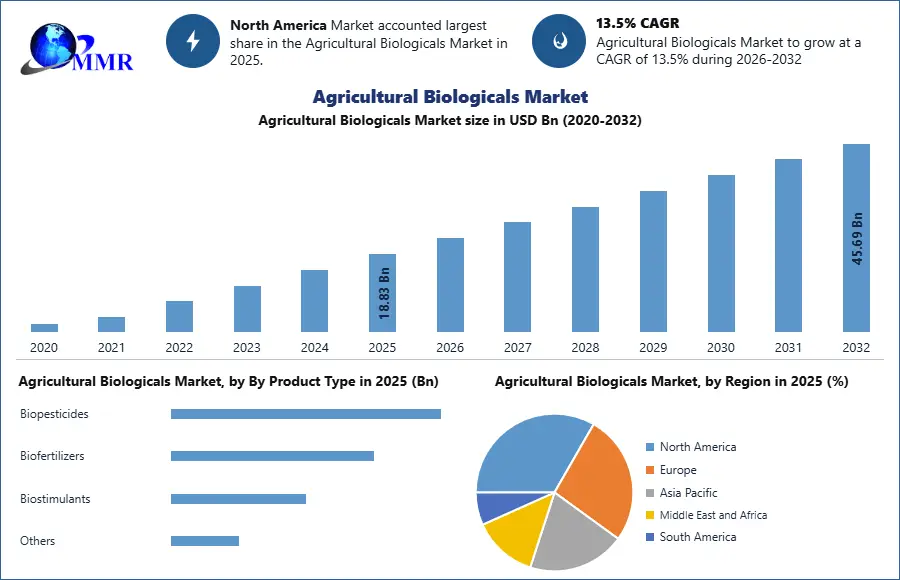
Agricultural Biologicals Market was valued at USD 18.83 Bn in 2025, and the Global Agricultural Biologicals Market is expected to reach USD 45.69 Bn by 2032, growing at a CAGR of 13.5% during the forecast period.

Agricultural Biologicals Market Overview:

Agricultural biologicals are innovative nature-based technologies that serve as an important part of many integrated crop management systems, often in the form of biocontrols and biostimulants. When complemented by leading seeds & traits, digital tools, and chemical crop protection, biologicals can help growers achieve the best results in their fields.

Agricultural biologicals market refers to the industry focused on natural, biological products used in agriculture to enhance crop health, productivity, and protection. Agricultural Biologicals Market is also recording a high growth rate, whereby the changing consumer trend towards consuming organically produced food is a major contributor.

The Agricultural Biologicals Market is rapidly expanding, fueled by the growing global demand for organically produced food, which reached approximately USD 135 billion in 2025. Consumers' preference for residue-free produce is driving adoption of bio-based inputs like biopesticides, biofertilizers, and biostimulants. Biopesticides are leading the market, offering natural alternatives to chemical pesticides. Also, foliar spray dominates the mode of application due to its high efficiency in nutrient delivery. Sustainable farming initiatives, such as the EU’s Farm to Fork Strategy and increased U.S. EPA biopesticide registrations, are accelerating market growth. The Asia Pacific region leads due to economic growth, crop protection demand, and regulatory support, with key players like Bayer and Syngenta expanding R&D efforts there. The market is highly competitive, with recent M&As such as Syngenta’s acquisition of Intrinsyx Bio and Bayer’s biological product expansions. Innovation and strategic partnerships continue to shape the market toward environmentally sustainable agriculture.Agricultural Biologicals MarketTo know about the Research Methodology:- Request Free Sample Report
Agricultural Biologicals Market Dynamics:

Increasing Consumer Trend of Organically Produced Food Drives the Agricultural Biologicals Market

The rise in consumer demand of organically grow food is a significant trend that is behind the agricultural biologicals market. Globally, the market value of organic food in 2024 was approximated to be USD 135 billion with the US alone registering USD 19.2 billion organic fresh fruits and vegetable sales in the year 2024. Sustainability and the demand of the residue-free produce are forcing farmers to apply biological pesticides, fertilizers, and biostimulants, which are included in the organic farming system as more regulated.

Sustainable Farming Driving the Agricultural Biologicals Market Growth

Agricultural biologicals market undoubtedly is increasing on account of sustainable farming practices. To give an example, the European Union initiates the Farm to Fork Strategy, which aims at reducing the consumption of chemical pesticides by half as soon as by 2030, the demand in biological alternatives, in its turn, is induced. Similarly, 40 percent increases in the speed of biopesticide registrations was introduced in 2024 by the U.S. EPA. Environmental needs and the regulations by the government that have resulted to transition of global farming into environmentally sensitive farming makes the biologicals a must-have to the growers.

Unpredictable Performance Restraints the Agricultural Biologicals Market

The resultant instability of agricultural biologicals makes a considerable limitation. They may be highly effective or ineffective depending on sensitivity to such environmental factors as soil type, temperature, and moisture levels. It has also been reported that 30-40 percent of the biological products lose their efficacy in 6-12 months of storage using the standard storage conditions. Retailers also can report fluctuating performance, with only about 45 percent of the time resulting in retailers reporting a good to excellent rating, causing farmers reluctance and lack of adoption by others.

Agricultural Biologicals Market Segmentation Analysis:

In 2025, the Product Type segment is dominated by Biopesticides, driven by increasing demand for eco-friendly crop protection solutions and the rising restrictions on chemical pesticides. Within this category, microbial-based biopesticides hold a significant share due to their effectiveness against a wide range of pests. Biostimulants are the fastest-growing segment, particularly seaweed extracts and acid-based products, as they enhance plant growth, stress tolerance, and yield quality. Biofertilizers, especially nitrogen-fixing and phosphate-solubilizing types, are gaining steady traction due to their role in improving soil fertility and reducing dependency on synthetic fertilizers.

Based on Form, the Liquid segment holds the highest demand in 2025 due to its ease of application, better absorption, and compatibility with modern irrigation systems such as drip and fertigation. Liquid formulations are widely preferred for foliar sprays and soil applications. However, the Solid segment continues to maintain relevance, particularly in seed treatment and traditional farming practices, due to its longer shelf life and ease of storage.

Based on Crop Types, Fruits and Vegetables dominate the market in 2025 owing to the increasing consumer preference for organic and residue-free produce. The demand for high-quality yield and improved shelf life further drives the adoption of agricultural biologicals in this segment. Plantation & Specialty Crops also represent a significant share due to export-oriented farming practices. Meanwhile, Floriculture & Ornamentals are witnessing rapid growth as growers increasingly adopt biological inputs to maintain aesthetic quality and sustainability standards.

Agricultural Biologicals Market
Report Coverage Details
Base Year: 2025 Forecast Period: 2026-2032
Historical Data: 2020 to 2025 Market Size in 2025: 18.83 USD Bn
Forecast Period 2026-2032 CAGR: 13.5% Market Size in 2032: 45.69 USD Bn
Segments Covered: By Product Type Biopesticides
    Biochemicals
    Microbials
    Others
Biofertilizers
    Nitrogen Fixation
    Phosphate Solubilizing
    Others
Biostimulants
    Acid Based
    Seaweed Extract
    Others
Others
By Form Solid
Liquid
By Crop Types Fruits
Vegetables
Floriculture & Ornamentals
Plantation & Specialty Crops
Others
By Source Microbial-Based
Plant Extracts
Others
By Mode of Application Foliar Application
Soil Treatment
Seed Treatment
Root Dip / Transplant Treatment
Drip Irrigation / Fertigation
Others

Agricultural Biologicals Market Regional Insights:

Significant Growth in Demand, R&D, and Sustainable Practices creates an Asia-Pacific Dominated Agricultural Biologicals Market

The Asia Pacific is expected to witness significant growth in the global agricultural biologicals market during the forecast period. The growth in the market can be attributed to the growing demand for crop protection and crop nutrition products in the regional market, in line with the rising economic growth conditions. Some of the key players like Bayer, Monsanto, and Syngenta are focusing on tapping this potential market and also expanding their R&D centers across the region. Strict regulations on chemical usage have been limited in the agriculture industry across major countries and governments have been endorsing sustainable practices in developing countries like China and India.

Agricultural Biologicals Market Competitive Landscape:

Agricultural Biologicals Market Top key players include Bayer AG, Syngenta AG, BASF SE, Corteva Agriscience, and UPL Ltd.

In the recent news, Syngenta acquired Intrinsyx Bio (May 2025) to strengthen nutrient use efficiency, and Bayer concentrated on the existing biological (e.g., Serenade) expansion and creation of new ones (e.g., Ibisio) (June 2025). The former organization is leading the way to use artificial intelligence to speed up the process of biological discovery (June 2025), and the latter is positioning its ag business to go public in 2027, setting its sights on growth in Asia. UPL, via UPL-SAS, is betting big on tech and climate (Dec 2024), a move that would see it transform to a holistic solution provider. This competition injects innovation, M&A, and strategic business alliances, which are interested in effective and sustainable agricultural processes to address the increased demand and need of clean, safe agriculture.

Agricultural Biologicals Market Key Trends:

• Convergence with Digital and Precision Agriculture

Digital and precision farming the intersection of agricultural biologicals and advanced digital and precision farming technology is a significant shift. It includes AI-powered platforms, satellite and aerial images, drones and GPS-driven equipment to maximize timing, dose rates and the localized application of biologicals. Such synergy promotes effectiveness, eliminates wastage, and enables evidence-based predictions about plant responses and the dynamics of the soil microbiome, which increases farmer ROI significantly.
• Focus on Novel Bio-Nematicides and Post-Harvest Biocontrols

Biofertilizer, biostimulants and biopesticide have already emerged, but there is also emerging and distinct focus on specialized segments. Bio- nematicides are a fast-growing segment and are used to fight the microscopic worms that lead to huge crop losses. Moreover, use of beneficial microorganisms in post-harvest biocontrols is also emerging to increase the shelf life and limit spoilage of produce, addressing the much-needed food security issue
• Agrochemical giants Strategy on Brand Launches and Portfolio Integration

Large agrochemical firms no longer view biologicals as a niche but are positioning dedicated biological brands and coupling them within their core portfolios. This is an indication of moving towards offering full-chain solutions which incorporates the combination of conventional and biological inputs. Such strategic hug gave the biologicals industry legitimacy and hastened the acceleration of their use by distribution channel and farmer credibility.

Recent Industry Developments

Year Company Name Key Development
May 13, 2025 Bayer AG Announced a $100 million expansion of its biologicals R&D facility in California, focusing on next-generation microbial products, and committed to over €3.5 billion incremental sales from innovation by 2029.
 Feb 26, 2025 Syngenta AG Strengthened global leadership in agricultural biologicals by acquiring natural product and genetic strain assets from Novartis and inaugurating a cutting-edge production facility in South Carolina, USA.
Mar 5, 2024 BASF SE Expanded its BioSolutions offering by incorporating seaweed biostimulants through a partnership with Acadian Plant Health™, and invested in a new fermentation plant for biological crop protection products in Ludwigshafen.
Dec 21, 2023 Corteva Agriscience Launched "Corteva Biologics" to provide farmers with a comprehensive portfolio covering the entire planting cycle, signaling an expanded and dedicated biologicals business.
May 12, 2025 UPL Ltd. Highlighted a strategic shift towards a comprehensive solution provider model, with significant investment in technology and climate solutions, emphasizing leadership in biosolutions and sustainable farming.

Agricultural Biologicals Market Scope: Inquire before buying

Agricultural Biologicals Market, by Region

North America (United States, Canada and Mexico)

Europe (UK, France, Germany, Italy, Spain, Sweden, Austria and Rest of Europe)

Asia Pacific (China, South Korea, Japan, India, Australia, Indonesia, Malaysia, Vietnam, Taiwan, Bangladesh, Pakistan and Rest of APAC)

Middle East and Africa (South Africa, GCC, Egypt, Nigeria and Rest of ME&A)

South America (Brazil, Argentina Rest of South America)

Key Players / Competitors Profiles Covered in Brief in Global Agricultural Biologicals Market Report in Strategic Perspective:

  1. Bayer AG
  2. BASF SE
  3. Corteva Agriscience
  4. Syngenta
  5. UPL
  6. Novozymes
  7. Certis Biologicals
  8. Isagro SpA
  9. Koppert Biological Systems
  10. Valent BioSciences
  11. Agricen
  12. Lallemand Inc.
  13. Bioceres Crop Solutions
  14. Rizobacter S.A.
  15. Sigma Agri-Science LLC
  16. Agrinos Inc.
  17. Biomaxnaturals
  18. Andermatt Group AG
  19. Atlántica Agrícola
  20. Gujarat State Fertilizers & Chemicals Ltd
  21. IPL Biologicals Ltd.
  22. T.Stanes & Company Ltd
  23. Som Phytopharma Biotech
  24. Biobest Group NV
  25. Others

Table of Contents

1. Agricultural Biologicals Market : Executive Summary 1.1. Study Assumption and Market Definition 1.2. Scope of the Study 1.3. Executive Summary 1.3.1 Market Size (2025) & Forecast (2026-2032), 1.3.2 Market Size (Value USD) (Volume in Metric Tons) and Market Share (%) - By Segments, Regions and Country 2. Agricultural Biologicals Market : Competitive Landscapes 2.1. MMR Competition Matrix 2.2. Key Players Benchmarking 2.2.1 Company Name 2.2.2 Headquarter 2.2.3 Product Portfolio 2.2.4 Production Capacity (Tons) 2.2.5 Technology Adoption 2.2.6 Sustainability & ESG Positioning 2.2.7 Strategic Partnerships & Collaborations 2.2.8 Go-to-Market & Distribution Strategy 2.2.9 Farmer Adoption & Brand Trust 2.2.10 Revenue (2025) 2.2.11 Market Share (%)2025 2.2.12 Growth Rate(%) 2.2.13 R&D Investment 2.2.14 Geographical Presence 2.3 Competitive Positioning Of Top Key Players 2.4. Market Structure 2.4.1 Market Leaders 2.4.2 Market Followers 2.4.3 Emerging Players 2.5. Mergers and Acquisitions Details 2.6. Market Share Analysis (2025) 2.6.1 Global market share by leading players 2.6.2 Regional market share distribution 2.6.3 Competitive dynamics in emerging markets 2.7. Mergers, Acquisitions & Investment Activity 2.7.1 Recent M&A transactions and deal rationale 2.7.2 Acquisition targets and strategic fit analysis 2.7.3 Minority investments and venture stakes 2.7.4 Valuation multiples and deal trends 2.8. Innovation & IP Competition 2.8.1 Patent ownership and filing trends 2.8.2 Proprietary strains and formulation advantages 2.8.3 R&D intensity comparison across key players 2.8.4 Speed of commercialization and scale-up capability 2.9. Go-to-Market & Distribution Competition 2.9.1 Channel mix comparison (direct, distributor, digital) 2.9.2 Dealer and agri-retailer network strength 2.9.3 Role of cooperatives and FPO partnerships 2.9.4 Pricing, bundling, and value communication approaches 2.9.5 Farmer engagement and field-support models 3. Agricultural Biologicals Market: Dynamics 3.1. Agricultural Biologicals Market Trends 3.2. Agricultural Biologicals Market Dynamics 3.2.1 Drivers 3.2.2 Restraints 3.2.3 Opportunities 3.2.4 Challenges 3.3. PORTER’s Five Forces Analysis 3.4. PESTLE Analysis 4. Regulatory, Quality & Certification Framework 4.1 Overview of global regulatory pathways for agricultural biologicals 4.2 Approval requirements for biopesticides, biofertilizers, and biostimulants in horticulture 4.3 Quality and compliance norms for stability, purity, and microbial 4.3.1 viability 4.4 Organic, residue-free, clean-label, and sustainability certifications 4.5 Regulatory bottlenecks impacting horticulture-focused product commercialization 5. Farmer Adoption & Behavioral Insights 5.1 Adoption drivers across smallholder, mid-scale, and commercial horticulture farms 5.2 Barriers related to cost sensitivity, performance risk, and awareness gaps 5.3 Influence of agronomists, cooperatives, FPOs, and input dealers 5.4 Role of field demonstrations, trials, and peer validation in horticulture crops 5.5 Behavioral differences across fruits, vegetables, floriculture, and plantation crops 5.6 Impact of digital advisory tools and market linkages on biological adoption 6. Pricing & Margin Analysis (2025) 6.1 Price benchmarking by product category in horticulture (2020–2025) 6.2 Margin structure across manufacturing, distribution, and retail layers 6.3 Key cost drivers shaping regional price variations 6.4 Farmer price sensitivity and willingness-to-pay across crop segments 6.5 Distributor and retailer margin expectations 6.6 Pricing comparison versus conventional chemical inputs 6.7 Profit pool analysis and unit economics by biological product category 7. Distribution Constraints & Last-Mile Execution Risks 7.1 Supply chain inefficiencies affecting horticulture input accessibility 7.2 Dealer network gaps and retailer onboarding challenges 7.3 Cold-chain and storage constraints impacting microbial-based products 7.4 Transportation and logistics challenges in remote and peri-urban regions 7.5 Digital distribution constraints and platform adoption barriers 7.6 Trust, product visibility, and brand acceptance challenges 8. Manufacturing & Production Analysis 8.1 Overview of biological production and formulation processes 8.2 Installed production capacity and utilization levels 8.3 Raw material sourcing, fermentation inputs, and strain availability 8.4 Regional production capacity assessment 8.5 Quality control and compliance standards (ISO, OECD, national norms) 8.6 Manufacturing bottlenecks and scale-up challenges 8.7 Contract manufacturing, toll production, and outsourcing trends 9. Technology & Innovation Assessment 9.1 Advances in fermentation, formulation, and encapsulation technologies 9.2 Innovation in microbial consortia and strain optimization 9.3 AI- and data-driven soil microbiome profiling tools 9.4 Emerging technologies including RNA-based and next-generation biologicals 9.5 Patent landscape covering strains, formulations, and production processes 10. Physical Supply Chain, Storage & Logistics Infrastructure 10.1 Storage and handling requirements for biological products 10.2 Cold-chain readiness and infrastructure gaps 10.3 Distributor, agri-retailer, and FPO network mapping 10.4 Last-mile delivery challenges in horticulture-intensive regions 10.5 Role of digital platforms and e-commerce in biological distribution 11. Market Penetration & Benchmarking Analysis 11.1 Adoption and penetration rates by country 11.2 Penetration across horticulture crop categories 11.3 Performance benchmarking: biologicals versus chemical alternatives 11.4 Yield improvement, quality enhancement, and agronomic outcome indicators 12. Demand Forecast by Farming System 12.1 Adoption outlook across conventional, regenerative, and organic horticulture farms 12.2 Demand variation by farm size: smallholder, cooperative, and 12.2.1 commercial 12.3 Crop-wise demand forecast for fruits, vegetables, floriculture, and plantation crops 12.4 Regional demand differentiation based on climate, soil, and policy environment 12.5 Scenario analysis considering subsidies, climate risks, and input price volatility 12.6 Medium- to long-term (5–10 year) demand forecast and growth drivers 13. Go-to-Market Models & Channel Strategy 13.1 Evaluation of direct, distributor-led, and digital sales models 13.2 Role of agri-retailers, cooperatives, and FPOs in market expansion 13.3 Pricing communication, ROI articulation, and farmer education strategies 13.4 Importance of field demonstrations and agronomy support 13.5 Scaling digital advisory platforms and online marketplaces 13.6 Data monetization and service-led revenue opportunities 14. Sustainability, ESG & Environmental Impact 14.1 Contribution to soil health, nutrient efficiency, and carbon reduction 14.2 Life-cycle impact comparison versus chemical crop inputs 14.3 ESG benchmarking of key agricultural biological players 14.4 Impact on biodiversity, residue reduction, and ecosystem health 14.5 Alignment with global sustainability and climate action goals 14.6 Climate resilience and risk mitigation through biological adoption 15. Economic & Agronomic Comparison: Biologicals vs Chemical Inputs 15.1 Cost structure and cost-per-hectare comparison 15.2 Yield performance, quality improvement, and crop response analysis 15.3 Resistance management and long-term efficacy considerations 15.4 Environmental footprint, residue profile, and soil health outcomes 15.5 Regulatory compliance and export market acceptance 15.6 Farmer ROI analysis, risk perception, and switching economics 16. Product Efficacy & Field Performance Validation 16.1 Yield and quality response across key horticulture crops 16.2 Performance consistency across soil types and climatic zones 16.3 Comparative field efficacy versus chemical and untreated controls 16.4 Duration of effectiveness and seasonal reliability 16.5 Impact on soil biology and nutrient availability 16.6 Field trials, demo plots, and third-party validation 16.7 Performance variability, trust gaps, and standardization challenges 17. Investment, Funding & M&A Landscape 17.1 Global investment trends in agricultural biologicals (2020–2025) 17.2 Venture capital, private equity, and strategic investments 17.3 Funding distribution by product type and technology focus 17.4 Regional innovation hubs and investment hotspots 17.5 M&A activity, partnerships, and strategic alliances 17.6 Valuation benchmarks and investor return expectations 18. Policy Support, Subsidies & Government Programs 18.1 Government schemes supporting biological input adoption 18.2 Role of biologicals in regenerative and sustainable agriculture policies 18.3 Public procurement, pilots, and demonstration programs 18.4 Incentives linked to carbon credits and soil health initiatives 18.5 Policy-driven adoption differences by region and farm type 18.6 Future policy outlook and implications for the horticulture biologicals market 19. Horticulture Land Area, Crop Acreage, and Intensity Analysis 19.1 Global horticulture acreage by crop and region 19.2 High-value crop concentration and biological suitability 19.3 Irrigated and protected cultivation area analysis 19.4 Export-focused horticulture zones and clusters 19.5 Acreage growth outlook and demand linkage 20. Adoption Rates and Penetration of Biologicals in Horticulture 20.1 Adoption levels by crop and country 20.2 Penetration versus chemical crop protection products 20.3 Barriers to adoption among small and marginal farmers 20.4 Adoption differences between open-field and greenhouse cultivation 20.5 Long-term adoption curve assessment 21. Global Agricultural Biologicals Market: Market Size and Forecast By Segmentation (By Value in USD Billion and Volume in Metric Tons) (2025-2032) 21.1. Global Agricultural Biologicals Market Size and Forecast, By Product Type 21.1.1 Biopesticides 21.1.2 Biochemicals 21.1.3 Microbials 21.1.4 Others 21.1.5 Biofertilizers 21.1.6 Nitrogen Fixation 21.1.7 Phosphate Solubilizing 21.1.8 Others 21.1.9 Biostimulants 21.1.10 Acid Based 21.1.11 Seaweed Extract 21.1.12 Others 21.1.13 Others 21.2. Global Agricultural Biologicals Market Size and Forecast, By Form 21.2.1 Solid 21.2.2 Liquid 21.3. Global Agricultural Biologicals Market Size and Forecast, By Crop Types 21.3.1 Fruits 21.3.2 Vegetables 21.3.3 Floriculture & Ornamentals 21.3.4 Plantation & Specialty Crops 21.3.5 Others 21.4. Global Agricultural Biologicals Market Size and Forecast, By Source 21.4.1 Microbial-Based 21.4.2 Plant Extracts 21.4.3 Others 21.5 Global Agricultural Biologicals Market Size and Forecast, By Mode of Application 21.5.1 Foliar Application 21.5.2 Soil Treatment 21.5.3 Seed Treatment 21.5.4 Root Dip / Transplant Treatment 21.5.5 Drip Irrigation / Fertigation 21.5.6 Others 21.6. Global Agricultural Biologicals Market Size and Forecast, By Region 21.6.1 North America 21.6.2 Europe 21.6.3 Asia Pacific 21.6.4 Middle East and Africa 21.6.5 South America 22. North America Agricultural Biologicals Market Size and Forecast By Segmentation (By Value in USD Billion and Volume in Metric Tons) (2025-2032) 22.1. North America Market Size and Forecast, By Product Type 22.2. North America Market Size and Forecast, By Form 22.3. North America Market Size and Forecast, By Crop Types 22.4. North America Market Size and Forecast, By Source 22.5 North America Market Size and Forecast, By Mode of Application 22.6. North America Market Size and Forecast, By Country 22.6.1 United States 22.6.2 Canada 22.6.3 Mexico 23. Europe Agricultural Biologicals Market Size and Forecast By Segmentation (By Value in USD Billion and Volume in Metric Tons) (2025-2032) 23.1. Europe Market Size and Forecast, By Product Type 23.2. Europe Market Size and Forecast, By Form 23.3. Europe Market Size and Forecast, By Crop Types 23.4. Europe Market Size and Forecast, By Source 23.5 Europe Market Size and Forecast, By Mode of Application 23.6. Europe Market Size and Forecast, By Country 23.6.1 United Kingdom 23.6.2 France 23.6.3 Germany 23.6.4 Italy 23.6.5 Spain 23.6.6 Sweden 23.6.7 Russia 23.6.8 Portugal 23.6.9 Rest of Europe 24. Asia Pacific Agricultural Biologicals Market Size and Forecast By Segmentation (By Value in USD Billion and Volume in Metric Tons) (2025-2032) 24.1. Asia Pacific Market Size and Forecast, By Product Type 24.2. Asia Pacific Market Size and Forecast, By Form 24.3. Asia Pacific Market Size and Forecast, By Crop Types 24.4. Asia Pacific Market Size and Forecast, By Source 24.5 Asia Pacific Market Size and Forecast, By Mode of Application 24.6. Asia Pacific Market Size and Forecast, By Country 24.6.1 China 24.6.2 South Korea 24.6.3 Japan 24.6.4 India 24.6.5 Australia 24.6.6 Indonesia 24.6.7 Philippines 24.6.8 Malaysia 24.6.9 Vietnam 24.6.10 Thailand 24.6.11 Rest of Asia Pacific 25. Middle East and Africa Agricultural Biologicals Market Size and Forecast By Segmentation (By Value in USD Billion and Volume in Metric Tons) (2025-2032) 25.1. Middle East and Africa Market Size and Forecast, By Product Type 25.2. Middle East and Africa Market Size and Forecast, By Form 25.3. Middle East and Africa Market Size and Forecast, By Crop Types 25.4. Middle East and Africa Market Size and Forecast, By Source 25.5 Middle East and Africa Market Size and Forecast, By Mode of Application 25.6. Middle East and Africa Market Size and Forecast, By Country 25.6.1 South Africa 25.6.2 GCC 25.6.3 Egypt 25.6.4 Nigeria 25.6.5 Israel 25.6.6 Rest of ME&A 26. South America Agricultural Biologicals Market Size and Forecast By Segmentation (By Value in USD Billion and Volume in Metric Tons) (2025-2032) 26.1. South America Market Size and Forecast, By Product Type 26.2. South America Market Size and Forecast, By Form 26.3. South America Market Size and Forecast, By Crop Types 26.4. South America Market Size and Forecast, By Source 26.5 South America Market Size and Forecast, By Mode of Application 26.6. South America Market Size and Forecast, By Country 26.6.1 Brazil 26.6.2 Argentina 26.6.3 Colombia 26.6.4 Chile 26.6.5 Rest Of South America 27. Company Profile: Key Players 27.01. Bayer AG 27.01.1 Company Overview 27.01.2 Business Portfolio 27.01.3 Financial Overview 27.01.4 SWOT Analysis 27.01.5 Strategic Analysis 27.02. BASF SE 27.03. Corteva Agriscience 27.04. Syngenta 27.05. UPL 27.06. Novozymes 27.07. Certis Biologicals 27.08. Isagro SpA 27.09. Koppert Biological Systems 27.10. Valent BioSciences 27.11. Agricen 27.12. Lallemand Inc. 27.13. Bioceres Crop Solutions 27.14. Rizobacter S.A. 27.15. Sigma Agri-Science LLC 27.16. Agrinos Inc. 27.17. Biomaxnaturals 27.18. Andermatt Group AG 27.19. Atlántica Agrícola 27.20. Gujarat State Fertilizers & Chemicals Ltd 27.21. IPL Biologicals Ltd. 27.22. T.Stanes & Company Ltd 27.23. Som Phytopharma Biotech 27.24. Biobest Group NV 27.24.1 Others 28. Key Findings 29. Future Outlook and Strategic Recommendations 30. Agricultural Biologicals Market: Research Methodology

Custom Market Research Services

We Will Customise The Research For You, In Case The Report Listed Above Does Not Meet With Your Requirements