
Acrylic Processing Aid Market by Polymer Type, Fabrication Process, Application, End-use Industry, and Region – Global Market Size Estimation, Industry-Wide Analysis, Competitive Landscape Assessment & Long-Term Forecast to 2029
Overview
By 2029, the Acrylic Processing Aid Market is expected to reach US $1084.51 million, thanks to growth in the Polymer Type, Fabrication Process, Application, and End-use Industry segment. The report analyzes market dynamics by region and end-user industries.
Acrylic Processing Aid Market Overview:
The global acrylic processing aid market was valued at US $688.78 Mn. in 2022, and it is expected to reach US $1084.51 Mn. by 2029 with a CAGR of 6.7% during the forecast period.
The growing need for acrylic processing aids in industries such as automotive, consumer products, building & construction, and packaging is driving the market growth. The acrylic processing aid market is expected to be driven by factors such as the substitution of conventional materials with PVC and increased demand for acrylic processing aid from Asia-Pacific during the forecast period.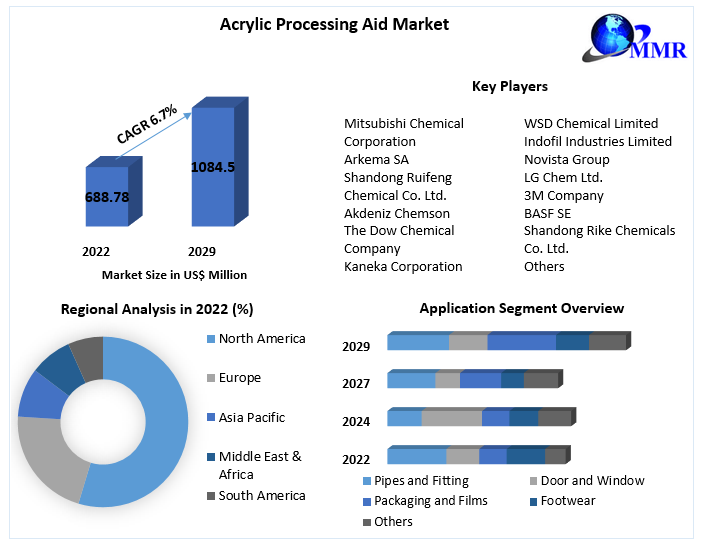 To know about the Research Methodology :- Request Free Sample Report
COVID–19 Influence on Global Acrylic Processing Aid Market:
In 2020, many sectors throughout the world have suffered as a result of the COVID-19 pandemic. It has seen a decrease in demand because of a drop in consumption for plastics from end-use industries such as automotive, building & construction, consumer goods, packaging, and others. The construction sector was the most affected by the COVID-19, as it had already been struggling with financial instability for more than a year related to the impact of non-banking financial institutions on the financial sector.
The slowdown in construction has also affected demand for polyvinyl chloride (PVC), which is used in pipes, siding, windows, and doors. According to the US Census Bureau, housing developments fell 19% in April compared to the previous year. PVC consumption dropped by 25% over that period. Many projects have been left unfinished because of a lack of money. With the stated factors, the acrylic processing aid market is expected to experience sluggish growth in 2020 before recovering with positive growth during the forecast period.
Acrylic Processing Aid Market Dynamics:
The replacement of traditional materials with polyvinyl chloride (PVC) is expected to drive the growth of the acrylic processing aid market during the forecast period. When compared to traditional materials such as metals, glass, paper, and ceramic, PVC has better mechanical, electrical, corrosion resistance, and chemical resistance, of many other properties. Plastic is gradually being used to replace traditional materials in a variety of applications thanks to ongoing innovation and the need for lighter materials in a variety of applications.
Acrylic processing aid is used by PVC manufacturers since it provides faster merging, enhanced production yield, improved melt elasticity and strength, lowered plate-out, melt appearance, improved surface shine and finishing, better thickness, and tensile strength. With its cost-effectiveness and qualities for generating high-quality products, acrylic processing aid is more popular in Asian countries.
Acrylic processing aid is a growing industry in Asia-Pacific and South America. Europe and North America have a more developed market than these growing markets. The Asia Pacific consumes more acrylic processing aid than North America and Europe combined. China, Japan, and Taiwan are the leading producers of acrylic processing aid in the Asia Pacific. However, because of lack of money, small industries R&D (Research and Development) investment is limited. This harms the region's overall growth of acrylic processing aid.
Similarly, in other emerging plastic markets in South America, investment is lower than in North America and Europe. The acrylic processing aid industry is being hampered by a lack of focus on R&D activities in emerging countries. Some industries are still working to develop new polymerization methods and make higher-quality plastics with more properties. After 3–5 years, R&D activities and technology developments are expected to gain pace. As the result, the market's lack of focus on R&D activities is seen as a hampering factor in the medium term.
Building and construction, as well as automobile applications, are seeing an increase in demand, which is expected to create lucrative growth opportunities for the market globally. Acrylic processing aid is often used in the building and construction, as well as the automobile industries, in polymers for PVC applications. Since its high clarity, surface quality, glossy effects, and cost-effectiveness, acrylic processing aid in plastics for PVC flooring, windows, pipes, and car interior and exterior is attracting consumers. Acrylic processing aid is used primarily to improve plastic material flows, limit the shark skin effect during extrusion, and improve process-ability. In important end-use industries such as packaging, building & construction, automotive, consumer products, and others, the usage of acrylic processing aid in plastics is gaining momentum. With the development of these industries, acrylic processing aid need is expected to increase during the forecast period.
Acrylic Processing Aid Market Segment Analysis:
Based on Polymer Type, the global acrylic processing aid market is segmented into five types as follows, Polyvinyl chloride (PVC), Acrylonitrile Butadiene Styrene (ABS), Polycarbonates, Polystyrene, and Others.
In 2022, the Polyvinyl chloride (PVC) segment was dominant and held 35% of the overall market share. PVC provides flexibility, which is a key component in developing new generation automobiles that are low-cost, safe, and high-quality. It helps in the weight reduction and lightening of automobiles since it is lighter than the other components and materials used in their production. PVC is less costly and more flexible when compared to other plastic materials.
2022 is considered as a base year to forecast the market from 2023 to 2029. 2022’s market size is estimated based on real numbers and outputs of the key players across the globe. The past five years trends are considered while forecasting the market through 2029. 2020 is a year of exception and is analyzed especially with the impact of lockdown by region.
Based on Fabrication Process, the global acrylic processing aid market is segmented into five types as follows, Extrusion, Injection Molding, Thermoforming, Calendaring, and Blow Molding.
In 2022, the Extrusion segment was dominant and held 33% of the overall market share. Plastics are extruded in large quantities during the extrusion process. Various materials, such as granules, flakes, pellets, and powder, are fed into the machine and melted at a high temperature. Processing aids are primarily used to prevent melt fracture and die lines, as well as to enhance less gel formation and cleaner running in various extrusion processes, such as blown and cast film extrusion. This allows the processor to run for extended periods between dying cleaning stops.
Based on Application, the global acrylic processing aid market is segmented into six types as follows, Pipes and Fitting, Door and Window, Packaging and Films, Furniture, Footwear, and Others.
In 2022, the Pipe and Fitting segment was dominant and held 33.50% of the overall market share. The need for pipes and fittings in piping and plumbing, gas pipeline laying, and communications and electrical cable sheathing is constantly on the rise. The market for acrylic processing aid in the pipes & fittings segment is expected to grow significantly as traditional concrete, iron, and steel-based pipes & fittings are replaced by pipes in the building & construction industry. With the ever-increasing population, the market for building materials is in high demand. Pipes and fittings, which are a crucial requirement for housing, are a precondition. Drainage requirements have increased as a result of increased urbanization and a broad network of connections. To deal with improved piping links, there is an increasing demand for pipes and fittings, which supports market growth. Many companies invest heavily in R&D to develop new cutting-edge processing aids and deliver smarter solutions.
Based on End-use Industry, the global acrylic processing aid market is segmented into six types as follows, Automotive, Building, and Construction, Consumer Goods, Plastic Industry, Chemical Industry, and Others.

In 2022, the Building and Construction segment was dominant and held xx% of the overall market share. The rise in building and construction is linked to the introduction of new materials and products in the construction like flooring, pipelines, roofing, windows, doors, containers, trim boards, and many more. The rising construction sector and its demand for acrylic processing aid, mainly in Asia-Pacific, North America, and Europe is expected to drive up demand for acrylic processing aid for all types of buildings.
The residential application segment is growing thanks to increased exposure from formerly undiscovered regions. In this application industry, first-mover advantage in unexplored regions and relatively low acquisition costs remain major driving forces. Also, the acrylic processing aid market is expected to get an advantage from R&D activities in the field of acrylic processing aid.
Acrylic Processing Aid Market Regional Insights:
In 2022, Asia Pacific was the dominant region and held the highest share 42.50% of the global acrylic processing aid market. It is also expected to grow with the highest CAGR of xx% over the forecast period. Over the forecast period, large and developed markets such as China, India, Japan and South Korea are expected to grow even faster. In the Asia Pacific region, China leads the way in terms of acrylic processing aid demand, followed by India and Japan. Apart from the United States, the five fastest-growing regions in the construction sector are all Asian countries, including China and India, which drive the demand for construction investment in these regions.
Strong and healthy growth in the building sector is linked to a rising population and a growing middle-class economy, which tends to push Asia Pacific residential construction market, and therefore the acrylic processing aid market, even further. In the Asia Pacific region, the number of buildings with acrylic processing aid is rapidly increasing. The market has been driven further by an increase in the number of new building constructions, as well as an increase in the number of maintenance projects.
In Europe, innovation drives the market. In the region, Germany is the most important market for acrylic processing aid. However, because of the recovery from the pandemic and reduced consumption of plastic products, it is expected to grow slowly between forecast period. The packaging company in Eastern Europe has a lot of untapped potentials, which indicates positively for the acrylic processing aid market in the region.
Acrylic Processing Aid Market Recent Advancements:
• In July 2020, PLASTISTRENGTH® 562 NA is a new process aid from Arkema that is designed to help PVC converters achieve a better balance between processing performance and formulation cost. This innovative solution enables consistent PVC fusion and filler integration, higher melt power, and efficient processing in both rigid and semi-rigid extruded or calendared PVC products.
The objective of the report is to present a comprehensive analysis of the global acrylic processing aid market to the stakeholders in the industry. The past and current status of the industry with the forecasted market size and trends are presented in the report with the analysis of complicated data in simple language. The report covers all the aspects of the industry with a dedicated study of key players that include market leaders, followers, and new entrants.
PORTER, PESTEL analysis with the potential impact of micro-economic factors of the market have been presented in the report. External as well as internal factors that are supposed to affect the business positively or negatively have been analyzed, which will give a clear futuristic view of the industry to the decision-makers.
The report also helps in understanding the global acrylic processing aid market dynamics, structure by analyzing the market segments and project the global acrylic processing aid market size. Clear representation of competitive analysis of key players by product, price, financial position, product portfolio, growth strategies, and regional presence in the global Acrylic Processing Aid market make the report investor’s guide.
Acrylic Processing Aid Market Scope: Inquire before buying
| Acrylic Processing Aid Market | |||
|---|---|---|---|
| Report Coverage | Details | ||
| Base Year: | 2022 | Forecast Period: | 2023-2029 |
| Historical Data: | 2017 to 2022 | Market Size in 2022: | US $ 688.78 Mn. |
| Forecast Period 2023 to 2029 CAGR: | 6.7% | Market Size in 2029: | US $ 1084.51 Mn. |
| Segments Covered: | by Polymer Type | • Polyvinyl chloride (PVC) • Acrylonitrile Butadiene Styrene (ABS) • Polycarbonates • Polystyrene • Others |
|
| by Fabrication Process | • Extrusion • Injection Molding • Thermoforming • Calendaring • Blow Molding |
||
| by Application | • Pipes and Fitting • Door and Window • Packaging and Films • Footwear • Others |
||
| by End-use Industry | • Automotive • Building and Construction • Consumer Goods • Plastic Industry • Chemical Industry • Others |
||
Acrylic Processing Aid Market, by Region
• North America (United States, Canada and Mexico)
• Europe (UK, France, Germany, Italy, Spain, Sweden, Austria and Rest of Europe)
• Asia Pacific (China, South Korea, Japan, India, Australia, Indonesia, Malaysia, Vietnam, Taiwan, Bangladesh, Pakistan and Rest of APAC)
• Middle East and Africa (South Africa, GCC, Egypt, Nigeria and Rest of ME&A)
• South America (Brazil, Argentina Rest of South America)
Acrylic Processing Aid Market Key Players
• Mitsubishi Chemical Corporation
• Arkema SA
• Shandong Ruifeng Chemical Co. Ltd.
• Akdeniz Chemson
• The Dow Chemical Company
• Kaneka Corporation
• WSD Chemical Limited
• Indofil Industries Limited
• Novista Group
• LG Chem Ltd.
• 3M Company
• BASF SE
• Shandong Rike Chemicals Co. Ltd.
• Others
Frequently Asked Questions:
1. Which region has the largest share in Global Acrylic Processing Aid Market?
Ans: Asia Pacific region held the highest share in 2022.
2. What is the growth rate of Global Acrylic Processing Aid Market?
Ans: The Global Acrylic Processing Aid Market is growing at a CAGR of 6.7% during forecasting period 2023-2029.
3. What is scope of the Global Acrylic Processing Aid Market report?
Ans: Global Acrylic Processing Aid Market report helps with the PESTEL, PORTER, COVID-19 Impact analysis, Recommendations for Investors & Leaders, and market estimation of the forecast period.
4. Who are the key players in Global Acrylic Processing Aid Market?
Ans: The important key players in the Global Acrylic Processing Aid Market are – Mitsubishi Chemical Corporation, Arkema SA, Shandong Ruifeng Chemical Co. Ltd., Akdeniz Chemson, The Dow Chemical Company, Kaneka Corporation, WSD Chemical Limited, Indofil Industries Limited, Novista Group, LG Chem Ltd., 3M Company, BASF SE, Shandong Rike Chemicals Co. Ltd., and Others
5. What is the study period of this Market?
Ans: The Global Acrylic Processing Aid Market is studied from 2022 to 2029.